26M Trailer Capacity Upgrade

A forum for discussing issues relating to trailers and towing MacGregor sailboats.
Post Reply
User avatar
Oskar 26M
First Officer
Posts: 411
Joined: Sun Mar 23, 2008 10:04 pm
Sailboat: MacGregor 26M
Location: Perth Australia, 2007 26M, 60hp E-tec

26M Trailer Capacity Upgrade

Post by Oskar 26M »

I have been planning to take my 26M north along the Western Australian coast, stopping off to explore various coastal features under sail. Some of these locations are fairly remote and the access roads are poor. I did not want to travel these road overloaded and was therefore conscious of the weight the extra gear and provisions I planned to take on the trip would add to the overall towing weight.

The Australian version of my steel Mac trailer had a compliance plate indicating that the gross vehicle mass should not exceed 1905 kg. The Macgregor website gave me some idea of the basic boat and steel trailer weight, and I added up other major items such as the motor, fuel, etc and thought I had a reasonable margin to accommodate my planned extras. Nonetheless, I decided to put the trailer and what I thought was then a relatively lightly loaded boat over a weighbridge to get a baseline reading before adding the extra gear.
I was shocked to find that the combined boat and trailer already weighed in at 2100 kg (4630 lbs), well over the 1905 kg (4200 lb) trailer limit. It also exceeded the 2000 kg towing capacity of my Toyota Kluger tow vehicle.
It was clear that if I wanted to fulfil my trip plans, something fairly drastic would have to be done. So I upgraded the tow vehicle to a V8 Diesel Landcruiser (tow rating 3500 kg) and considered replacing the trailer entirely. However, I eventually decided to upgrade the existing trailer to a higher capacity.

I considered a dual axle trailer but opted to retain the single axle configuration for better manoeuvrability. To meet regulatory requirements I recognised that the axle, wheels, tyres, suspension, and tow-hitch would all have to be upgraded, and I decided to get it cleaned and galvanised at the same time because it was already showing significant rust. The initial cost estimates for the upgrade were considerably less than the alternative of a new trailer, so I decided to proceed.

It turned out to be a long and tortuous process. There were major delays in getting sand blasting and galvanising done and as regulatory requirement became clearer there were significant extra costs (the existing surge brakes had to be replaced with an electric-hydraulic system that could be independently controlled from within the tow vehicle).

However, after far too many weeks and quite a few boat bucks, the upgrade has finally been completed and the trailer has passed its regulatory pit inspection (second attempt because the trailer guy didn't upgrade the tyres to match the new load rating). The trailer now has a 2800kg rating. The mods made it considerably heavier ( 520 kg) but even with all the additional gear I plan to add I should have a reasonable safety margin.
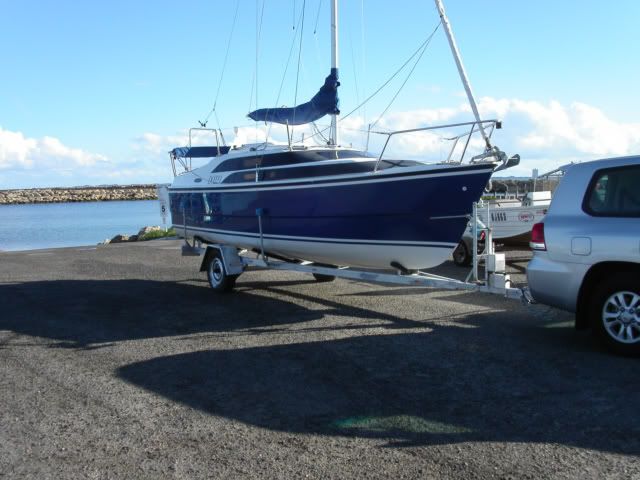
The following pics illustrate the end result:
Image
Oskar on shiny galvanised trailer
Image
The M sits quite a bit higher on the new suspension, but launching and retrieval has worked okay so far
Image
3 tonne axle, upgraded springs, twin hydraulic disk brakes, 7.5"x16" rims and tube-type tyres rated 121 M
Image
New winch (the original bent), 50mm tow hitch, "Brake Safe" Electric-Hydraulic Braking System with on-board battery. Brakes can be controlled independently from inside the tow vehicle
Image
New fenders to accommodate the larger wheels (trailer guy tried to re-use the original fenders but they jammed up on the larger wheels), LED running lights
Image
Roller behind bow bunk works well and makes winching on much easier.
Image
LED lights- very bright! Although the lights themselves are genuinely waterproof they shorted out on first use because of crappy junctions. Liquid electrical tape fixed the problem.
Image
Trailer during launching/retrieval. This pic was taken before the new fenders and LED lights were fitted. The so-called "waterproof" Narva conventional lights immediately leaked water
User avatar
Bob Johnson
Posts: 5
Joined: Wed Aug 08, 2007 11:31 pm
Sailboat: MacGregor 26M
Location: Western Australia

Re: 26M Trailer Capacity Upgrade

Post by Bob Johnson »

Hi Oskar,
I also live in Perth and am going throught the exact same problems that you have been through. I would like to contact you and ask how much and where the mods were carried out. Maybe you could could call me 08 92931522.

Regards Bob Johnson.
User avatar
puggsy
Captain
Posts: 571
Joined: Sat Feb 02, 2008 1:30 am
Sailboat: Venture 25
Location: MACLESS but not quite BOATLESS in Perth Western Australia

Re: 26M Trailer Capacity Upgrade

Post by puggsy »

Hi Oskar...Nice upgrade....Did you think to consider a " drop" axle....this is where the stub axle is welded via a 'step down' from the straight axle bar. The result is the wheels are just that much lower. Martin trailers out here in Wangara supplied me with galvanised springs and wheels on the 'other' trailer i built. So far my MAC trailer [ standard] is doing alright. Handled a trip to Mandurah with SEAHORSE LOADED...Photos to follow...Puggsy.
Boblee
Admiral
Posts: 1702
Joined: Thu Aug 10, 2006 5:08 am
Location: Berrigan, Riverina Australia boatless at present

Re: 26M Trailer Capacity Upgrade

Post by Boblee »

Top job Oskar that will be money well spent, crikey them springs look stiff, did you have to put mudflaps on? or are the guards considered low enough over there, I think here we can't be more than 3" above the road.
Puggsy I think the drop axle lowers the rating of the axle but agree it's better for launching/retrieving.
Hey Oscar you better get your act together and I'll meet you up the Kimberlies this year, you only have to travel half our distance, you won't even have to worry about rough roads either, but then we will probably put in a Whyndam anyway.
Lake Argyle would be good for a couple of weeks :)
User avatar
Oskar 26M
First Officer
Posts: 411
Joined: Sun Mar 23, 2008 10:04 pm
Sailboat: MacGregor 26M
Location: Perth Australia, 2007 26M, 60hp E-tec

Re: 26M Trailer Capacity Upgrade

Post by Oskar 26M »

Bob Johnson:
I'll give you a call this evening or over the weekend. If you want to come down to the Cockburn Boat Store you can take a look for your self and see what you think. At the very least I can forewarn you of some of the traps I ran into.

Puggsy:
The drop axle sounds like a good idea, but was not presented as an option by the trailer guy I used. There might have been an issue with the load rating for a single axle.
BTW, where did you get that Hifield lever for Seahorse? If I finally get to tow to a few more locations, I'd like to improve on the stupid forestay fitting.

Boblee: Lake Argyle sounds great, but it will depend if I've gone back to being " retired". I do consulting work and after about a year of nothing I'm swamped at the moment. But it will probably dry up again in time for the next dry season up north.

General comment on the upgrade:
Because the trailer is so much higher, I have to put the back wheels of my Land Cruiser into the water (about half tyre depth) to get the boat off and on easily at the ramps that I use, so I get a bit wet.

The electrical job was lousy (sub contracted by my trailer guy to a bunch I'd never go near again). The trailer wiring was OK once I sealer the wire joins with liquid electrical tape, but the auto-electrician had screwed up the brake wiring in the car so the brakes never worked. Fortunately this was not a problem with the Land Cruiser's grunt and weight.

I finally got the wiring fixed by someone else last week (which also revealed what a shonky job had been done originally). Now I have to "tune" the brake system

I have not yet towed very far, only a few hundred kms, but that includes some very steep hills near where I live. The trailer behaves quite well and tracks nicely with no evidence of sway. Surprisingly those "beefy" springs give the boat quite a soft ride.

I'm still trying to figure out the best (safest) tyre pressure. Tyres have a max load rating at 95 psi but I'm currently running them a lot lower (about 60) on advice from the tyre dealer. I've found it difficult to find clear advice and what is the most appropriate pressure to use.
Kelly Hanson East
Admiral
Posts: 1786
Joined: Sat Apr 19, 2008 2:35 pm
Sailboat: MacGregor 26X
Location: Kelly Hanson Marine........Mac 26M Dealer......Freedom Boat Works

Re: 26M Trailer Capacity Upgrade

Post by Kelly Hanson East »

'm still trying to figure out the best (safest) tyre pressure. Tyres have a max load rating at 95 psi but I'm currently running them a lot lower (about 60) on advice from the tyre dealer. I've found it difficult to find clear advice and what is the most appropriate pressure to use.
Im not a tire expert but Ill give you these two cents...unlike a car tire, you usually find a trailer tire life isnt limited by tread wearout, but my either sidewall failure or some other catastrophic failure. Thus, rather than trying to run at an optimum pressure which will give even treadwear, you should run the tire at the max rated pressure, which will give the lowest rolling resistance, lowest heat, and thus longest life.

Im not sure why someone would advise you to run at 60 psi - would like to see the reasoning here I guess.

If you were to run at max pressure on your car (DO NOT DO THIS) , what will happen is the middle of the tread will wear out before the edges, and you lose traction on wet surfaces and/or snow.

I run my (original 2002) trailer tires at the Max rated pressure of (edited) 50 psi. My three other trailers are also all inflated to the max tirewall pressure.

On edit - corrected my pressure to 50 psi from 60 psi first posted
Last edited by Kelly Hanson East on Wed Dec 24, 2008 7:28 am, edited 1 time in total.
User avatar
Oskar 26M
First Officer
Posts: 411
Joined: Sun Mar 23, 2008 10:04 pm
Sailboat: MacGregor 26M
Location: Perth Australia, 2007 26M, 60hp E-tec

Re: 26M Trailer Capacity Upgrade

Post by Oskar 26M »

Thanks KHE
Your rationale makes sense. I had already decided to take the pressure up to the recommended maximum. After all, the pressure stamped on the wall refers to the maximum load rating of the tyre, not the maximum pressure the tyre can withstand. :)
User avatar
MadMacX
First Officer
Posts: 204
Joined: Mon Apr 07, 2008 6:23 am
Sailboat: Venture 23
Location: north Georgia

Re: 26M Trailer Capacity Upgrade

Post by MadMacX »

Here is some additional info on trailer tires.

http://www.discounttire.com/dtcs/infoTr ... eFacts.dos

I have always used MAX pressure stated on trailer tires without any problem, be it, boats trailers or race car trailers.

Pat
User avatar
Oskar 26M
First Officer
Posts: 411
Joined: Sun Mar 23, 2008 10:04 pm
Sailboat: MacGregor 26M
Location: Perth Australia, 2007 26M, 60hp E-tec

Re: 26M Trailer Capacity Upgrade

Post by Oskar 26M »

Thank you Pat
I have bookmarked that information. Much appreciated! :)
Kelly Hanson East
Admiral
Posts: 1786
Joined: Sat Apr 19, 2008 2:35 pm
Sailboat: MacGregor 26X
Location: Kelly Hanson Marine........Mac 26M Dealer......Freedom Boat Works

Re: 26M Trailer Capacity Upgrade

Post by Kelly Hanson East »

Correct pressure for my 2002 trailer tires (from the sidewall) is 50 psi, not 60 psi. Corrected above in post as well.
User avatar
Don T
Admiral
Posts: 1084
Joined: Fri Jan 02, 2004 7:13 pm
Sailboat: MacGregor 26X
Location: 95 2600 "SS OTTER" - Portland OR - Tohatsu 50 - Hull#64 (May 95)

Re: 26M Trailer Capacity Upgrade

Post by Don T »

Hello,
I ran 60 psi in my X trailer tires and here is why. AT 50 psi (cold) the pressure went way up when the tires got hot, checked after 50 miles or so. AT 60 psi (cold) the tires run much cooler and and you'll find the hot running pressure is almost the same. So the only difference was the temperature when rolling down the highway at 60 mph. Cooler tires mean longer life and cooler bearings as well.

My 2c

On edit: I have replaced the tires with 15" when the old 14's were heat and weather checked (one started losing pressure out the sidewall).
User avatar
Terry
Admiral
Posts: 1487
Joined: Thu Feb 19, 2004 2:35 pm
Sailboat: MacGregor 26M
Location: Vancouver, B.C. Canada. '03 26M - New Yamaha 70

Re: 26M Trailer Capacity Upgrade

Post by Terry »

Well Oskar,
Nice job, curious though, did the trailer have to be dis-assembled for galvanizing? I mean, did the spring leafs have to be done individually and did the tongue assembly have to be dismanteld to get inside done? What about brakes? Were extra leafs added, you have a lot?
I have an '03 26M with a steel trailer and the capacity plate indicates a maximum 5000 lbs not sure this includes the trailer or refers to the weight loaded on the trailer. I also noticed your square axle, mine is round and definitely larger in diameter than your square one. Anyway I was eyeballing the new aluminum one but after seeing your improvement I am going to scope out the cost of going your route, it may provide me with a more solid trailer. There is really nothing wrong with my trailer other than some surface rust/corrosion that can easily be remedied. I also have a lousy wiring system that I plan to get replaced. If it is more economical with the end result being a stronger trailer, perhaps yours is the way to go. Nice job, inspirational!
User avatar
Oskar 26M
First Officer
Posts: 411
Joined: Sun Mar 23, 2008 10:04 pm
Sailboat: MacGregor 26M
Location: Perth Australia, 2007 26M, 60hp E-tec

Re: 26M Trailer Capacity Upgrade

Post by Oskar 26M »

Thanks for the comments Terry.
"Inspirational", would not be the word I would have chosen ... "painful" would be more appropriate after all the little snags and hassles and unanticipated cost I encountered along the way. :(

However, I am quite satisfied with the end result, and tow with a lot more confidence now that everything is working as intended. The one lasting downside is the added trailer height, which means I have to get the back wheels of my Land Cruiser tow vehicle wet at the ramps I use- usually to a depth of about 3-4 inches of water. Its not a major problem, but does mean I also have to wade into the water when when launching and retrieving and get more wet than was necessary before the upgrade.

Below is a long an rambling account of some of the pitfalls I encountered. It might make you reconsider an upgrade in favour of a completely new trailer from a reputable marine trailer manufacturer!

Capacity Plate.
The 5000 lbs should indicate the aggregate gross vehicle mass of the fully loaded trailer including the boat and all the gear you have on board. There should also be a tare weight that shows the mass of the trailer itself.

Galvanising
Yes the trailer has to be dismantled to be galvanised. This is not a big deal if a major upgrade is going to happen anyway. The painted trailer had to be sandblasted to remove all of the old paint and any existing rust and also needed some additional holes drilled in the square and tubular-section frame components. I think it then goes through an acid bath to get residual rust off before the galvanising takes place. I originally planned to get the leaf springs and axle galvanised, but it didn't happen and I have not pursued it. Similarly the rims have not been galvanised because the size change was a last minute thing. Hopefully, "one day..."

Options: I considered following the path of others on this forum and installing a dual axle system. The advantages would have been smaller wheel diameter, lower trailer and therefore easier launching. The disadvantages would have been loss of manoeuvrability (my boat yard requires me to back the trailer between other craft with only a couple of feet clearance on either side), difficulty with getting braking right (dual axles have some braking peculiarities that can be difficult to get right) and, from recollection, a higher overall trailer mass in relation to the payload I can carry. I think cost could have worked out marginally higher as well, but I would have be able to reuse some of the parts like axles and bearing that became obsolete in the single axle version. I'm happy with the route I chose.

Some of the lessons learned during my upgrade process:
1. If you can find one, use a trailer guy who has experience with marine trailers. I did not have a lot of choice in my area. The while one I chose had plenty of experience in building trailers of the tonnage I required through building horse floats and he had also done a bit of marine work, but not as much as I would have liked. Some problems would have been avoided had he/we thought them through more thoroughly.

2. Likewise with any electrical work. Find someone who has experience with both marine work and the types of brakes you plan to use. The guys who installed the electrics in my tow vehicle were chosen by my trailer guy and had (I found out later) no significant experience with trailer power braking systems or the marine trailer environment. They were also sloppy workmen and neither the brakes nor the extra power outlet I got them to install in the rear of the tow vehicle worked properly.

3. Find out everything you can about the engineering -registration requirements for your jurisdiction AND AVAILABILITY of necessary parts. Being quite naive, I had a lot to learn and found it difficult to get hold of useful information about the requirements in my State. My upgrade crossed a number of "mass thresholds" that forced me to upgrade some items I had not anticipated before the local authorities would register/certify the trailer. I also had problems procuring some items and that messed my plans up at the last minute.

The most significant items in the upgrade were:
* the frame itself (the original 26M trailer frame was in good condition and was okay. It is all that is left of the original trailer);
* the bearings and hubs (had to be replaced with ones with a higher load-rating);
* axle - (had to be replaced to match the required load rating - the square section axle I have is solid steel (not hollow) and is rated for 3 metric tonnes)
* springs - (had to be upgraded to meet engineering requirements for the higher load rating. These also added some height to the trailer)
* rims and tires (had to be replaced. I had originally planned to use the 16 inch rims fitted to the Australian version of the trailer, but at the last minute the trailer guy found out that he could not get tires with an adequate rating unless I went to 17" light truck tires. Even then he was limited by availability in this Australian backwater, so the best I could get in that diameter were only rated for 1.4 metric tonnes each. As a result my trailer was only registered for 2.8 metric tonnes instead of the 3 tonnes I had originally planned.
* don't forget that tires age and that age has nothing to do with the tread on the tire. My trailer guy went for second hand tires that were cheap but were already 7 years old and well past their safe use-by date. I have since replaced them.)
* fenders or mud guards - (fairly obviously these had to be modified to allow for the large diameter wheels and tyres. The new fenders were not part of the original plan, although the design is a lot better than the factory originals.)
* safety chains - ( had to be upgraded to match the requirements of the higher mass)
* tow-hitch, tow-ball and coupling -(the new ones on both the car and trailer are 50 mm (around 2") but are rated for 3.5 metric tonnes.
* brakes - (the original disk brakes were inadequate for the mass requirements and had to be replaced. I knew this would be the case and originally planned to use stainless disks but couldn't get them at the time. The steel disks have proven to be okay so far and rust doesn't really seem a problem.)
* brake actuator - (the most expensive item! The original surge brakes were deemed inadequate for the trailer's target gross vehicle mass of 3 tonnes. To meet registration requirements I had to install an electric-hydraulic system (Hydrastar), a system that has and on board electric hydraulic pump powered by its own trailer-mounted battery. It has an inertia sensor mounted in the tow vehicle to control braking aggressiveness and also has a trailer-mounted breakaway switch that activates the trailer brakes fully in the event that the trailer breaks away from the tow vehicle. I had a lot of trouble getting the electrics for the braking system on my tow vehicle working properly until I took the car to someone who knew what he was doing.)
*trailer lights - (I originally tried to use the near-new and so called "submersible" incandescent lights. Bad mistake. LED's are definitely the way to go.)
*trailer wiring - (Don't trust shrink wrap insulation for trailer wiring junctions! It is not a great insulator and only waterproofs a join if it is perfectly applied. LED's are quite sensitive to any current leakage and salt water is a good enough conductor to power the LEDs. I overcame the insulation/water seepage problem with liberal application of liquid electrical tape, but I wish I had applied it before the trailer went anywhere near the salt water. With hindsight I would probably have used BOTH liquid electrical tape to ensure a good seal over all junctions, and shrink-wrap insulation on top to add strength.
* final trailer weight - unladen my trailer went from around 300 kg to 520 kg. My new net payload for the boat plus gear is therefore just under 2300 kg. I think that's enough :) .
And last but not least, the tow vehicle has to be capable of (legally) towing the extra gross trailer mass. The vehicle I had originally would tow everything quite well but was only rated for 2000kg so there were major legal and insurance implications in the event of an accident.
Post Reply