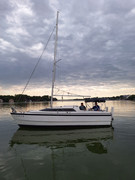
leefrankpierce wrote: ↑Wed Dec 24, 2025 12:04 pm
Back when trailer boating, empty ballast, dragging my son on a tube was a major part of our boating, I swapped the origional 50hp honda for an evenrude/johnson 120 with power tilt.
I now have the boat in a slip where I never let the ballast out, only use the engine to get in and out of the marina, so the boat is now 100% a sailboat vs the earlier powerboat usage.
There are plenty of discussions on which engines to use, but my question is specific to sailing performance.
Is having that big chunk of metal hanging off the back hurting my sailing performance, or does the boat just not care?
Thinking all aspects, handling, pointing, speed, stability, etc....
My engine approx 350lbs vs newer 30hp 4 stroke approx 160, so I guess about 200 lbs difference?
Short answer: it will hurt your sailing performance.
Long answer:
Extra weight is always going to affect sailing performance and most of it is going to be negative. You will need more wind to get the boat to begin to move and more wind to keep it moving relative to what it would have done with the smaller engine. On the plus side you will have a bit more momentum to carry you through waves, small "dead spots", and tacks. On the whole, it's probably a small net negative but not enough to worry about unless you are racing.
The bigger problem is not that you have extra weight but that all of the extra weight on or behind the transom. This makes your bow is high and your stern is low. You should always try to keep the boat "on her lines" for your best performance.
Whether your bow is high or low you will increase the wetted area of the hull which increases the drag on the hull and slows you down. With the stern down you are also turning the largest and flattest "powerboat" part of the hull into a brake by digging it deeper into the water and tilting it (slightly) against your forward motion. There is no positive effect. Try to get the boat to sit level in the water when it is loaded and crewed.
Having the bow high will tend to reduce weather helm and conversely increase lee helm. It is generally less desirable (and less safe) to have lee helm vs weather helm. Lee helm will make the boat more likely to turn away from the wind in a gust and increases the likelihood of an accidental gybe. This is potentially a dangerous negative.
Having the stern low will modify the angle of the rudders and make them less effective. It is possible that the rudders will be more likely to "kick up" unexpectedly depending on the angle and your speed. There is no positive outcome from this and potentially an expensive negative.
Having the bow high may increase "hobby horsing" where the bow rises and falls excessively in waves. This is triggered by wave height and frequency in concert with your speed. It won't happen all of the time but when it does it will cause extra strain on the rigging and to a lesser extent, the sails. All negative.
Having the stern low makes you more susceptible to being "pooped" by following waves. In a perfect world that is an irritation. As the world becomes less perfect it becomes more serious.
With the stern low you are probably keeping the engine well drain submerged. There are several potential problems that can happen with that drain, particularly as old as it is. If any of them happen you will take on water, possibly a lot of water. If you don't have all of your original flotation you may have a very serious problem.
The solution:
You need to get the boat to sit level (fore-aft) for maximum performance. Since you are already carrying more weight than you did before the engine change adding
additional weight to the bow is not your best option. Instead, try to move as much
existing weight as you can from the rear of the boat into the bow. A spare anchor, anchor chain, water supplies, or tools would be good candidates. Remove items from the aft berth (heaviest first) and if you can't get them into the bow (v berth) at least try to get them as close to the compression post (preferably in front of it) as you can. If you are like me, you probably have some stuff in the aft berth that does not really need to be there anyway and really should be left at home.