Page 1 of 2
Sailing in light wind
Posted: Wed May 24, 2006 8:10 pm
by baldbaby2000
I'm not the greatest light wind sailor but it seems that I have more trouble with my 26M than I've had with other boats. It seems hard to control and tends to have a lot of lee helm. I'm wondering about the experience of others when the wind is under 5 knots. I suspect that what happens to me is that my sail trim isn't right for the light air and the boat doesn't have enough speed to maintain control. It seems like a Catch-22: I don't have control because I don't have speed but I can't get the speed up because I don't have control. I've always tried to have my sails kind of baggy in light wind but I wonder if maybe they should be flatter. The lee helm has been kind of a mystery to me. I have a comfortable weather helm at higher wind speeds. Should I not be using the genoa in light air.
Posted: Wed May 24, 2006 9:15 pm
by Frank C
We rarely have the problem of very light winds around my area, and when they're THAT light, guess we'd usually just use the outboard.
However, I have read exactly what you suggested, that sometimes a flatter sail is better. The deciding factor is whether the wind can keep the sail inflated - if so, the the fullest sail generates the most power. But if the sail is collapsing, then a flatter trim can help a zephyr keep the sail filled. The Genoa should be ideal for lighter winds, but might need lighter sheets for the lightest conditions ... maybe a quarter-inch line for special days?
Posted: Thu May 25, 2006 4:39 am
by Dimitri-2000X-Tampa
Presumably, you have your DB all the way down for light winds. I've never sailed a 26M so I have to speak for a 26X but the brutal truth as most everyone knows is that these boats do not point well at all compared to most all other sail boats, certainly nothing compared to a full keeled racing boat. I've tried to pound my head against the wall and get really close the wind before but it is futile with these boats. I finally just give up and fall off 10-15 degrees in order to get some speed up. Of course, this is more like half way between a beam reach and a beat really and you are gonna lose the race. By the way, if I was racing my Mac (which I've never done), then I would use the VMG on the GPS to decide exactly where I get my best speed towards a mark.
Now if you are having trouble on a reach or a run, then maybe your sail trim is off (you may be sheeted in too far). If I don't have enough wind to watch the tell tales flutter properly, then I'm not going to be sailing either, just too boring. Make sure your genny cars are all the way forward too. Use your traveller to make sure the main sheet is pulling straight on the leach of the sail so that you don't get any twist.
Another thing which may be more applicable on an M due to hits higher deadrise on the hull is that you should put your railmeat on the leeward rail to induce some artificial heel in very light winds. This presents less wetted area and makes you go faster. You may also want to move more weight forward for the same reason although that may not be a good idea if you get more lee helm due to it.
Posted: Thu May 25, 2006 4:45 am
by deacm
While there are some obvious dangers with this approach if the winds go ANYwhere beyond 'light', especially upwind, before you fire up your outboard you could drain the ballast out and sail without ballast in very light winds..............at least off the wind. I've been (carefully) doing that some of late and besides feeling a tad irresponsible, it actually works pretty good. Of course my Odin 820 is about 800 pounds heavier than a Mac, so I feel a little more comfortable doing so.
Posted: Thu May 25, 2006 7:47 am
by They Theirs
tension?
Posted: Thu May 25, 2006 11:09 am
by Night Sailor
I recently had a good sail in winds of less than 5 mph on my X. Some of what I do might apply to your M.
I try to balance the boat by moving gear, cargo forward so that when the normal crew is on board, the boot stripe is parallel to the water surface.
I keep both rudders down. I think the more control surface you have in the water, the more control you have at very low speeds. The centerboard is all the way down.
I release all tension in the leach of the main and genoa, use only a little bit of outhaul on the main foot.
I move the gen block to the best location for the best sail shape, after moving crew to leeward to heel the boat. The standard Mac genoa on the CDI furler works fine in light or heavier air.
I clean the bottom with a Dri Diver before a light air sail.
Posted: Thu May 25, 2006 1:01 pm
by Scott
The spinnaker can be used in light winds for all reaches except beating. Great light air sail. You may be suprised how far into the wind you can use it.
Posted: Thu May 25, 2006 1:25 pm
by Chip Hindes
Definitely, you should be using the genny in light air; that's its primary purpose in life.
Normally in really light winds the sail is too flat rather than too full. Leave the mainsheet a little slack; if you have a topping lift, boomkicker or the like try using it to lift the boom slightly to give the sail some shape. You can sometimes point a little higher by "sheeting to windward," that is, use the traveler to pull the boom 10-15 degrees to windward of center. I do the same thing on my X by attaching the lower mainsheet block to the windward stanchion. It seems to work but it may be my imagination; it's hard to tell the difference between .4 knots and .5 even with both a paddle wheel speedo and GPS.
Posted: Thu May 25, 2006 2:23 pm
by baldbaby2000
Thanks for the responses. I guess I knew that I should have used the topping lift to give the sail more shape but for some reason I didn't try it. I think I was having a mild case of scurvy after drifting for so long! Next time I'll have to pack some limes. I do usually put the traveller to windward to give the sail more twist but that probably only helps if there's enough wind to twist it. I suspect it was a main sail issue because at times the genny was obviously providing drive but I couldn't seem to get the boat to head up.
The foil shape of the dagger board and the rudders is supposed to be superior to a flat plate because of the lift produced. I wonder if the foil shape is actually a detriment at very slow speeds because of more drag.
Posted: Thu May 25, 2006 5:54 pm
by Richard O'Brien
baldbaby2000 wrote: I suspect it was a main sail issue because at times the genny was obviously providing drive but I couldn't seem to get the boat to head up.
.
Yup! that's what I'm thinking about too. I like the idea of using a gennaker on a tack too? i wonder if we can get a sail expert like Madmike and northsails to examine a stock sail, and make recommendations for a higher performance (dacron) sail. I would pay if I had some real idea of potential, performance improvements?
The other item besides adopting Octaman's steering mod, is some other ballast. the 300 lbs. isn't enough for Colorado's sudden bursts, but 3-400 more would be interesting, water or sand near the daggerboard? maybe I'll have the courage by the fall

Posted: Thu May 25, 2006 8:31 pm
by They Theirs
Solutions for Sailors
Submitted on June 21, 2005
by
Terry Bowman
Question: I have a 2003 MacGregor 26M and suspect I will be replacing the mainsail in the next couple years and the headsails shortly thereafter. I am leaning towards the laminates but my question is, can you improve on the OEM sail design and produce a better sailing performance sail than the one I am replacing? I realize you can produce superior fabrics but I am also interested in better performance. The OEM sails (non-North) I have now are adequate at best and serve to initiate the novice but once experience is gained performance is desired. Since there is a plenitude of MacGregors in the Pacific Northwest there must also be some experience in sail replacement by North Sails for them. Can you share your experiences with us, especially in the area of improved performance? Thank you.
Cheers,
Terry Bowman
Answer:
Dear Terry,
North Sails has built a number of sails for the MacGregor 26. There are many ways to improve the performance of your boat with the design of the sail and the material used.
With the design, we can do things such as give you a larger roach, or adjust the batten layout. These sails are customer-built which allows for the North Sails Design team to design a sail that you will be happy with.
As for the different materials, we could use a Dacron or a Laminate. Dacron is the most durable of the materials available and offers nice performance for the price and design. If you choose to go with a laminate you will gain performance, but lose some of the durability that Dacron has to offer.
We look forward to working with you in the future and are sure that we will be able to deliver a sail that will increase your boat's performance. If you have any further questions please contact us.
Regards,
Dan Calore
What Cruising Sailors Need to Know
Posted: Fri May 26, 2006 7:28 am
by baldbaby2000
I'll probably be ready for a new main next season. Maybe I'll consider something from North Sails. I just ordered a couple books: "Illustrated Sail & Rig Tuning" by Ivar Dedekam and "The Physics of Sailing Explained"
by Bryon D. Anderson. Both are paperbacks and less than $15 used at Amazon.
I'd like to find an "expert" to sail with me and maybe point out things. Using the VMG function on a GPS was mentioned. That would require entering the marks into the GPS but it may be a good way to practice or if you had time before the race to enter them that would be useful. I find that it's hard take advange of my VMG calculation on my wind display (different than the GPS VMG in that it actually calculates the velocity component in the direction of the wind) unless the wind is steady. Otherwise it's hard to correlate sail and helm changes with changes on the display.
Posted: Fri May 26, 2006 3:56 pm
by Lease
What would be useful would if those who have had performance sails made, could publish details on the specs & dimensions.
Particularly interesting would be whether changes have been to the roach, head, foot, belly,loose footed & fully battened, etc, etc.
How did they perform?
What kind of combinations have been used with these sails?
Posted: Sat May 27, 2006 5:26 am
by Dimitri-2000X-Tampa
Scott wrote:The spinnaker can be used in light winds for all reaches except beating. Great light air sail. You may be suprised how far into the wind you can use it.
Presumably, you are talking about the Mac asymetrical one. You can't reach very well with a symetrical one. I have been thinking about Spinnaker possibilities for a future project, but that should probably be in a different thread.
Posted: Sat May 27, 2006 6:23 am
by Scott
Dinitri says
Presumably, you are talking about the Mac asymetrical one
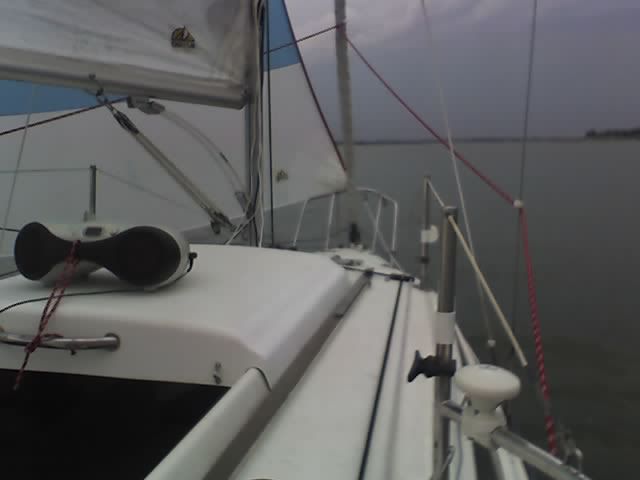
This pic is going upwind in light air. You can get pretty tight with the a-sym.