

Hi Guys
welcome to the new look forum,well done to heath.
ive gone and bought a spinnaker fron HH,i have the tack pennant and the chutescoop with it,
i have put a block for the spin higher up the mast than the jib halyard,
now i intend to turn the sheets back to the genoa cars,
where do i attach the tack pennant?
Asymmetrical Spinnaker
-
bastonjock

- Admiral
- Posts: 1161
- Joined: Fri May 25, 2007 10:41 pm
- Location: Lincolnshire United Kingdom Mac 26X
-
Richard O'Brien

- Captain
- Posts: 653
- Joined: Fri May 14, 2004 8:20 am
- Location: Lakewood, CO. Mercury 60hp bigfoot M0427B404
Re: a symetric spinnaker
Hi BJ
I see that you have an X, so I'm not sure how your bow is set up? In any case, I initially fastened my tack line (about 3') onto the bow roller. Eventually I moved it to the bow pulpit, and added a few feet ,where the mast bolts on for trailering. I know the pulpit is not probably engineered to take the stress, but in light air it is a big advantage, as well as making the gybe easier? You definitely don't want to fly it if you see a squall line, anyway. You want to get the spinnaker as far from the main as possible.
I see that you have an X, so I'm not sure how your bow is set up? In any case, I initially fastened my tack line (about 3') onto the bow roller. Eventually I moved it to the bow pulpit, and added a few feet ,where the mast bolts on for trailering. I know the pulpit is not probably engineered to take the stress, but in light air it is a big advantage, as well as making the gybe easier? You definitely don't want to fly it if you see a squall line, anyway. You want to get the spinnaker as far from the main as possible.
-
baldbaby2000
- Admiral
- Posts: 1382
- Joined: Sun Mar 28, 2004 8:41 am
- Location: Rapid City, SD, 2005 26M, 40hp Tohatsu
- Contact:
Re: a symetric spinnaker
Richard,
If you attach the tack line to the bow pulpit, doesn't it interferred with by the furled jib when you come about?
Daniel
If you attach the tack line to the bow pulpit, doesn't it interferred with by the furled jib when you come about?
Daniel
-
Richard O'Brien
- Captain
- Posts: 653
- Joined: Fri May 14, 2004 8:20 am
- Location: Lakewood, CO. Mercury 60hp bigfoot M0427B404
Re: a symetric spinnaker
Hi Danielbaldbaby2000 wrote:Richard,
If you attach the tack line to the bow pulpit, doesn't it interferred with by the furled jib when you come about?
Daniel
I added a 3" bail about 10" above my forestay attachment. If you are 12" or more they can add 3 more seconds to your phrf. The sheets are outside the forestay, and run back to the aft corners to blocks, then forward to rear facing cam cleats. I wish that I could figure out how to gybe underneath the forestay, but now I have to do a full outside chicken gybe. I love my assymetric spinnaker.
Wish it was a little bigger to the full 180% allowed?
-
brianhar

- Engineer
- Posts: 116
- Joined: Tue May 20, 2008 2:25 am
- Location: "Waterbago", Laverton, Melbourne, VIC, Australia. 2004 26M Johnson 50HP
Re: Asymmetrical Spinnaker
Daniel,
I attach my tack to the Pulpit rail (although I intend to change this to a more re-inforced ring for spinnaker retriveal later on). I also have my halyard block 500mm above the forestay connection on the mast. On Gybing the technique that I employ is different to other Assymetricals with a bowsprit (where you leave it to the very last moment and have it blow through the huge gap between the luff and the forestay). Instead I steer the boat slowly through the gybe allowing the spinnaker to fly a lot looser during the gybe and complete the gybe of the kite before the main is gybed, essentially hiding the whole activity behind the main. Only gybing the main once the kite is happy on it's new side.
Brian
I attach my tack to the Pulpit rail (although I intend to change this to a more re-inforced ring for spinnaker retriveal later on). I also have my halyard block 500mm above the forestay connection on the mast. On Gybing the technique that I employ is different to other Assymetricals with a bowsprit (where you leave it to the very last moment and have it blow through the huge gap between the luff and the forestay). Instead I steer the boat slowly through the gybe allowing the spinnaker to fly a lot looser during the gybe and complete the gybe of the kite before the main is gybed, essentially hiding the whole activity behind the main. Only gybing the main once the kite is happy on it's new side.
Brian
-
RickJ

- First Officer
- Posts: 292
- Joined: Mon Oct 01, 2007 2:39 pm
- Sailboat: MacGregor 19
- Location: Isle of Wight, UK - '94 19 + Tohatsu MFS30
Re: Asymmetrical Spinnaker
I'm in the same position as BJ, just got the KH spinnaker "kit" (chutescoop, pennant, & sheets). I tried it out yesterday and it was something of a disaster. 
I attached the pennant (which is about 3') to the trailer-winch bow eye - when I met up with some other Mac sailors a few weeks ago, most said this was the "recommended way". I hoisted using the jib halyard, the jib of course being rolled on the furler at the time. I had the sheets going round the front of everything, so the spin. would do a full round-the-front gybe (in theory), and running to cam cleats on the genny tracks.
I assume the short side is the luff? I couldn't see it made sense to use the long side, but never having flow an asym. before I'm still not 100% sure on that.
Anyway, I pulled up the sock, the spin. flew out in the wind, but I couldn't keep a stable shape. It just wouldn't fill, kept kicking about like trying to make a jib fly. I tried various things with the sheet, even taking it back to the aft cleat, but no luck. Wind was about 30 deg. off the stern, around 7-10 kts apparent.
I thought I'd try to fly it on the other side in case the main was masking it , so turned a bit straighter downwind and tried to gybe it with the sheets. That's when the problems really started. The clew got caught up in the tack, and then the whole thing wrapped itself round the furled jib.
My friend Pete (sailing novice) continued doing a grand job holding a steady course while I went up on the foredeck to do battle. Eventually, after tying the jib onto the furler so I could remove its sheets, and putting ties round the spinnaker so I could undo the foot and still hold it, I managed to unwrap the whole thing and pull the sock down. By the end I was so exhausted from the mental and physical effort of getting it under control while hanging on to a pitching foredeck I couldn't be bothered to hook up and deploy the jib again so we just continue to trundle home on the main - at least we had the tide with us.
My first though was that the halyard needs its own hound further up the mast, this seems to be confirmed by the other posts. I'd also thought about the bow roller for the pennant but wasn't sure of the ideal length if attached there.
But my main concern is why it wouldn't fly properly. Would this be affected by the position of the halyard hound? Have I even got it the right way round.

As always, the thoughts of the sage and wise (are there any others? ) would be most appreciated.
And great to see the forum back BTW, looking good too - kudos to Heath!
Cheers, Rick
I attached the pennant (which is about 3') to the trailer-winch bow eye - when I met up with some other Mac sailors a few weeks ago, most said this was the "recommended way". I hoisted using the jib halyard, the jib of course being rolled on the furler at the time. I had the sheets going round the front of everything, so the spin. would do a full round-the-front gybe (in theory), and running to cam cleats on the genny tracks.
I assume the short side is the luff? I couldn't see it made sense to use the long side, but never having flow an asym. before I'm still not 100% sure on that.
Anyway, I pulled up the sock, the spin. flew out in the wind, but I couldn't keep a stable shape. It just wouldn't fill, kept kicking about like trying to make a jib fly. I tried various things with the sheet, even taking it back to the aft cleat, but no luck. Wind was about 30 deg. off the stern, around 7-10 kts apparent.
I thought I'd try to fly it on the other side in case the main was masking it , so turned a bit straighter downwind and tried to gybe it with the sheets. That's when the problems really started. The clew got caught up in the tack, and then the whole thing wrapped itself round the furled jib.
My friend Pete (sailing novice) continued doing a grand job holding a steady course while I went up on the foredeck to do battle. Eventually, after tying the jib onto the furler so I could remove its sheets, and putting ties round the spinnaker so I could undo the foot and still hold it, I managed to unwrap the whole thing and pull the sock down. By the end I was so exhausted from the mental and physical effort of getting it under control while hanging on to a pitching foredeck I couldn't be bothered to hook up and deploy the jib again so we just continue to trundle home on the main - at least we had the tide with us.
My first though was that the halyard needs its own hound further up the mast, this seems to be confirmed by the other posts. I'd also thought about the bow roller for the pennant but wasn't sure of the ideal length if attached there.
But my main concern is why it wouldn't fly properly. Would this be affected by the position of the halyard hound? Have I even got it the right way round.
As always, the thoughts of the sage and wise (are there any others?
) would be most appreciated.And great to see the forum back BTW, looking good too - kudos to Heath!
Cheers, Rick
-
parrothead

- First Officer
- Posts: 426
- Joined: Sun Mar 06, 2005 7:25 am
- Sailboat: MacGregor 26M
- Location: Former vessel: '05 M "Blue Heaven" - Nissan 50 TLDI --- Now owner of a Gemini 3400
Re: Asymmetrical Spinnaker
RickJ,
If you have the standard Doyle asym for the Mac, the tack is the corner with the Doyle tag closest to it, and the luff [the longer side] is designated by a red stripe.
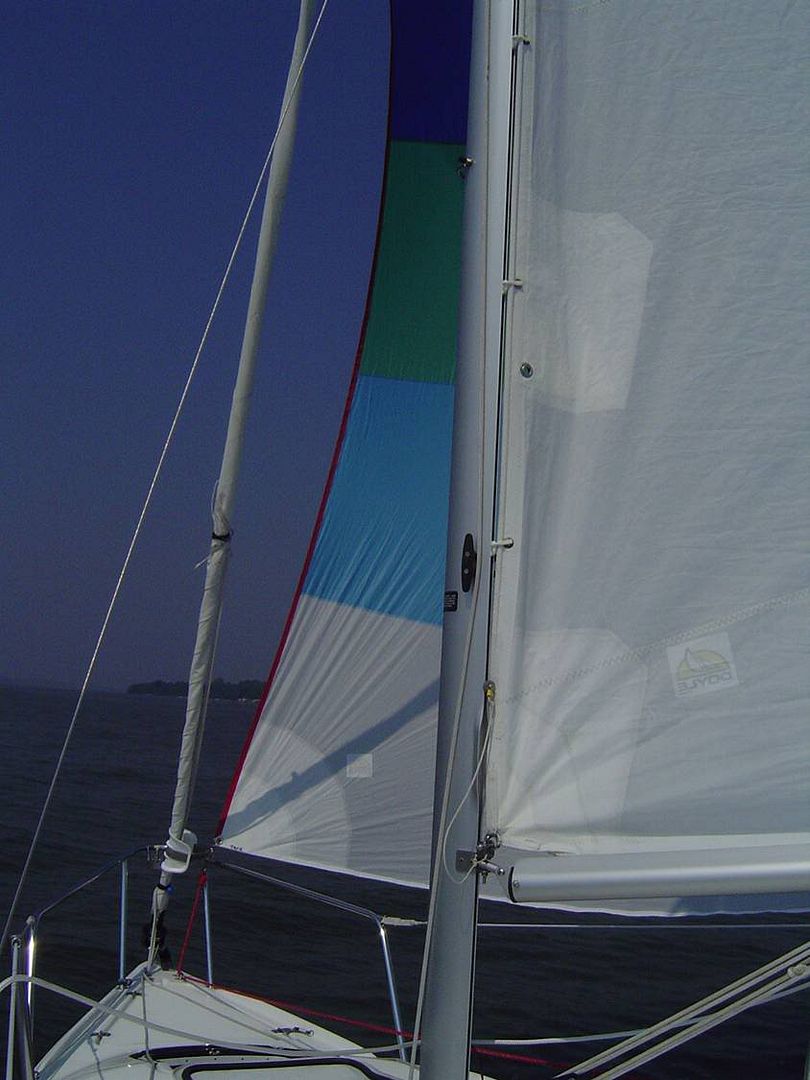
The above photo shows how you'll need to rig it to fly it from the jib halyard - with the jib sheets secured to the furled jib so they are out of the way. The asym is then jibed inside the forestay, just like a genoa would be. In this photo from our first season with the asym, you can see that we have the tack secured to an ATN Tacker, which allows the height of the tack [and the shape of the luff -- tight for a close reach, more curve on a run] to be adjusted by means of a downhaul that is led back to the cockpit [the red line]. In this early photo, the downhaul line was simply led through the starboard bow cleat. Now we lead it through a small block that is clipped to the 2nd hole in the tang on the bow where the CDI furler attaches, which keeps the tack close to the boat's centerline at all times.
If you want to fly the asym outside of the forestay, you'll need to move its halyard to a higher, dedicated mast hound.

We added this hound, along with the running backstays, for last season. Subsequently, the spinnaker halyard has been downsized to lighter line and the block replaced with a smaller composite one [in the interest of less weight aloft].
In its current configuration, flying from its dedicated spinnaker halyard, our asym can be jibed outside of the forestay and the jib sheets do not have to be adjusted. This makes it possible to unfurl most of the jib [down to the point of the ATN Tacker] and wing it out on the opposite side from the asym, if desired - not using the main at all [can't find a photo of that... darn].
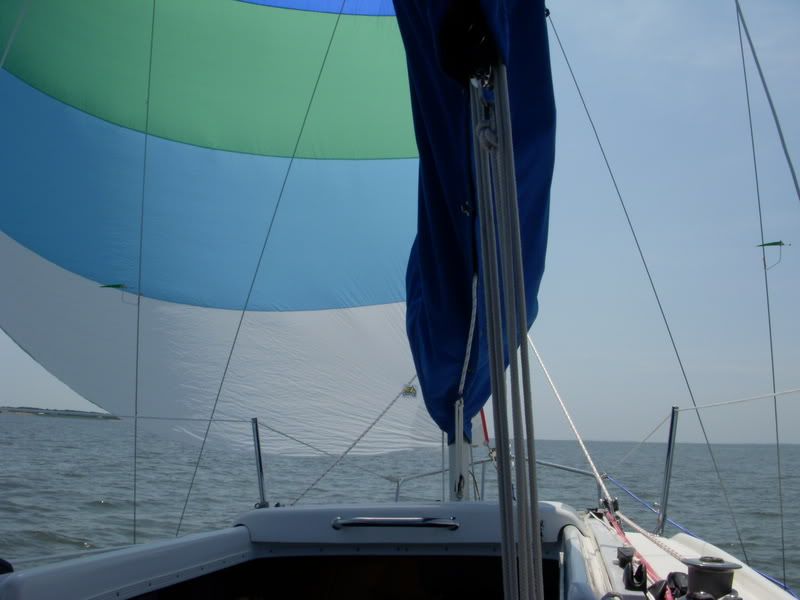
Finally, here's a photo looking up at our retracted Chute Scoop.
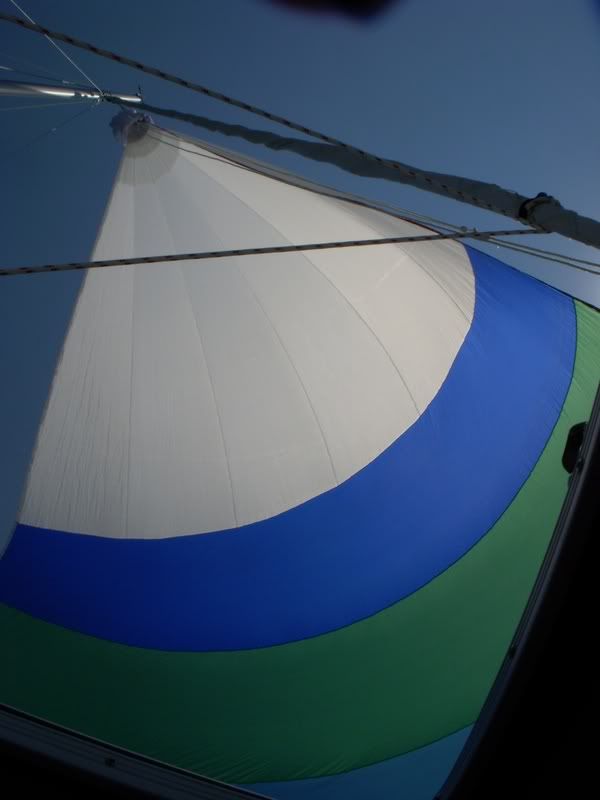
The Chute Scoop control lines, visible between the luff of the asym and the furled jib, form a continuous loop and are held under tension by a small snatch block that is secured to the bow cleats with a carabiner-ended bungee. This keeps them neat, and allows the asym to easily be deployed or doused by simply pulling up or down on the appropriate side of the looped Chute Scoop line. Now that we have the Chute Scoop, I actually prefer to execute a jibe by dousing the asym - flipping it around the outside of the headstay to the other tack, and redeploying it. This way, we only use one spinnaker sheet at a time - keeping the "lazy" sheet clipped to the bow pulpit. The reduction in weight on the clew makes a noticable difference in sail shape in light air.
The sheets are led through blocks attached to the stern cleats and then secured to camcleats mounted on the genoa tracks [see blue line in photo below].

If you have the standard Doyle asym for the Mac, the tack is the corner with the Doyle tag closest to it, and the luff [the longer side] is designated by a red stripe.
The above photo shows how you'll need to rig it to fly it from the jib halyard - with the jib sheets secured to the furled jib so they are out of the way. The asym is then jibed inside the forestay, just like a genoa would be. In this photo from our first season with the asym, you can see that we have the tack secured to an ATN Tacker, which allows the height of the tack [and the shape of the luff -- tight for a close reach, more curve on a run] to be adjusted by means of a downhaul that is led back to the cockpit [the red line]. In this early photo, the downhaul line was simply led through the starboard bow cleat. Now we lead it through a small block that is clipped to the 2nd hole in the tang on the bow where the CDI furler attaches, which keeps the tack close to the boat's centerline at all times.
If you want to fly the asym outside of the forestay, you'll need to move its halyard to a higher, dedicated mast hound.
We added this hound, along with the running backstays, for last season. Subsequently, the spinnaker halyard has been downsized to lighter line and the block replaced with a smaller composite one [in the interest of less weight aloft].
In its current configuration, flying from its dedicated spinnaker halyard, our asym can be jibed outside of the forestay and the jib sheets do not have to be adjusted. This makes it possible to unfurl most of the jib [down to the point of the ATN Tacker] and wing it out on the opposite side from the asym, if desired - not using the main at all [can't find a photo of that... darn].
Finally, here's a photo looking up at our retracted Chute Scoop.
The Chute Scoop control lines, visible between the luff of the asym and the furled jib, form a continuous loop and are held under tension by a small snatch block that is secured to the bow cleats with a carabiner-ended bungee. This keeps them neat, and allows the asym to easily be deployed or doused by simply pulling up or down on the appropriate side of the looped Chute Scoop line. Now that we have the Chute Scoop, I actually prefer to execute a jibe by dousing the asym - flipping it around the outside of the headstay to the other tack, and redeploying it. This way, we only use one spinnaker sheet at a time - keeping the "lazy" sheet clipped to the bow pulpit. The reduction in weight on the clew makes a noticable difference in sail shape in light air.
The sheets are led through blocks attached to the stern cleats and then secured to camcleats mounted on the genoa tracks [see blue line in photo below].
-
RickJ
- First Officer
- Posts: 292
- Joined: Mon Oct 01, 2007 2:39 pm
- Sailboat: MacGregor 19
- Location: Isle of Wight, UK - '94 19 + Tohatsu MFS30
Re: Asymmetrical Spinnaker
Parrothead
Thanks a mil. for the detailed description and photos, very helpful. To start with it sounds like I had it the wrong way round which would explain why it didn't fly.
It's a KH spinnaker, not the Doyle one, and I suspect it may be a bit bigger. When fully hoisted on the jib halyard, the tack would have to be pulled below the anchor roller to get any degree of tension on the luff. This is what made me think the short side should be the luff - wrong! The chutescoop also adds a bit of distance between the end of the halyard and the top of the spin. which makes this worse. I can't see that it's feasible to rig it inside the forestay.
Looks like I'll have to add a new hound and block to raise the top of the halyard. With the spin. hoisted and the luff pulled tight, where should the tack come down to? Top of pulpit for example?
I like the idea of dowsing to gybe, avoids possible tangles. Would you say the chutescoop lines could be led aft, allowing this to be done from the cockpit (ignoring the advantage of disconnecting the lazy sheet, though I take your point about that)?
I take it you always drop the spin. (not just dowse it) when not using it? I single hand a lot, and right now I can't see a viable way to hoist and drop the spinnaker without going to the foredeck. I suppose it could be attached and hoisted in the scoop while hove-to, then with scoop lines led aft could be deployed when turned downwind. I need to think about that.
Cheers, Rick
Thanks a mil. for the detailed description and photos, very helpful. To start with it sounds like I had it the wrong way round
which would explain why it didn't fly.It's a KH spinnaker, not the Doyle one, and I suspect it may be a bit bigger. When fully hoisted on the jib halyard, the tack would have to be pulled below the anchor roller to get any degree of tension on the luff. This is what made me think the short side should be the luff - wrong! The chutescoop also adds a bit of distance between the end of the halyard and the top of the spin. which makes this worse. I can't see that it's feasible to rig it inside the forestay.
Looks like I'll have to add a new hound and block to raise the top of the halyard. With the spin. hoisted and the luff pulled tight, where should the tack come down to? Top of pulpit for example?
I like the idea of dowsing to gybe, avoids possible tangles. Would you say the chutescoop lines could be led aft, allowing this to be done from the cockpit (ignoring the advantage of disconnecting the lazy sheet, though I take your point about that)?
I take it you always drop the spin. (not just dowse it) when not using it? I single hand a lot, and right now I can't see a viable way to hoist and drop the spinnaker without going to the foredeck. I suppose it could be attached and hoisted in the scoop while hove-to, then with scoop lines led aft could be deployed when turned downwind. I need to think about that.
Cheers, Rick
-
bastonjock
- Admiral
- Posts: 1161
- Joined: Fri May 25, 2007 10:41 pm
- Location: Lincolnshire United Kingdom Mac 26X
Re: Asymmetrical Spinnaker
Hi Rick
I finally got my spin and chutescopp out of the box tonight,i had fixed a block further up the mast from the jib halyard,i clipped the tack to the halyard first then i figued that the "Barbados tag was the tack and that the other was the clew,the chute scoop was easy enough to work out.
I attached the tack pennant to the trailering clip and hoiseted up the spin,with the added 12 " above the mast the spin seemed to fill with the light wind,it is one pretty sail
I finally got my spin and chutescopp out of the box tonight,i had fixed a block further up the mast from the jib halyard,i clipped the tack to the halyard first
then i figued that the "Barbados tag was the tack and that the other was the clew,the chute scoop was easy enough to work out.I attached the tack pennant to the trailering clip and hoiseted up the spin,with the added 12 " above the mast the spin seemed to fill with the light wind,it is one pretty sail
-
parrothead
- First Officer
- Posts: 426
- Joined: Sun Mar 06, 2005 7:25 am
- Sailboat: MacGregor 26M
- Location: Former vessel: '05 M "Blue Heaven" - Nissan 50 TLDI --- Now owner of a Gemini 3400
Re: Asymmetrical Spinnaker
Rick,
The top of the pulpit is about as low as you can practically pull the tack, or else the shape of the foot is affected by the railing. I'd forgotten to mention the fact that the chute scoop adds a few inches to the height problem - that's certainly true.
I don't see why the Chute Scoop control line couldn't be led back to the cockpit if it was lengthened. It's just a loop, so its ascending and descending parts could both pass through turning blocks attached to the bow cleats, and then back to the cockpit where the "end" of the loop made its turn. I think it would be best to keep some tension on it, as I do with my foredeck bungee, else it's bound to get tangled.
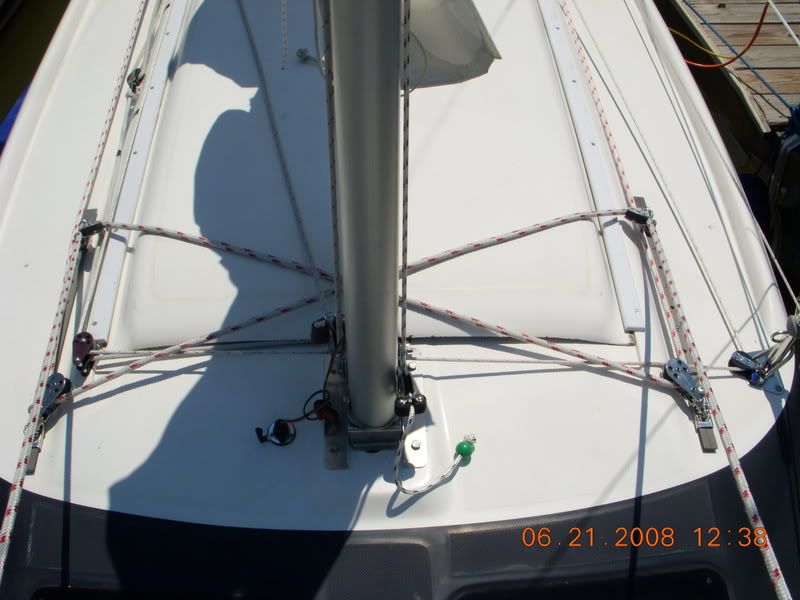
I don't single-hand, so can't offer advice about precisley how to do that [although I'm sure there are others on the Board who clould chime in]. I've actually changed the configuration of the spinnaker halyard so it now goes through a Harken 291 pivot exit block at the base of the mast, from which it is "led forward" so I can hoist or lower the spinnaker [in its chute] while standing in the front hatch. You can see the end of the halyard in this photo - it terminates in a green ball.
Best wishes,
Doug
The top of the pulpit is about as low as you can practically pull the tack, or else the shape of the foot is affected by the railing. I'd forgotten to mention the fact that the chute scoop adds a few inches to the height problem - that's certainly true.
I don't see why the Chute Scoop control line couldn't be led back to the cockpit if it was lengthened. It's just a loop, so its ascending and descending parts could both pass through turning blocks attached to the bow cleats, and then back to the cockpit where the "end" of the loop made its turn. I think it would be best to keep some tension on it, as I do with my foredeck bungee, else it's bound to get tangled.
I don't single-hand, so can't offer advice about precisley how to do that [although I'm sure there are others on the Board who clould chime in]. I've actually changed the configuration of the spinnaker halyard so it now goes through a Harken 291 pivot exit block at the base of the mast, from which it is "led forward" so I can hoist or lower the spinnaker [in its chute] while standing in the front hatch. You can see the end of the halyard in this photo - it terminates in a green ball.
Best wishes,
Doug
-
bastonjock
- Admiral
- Posts: 1161
- Joined: Fri May 25, 2007 10:41 pm
- Location: Lincolnshire United Kingdom Mac 26X
-
parrothead
- First Officer
- Posts: 426
- Joined: Sun Mar 06, 2005 7:25 am
- Sailboat: MacGregor 26M
- Location: Former vessel: '05 M "Blue Heaven" - Nissan 50 TLDI --- Now owner of a Gemini 3400
Re: Asymmetrical Spinnaker
I fly the asym anywhere from a close reach to a run. The closer to windward you want to go, the tighter you'll want the luff to be.
-
sailfish02
- Chief Steward
- Posts: 64
- Joined: Sat Apr 22, 2006 7:55 am
- Location: Salt Lake City
Re: Asymmetrical Spinnaker
Sea Dogs,
Any comments on the ATN tacker used with the spinnaker ?
Anyone fly their jib AND spin ?

Any comments on the ATN tacker used with the spinnaker ?
Anyone fly their jib AND spin ?
-
Tomfoolery

- Admiral
- Posts: 6135
- Joined: Tue Jul 05, 2011 7:42 am
- Sailboat: MacGregor 26X
- Location: Rochester, NY '99X BF50 'Tomfoolery'
Re: Asymmetrical Spinnaker
When rigged with the assym. in its ChuteScoop, I keep it stored in the forward hatch so it's easily deployed or tucked away, while the lines remain attached. But that does require going forward, both for hoisting the whole rig and putting it away, and for hoisting the ChuteScoop to deploy the spin, at least on my boat.RickJ wrote:I take it you always drop the spin. (not just dowse it) when not using it? I single hand a lot, and right now I can't see a viable way to hoist and drop the spinnaker without going to the foredeck. I suppose it could be attached and hoisted in the scoop while hove-to, then with scoop lines led aft could be deployed when turned downwind. I need to think about that.