

I suspect most of us have motored our Macs on a plane (or semi-plane) with rudders and daggerboard (or centerboard), retracted and pulled up. With the M, I normally pull the rudders up with the motor in the water in a centered position and running at low rpm's, then raise the daggerboard, then push the throttle forward to bring the boat up to planing speed. When transitioning from the planing mode back to to hull speed, the procedure is approximately reversed.
During either of these transitions, I sometimes have problems keeping the boat on course. For example, when transitioning from a plane to motoring around 3 to 5 knots (as is sometimes necessary when returning to port), after the boat has slowed from a plane, it then has to slow further to reach a reduced speed permitting lowering and tie-down of the rudders, and lowering the daggerboard. During this phase (slow speeds, no rudders, and/or no dagger board), there is little control of the boat. I sometimes find this to be a problem when coming back to port when there is lots of traffic, in that my boat may tend to wander about erratically during the process if I'm not careful. Of course, I could slow down and set the rudders earlier, some distance farther out, but that defeats the advantages of the Mac's available higher speeds when returning to port or going out (the ability to motor out or back at relatively higher speeds.)
Does anyone have an efficient way to manage these transitions without control problems? I'm curious what others have found to be the best sequence of steps for both transitions, particularly when there is some traffic in the area. (This is one of those procedures that usually goes well, but sometimes gets a little more difficult. If it's been answered elsewhere, please give me a suggestion for searching for the prior discussion.)
Jim Cate
Transition to planing mode and back
-
Oskar 26M

- First Officer
- Posts: 411
- Joined: Sun Mar 23, 2008 10:04 pm
- Sailboat: MacGregor 26M
- Location: Perth Australia, 2007 26M, 60hp E-tec
I'm another one who would appreciate some planing transition tips.
I have the same problems controlling my boat at slow speed without daggerboard and rudders, especially in windy condition. I usually find that I have to slow to a dead stop before I can pull the daggerboard up. I sail mostly single handed and so raising board and rudders to go to planing speed is quite time consuming. Meanwhile I'm wallowing around outside the harbour mouth
I have the same problems controlling my boat at slow speed without daggerboard and rudders, especially in windy condition. I usually find that I have to slow to a dead stop before I can pull the daggerboard up. I sail mostly single handed and so raising board and rudders to go to planing speed is quite time consuming. Meanwhile I'm wallowing around outside the harbour mouth
-
Frank C
Experienced only with the X-boat, can't promise this will work for you M'ers. But I ALWAYS let out a few inches of centerboard line shortly after dropping from a plane, for just the reasons you've observed.
As long as it's only 3 or 4 inches of CB line, the centerboard is a maximum 12 inches deep. That's not deep enough for the board to impart any side-lift to the hull, so it's safe at 10 or 12 mph. Further, I find the board alone provides ample directional control when the motor is steerable. I don't like to drop a rudder for slow speed control, unless I'm going very slow. Even then, one rudder is ample, no need for the second one.
Even though your DB foil might impart a slight bit of lift, I doubt it's effective during its first 5 inches of depth.
Try it for directional control at a somewhat higher speed ... bet you'll like it.
As long as it's only 3 or 4 inches of CB line, the centerboard is a maximum 12 inches deep. That's not deep enough for the board to impart any side-lift to the hull, so it's safe at 10 or 12 mph. Further, I find the board alone provides ample directional control when the motor is steerable. I don't like to drop a rudder for slow speed control, unless I'm going very slow. Even then, one rudder is ample, no need for the second one.
Even though your DB foil might impart a slight bit of lift, I doubt it's effective during its first 5 inches of depth.
Try it for directional control at a somewhat higher speed ... bet you'll like it.
-
David Mellon

- Captain
- Posts: 507
- Joined: Tue Mar 14, 2006 12:16 pm
- Sailboat: MacGregor 26M
- Location: Anaheim, CA-Yamphibian, Yamaha 70, MACM1376C606
-
Craig LaForce
- First Officer
- Posts: 349
- Joined: Thu Jun 29, 2006 9:38 pm
You just need to hire "Q" from those James Bond movies to rig up a button you hit to transition the boat to raise or lower the fins. While he is at it, another button to transition the mast from sailing to trailering position would be nice. Should be doable. Couple of winchs and pulleys and such.
Barring that an autopilot works wonders for single handing the boat to maintain some semblance of control while you fiddle about with the adjustments.
I would also like it to turn into a submarine. We already have the ballast tank and a mast for the periscope. Inboard diesel and sealed electric drive and there you are. Captain nemo.
Barring that an autopilot works wonders for single handing the boat to maintain some semblance of control while you fiddle about with the adjustments.
I would also like it to turn into a submarine. We already have the ballast tank and a mast for the periscope. Inboard diesel and sealed electric drive and there you are. Captain nemo.
-
Bill Earnhardt
- Chief Steward
- Posts: 58
- Joined: Sun Jun 25, 2006 3:44 pm
- Sailboat: MacGregor 26M
- Location: Lake Tahoe Nv.
raising fins
David, try adding a block on each fin line, cuts the lifting weight in half.
then anyone can pull them up.
see mod section for details
then anyone can pull them up.
see mod section for details

-
tangentair

- Admiral
- Posts: 1234
- Joined: Mon Jan 22, 2007 11:59 am
- Sailboat: MacGregor 26M
- Location: Highland Park, IL ...07M...Merc 50 BF...Mila K
My experice is the same as above and I also raise the rudders and drop the dagger about 6-8 inches and leave it there even at speed, there is no lift to speak of in those 6 inches but it does give a little steering control when the nose points to the moon. I wonder however if what you are describing is when slowing down, you have the effect of the bow wave moving forward and the resulting surfing moment of the stern as it rises on the aft swell. Basiclly the stern wants to keep moving and is pushed by the aft rising wave while the bow plows into the rising crest of the forward moving bow wave.
-
pokerrick1

- Admiral
- Posts: 2269
- Joined: Sun Aug 27, 2006 7:20 pm
- Sailboat: Venture 23
- Location: Las Vegas, NV (Henderson, near Lake Mead)
Right on
Exactly - - - leave enough room and don't worry about it.c130king wrote:A future project is to put a 2:1 on my dagger board.
But even so I also experience the slight loss of control during the transition. I just ensure I have sea room when I make the transition and don't worry about it.
I want 1 2:1 on my dagger board also - - - great idea - - - I think I'll have that done this week - - - I'm getting weaker or the board is getting heavier.
Rick


-
David Mellon
- Captain
- Posts: 507
- Joined: Tue Mar 14, 2006 12:16 pm
- Sailboat: MacGregor 26M
- Location: Anaheim, CA-Yamphibian, Yamaha 70, MACM1376C606
-
parrothead

- First Officer
- Posts: 426
- Joined: Sun Mar 06, 2005 7:25 am
- Sailboat: MacGregor 26M
- Location: Former vessel: '05 M "Blue Heaven" - Nissan 50 TLDI --- Now owner of a Gemini 3400
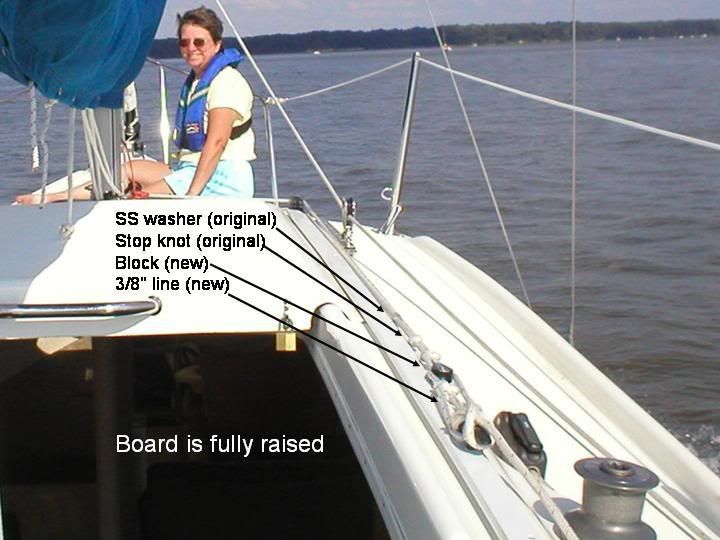
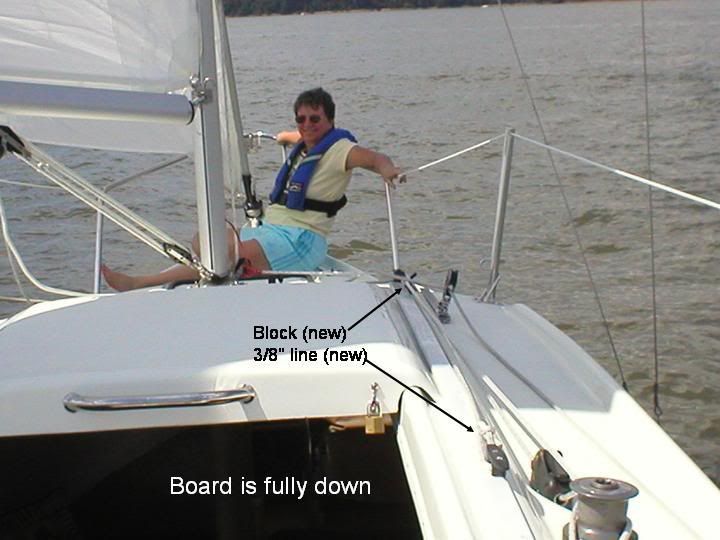
Is there a note with picture or diagrams of the rudder pulley arrangement for the 26M? Apparently there have been previous discussions. - Could someone give me directions to find them?c130king wrote:I have the pulleys on my rudders. Makes it much quicker and easier IMHO.
A future project is to put a 2:1 on my dagger board.
But even so I also experience the slight loss of control during the transition. I just ensure I have sea room when I make the transition and don't worry about it.
Jim
Jim

solo
I single-hand my 26M all the time, too.
The true answer to your question is to practice, practice, practice steering the boat with just the engine until you learn to anticipate what is going to happen and input corrections far enough in advance to counter the wandering motion. It's nothing like a car - you are steering from the rear and if you wait until the bow is where you want it to try and stop it's motion, then you're too late. It's going to be a very rare event to steer the boat under power and have the wheel stay still for more than a few seconds.
My basic process, though, is to come down off a plane, get the boat pretty stable, leave the wheel a few seconds to drop the daggerboard about 6 inches, return to the wheel and from there drop one rudder only if I've got a fairly long run to the dock. If traffic and conditions allow, I just stop to put the board down because I also have to put the fenders over and arrange my mooring lines. If I have dropped a rudder, I stop the boat before getting to the dock and pull it back up, plus drop the daggerboard more if possible. I always dock with as much daggerboard down as the depth at the dock allows, and both rudders up. For my way of doing things, this is the most maneuverable configuration.
To really make this whole question easy - install an autopilot and let "Otto" steer for you while you configure your boards, lines, etc.
- Andy
The true answer to your question is to practice, practice, practice steering the boat with just the engine until you learn to anticipate what is going to happen and input corrections far enough in advance to counter the wandering motion. It's nothing like a car - you are steering from the rear and if you wait until the bow is where you want it to try and stop it's motion, then you're too late. It's going to be a very rare event to steer the boat under power and have the wheel stay still for more than a few seconds.
My basic process, though, is to come down off a plane, get the boat pretty stable, leave the wheel a few seconds to drop the daggerboard about 6 inches, return to the wheel and from there drop one rudder only if I've got a fairly long run to the dock. If traffic and conditions allow, I just stop to put the board down because I also have to put the fenders over and arrange my mooring lines. If I have dropped a rudder, I stop the boat before getting to the dock and pull it back up, plus drop the daggerboard more if possible. I always dock with as much daggerboard down as the depth at the dock allows, and both rudders up. For my way of doing things, this is the most maneuverable configuration.
To really make this whole question easy - install an autopilot and let "Otto" steer for you while you configure your boards, lines, etc.
- Andy
-
Captain Steve

- Captain
- Posts: 722
- Joined: Fri Jan 02, 2004 9:40 am
- Sailboat: MacGregor 26X
- Location: Oxnard, CA "Wildest Dream" '98X Nissan 50