

Docking for a Beginner please help
-
ksatterlee
- Just Enlisted
- Posts: 15
- Joined: Fri Apr 16, 2010 10:46 pm
- Sailboat: MacGregor 26M
- Location: Milford, CT
Docking for a Beginner please help
I've owned my 2007 26M for 2 seasons. It has the 50hp suzuki. My sailing skills are coming along and I really love it. Opportunities to learn more and experiment add to my excitement. Operating in close quarters ie. the harbor is where I am lacking. I've had several close calls and as a result I usually become stressed at the end of a great day when it's time to dock/park the boat at it's floating mooring dock located mid-harbor. I do plan to hit the harbor very soon on a quiet day to spend a few hrs practicing. I usually come into the harbor with both rudders down for add'l steering at low speed and the dagger board lowered about 25% hoping to improve tracking esp. if it is windy. I've docked perfectly a few times, been laughed at a few times, and terrified myself and crew on others. I'd greatly appreciate any suggestions.
-
dutchwinter

- Engineer
- Posts: 104
- Joined: Sat Jan 24, 2009 3:32 pm
- Sailboat: MacGregor 26M
- Location: agressively priced '09 26M 60hp etec for sale at ays.com
Re: Docking for a Beginner please help
Hi there.
I also am new to boating. when i first took out my M, i had my rudders and CB up. it was a windy day, and i got pushed around in circles, right next to million dollar trawlers. Needless to say, i was worried. I yelled out for help, and some ppl popped out of their boats, and said it looked like I had my had my board up. It amazed me that they could tell it was up just by the way that I was maneuvering. i threw them a line, and i rafted for a minute to calm down, and to get my CB all the way down, as well as my rudders. they explained to me that a sailboat needs those control surfaces to maneuver. when you turn you'll notice that the CB is the center of those turns. without your board down, this will be much harder in my experience. also to make docking easier you might want to put a couple fenders on your dock. kissing fenders is better than kissing the dock. hope this helps.
I also am new to boating. when i first took out my M, i had my rudders and CB up. it was a windy day, and i got pushed around in circles, right next to million dollar trawlers. Needless to say, i was worried. I yelled out for help, and some ppl popped out of their boats, and said it looked like I had my had my board up. It amazed me that they could tell it was up just by the way that I was maneuvering. i threw them a line, and i rafted for a minute to calm down, and to get my CB all the way down, as well as my rudders. they explained to me that a sailboat needs those control surfaces to maneuver. when you turn you'll notice that the CB is the center of those turns. without your board down, this will be much harder in my experience. also to make docking easier you might want to put a couple fenders on your dock. kissing fenders is better than kissing the dock. hope this helps.
-
Duane Dunn, Allegro

- Admiral
- Posts: 2459
- Joined: Fri Jan 02, 2004 6:41 pm
- Sailboat: MacGregor 26X
- Location: Bellevue, Wa '96 26x, Tohatsu 90 TLDI and Plug In Hybrid Electric drive
- Contact:
Re: Docking for a Beginner please help
Always all fins down all the way. Going into any tough wind or current you will find the boat handles far better in reverse. Back into the tough spots, this will let you stop fighting the tendency of the boat to weather vane in the wind. Use the wind to your advantage, let it keep the bow downwind pointed in a consistent direction and use the motor to pull rather than push the boat into the wind.
Also, take a look at this page at my website, http://ddunn.org/BoatHandling.htm , have a good long spring line on board and take the time to learn how to use it. Once you get just one line on the dock, you can work against it to make the boat spin in all kinds of ways previously not possible. You can use a spring line to work the boat into the strongest wind or current when approaching or leaving the dock.
There are many ways to get that first line to the dock. Learning to heave the mid point of the line over a cleat can be a useful skill. Have one end cleated to the boat, coil the rest in two equal coils holding one in each hand. Be sure to also have a good hold of the loose tail. Toss both coils well past the cleat on the dock. Now you can pull the line in and secure it at a length that can be used as a spring line.
If you end up with volunteer helpers on the dock, be very specific with your instructions of what you want them to do with any line you pass to them. Do not assume they have any idea how to properly handle and secure the line. Do not assume they know anything about how to dock a boat even if they just got out of their boat. My wife has specific instructions she gives to anyone on the dock who comes to take a line from her. In general she tells them not to secure the line, she asks to simply have it passed around a cleat and returned to her. This gives us control of the line. We can secure it at the length we want, we can release it if things go bad and we need to get away.
Make sure your first mate clearly knows what you intend to do when you approach the dock. We go over the game plan before we approach. We discuss how we will approach the dock, how we will get a line to the dock, how it should be secured, if we are going to use it as a spring, what we will do if things go bad, etc. Taking a little prep time can save a lot of yelling and dings to the boat. We even keep a small dry erase board in the cockpit where I can draw pictures so everyone knows what we will do. In normal situations we have docked so many times that we don't even need to say a word, but in challenging situations these methods can be very helpful.
Also, take a look at this page at my website, http://ddunn.org/BoatHandling.htm , have a good long spring line on board and take the time to learn how to use it. Once you get just one line on the dock, you can work against it to make the boat spin in all kinds of ways previously not possible. You can use a spring line to work the boat into the strongest wind or current when approaching or leaving the dock.
There are many ways to get that first line to the dock. Learning to heave the mid point of the line over a cleat can be a useful skill. Have one end cleated to the boat, coil the rest in two equal coils holding one in each hand. Be sure to also have a good hold of the loose tail. Toss both coils well past the cleat on the dock. Now you can pull the line in and secure it at a length that can be used as a spring line.
If you end up with volunteer helpers on the dock, be very specific with your instructions of what you want them to do with any line you pass to them. Do not assume they have any idea how to properly handle and secure the line. Do not assume they know anything about how to dock a boat even if they just got out of their boat. My wife has specific instructions she gives to anyone on the dock who comes to take a line from her. In general she tells them not to secure the line, she asks to simply have it passed around a cleat and returned to her. This gives us control of the line. We can secure it at the length we want, we can release it if things go bad and we need to get away.
Make sure your first mate clearly knows what you intend to do when you approach the dock. We go over the game plan before we approach. We discuss how we will approach the dock, how we will get a line to the dock, how it should be secured, if we are going to use it as a spring, what we will do if things go bad, etc. Taking a little prep time can save a lot of yelling and dings to the boat. We even keep a small dry erase board in the cockpit where I can draw pictures so everyone knows what we will do. In normal situations we have docked so many times that we don't even need to say a word, but in challenging situations these methods can be very helpful.
-
Indulgence

- First Officer
- Posts: 206
- Joined: Mon Aug 11, 2008 6:53 pm
- Sailboat: MacGregor 26X
- Location: Calgary, Ab, Canada
Re: Docking for a Beginner please help
I single-hand a lot and have had to find ways of docking without help in lousy
conditions. The worst is always when there's no room, it's choppy and the wind
is blowing you off the dock. As DD says, all fins down- all the way. I also leave
the ballast in the boat so it doesn't pitch about as wildly. Still, if everything goes
well there are only a few seconds to snag something before you have to give up
and go around again. I've tried heaving a loop over a cleat as Duane suggests,
but I don't think my cowboy skills will ever be well enough honed to pull that off
consistently from a tossing boat.
I came up with this gizmo when I ran across a golf ball retriever in
Canadian Tire one day. I cut a slot in the ball cup to hold a loop of
aircraft cable with twenty feet of dock line attached.

The golf ball retriever extends out sixteen feet if necessary but normally I just
need it about eight feet long. I can lurch up close enough to dock to drop the
loop over a cleat, with the bitter end already secured to the boat of course.
Then I pull the ball retriever back into the cockpit and toss it below. Now I've
got that spring line on the dock so I can manoever the boat in tight,
then step ashore with the mid line in my hand confident I'm not going to lose the boat.
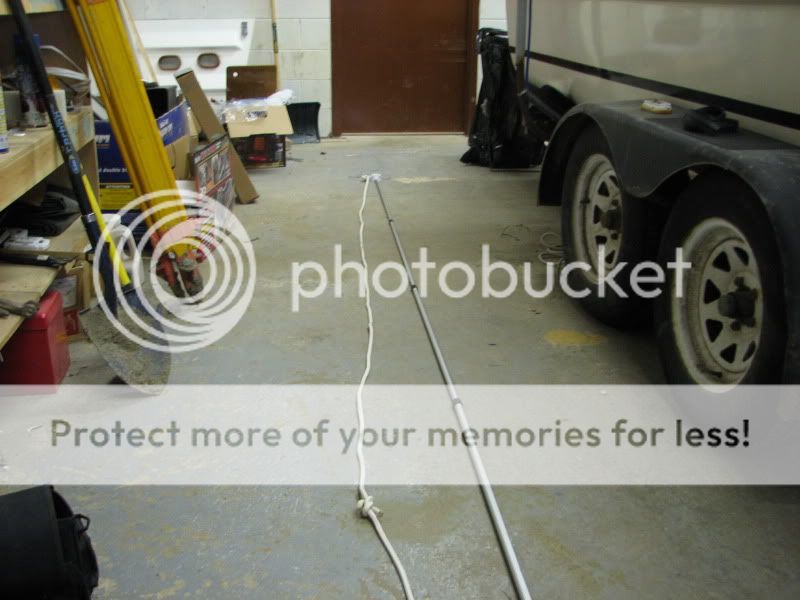
I've only had to resort to using it three or four times, but I was glad I had it on those occasions.
Laurie.
conditions. The worst is always when there's no room, it's choppy and the wind
is blowing you off the dock. As DD says, all fins down- all the way. I also leave
the ballast in the boat so it doesn't pitch about as wildly. Still, if everything goes
well there are only a few seconds to snag something before you have to give up
and go around again. I've tried heaving a loop over a cleat as Duane suggests,
but I don't think my cowboy skills will ever be well enough honed to pull that off
consistently from a tossing boat.
I came up with this gizmo when I ran across a golf ball retriever in
Canadian Tire one day. I cut a slot in the ball cup to hold a loop of
aircraft cable with twenty feet of dock line attached.
The golf ball retriever extends out sixteen feet if necessary but normally I just
need it about eight feet long. I can lurch up close enough to dock to drop the
loop over a cleat, with the bitter end already secured to the boat of course.
Then I pull the ball retriever back into the cockpit and toss it below. Now I've
got that spring line on the dock so I can manoever the boat in tight,
then step ashore with the mid line in my hand confident I'm not going to lose the boat.
I've only had to resort to using it three or four times, but I was glad I had it on those occasions.
Laurie.
-
Russ

- Admiral
- Posts: 8299
- Joined: Thu Oct 11, 2007 12:01 pm
- Sailboat: MacGregor 26M
- Location: Bozeman, Montana "Luna Azul" 2008 M 70hp Suzi
Re: Docking for a Beginner please help
Yes, daggerboard and rudders all the way down (except when pulling on trailer). This is a must. I have also found that going too slow will reduce your steerage greatly, so don't come in too slow.
Another tip is to run a tight line from the bow cleat all the way back to the stern cleat. A mate can hop off the boat and grab that line to pull the boat up into the dock.
--Russ
Another tip is to run a tight line from the bow cleat all the way back to the stern cleat. A mate can hop off the boat and grab that line to pull the boat up into the dock.
--Russ
-
Duane Dunn, Allegro
- Admiral
- Posts: 2459
- Joined: Fri Jan 02, 2004 6:41 pm
- Sailboat: MacGregor 26X
- Location: Bellevue, Wa '96 26x, Tohatsu 90 TLDI and Plug In Hybrid Electric drive
- Contact:
Re: Docking for a Beginner please help
Just to clarify, I'm not talking about heaving a loop at the end of a line like a cowboy, that is far too difficult to do reliably.
What I am describing is throwing the center section of a longer line past the cleat onto the dock, both ends of the line are still securely on your boat. If you coil the line into two equal coils and hold one in each hand it is very easy to throw the line past a cleat onto the dock behind it. After 2-3 practice throw you will be able to do this every time. Do not aim for the cleat, aim for the dock a good 4'-6' behind the cleat. Throwing both coils at the same time, you throw one to one side of the cleat and the second to the other side of the cleat. You now have a line laying loose on the dock with each end coming back to the boat on opposite sides of the cleat. After you pull the line in, you end up with a loop going from the boat, around the cleat and back to the boat.
What I am describing is throwing the center section of a longer line past the cleat onto the dock, both ends of the line are still securely on your boat. If you coil the line into two equal coils and hold one in each hand it is very easy to throw the line past a cleat onto the dock behind it. After 2-3 practice throw you will be able to do this every time. Do not aim for the cleat, aim for the dock a good 4'-6' behind the cleat. Throwing both coils at the same time, you throw one to one side of the cleat and the second to the other side of the cleat. You now have a line laying loose on the dock with each end coming back to the boat on opposite sides of the cleat. After you pull the line in, you end up with a loop going from the boat, around the cleat and back to the boat.
-
Indulgence
- First Officer
- Posts: 206
- Joined: Mon Aug 11, 2008 6:53 pm
- Sailboat: MacGregor 26X
- Location: Calgary, Ab, Canada
Re: Docking for a Beginner please help
DD, you wouldn't believe what I have to try and snag on a windy day!
We have these docks, http://www.candock.com/product_cube.php?tZ=1275171240& .
I can flip a line over a cleat anywhere else, but these are a -word website will delete- !
on edit- they also hurt like hull to kneel on and I do not believe there is a single
surface in the world more slippery when covered with frost. It's all a challenge.
Laurie
We have these docks, http://www.candock.com/product_cube.php?tZ=1275171240& .
I can flip a line over a cleat anywhere else, but these are a -word website will delete- !
on edit- they also hurt like hull to kneel on and I do not believe there is a single
surface in the world more slippery when covered with frost. It's all a challenge.
Laurie
-
dlymn
- Deckhand
- Posts: 26
- Joined: Fri Feb 19, 2010 6:27 pm
- Sailboat: MacGregor 26M
- Location: Adelaide South Australia
Re: Docking for a Beginner please help
There are a few mooring aids such as Stearns Happy Hooker™ Mooring Tool (!!!!) that can tie a line to a cleat from a distance. They poke the end of the mooring line through the centre hole of the cleat and then return the end to the boat.
-
Catigale

- Site Admin
- Posts: 10421
- Joined: Fri Jun 11, 2004 5:59 pm
- Sailboat: MacGregor 26X
- Location: Admiral .............Catigale 2002X.......Lots of Harpoon Hobie 16 Skiffs....Island 17
- Contact:
Re: Docking for a Beginner please help
Note the bolded words. Its a common mistake for beginners to dock TOO SLOW.....remember at zero speed your rudders and CB are useless. At low speed the work a bit, and at hull speed they work well.I usually come into the harbor with both rudders down for add'l steering at low speed and the dagger board lowered about 25% hoping to improve tracking esp.
The safest approach is one made smartly into the dock at a good clip, then the speed is quenched with a series of manuevers and/or reverse thrust to bring the boat to a standstill where lines can be attached.
Trying to dock at 1-2mph will almost guarantee a mismash..
-
Boblee
- Admiral
- Posts: 1702
- Joined: Thu Aug 10, 2006 5:08 am
- Location: Berrigan, Riverina Australia boatless at present
Re: Docking for a Beginner please help
All good advice but the biggest difference I have seen to the handling was putting the power thruster on which should help on those many occasions when the boards can't be lowered eg shallow water or weeds stumps etc.
Once you get a bow line on the dock it's usually easy to bring the stern in but there are so many variables especially with a light high freeboard boat like the macs which really are hard to control in any wind if you aren't experienced but there is no shame in pulling out and coming around again especially if the alternative might be to wreck your boat.
On some occasions there are no alternaves but to just bite the bullet especially when loading on the trailer, we struck a 25-30 knot cross wind with driving rain and a 4knot tide running and knew there was a huge storm coming (floods) so we had to get out immediately and the ramp was surrounded by rocks both sides and in front, in this situation there is only one way and that is to power on at speed and there is no turning back or trying again.
My advice would be to drop some buoys out in open water and try and navigate around them at different speeds, this will help for a hopefully very much in the future MOB situation.
Once you get a bow line on the dock it's usually easy to bring the stern in but there are so many variables especially with a light high freeboard boat like the macs which really are hard to control in any wind if you aren't experienced but there is no shame in pulling out and coming around again especially if the alternative might be to wreck your boat.
On some occasions there are no alternaves but to just bite the bullet especially when loading on the trailer, we struck a 25-30 knot cross wind with driving rain and a 4knot tide running and knew there was a huge storm coming (floods) so we had to get out immediately and the ramp was surrounded by rocks both sides and in front, in this situation there is only one way and that is to power on at speed and there is no turning back or trying again.
My advice would be to drop some buoys out in open water and try and navigate around them at different speeds, this will help for a hopefully very much in the future MOB situation.
-
fishheadbarandgrill

- Captain
- Posts: 501
- Joined: Fri Apr 23, 2010 6:08 pm
- Sailboat: Other
- Location: Isle Of Palms, SC - 2000 Catalina 380 "Interlude"
Re: Docking for a Beginner please help
A wise man once told me never approach a dock any faster than you're willing to hit it.
-
Y.B.Normal
- First Officer
- Posts: 335
- Joined: Sat Jan 26, 2008 2:55 pm
- Sailboat: MacGregor 26M
- Location: Western PA
Re: Docking for a Beginner please help
I guess I'm going against the flow, however, I come from a powerboat/sail background.
I lower my board about 6-12", put my rudders up and use the OB for directional control. I find it's easier to use the power and forward/reverse thrust of the OB to maneuver, especially when backing or getting into a tight spot. I can spin the boat in a tighter circle with the rudders up.
I lower my board about 6-12", put my rudders up and use the OB for directional control. I find it's easier to use the power and forward/reverse thrust of the OB to maneuver, especially when backing or getting into a tight spot. I can spin the boat in a tighter circle with the rudders up.
-
hart

- Captain
- Posts: 514
- Joined: Wed Oct 03, 2007 1:31 pm
- Sailboat: MacGregor 26X
- Location: Foley, AL 2001 26X "Wind Song" 50 hp Mercury Classic MMSI/DSC: 338081191
Re: Docking for a Beginner please help
I just docked at the public pier in Pensacola Beach. Quite a challenge. Wind and tide both pushing me into the dock but not quite from the same direction. Compounding the problem, the pier is too high to use fenders. Oh and I am singlehanding. Luckily there was another X here and they helped me out. I ended up setting an anchor to hold the boat off the dock and once I was secure I hung my biggest fenders from the pilings for addiotional insurance. I'll have to use the motor and pull on the anchor line if the wind doesn't change before I leave. In this case having the water ballast in was a great help. The boards are up though due to the shallow depth (3 to 4 feet).
Had a nice lunch at Hooters and now I'm waiting on an ice truck to show up at the Circle K before I retreat from civilazation for the rest of the weekend.
Had a nice lunch at Hooters and now I'm waiting on an ice truck to show up at the Circle K before I retreat from civilazation for the rest of the weekend.
-
bscott

- Admiral
- Posts: 1143
- Joined: Mon Mar 08, 2004 2:45 pm
- Sailboat: MacGregor 26X
- Location: Arvada, Colorado 2001 X, M rotating mast, E-tec 60 with Power Thruster, "HUFF n Puff"
Re: Docking for a Beginner please help
I learned to use 2 fenders fixed to a 30" 2x6 when docking against piers. The 2x6 rides up and down the pier with the tide. The trick is getting on and off the boat at low tide 
Bob
Bob
-
Rocketman1098
- Posts: 8
- Joined: Fri May 28, 2010 9:16 am
- Sailboat: MacGregor 26M
Re: Docking for a Beginner please help
I have been sailing the 26M for 3 years now. Still, everytime I come into a marina full of boats I get nervous. The boat is so light and has so much freeboard I fell like I am oushed around like a paper boat. I agree with dagger and rudders down while maintaining a safe speed..I.e.- one that you can put the motor in reverse and get out of trouble! I don't think there is any easy answer to this. Moving too slow is a problem..moving too fast can be a problem! Need to find a spped that will work for you. Also, knowing how tricky the boat is to handle in a wind I try and plan on docing on the leeward side. Letting the wind push me in. I once tried several attempts to dock with the wind blowingfairly hard at 90 degrees to the dock. I failed to get a good approach when coming in cross wind. I finially went down wind, turned around and headed directly into the wind as close to shaore as I could. Once I reaced the dock I did a sharp 90 turn... that worked!! But I still never feel comfortable coming into a marina!! 