


Walt...good reading and I appreciate all the discussions on this topic. I need to read it again (and again) to let it sink in.
BTW Walt..your image linkies aren't working.
Lightning
-
Hamin' X

- Site Admin
- Posts: 3464
- Joined: Sat Aug 27, 2005 6:02 pm
- Sailboat: MacGregor 26X
- Location: Hermiston, OR-----------2001 26X DF-50 Suz---------------(Now Sold)
- Contact:
Re: Lightning
Walt,
Yes, ground/ing are very confusing terms, but also common (no pun intended). Generally, grounding indicates sending a charge to a large, negative source. Old British cars with positive earth systems excepted. I use the term ground to indicate a place of opposite potential from the charged cloud. This is any place that can gather enough positive charge for the negatively charged leaders to be attracted to. It can even be a large object that is totally insulated from the earth. such as another cloud. hence the cloud-to-cloud lightning phenomenon.
Your water demonstrations are interesting, but only show that fresh water is slower to gather enough positive charge to initiate a strike than salt water and most people already know that salt water is a better conductor than fresh. I would be willing to bet that if you were to increase the distance of the device that is delivering the charge to the point that it would not discharge when it was turned on (not the distance that it stopped, as this would include an ionized air path), then placed the lower electrode into the water, fresh, or salt, that the stroke would reinitiate when turned on. I have done this experiment with an automotive ignition coil, which is crude, but confirms what I am saying. I was doing this to study the different dielectric properties of substances that I was using to insulate towers and guys. Again, crude, but it is not called amateur radio for nothing. My conclusion is that the impedance over the total path was reduced, requiring less energy to produce the strike. For those that are wondering, you can substitute resistance for impedance, although they are not quite the same, the concept will work.
You stated before, that the charge on the boat was coming from the clouds and not the water, but now you are saying that the water has to gather sufficient charge for the strike to travel to it. If the cloud charge is negative, how is this transferring a positive charge to the boat, or water? My theory says that the cloud charge is causing the the water to gather a positive charge from a larger area of water around it. It sounds like we agree, but do not agree? Perhaps you can expand upon this?
I see nothing in what you write, or in the links that you refer to that negates what I am saying. I do find it amusing that the papers that you refer to do not agree on all aspects, as we do not., but that is what makes for interesting dialog and furthering understanding. The truth usually lies somewhere between opposing viewpoints and as lightning research is ongoing, I don't believe that anyone has all the answers. Nature is a deeper puzzle than we want to admit. I just wish that the so called "experts" would not cite Wikipedia as a source in their writings. It makes me think that they are more interested in selling the products of the companies that hire them. I have no pecuniary interest in this matter and only wish to further my own understanding of the matter, as well as make sure that the members of this forum get the best info possible. As I have indicated before, doing the wrong thing can be worse than doing nothing at all.
~Rich
Yes, ground/ing are very confusing terms, but also common (no pun intended). Generally, grounding indicates sending a charge to a large, negative source. Old British cars with positive earth systems excepted. I use the term ground to indicate a place of opposite potential from the charged cloud. This is any place that can gather enough positive charge for the negatively charged leaders to be attracted to. It can even be a large object that is totally insulated from the earth. such as another cloud. hence the cloud-to-cloud lightning phenomenon.
Your water demonstrations are interesting, but only show that fresh water is slower to gather enough positive charge to initiate a strike than salt water and most people already know that salt water is a better conductor than fresh. I would be willing to bet that if you were to increase the distance of the device that is delivering the charge to the point that it would not discharge when it was turned on (not the distance that it stopped, as this would include an ionized air path), then placed the lower electrode into the water, fresh, or salt, that the stroke would reinitiate when turned on. I have done this experiment with an automotive ignition coil, which is crude, but confirms what I am saying. I was doing this to study the different dielectric properties of substances that I was using to insulate towers and guys. Again, crude, but it is not called amateur radio for nothing.
My conclusion is that the impedance over the total path was reduced, requiring less energy to produce the strike. For those that are wondering, you can substitute resistance for impedance, although they are not quite the same, the concept will work.You stated before, that the charge on the boat was coming from the clouds and not the water, but now you are saying that the water has to gather sufficient charge for the strike to travel to it. If the cloud charge is negative, how is this transferring a positive charge to the boat, or water? My theory says that the cloud charge is causing the the water to gather a positive charge from a larger area of water around it. It sounds like we agree, but do not agree? Perhaps you can expand upon this?
I see nothing in what you write, or in the links that you refer to that negates what I am saying. I do find it amusing that the papers that you refer to do not agree on all aspects, as we do not., but that is what makes for interesting dialog and furthering understanding. The truth usually lies somewhere between opposing viewpoints and as lightning research is ongoing, I don't believe that anyone has all the answers. Nature is a deeper puzzle than we want to admit. I just wish that the so called "experts" would not cite Wikipedia as a source in their writings. It makes me think that they are more interested in selling the products of the companies that hire them. I have no pecuniary interest in this matter and only wish to further my own understanding of the matter, as well as make sure that the members of this forum get the best info possible. As I have indicated before, doing the wrong thing can be worse than doing nothing at all.
~Rich
-
Catigale

- Site Admin
- Posts: 10421
- Joined: Fri Jun 11, 2004 5:59 pm
- Sailboat: MacGregor 26X
- Location: Admiral .............Catigale 2002X.......Lots of Harpoon Hobie 16 Skiffs....Island 17
- Contact:
Re: Lightning
I still think there should be enough good statistics out there on strikes to understand advantages of strike systems empirically - the stats that are used by the strike system sellers (and Boat US) certainly suck...
Understanding grounding is difficult for the common man, but some this thread brings it back to earth, indeed.
Understanding grounding is difficult for the common man, but some this thread brings it back to earth, indeed.
-
walt
- First Officer
- Posts: 209
- Joined: Mon Feb 05, 2007 9:05 am
- Location: Colorado "Sea Eagle" 1990 26S
Re: Lightning
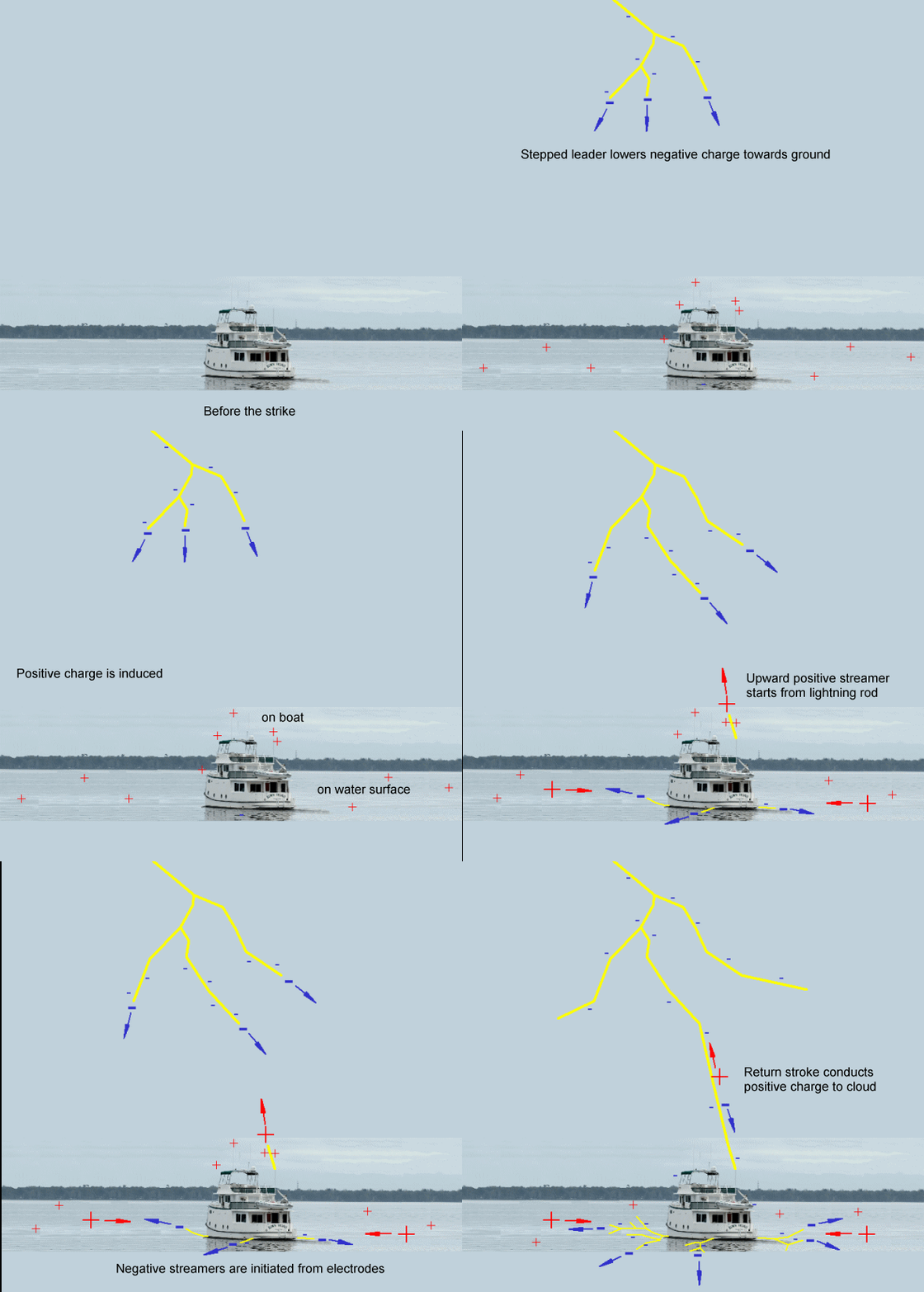
What I hope I said was that the charging of conductors on a sailboat was due to the electric field present because of the charge in the clouds. The charging of insulated conductors does not need any charge to actually come from either the water or the sky. Hopefully the diagram below (and also hopefully it is visible) shows how this occurs. The important mechanism is that when you place a conductor in an electric field, it will take on the voltage of its "geometric" mid point. The entire conductor will take on this single voltage. If the conductor did not do this (i.e., it had a potential across the conductor), there would be current flowing in the conductor - which is not the case since it is insulated. In this picture, there is a difference of 20KV between the person and the mast simply because they have different heights in the electric field. It the person gets near the mast, there will be a spark but it only needs to discharge the capacitance between the two objects - which is usually a very small capacitance.You stated before, that the charge on the boat was coming from the clouds and not the water, but now you are saying that the water has to gather sufficient charge for the strike to travel to it. If the cloud charge is negative, how is this transferring a positive charge to the boat, or water? My theory says that the cloud charge is causing the water to gather a positive charge from a larger area of water around it. It sounds like we agree, but do not agree? Perhaps you can expand upon this?

What I understand about all the charging is from the radials paper. A bunch of negative charge gets blown over a lake by the upper level winds. Because the water is somewhat conductive (due to dissolved content such as salts), electrons at the water surface are driven into the water bulk leaving the water surface positively charged.
This picture on the marine lightning web site I think shows what happens fairly well http://www.marinelightning.com/index_fi ... hanism.gif
Interesting to note that the pictures I showed earlier to some extent show how Dr. Thomson’s Seidarc electrodes work (and how his patent works) http://www.marinelightning.com/
-
Sumner

- Admiral
- Posts: 2375
- Joined: Sun Jan 04, 2009 3:20 pm
- Sailboat: MacGregor 26S
- Location: SE Utah
- Contact:
Re: Lightning
To be fair I think you should apply the same criteria to the other side of the discussion and show good stats that say that diffusers do work and that grounding is a bad idea,Catigale wrote:I still think there should be enough good statistics out there on strikes to understand advantages of strike systems empirically - the stats that are used by the strike system sellers (and Boat US) certainly suck...
...
Sum
-
Catigale
- Site Admin
- Posts: 10421
- Joined: Fri Jun 11, 2004 5:59 pm
- Sailboat: MacGregor 26X
- Location: Admiral .............Catigale 2002X.......Lots of Harpoon Hobie 16 Skiffs....Island 17
- Contact:
Re: Lightning
Sorry - I didnt mean to single out the strike system in that post.
I havent seen good stats that support ANY system or lack of system over another, frankly. My personality isnt one to spend any amount of money saying, "well, its better than nothing", especially when there is a reasonable argument than NOTHING may well be better.
In the example above, comparing cats to monohulls, and then diving off into the mast vs area coverage is a horrible use of stats imho.
I havent seen good stats that support ANY system or lack of system over another, frankly. My personality isnt one to spend any amount of money saying, "well, its better than nothing", especially when there is a reasonable argument than NOTHING may well be better.
In the example above, comparing cats to monohulls, and then diving off into the mast vs area coverage is a horrible use of stats imho.
-
Capt Capsize
- Deckhand
- Posts: 26
- Joined: Sun Jul 20, 2008 6:42 pm
- Sailboat: MacGregor 26X
- Location: New Mexico 97X with 50Hp Nissan
Re: Lightning
Lightening
I have a static dissipater on my mast, a birthday present from my brother since he knows I don’t have sense enough to come in out of the rain.
I live in the high desert where our best wind is usually the gust fronts ahead of thunderstorms. The problem in the years before I installed the dissipater was just after I pulled the boat out on the trailer. The boat was electrically hot enough to draw a 1 to 2 inch arc “ouch”. And like a dummy it would take a couple of zaps before I would wise up and back the boat into the lake drop an short length chain over the shroud and in the water. Then step the mast while it was shorted and then pull it back out of the water.
Some friends say I am trying for a Darwin Award nomination.
After I installed the dissipater and under similar circumstances it takes only a few minutes for the boat to self discharge and allow me to step the mast and then run for cover. I am still a lightening target but for much less time. I believe the multi-point corona discharge these stainless steel bottle brush dissipater provide is worthwhile. So I brought one for my brother on his 26D, because he isn’t much brighter than I am, when it comes to weather.
When camping out during Thunderstorm season, I usually ground the shrouds to the water with some spare anchor chain. I figure the dissipater makes me a lesser target, but if struck an outside path is better than an inside one.
I know from personal experience lightening is painful.
I have a static dissipater on my mast, a birthday present from my brother since he knows I don’t have sense enough to come in out of the rain.
I live in the high desert where our best wind is usually the gust fronts ahead of thunderstorms. The problem in the years before I installed the dissipater was just after I pulled the boat out on the trailer. The boat was electrically hot enough to draw a 1 to 2 inch arc “ouch”. And like a dummy it would take a couple of zaps before I would wise up and back the boat into the lake drop an short length chain over the shroud and in the water. Then step the mast while it was shorted and then pull it back out of the water.
Some friends say I am trying for a Darwin Award nomination.
After I installed the dissipater and under similar circumstances it takes only a few minutes for the boat to self discharge and allow me to step the mast and then run for cover. I am still a lightening target but for much less time. I believe the multi-point corona discharge these stainless steel bottle brush dissipater provide is worthwhile. So I brought one for my brother on his 26D, because he isn’t much brighter than I am, when it comes to weather.
When camping out during Thunderstorm season, I usually ground the shrouds to the water with some spare anchor chain. I figure the dissipater makes me a lesser target, but if struck an outside path is better than an inside one.
I know from personal experience lightening is painful.
-
ROAD Soldier

- Captain
- Posts: 799
- Joined: Tue Jan 22, 2008 5:39 pm
- Sailboat: MacGregor 26X
- Location: Poquoson VA
Re: Lightning
I heard if you keep your tongue in contact with the mast during a lightning storm it will slowly discharge all static electricity in the riggging. Try it let me know how it turns out.
-
kmclemore

- Site Admin
- Posts: 6255
- Joined: Sun Feb 08, 2004 9:24 am
- Sailboat: MacGregor 26X
- Location: Ambler, PA -- MACX2018A898 w/ Suzuki DF60AV -- 78 BW Harpoon 4.6 -- 2018 Tahoe 550TF w/ 150 Merc
Re: Lightning
Don't listen to him. Your tongue will stick to the mast.ROAD Soldier wrote:I heard if you keep your tongue in contact with the mast during a lightning storm it will slowly discharge all static electricity in the rigging. Try it let me know how it turns out.

-
c130king

- Admiral
- Posts: 2730
- Joined: Sun Nov 05, 2006 5:30 pm
- Sailboat: MacGregor 26M
- Location: Wiggins, MS --- '05 26M "König" w/ 40hp Merc
- Contact:
Re: Lightning
I TRIPLE-dog-dare ya!kmclemore wrote:Don't listen to him. Your tongue will stick to the mast.ROAD Soldier wrote:I heard if you keep your tongue in contact with the mast during a lightning storm it will slowly discharge all static electricity in the rigging. Try it let me know how it turns out.

-
Catigale
- Site Admin
- Posts: 10421
- Joined: Fri Jun 11, 2004 5:59 pm
- Sailboat: MacGregor 26X
- Location: Admiral .............Catigale 2002X.......Lots of Harpoon Hobie 16 Skiffs....Island 17
- Contact:
Re: Lightning
Sorry - couldnt resist this one
In other Ohio news, a 62-foot statue of Jesus exploded Monday night after lightning struck the 6-story-tall structure. "Touchdown Jesus," as Ohio citizens nicknamed it, was completely destroyed.
In other Ohio news, a 62-foot statue of Jesus exploded Monday night after lightning struck the 6-story-tall structure. "Touchdown Jesus," as Ohio citizens nicknamed it, was completely destroyed.