Has anyone posted photo"s as to how to set up a for safely handling single handed. Tried searching d/base but unsuccessful so far. I know from reading posts that a lot of you experienced sailors go solo, but for a newboy to sailing a lot of how to set-up advise much apreached. As the saying goes, a pitchure is worth a thousand words. Thanks for your time.
You don't really need that much. I think you will find a variety of set-ups. But I mostly single-hand and here is a list of the mods that I have that make this easier for me.
1. Lines led aft into the cockpit. Specifically the main halyard so that I don't have to go up on deck and stand by the mast to raise the main. Mine is on the starboard side. And my halyard is kinda/sorta a "continuous line" that works to both raise the main and pull it back down when lowering (versus hoping it free falls as it is supposed to). And of course to make this set-up work you have to have sail slugs installed on your main.
2. Roller furling foresail. I have a 150 Genoa on a CDI-FF2 furler. And of course the furling line is led aft into the cockpit on the starboard side. Works great.
3. Single-line, "Jiffy Reef" system. The line is led to the cockpit on the port side. Runs through a series of turning blocks and through the reefing points on the main. Simply loosen the halyard, pull on the reefing line until the reefing points are down against the boom, secure the reefing line, tighten the halyard back up. That explanation may be a little over simplified but it works.
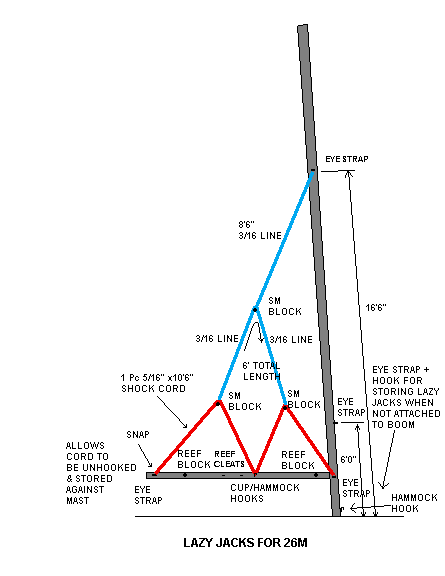
4. Lazy Jacks. These lines "hold" the main in place as you release the halyard and allow the main to come down. Keeps the sail from "falling off" the boom. Several different varieties. Mine is pretty much homemade but started as a "Jiffy Jax" system I think...got it from the original owner.
And that is pretty much it IMHO. I also have a Raymarine S1 Wheel Pilot. But I only got this fairly recently...sailed many a day solo without it.
THANKS FOR THE INFORMATION. LOOKS LIKE I HAVE TO FIGURE OUT WHAT TO PUT AND WHERE. I DO LIKE THE IDEA OF LAZY JACKS, MUST DO SOME MORE RESEARCH TO FIND A SUPPLIER IN NEW ZEALAND.
ALL THE BEST
RAY.
Ray
I have a similar set-up to Jim's : roller furling jib, sail slugs, down-haul, jiffy reefing and lazy jacks (with all lines led aft to the cockpit), safety harness and jack-line. I managed with just a poor man's autopilot for a long while but have to say that a wheel-pilot was a worthwhile investment for single handed sailing.
Lazy jacks are a must in my opinion but they are an easy mod to fit yourself:
Another mod that I find really useful for solo sailing is the passive ballast vent hose led to the anchor locker. If this is done right, it will free you from ever having to go forward at all, to fill or drain ballast. Do it all from the helm seat. Use a boat hook pole to close and open the gate valve over the transom ( I shortened a pole especially for this, and have it attached at the transom near the gate valve handle ) With a passive ballast vent, you just motor at 8 or 10 kts. for 10 minutes to drain the tank, ( I just put the throttle at planing speed and wait for that light feeling and top speed reached when the water is all out, and then a minute more. For filling, have a short ribbon attached to the gate valve that shows water flow, so when no more water is entering the valve there, and the ribbon just floats random, I close the gate valve.
The ballast vent can be plumbed with a hose led straight up, and then over/thru the bulkhead under the V-berth, straight forward and then up at the very nose of the v-berth, ( that's the only place it is visible, for about two feet, and is completely out of the way ) and up as high as the deck at the bow, where I put two elbows together to make a U turn, and then back down to the bottom of the anchor locker, where a T joins the anchor locker drain.
This means no more rushing forward to throw berth cushions out of the way and raising the cover to open or close the ballast valve, and no more checking the level. There is no risk of forgetting to plug the hole, no need to re-check the level unless you have the time and need to. No need to disturb anyone in the v-berth. No need to ever leave the helm, especially when you need to be there for solo going.
The vent is completely self-tending, as even on a steep heel, the ballast water will not rasise higher in the hose than the fore-deck at the bow, and only fill the hose to the same level as the side tank on the high side. Any outside water that gets into the anchor locker just drains out the regular locker drain hose, and will not back up into the vertical hose going to the ballast drain. Even if the anchor locker drain becomes plugged, and fills comletely up, it will spill out over the deck before it gets higher than the hose inside under the deck at the nose. Even if water did get back into the hose, it can only go toward the ballast tank.
I leave it open all the time, but did also plumb an in-line ball valve right above the ballast tank in the hose before it turns under the v-berth. SO if I ever want to, I can positively shut the ballast vent there, as well as check the level thru the original hole which I left with the plug. I driled an identical hole beside it for the passive ballast vent hose, and put a very tight fitting nipple in, plus a strut across the top of the dam which binds the vent hose fittings in place, for a more secure installation.
If you are expecting very severe storm weather, and anticipate turning your boat on its side, the ball valve in the vent hose can be closed.


 for safely handling single handed. Tried searching d/base but unsuccessful so far. I know from reading posts that a lot of you experienced sailors go solo, but for a newboy to sailing a lot of how to set-up advise much apreached. As the saying goes, a pitchure is worth a thousand words. Thanks for your time.