

On fuel management - mpg in heavy seas
-
Duane Dunn, Allegro

- Admiral
- Posts: 2459
- Joined: Fri Jan 02, 2004 6:41 pm
- Sailboat: MacGregor 26X
- Location: Bellevue, Wa '96 26x, Tohatsu 90 TLDI and Plug In Hybrid Electric drive
- Contact:
Re: On fuel management - mpg in heavy seas
Dave, you are using too high of a pitch. It's not just at high rpms that you are putting undue strain on the motor, it's at all rpms. Being able to hit the factory rpm target is a measure that you have the correct load on the prop for the motor. Not getting a high enough rpm means you have a higher load at all rpms than the motor is designed for. Not using WOT is irrelevant, your motor is overloaded at 2200 rpm as well.
-
ROAD Soldier

- Captain
- Posts: 799
- Joined: Tue Jan 22, 2008 5:39 pm
- Sailboat: MacGregor 26X
- Location: Poquoson VA
Re: On fuel management - mpg in heavy seas
How is this for reducing water drag 
http://www.youtube.com/watch?v=C7NEaM2o ... re=related
Take that and a and mix them together and you can have a sailing option too. Tell you what I will build it if I can get one of you to test fly it with only 2 conditions:
1. You supply your own liquid courage and enough for me too.
2. You get a big million dollar life insurance policy and put me as the soul beneficiary. Its only far so I can recoup my costs and get over the emotional loss of my brave test pilot.
http://www.youtube.com/watch?v=C7NEaM2o ... re=related
Take that and a
and mix them together and you can have a sailing option too. Tell you what I will build it if I can get one of you to test fly it with only 2 conditions:1. You supply your own liquid courage and enough for me too.
2. You get a big million dollar life insurance policy and put me as the soul beneficiary. Its only far so I can recoup my costs and get over the emotional loss of my brave test pilot.
-
SkiDeep2001
- Captain
- Posts: 582
- Joined: Wed Feb 11, 2009 1:27 am
- Sailboat: MacGregor 26X
- Location: Redmond,WA USA 98X Nissan50 CATMAN DOUX
Re: On fuel management - mpg in heavy seas
Sheesh, another cool toy I would love to haveROAD Soldier wrote:How is this for reducing water drag

 Rob
Rob-
James V
- Admiral
- Posts: 1705
- Joined: Sat Jan 22, 2005 9:33 am
- Sailboat: MacGregor 26M
- Location: Key West, Fl USA, 26M 06, Merc 50hp BF "LYNX"
Re: On fuel management - mpg in heavy seas
Prop Pitch - The dealier can get you a chart for boat weight. For voyaging I suggest that you put the boat weight at 7000 pounds. I have a 14 x 11 and I wish I had a 14 x 10. Also, get an Stanless Steel prop. You will hit wayyyyy to many soft bottoms and damage you prop unless you have SS.
-
Matt19020

- Captain
- Posts: 576
- Joined: Sat Jul 15, 2006 1:29 pm
- Sailboat: MacGregor 26M
- Location: Middle River, Chesapeake Bay MD...2007 MacM Suzuki DF70 4-Stroke ..... "My Time"
- Contact:
Re: On fuel management - mpg in heavy seas
Randy, Thanks for converting the data over to a chart It is more comprehensible to many of us this way........
-
Phil M

- Captain
- Posts: 807
- Joined: Sun Jun 08, 2008 9:29 am
- Sailboat: Other
- Location: 44' Jeanneau, Saskatoon, SK, Canada
Re: On fuel management - mpg in heavy seas
When I watch a video like that one, I can only imagine the thunderous noise and havoc his machine would make on the beach and surrounding waters. It makes me think about the more readily available firearm deterrence that many Americans have as compared to Canadians.ROAD Soldier wrote:How is this for reducing water drag
http://www.youtube.com/watch?v=C7NEaM2o ... re=related

Phil M
Re: On fuel management - mpg in heavy seas
seacatcapt...
Regarding the 50% drop in mpg from 2000rpm to 3200rpm on the chart, it seems to be consistent with the increase in load corresponding to the increase in boat speed from 67% to 96% of theoretical displacement hull speed of a 23 ft waterline semidisplacement hull like that of an X or M.
I might expect that mpg pattern in my X's little Honda 9.9 4 stroke in that boat speed range, but it is impressive that
that big engine has such accurate (economical) fuel metering in its low rpm band, e.g. much more accurate than I would expect from some of the old carb metered 2 strokes of past decades.
!2 mpg is consistent with a season of motoring at various speeds the 2 -3 miles between slip and sailing Lake Michigan in our 9.9 powered X. Motorsailing occasionally takes that up to 14 mpg for the season.
Great chart. Thanks.
Ron
Regarding the 50% drop in mpg from 2000rpm to 3200rpm on the chart, it seems to be consistent with the increase in load corresponding to the increase in boat speed from 67% to 96% of theoretical displacement hull speed of a 23 ft waterline semidisplacement hull like that of an X or M.
I might expect that mpg pattern in my X's little Honda 9.9 4 stroke in that boat speed range, but it is impressive that
that big engine has such accurate (economical) fuel metering in its low rpm band, e.g. much more accurate than I would expect from some of the old carb metered 2 strokes of past decades.
!2 mpg is consistent with a season of motoring at various speeds the 2 -3 miles between slip and sailing Lake Michigan in our 9.9 powered X. Motorsailing occasionally takes that up to 14 mpg for the season.
Great chart. Thanks.
Ron
-
mastreb

- Admiral
- Posts: 3927
- Joined: Wed Feb 09, 2011 9:00 am
- Sailboat: MacGregor 26M
- Location: Cardiff by the Sea, CA ETEC-60 "Luna Sea"
- Contact:
Re: On fuel management - mpg in heavy seas
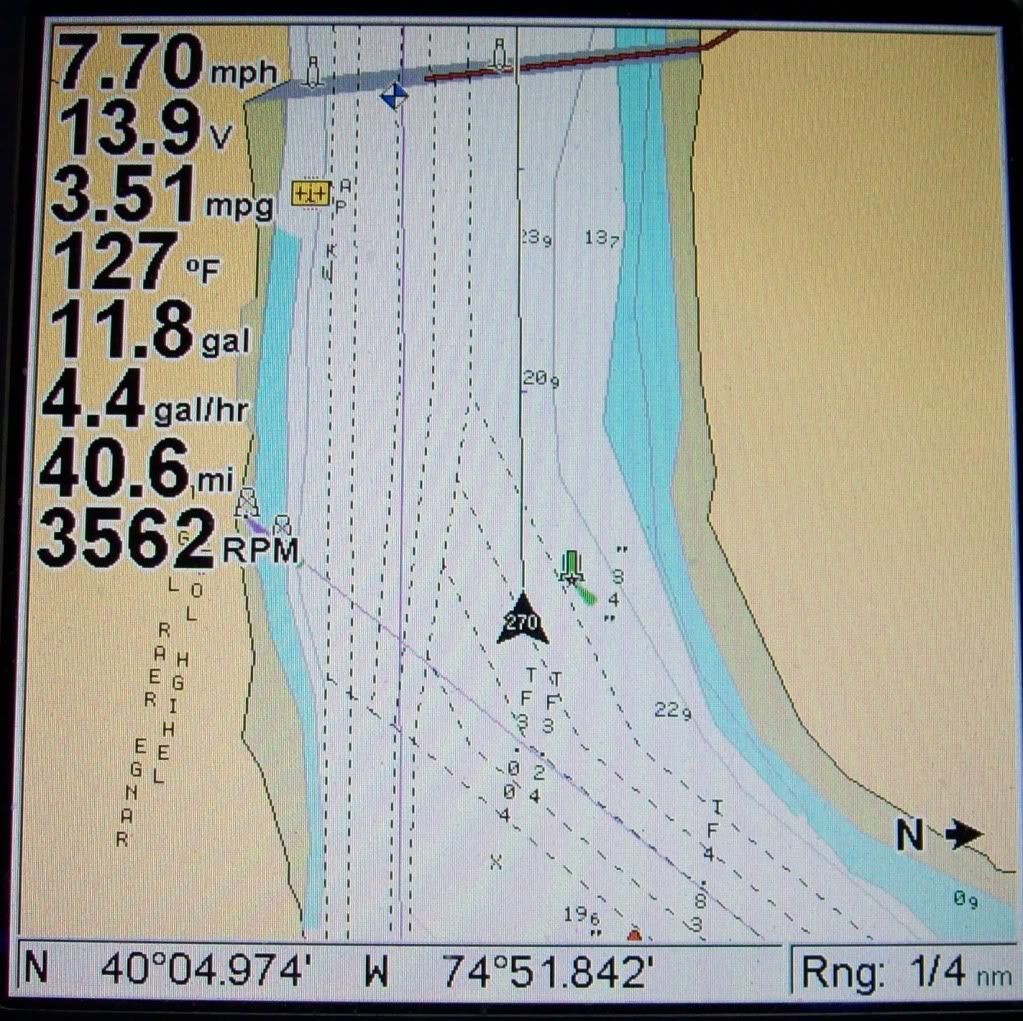
Russ, that cable is standard NMEA 2000. If your Garmin is NMEA 2000 compatible, it will work and the Garmins have all the fuel gauges. I have the same cable for my ETEC-60 and my Garmin 421s. Works perfectly and there's no setup other than connecting the cable.RussMT wrote:Matt, that is so slick. I want one.Matt19020 wrote:
I have a Garmin and I doubt it can do that. I would love to have all that data on my GPS display.
Well, there is one more selling point for the Lowrance.
--Russ
-
Boblee
- Admiral
- Posts: 1702
- Joined: Thu Aug 10, 2006 5:08 am
- Location: Berrigan, Riverina Australia boatless at present
Re: On fuel management - mpg in heavy seas
HMMM
Some great theories here but like all theories when they are put into practice there is usually a few variables not calculated and while some of the calculations may go fairly close in certain conditions the best advice is at least double your expected fuel storage but to lessen the usage I have found especially on the Mac, that keeping the revs down is the biggest help especially with the etec and four strokes (not so good with old 2 strokes).
This from Duane
This was very apparent with our new fishing boat ( 4.55 m poly) which at 2000 rpm on the 50hp mariner was only doing 8-10kph but after moving trim and ballast etc the speed jumped to 30kph and the revs also went up over 3500 as it got onto plane, altering trim made huge differences to both revs and speed (gps) without altering throttle (fuel input) where on the Mac it makes very little unless using the thruster.
Probably not as apparent on a Mac, as the Mac actually is much more efficient at low revs but not at high revs, was really surprised when this boat was actually slower than the Mac at 1500 RPM, admittedly different motor and different prop but then by getting on the plane the poly boat hits 50kph at 5400rpm and theres not much chance of the Mac doing that.
I think every situation needs to be judged seperately but it would be great to have more input regarding actual fuel use in any particular situation to be able to make decisions if the fuel level is getting a bit skinny.
Mastreb
One thing I am very interested in is the nmea 2000 cable and how to find it on the etec? as my dealer told me that option wasn't available on the smaller etecs.
Some great theories here but like all theories when they are put into practice there is usually a few variables not calculated and while some of the calculations may go fairly close in certain conditions the best advice is at least double your expected fuel storage but to lessen the usage I have found especially on the Mac, that keeping the revs down is the biggest help especially with the etec and four strokes (not so good with old 2 strokes).
This from Duane
works if conditions or drag remains constant but to highlight the innacuracy this quote shows how it is off to varying degrees also from duane talking about drag or load from the pitch of different props.It's pretty easy over time to know how much your engine consumes at a given rpm level
May be wrong with the Mac (not as apparent) but IMHO if you set your throttle and never touched it as the loads alter so will the revs and fuel consumption.Dave, you are using too high of a pitch. It's not just at high rpms that you are putting undue strain on the motor, it's at all rpms. Being able to hit the factory rpm target is a measure that you have the correct load on the prop for the motor. Not getting a high enough rpm means you have a higher load at all rpms than the motor is designed for. Not using WOT is irrelevant, your motor is overloaded at 2200 rpm as well.
This was very apparent with our new fishing boat ( 4.55 m poly) which at 2000 rpm on the 50hp mariner was only doing 8-10kph but after moving trim and ballast etc the speed jumped to 30kph and the revs also went up over 3500 as it got onto plane, altering trim made huge differences to both revs and speed (gps) without altering throttle (fuel input) where on the Mac it makes very little unless using the thruster.
Probably not as apparent on a Mac, as the Mac actually is much more efficient at low revs but not at high revs, was really surprised when this boat was actually slower than the Mac at 1500 RPM, admittedly different motor and different prop but then by getting on the plane the poly boat hits 50kph at 5400rpm and theres not much chance of the Mac doing that.
I think every situation needs to be judged seperately but it would be great to have more input regarding actual fuel use in any particular situation to be able to make decisions if the fuel level is getting a bit skinny.
Mastreb
One thing I am very interested in is the nmea 2000 cable and how to find it on the etec? as my dealer told me that option wasn't available on the smaller etecs.
-
mastreb
- Admiral
- Posts: 3927
- Joined: Wed Feb 09, 2011 9:00 am
- Sailboat: MacGregor 26M
- Location: Cardiff by the Sea, CA ETEC-60 "Luna Sea"
- Contact:
Re: On fuel management - mpg in heavy seas
For model years prior to 2008, your dealer was correct. 2008 and later BRP switched to NMEA-2000 output on their ECC for the 50 and 60. Can't say anything about engines smaller than that.Boblee wrote:One thing I am very interested in is the nmea 2000 cable and how to find it on the etec? as my dealer told me that option wasn't available on the smaller etecs.
Evinrude sold a kit called iCommand that that came with displays and all sorts of unnecessary crap for $$$$. All you need is the engine interface cable. I'm pretty sure the guy selling them on Ebay is just making them, but whatever, they're good quality and they work and they're $50. I just did a search and didn't come up with his though.
Lowrance/SIMRAD also make one you can buy online from Westmarine at this link: http://www.westmarine.com/webapp/wcs/st ... _617230_-1
If you don't already have an NMEA 2000 network you'll need to get the starter kit as well--it comes with the 12vdc battery cable, a T-Connector, a drop cable, and the two necessary end resisters. You likely won't need the 12vdc cable unless you put additional sensors that need to be bus powered on the network. Neither the chartplotter nor the engine interface should require it, although I'm not 100% certain of that.
You build the network by connecting all the T-connectors together in a line, put the two terminators on each end, then hook the 12vdc to one T tap, the Chartplotter to one T tap, and the Engine cable to one T tap. Any future devices you add to the network you just insert the T tap into the line of them and you'll be good. You can put drop cables between the T taps if you want, but you have to make sure that all your T taps form a series line that is terminated on both ends. It's pretty simple.