Brake Fluid

A forum for discussing issues relating to trailers and towing MacGregor sailboats.
User avatar
c130king
Admiral
Posts: 2730
Joined: Sun Nov 05, 2006 5:30 pm
Sailboat: MacGregor 26M
Location: Wiggins, MS --- '05 26M "König" w/ 40hp Merc
Contact:

Re: Brake Fluid

Post by c130king »

It's me again. Hoping one of you smart fella's will provide a little more guidance for me.

Here is a picture of my brakes. The metal brake line is coming in at the bottom. At the top you can see what I will call the "nipple". I presume I connect the clear tube to this. But what I am not sure is how to bleed the air out. Do I actually loose up that nipple which is threaded in? Or am I to turn the large bolt head right next to the incoming brake line?

Image

Thanks again for all the advice.

Cheers,
Jim
Sailing on König
Sailing on König YouTube Channel
User avatar
Fxwg80hd
Engineer
Posts: 134
Joined: Wed Nov 03, 2010 5:29 pm
Sailboat: MacGregor 26M
Location: Baltimore, MD

Re: Brake Fluid

Post by Fxwg80hd »

c130king wrote:It's me again. Hoping one of you smart fella's will provide a little more guidance for me.

Here is a picture of my brakes. The metal brake line is coming in at the bottom. At the top you can see what I will call the "nipple". I presume I connect the clear tube to this. But what I am not sure is how to bleed the air out. Do I actually loose up that nipple which is threaded in? Or am I to turn the large bolt head right next to the incoming brake line?
Jim - You are correct, you slip the tubing over the nipple. To bleed you loosen the nipple about a 1/2 turn or so, then crank the ratchet to compress the tongue. Tighten the nipple, then release the ratchet strap. You might have to pull the tongue back out if it does not come back ou on it's own. Warning, make sure you tighten the nipple before loosening the ratchet strap or you will suck air back. Also, make sure you start on bleeding the brakes furthest from the master cylinder. Trace the brake line to determine which side of the trailer it runs down from the master cylinder and start on the other side.

You will have to Repeat the process many times before you will see fluid come out of the nipple. Keep repeating until you see no air bubbles in the clear tube. Then start on the other side. Make sure you keep checking the fluid level in the master cylinder, you don't want it to run out or you will have to start all over again.

Chris
User avatar
1st Sail
Captain
Posts: 680
Joined: Wed Dec 31, 2008 11:58 am
Sailboat: MacGregor 26M
Location: Moline, IL '06M 50hp Etec
Contact:

Re: Brake Fluid

Post by 1st Sail »

slip the clear tube over the nipple. Make a loop in the tube so the top of the loop is above the nipple. Any bubbles will form in the tube and rise to the top of the tube arch. this will keep the air (bubble) from reentering the brake cylinder at the bleed nipple when you return the cylinder back to its rest position. You do not have to compress the tongue with a strap. Doing so you are working against the return spring and shock making more work than needed. IIRC you have an '05 trailer same as mine. Under the tongue in front of the cylinder push rod there is a small lever. Using a screw driver placed in the access hole toggle the screw driver to compress the master cylinder piston pin to pump the cylinder and thus the fluid. The UFP web site (see link in previous post) has a diagram of your master cylinder assembly. Pump the MC repeatedly until the fluid flowing from the nipple is free of air bubbles and is clear like the fluid you add to the reservoir. The MC reservoir must be slightly lower than the nipple so all air in the lines flows up hill! Otherwise air may remain trapped in the lines if you pump too slow thus not creating enough fluid flow. Once the air is out and the fluid is clear in the bleed tube (for both wheels) tighten the nipple and pump the MC and check for leaks. Note: only bleed one side at a time starting with the longest side. On mine the port side is the longest. The line T' on the starboard side above the axle just behind the wheel.

Hope this helps.
User avatar
c130king
Admiral
Posts: 2730
Joined: Sun Nov 05, 2006 5:30 pm
Sailboat: MacGregor 26M
Location: Wiggins, MS --- '05 26M "König" w/ 40hp Merc
Contact:

Re: Brake Fluid

Post by c130king »

1st Sail,

Good info thanks. I think I will give your method a try. Right now I am compressing the cylinder by backing the trailer against a brick (just 2-3"). Then setting the parking brake. Then walk to the trailer and loosen the nipple-nut (no jokes please... :wink: ). A small burst of air and old fluid will come out. Then tighten the nipple nut. Then back to the truck and pull forward against a second brick in front of the trailer tire (again just 2-3"). This will release the cylinder. Open the reservoir and top-off the fluid if necessary.

Then repeat.

Then repeat.

Then repeat.

I have done this somewhere between 40-50 times. I get a burp of fluid maybe 25% of the time. The other 75% I don't really see anything so I presume some air is coming out.

However, I am on a slight grade and the nipple is lower than the reservoir. I will try to get it lower.

In your technique I take it I loop the tube up higher than the nipple then I can leave the nipple-nut loose and just pump the cyliner multiple times until the fluid is coming out steady and clear. That sounds a little easier. Will give that a try on Tuesday. Loosening and then tightening the nut every single time is the biggest PITA...moving the truck 2-3" each time is the second biggest PITA. But it does seem to be working...just not very fast.

It is snowing this morning so I can't finish it today. Taking leave on Tuesday to finish up. Hope to take the boat out to the Chesapeake next weekend.

Thanks again.

Cheers,
Jim
Sailing on König
Sailing on König YouTube Channel
User avatar
1st Sail
Captain
Posts: 680
Joined: Wed Dec 31, 2008 11:58 am
Sailboat: MacGregor 26M
Location: Moline, IL '06M 50hp Etec
Contact:

Re: Brake Fluid

Post by 1st Sail »

I just realized I failed to post the links.
Universal Functional Products home page 'http://ufpnet.com/'
A-60 Actuator pdf link 'http://ufpnet.com/Actuators/tabid/54/Default.aspx'

Goto to the A-60 link, second pdf file (A-60, A70 & A-84 Actuator Maintenance)in list.
Pages 8 and 25 have an illustrations for using a screw driver pry bar.

Adjust hitch height so MC is slightly lower than your bleed valve nipple. Also your trailer must be level starboard to port.

Leave the nipple valve open during the whole process as air in the line will slowly migrate to the highest point.

The bleed tube loop is above the nipple with the tube end in a bottle below the nipple.
Then pump and refill.

Once you have the system bled of air and fluid is clear close the nipple valve. Wipe down all surfaces and then pump and check for leaks. You can guess how I figured that one out. I found the line leak at the BJ Block after I blead the system and replace my A60. So now I have a spare t rebuild.

Since mine leaked at the banjo block I primed the system by raising the MC above the bleed nipple and allowing fluid to syphon thru. The air remained in the lines but it reduced the pump time by patially filling the lines. Once primed I lowered the MC and started the bleed process.

Spent 2yrs at Ft. Belvoir as an instructor USAE Prime and precise power.


I did mine by myself so it as a PIA. When you hand pump le
User avatar
Catigale
Site Admin
Posts: 10421
Joined: Fri Jun 11, 2004 5:59 pm
Sailboat: MacGregor 26X
Location: Admiral .............Catigale 2002X.......Lots of Harpoon Hobie 16 Skiffs....Island 17
Contact:

Re: Brake Fluid

Post by Catigale »

Jim ...the trick is to have the bleeder valve (the nipple) cracked just enough that it releases fluid when the MC is pushed in, but not wide open enough to let air back in.

Ejected air will go up the tube and leave the system if you run the bleeder tube straight up from the valve.

I do confess that both the Admiral and the kids now know how to bleed brakes on all the cars with the two person system
User avatar
c130king
Admiral
Posts: 2730
Joined: Sun Nov 05, 2006 5:30 pm
Sailboat: MacGregor 26M
Location: Wiggins, MS --- '05 26M "König" w/ 40hp Merc
Contact:

Re: Brake Fluid

Post by c130king »

Thanks again for the tips/techniques. I am taking leave today to finish this thing off. Biggest job today is finishing the brakes. Boat goes to new marina on Sunday I think (Saturday looks cold/wet).

Jim
Paul S
Site Admin
Posts: 1672
Joined: Tue Jan 06, 2004 10:50 am
Sailboat: Other
Location: Boston, MA
Contact:

Re: Brake Fluid

Post by Paul S »

A couple tricks.. (didnt read the entire thread.so maybe someone covered it)

one person bleeding. Keep both bleeders shut.. put the screw driver in the slot.. push the screwdriver foward to actuate the Master cyl. Find some way to keep the screwdriver in that position! ( I used a crate and bungee cords.. but do what you have to do to rig it). This pressurizes the fluid/air in the line. Open the bleeder furthest from the master (starboard usually) for a moment or 2 til the air/fluid stops. repeat ..repeat..

2 person.. same deal. just the second person pumps the master and holds it.. the other person opens/closes the bleeder.

I find it helpful to not get air back, to have a clear hose going from the bleeder to a sealed container with some brake flud (old or new) in it

I actually bought a bleeder that attaches to my air compressor to suck out the fluid. It works great. bleeds in 10 seconds flat. I do always manually check it when its done..just to be on the safe side.
User avatar
kmclemore
Site Admin
Posts: 6267
Joined: Sun Feb 08, 2004 9:24 am
Sailboat: MacGregor 26X
Location: Ambler, PA -- MACX2018A898 w/ Suzuki DF60AV -- 78 BW Harpoon 4.6 -- 2018 Tahoe 550TF w/ 150 Merc

Re: Brake Fluid

Post by kmclemore »

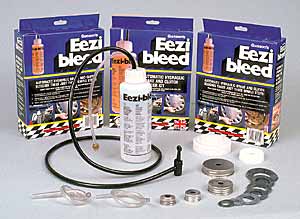
This is what I use for bleeding the brakes:

Gunson's Eezibleed
Image

The way it works is that a small amount of pressure (a car tire works nicely) is introduced into the top of the bottle, which is filled with fresh brake fluid... this forces the brake fluid into another hose which exits the bottle and goes into the top of the master cylinder... this then pushes past the master's relief valve and into the brake lines... so it's like having someone constantly pressing on the pedal. So long as you keep the Eezibleed filled with fluid, you're good to bleed. Just open each bleeder screw until it runs clear and free of bubbles and work your way around the car or trailer until all are done.

I modified a spare cap for my trailer's master cylinder so I am able to do the entire job very nicely, and single handedly. I've used this system for over 25 years on my English cars and it has always worked perfectly. It's particularly useful for systems where there can be trapped air, like in wheel cylinders that have an air pocket at the top... you can bleed the cylinder while unmounted so that it can be turned to eliminate the bubble. Other advantages of 'pressure bleeding' are that it prevents foaming, which can easily occur when pumping the brakes, and that one can bleed a 'dry' master very quickly with no priming.

The Gunson's product may be difficult to get off the shelf in the States, but Motive makes a similarly designed system that's available via Amazon and other outlets. Instead of using tire pressure, it uses a hand pump, which may be an advantage to some. At only $50 it's a good value if only for the aggro reduction.

http://www.amazon.com/Motive-Products-B ... -2-catcorr

Image

You could easily drill a hole in the standard reservoir cap for the hose fitting, and when done just plug the hole with a bolt and rubber washer.

A pressure bleeder like this makes the job so easy that regular changing of the brake fluid - which is what the manufacturer's recommend - is more likely to be done. I change my antique cars' fluid every two years and it only takes about 30 minutes per car. You should change your trailer's fluid on a similarly regular basis.
Paul S
Site Admin
Posts: 1672
Joined: Tue Jan 06, 2004 10:50 am
Sailboat: Other
Location: Boston, MA
Contact:

Re: Brake Fluid

Post by Paul S »

eezi bleed is a great system. use it on my B. a lot.

I didn't think how it could work on the mac M trailer (it is very different than the stock X , etc trailers)..how to get a good seal on the MC since there is no cap per-se, just a plug (on the stock M trailer MC).

This is why I used the vacuum bleeder instead of the eezi bleed (I own both)
User avatar
Catigale
Site Admin
Posts: 10421
Joined: Fri Jun 11, 2004 5:59 pm
Sailboat: MacGregor 26X
Location: Admiral .............Catigale 2002X.......Lots of Harpoon Hobie 16 Skiffs....Island 17
Contact:

Re: Brake Fluid

Post by Catigale »

Ditto that 2 year brake fluid replacement mantra. That will help keep water out of your system which will keep corrosion in your brakes down too.
User avatar
Hamin' X
Site Admin
Posts: 3464
Joined: Sat Aug 27, 2005 6:02 pm
Sailboat: MacGregor 26X
Location: Hermiston, OR-----------2001 26X DF-50 Suz---------------(Now Sold)
Contact:

Re: Brake Fluid

Post by Hamin' X »

Catigale wrote:Ditto that 2 year brake fluid replacement mantra. That will help keep water out of your system which will keep corrosion in your brakes down too.
Yup, brake fluid is Hygroscopic (absorbs water) by design and needs to be changed on a regular basis. A 2-3% absorption of moisture can reduce the boiling point by 50%. This is important on surge brakes, because on steep down grades, even when not using the tow beast brakes, the trailer brakes are going to be activated due to gravity and raise the temp of the brakes. If you need to do an emergency stop near the bottom of the hill, your trailer brakes may not apply, because the boiling fluid will compress and not transfer the pressure to the wheel cylinders. What is called "brake fade", is often boiling brake fluid.

Bleeding can be done solo by placing the tube in a container that contains brake fluid. When you pump the master cyl., the air comes out and draws brake fluid back in between strokes.

~Rich
Paul S
Site Admin
Posts: 1672
Joined: Tue Jan 06, 2004 10:50 am
Sailboat: Other
Location: Boston, MA
Contact:

Re: Brake Fluid

Post by Paul S »

or just wait 3-4 years and replace the brake line after the factory one (at least the M) one rots out due to it rubbing on the exit hole on the tounge :)
User avatar
kmclemore
Site Admin
Posts: 6267
Joined: Sun Feb 08, 2004 9:24 am
Sailboat: MacGregor 26X
Location: Ambler, PA -- MACX2018A898 w/ Suzuki DF60AV -- 78 BW Harpoon 4.6 -- 2018 Tahoe 550TF w/ 150 Merc

Re: Brake Fluid

Post by kmclemore »

Actually, Rich, not all brake fluid is hygroscopic. Silicone fluid is highly resistant to water absorption, and that's why I use it in all my vehicles. However, you *must* purge the system of all other fluid before installing it... the two don't mix well.

(And yes, you *can* use it in British cars with Girling or Lockheed systems, despite what others may say - I've done it for many years with great success).
User avatar
Hamin' X
Site Admin
Posts: 3464
Joined: Sat Aug 27, 2005 6:02 pm
Sailboat: MacGregor 26X
Location: Hermiston, OR-----------2001 26X DF-50 Suz---------------(Now Sold)
Contact:

Re: Brake Fluid

Post by Hamin' X »

kmclemore wrote:Actually, Rich, not all brake fluid is hygroscopic. Silicone fluid is highly resistant to water absorption, and that's why I use it in all my vehicles. However, you *must* purge the system of all other fluid before installing it... the two don't mix well.

(And yes, you *can* use it in British cars with Girling or Lockheed systems, despite what others may say - I've done it for many years with great success).
I'll deffer to your expertise in the area, sir. My familiarity ends with DOT 3 fluids of the past decade. My understanding was, that the fluid absorbed the moisture to keep it from corroding the brake parts. Mea culpa.

~Rich
Post Reply