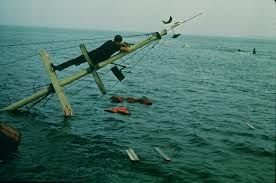
here is a picture of what I "think" I saw - but it's like a UFO sighting - your never really sure what you saw:


Reminds me of Captain Jack Sparrow riding the mast of his sinking ship into port.Crikey wrote:Yes, keep the flotation - and by the way, bring a rifle!


 .
.

While I agree with the technicality, I feel that this is misleading, because if the boat is swamped and full, then anything that floats inside the cabin WILL be wedged against the ceiling, or else the opposite..the cabin isn't full of water...is true, and not having the cabin full is actually not a bad thing in the scenario we're talking about...right? I mean, that indicates that the boat hasn't sunk... Of course, stuff could float out of the companionway and eventually leave it without the additional flotation, but that's getting a little detailed in light of the general topic.seahouse wrote:Note that any floatation located below the gunwale line has to be secured or somewhat fixed to be totally effective. Otherwise it will simply float around inside the cabin, wasting space, unless it's large enough to wedge against the ceiling.
As far as I know, the total fixed ballast in my 25 is the 650-pound iron centerboard. I imagine that a dingy rated at 600 pound safe carry capacity can probably displace much more weight than that as a floatation aid. Even partially inflated, I assume that the dingy alone could carry the centerboard and the cubic yard or two of foam floatation onboard could easily handle the boat and all my gear (keeping in mind that fiberglass displaces less than half of its dry weight in the water). But you know what happens when you ass-u-meI have no idea how any of this would translate to other Mac models, but the dingy sounds like an option I'd have on mind too, Dan. Do you know how much fixed ballast you have? In the past I've also thought about (not on my present boat of course) inflating car inner tubes inside little used, or inaccessible spaces.
. Of course, this also assumes that I would have time to inflate the thing before I was treading water, so I believe the best course of action is not to sink in the first place.if you actually were sinking I think it would be best to inflate the dingy outside the Mac, paddle, oar, or motor to shore and call the insurance company.DanInCanton wrote:I always thought that, if worse came to worse, I would inflate my dingy inside the cabin. Even only half full of air, it should provide several hundred pounds of lift to augment the foam already installed. Of course, if I was wrong about that, I've lost my life raft

I don't think it was misleading, Viz. I mentioned it applied to an M (or X which was in the OP's question), and the photo on page one of the thread shows the water level at or around the gunwale, which leaves plenty of space for things to float around inside without being wedged (or even touching in some cases) against the ceiling. But sure, it's possible the water level could go even higher than that in waves and with heavy loading, though. That may or may not apply to other models of Macs, though. No such warranty either expressed or implied!While I agree with the technicality, I feel that this is misleading...
 Seems to me they could do for short-term makeshift fenders at the dock too. I've made beer in them too– with a rubber valve in the top to stop them from exploding, but even without it they can take a lot of pressure before that happens.
 is described in the lit as resin, not concrete.
The rated capacity of the dinghy refers to it operating in non-swamped mode, so it would not offset a 650lb ballast once it was filled with water.As far as I know, the total fixed ballast in my 25 is the 650-pound iron centerboard. I imagine that a dingy rated at 600 pound safe carry capacity can probably displace much more weight than that as a floatation aid

When I was researching mine before I purchased the factory blurb said one of the differences between theCatigale wrote:The ballast on the
 and was 300 pounds of permanent ballast being a mixture or resin and sand.