

Does the Pope change his oil using Mobile One every 10,000 miles or does he wait until the storm contains lightning on election day?Catigale wrote:lightning has been added to the classic list of popcorn threads: oil viscosity, oil change intervals, sex, politics religion ...
The actual odds of being hit by lightning
-
Russ

- Admiral
- Posts: 8299
- Joined: Thu Oct 11, 2007 12:01 pm
- Sailboat: MacGregor 26M
- Location: Bozeman, Montana "Luna Azul" 2008 M 70hp Suzi
Re: The actual odds of being hit by lightning
-
Herschel

- Admiral
- Posts: 1487
- Joined: Wed Sep 28, 2005 4:22 pm
- Sailboat: MacGregor 26X
- Location: Orlando, Florida
- Contact:
Re: The actual odds of being hit by lightning
More follow up on this issue for those that are interested in the new lightning app. (Not sure what some of the other guys are drinking, but all that aside for now.)think that the app only reports ground strikes, so perhaps what you were hearing was cloud-to-cloud lightning? Don't know about recency, as I have not had a thunderstorm since I installed it.
and
While not an exclusive source of real-time strike data, aircraft (even smaller ones can be) are equipped with lightning detection equipment that is self-contained within the plane, so they can more easily navigate around it.
 I watched the phone display pretty closely this afternoon for the better part of an hour as Central Florida got its daily set of thunderstorms.This is what I learned. The colorized radar images are like other apps with time lapsed images with how long ago each image was originated given at the top. To some extent you can set up the amount of time you want to be displayed during these images by going to the layering menu. The lightning "bolt" symbols that report actual strikes, are superimposed on the radar images, but are not tied to them. They appear to be in real time and stay on the screen for about 3 minutes. You can touch each "bolt" and it will tell you if it was 1 or 2 minutes ago that the strike occurred. The confusing aspect is that the bolts might not show up when you open the app. If you hear thunder somewhere, and the screen map shows all clear, you can zoom out the display about 3-4 times and the "bolts" will all pop up. Then you can zoom in to the level of detail you want and the "bolts" will stay on the screen. I think the next test needs to be underway to see if the app actually tells you anything you can surmise from just looking at the sky. Not sure how soon I'll get to that part, so I'll turn the thread back to the guys speculating on "divinely inspired oil changes" and such!
-
walt
- First Officer
- Posts: 209
- Joined: Mon Feb 05, 2007 9:05 am
- Location: Colorado "Sea Eagle" 1990 26S
Re: The actual odds of being hit by lightning
I don’t post to this forum very often – but enjoy reading it every once in a while, great bunch of folks The big motor aspect of the power sailors doesn’t appeal to me at the moment but probably does allow you to reduce your odds of a strike. However, as I get older with retirement on the horizen, the RV and camping aspect of the power sailors does appeal to me, For my particular needs, think these would make good retirement boats. I’ve owned a Mac 26S for many years now and it’s kept me safe in some wild conditions, and think Macgregor did a good job on the design and build.
But.. seems the only time I post over here is to argue with a couple guys about lightning.. been going on for years, my apologies.. FYI, I respect these guys and they are very valuable contributors here but we sure disagree about lightning.
One thing to point out is that the only way to know if something like grounding your mast or not makes a difference is a controlled experiment. This is likely just not a big enough problem for anyone to spend the money on to do right. The insurance companies would be the closest to being able to do this but its complicated enough that you may not even be able to trust their numbers (for example well grounded boats might get lumped with poorly grounded boats and a poorly grounded boat may behave more like an ungrounded boat).
I do agree with one piece of advice usually given here – if you do nothing to your boat, it wont matter all that much. But if you want to hang jumper cables over the side, go for it. There is no evidence that it will increase your chances of a strike and it may even reduce damage, I really don’t know. The one clear thing is that if your in the water near your boat (such as getting off the boat when its beached), that likely is a dangerous thing to do.
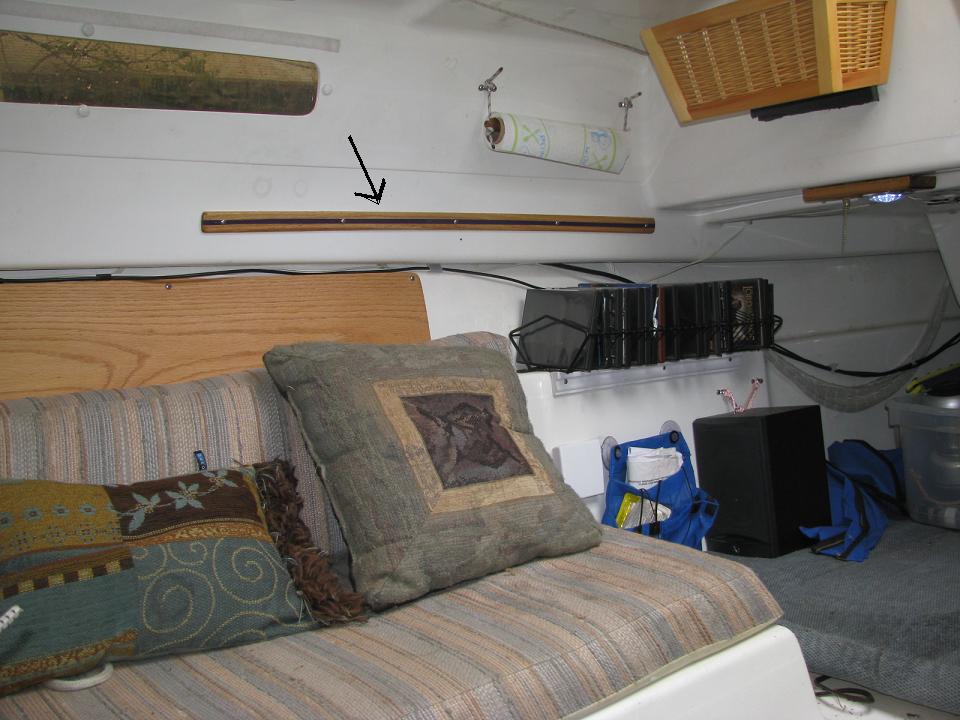
I used to sail my 26S on a mountain lake in Colorado that often had lightning. When a storm came in, I would get stuck out of the lake because all the power boats would get to the dock first (which I am OK with since I think the shore on a fresh water lake may be more dangerous than out on the water). I would sometimes have guests or family with me that I would want to go to the cabin and stay away from the bottom of the mast, chain plates, etc. Rather than try and explain where all this was, I just put up a wood strip with a purple stripe on it shown in the picture. When things got wild and I was trying to keep the boat in control, I could just tell the family or guest to go below and sit under the strip with the purple stripe on it – as I had already picked out what I thought was the safest place in the cabin beforehand.
But.. seems the only time I post over here is to argue with a couple guys about lightning.. been going on for years, my apologies.. FYI, I respect these guys and they are very valuable contributors here but we sure disagree about lightning.
The first part - "your mast is a tiny ripple" .. absolutely agree with. However, this second part is in my opinion way off. The first sentence would even imply that if you don’t “ground” (whatever that means on a trailer sailor), the charge leaders from the ground never come from you mast. I think this is completely false and was why I was asking what information there was to back this up. There is no theory or stats that I know of to back this up and actually a lot of evidence that leaders do still form on an ungrounded mast.One thing about the mast..
From your perspective in the cockpit, your 25 foot compensator looks like a huge target. From the perspective of the charge cloud at 20000 feet in the sky, your mast is a tiny ripple on the huge capacitance plane of the earth.
If you don't make a half-baked attempt to ground your mast, the charge leaders from the ground never come from your mast and you lessen the chance of bring struck. Dangling jumper cords or chain ups your odds in the inverse-Darwin lottery, in the wrong, undesirable way.
One thing to point out is that the only way to know if something like grounding your mast or not makes a difference is a controlled experiment. This is likely just not a big enough problem for anyone to spend the money on to do right. The insurance companies would be the closest to being able to do this but its complicated enough that you may not even be able to trust their numbers (for example well grounded boats might get lumped with poorly grounded boats and a poorly grounded boat may behave more like an ungrounded boat).
I do agree with one piece of advice usually given here – if you do nothing to your boat, it wont matter all that much. But if you want to hang jumper cables over the side, go for it. There is no evidence that it will increase your chances of a strike and it may even reduce damage, I really don’t know. The one clear thing is that if your in the water near your boat (such as getting off the boat when its beached), that likely is a dangerous thing to do.
I used to sail my 26S on a mountain lake in Colorado that often had lightning. When a storm came in, I would get stuck out of the lake because all the power boats would get to the dock first (which I am OK with since I think the shore on a fresh water lake may be more dangerous than out on the water). I would sometimes have guests or family with me that I would want to go to the cabin and stay away from the bottom of the mast, chain plates, etc. Rather than try and explain where all this was, I just put up a wood strip with a purple stripe on it shown in the picture. When things got wild and I was trying to keep the boat in control, I could just tell the family or guest to go below and sit under the strip with the purple stripe on it – as I had already picked out what I thought was the safest place in the cabin beforehand.
Last edited by walt on Fri Aug 08, 2014 7:35 am, edited 1 time in total.
-
RobertB

- Admiral
- Posts: 1863
- Joined: Sun Jun 05, 2011 7:42 pm
- Sailboat: MacGregor 26M
- Location: Clarksville, MD
Re: The actual odds of being hit by lightning
That is awesome. I knew I was missing something - I must get a purple strip 
-
Ixneigh

- Admiral
- Posts: 2462
- Joined: Thu Sep 09, 2010 11:00 am
- Sailboat: MacGregor 26M
- Location: Key largo Florida
Re: The actual odds of being hit by lightning
I like the purple stripe idea. I think we should all install one. Where on the M model should it go?
Ix
Ix
-
Hamin' X

- Site Admin
- Posts: 3464
- Joined: Sat Aug 27, 2005 6:02 pm
- Sailboat: MacGregor 26X
- Location: Hermiston, OR-----------2001 26X DF-50 Suz---------------(Now Sold)
- Contact:
Re: The actual odds of being hit by lightning
He hasn't been hit by lightning since he installed the purple strip! Must be working.
~Rich
~Rich
-
walt
- First Officer
- Posts: 209
- Joined: Mon Feb 05, 2007 9:05 am
- Location: Colorado "Sea Eagle" 1990 26S
Re: The actual odds of being hit by lightning
Maybe there is a faster color also.. (wife likes purple..)-
Catigale

- Site Admin
- Posts: 10421
- Joined: Fri Jun 11, 2004 5:59 pm
- Sailboat: MacGregor 26X
- Location: Admiral .............Catigale 2002X.......Lots of Harpoon Hobie 16 Skiffs....Island 17
- Contact:
Re: The actual odds of being hit by lightning
And Purple is the color of the Papacy....just saying.....
-
Herschel
- Admiral
- Posts: 1487
- Joined: Wed Sep 28, 2005 4:22 pm
- Sailboat: MacGregor 26X
- Location: Orlando, Florida
- Contact:
Re: The actual odds of being hit by lightning
Had a chance to go out to the boat today and "test" the new app that shows the lightning strikes. Bottom line: I found it useful. I think it adds helpful info that radar images alone don't give you. It did influence my decision not to go out for a brief trip to the fuel dock at my marina. In the past, I would have looked at the same cloud formation and said, "I can make it over and back before it gets nasty". Because that is exactly what I had intended to do.This time I looked at the app display first, and the two little lightening strike symbols about 4 miles away indicated that there was already lightning activity even though I had not seen or heard any. I stayed at the slip, finished cleaning up, and went home. As I left the parking lot, it turned very ugly. Good call! So, for what it is worth, especially for new sailors just dealing with the issue of lightning, or folks coming into the Central Florida area to sail, I thought I would list my protocol that I have developed that seems to work for me.
1. Since our lightening events are mostly seasonal (summer), I plan my boating mostly in the fall, winter,and spring.
2. Regardless of the season, I tend to not go out when the probability of thunderstorms is more than 30%.
3. On days when I want to go out and thunderstorms are predicted (usually the afternoons), I make a point to go out earlier in the day or later around sunset after the thunder storms are expected to be over, but that actually rarely occurs with as much clarity as I would like, so it does not happen often.
4. I do refer to my phone weather app for hourly predictions (although they can be really off), radar imaging, and now, lightning strike info.
5. If trying to transit from point to point, I will no longer make a rigid sail plan and try to stick to a schedule, electing to stay in port until the weather clears.
6. If caught out in a thunderstorm, and out running it with the engine isn't feasible, my plan (it has been a long time since this happened) is to avoid a beaching scenario and, at the same time, try to avoid holding onto the wheel and just "hope for the best". I would hopefully find refuge at a nearby dock or drop the anchor in a protected cove and get to the safest place in the boat I could. I like the idea of identifying that ahead of time and coaching the passengers where that is in advance. For my 26X, given the distribution of metal and wiring, I think it would be the aft dinette area forward of the head.
7. I will put a purple strip in that spot as soon as I can!
1. Since our lightening events are mostly seasonal (summer), I plan my boating mostly in the fall, winter,and spring.
2. Regardless of the season, I tend to not go out when the probability of thunderstorms is more than 30%.
3. On days when I want to go out and thunderstorms are predicted (usually the afternoons), I make a point to go out earlier in the day or later around sunset after the thunder storms are expected to be over, but that actually rarely occurs with as much clarity as I would like, so it does not happen often.
4. I do refer to my phone weather app for hourly predictions (although they can be really off), radar imaging, and now, lightning strike info.
5. If trying to transit from point to point, I will no longer make a rigid sail plan and try to stick to a schedule, electing to stay in port until the weather clears.
6. If caught out in a thunderstorm, and out running it with the engine isn't feasible, my plan (it has been a long time since this happened) is to avoid a beaching scenario and, at the same time, try to avoid holding onto the wheel and just "hope for the best". I would hopefully find refuge at a nearby dock or drop the anchor in a protected cove and get to the safest place in the boat I could. I like the idea of identifying that ahead of time and coaching the passengers where that is in advance. For my 26X, given the distribution of metal and wiring, I think it would be the aft dinette area forward of the head.
7. I will put a purple strip in that spot as soon as I can!
-
drams_1999
- Chief Steward
- Posts: 95
- Joined: Wed Oct 21, 2009 7:04 pm
- Sailboat: MacGregor 26M
- Location: S/V Aquarius Miami, FL
Re: The actual odds of being hit by lightning
Looks like Herschel and I both have similar approaches to dealing with lightning in Florida. I'm waiting another month until I start my next season.
Interesting idea, having a "safe zone" below deck to minimize risk if caught out there.
I think the best place in the "M" seems to be all the way forward in the forepeak. Since the mast is aft of the head and there isn't really anything mechanical or electrical up forward. On my "M" most of the equipment (batteries, wiring, steering hardware, motor, linkages, etc. are aft and very near the dinnette. On my boat the only stuff forward of the head is the water pump and the bow light wiring. Also, in the event of rigging failure, the mast would probably fall in any of the other 3 directions, but not forward. Seems to me that forward is about as safe as can be given the circumstances.
Anyone else with an M have thoughts on this?
Interesting idea, having a "safe zone" below deck to minimize risk if caught out there.
I think the best place in the "M" seems to be all the way forward in the forepeak. Since the mast is aft of the head and there isn't really anything mechanical or electrical up forward. On my "M" most of the equipment (batteries, wiring, steering hardware, motor, linkages, etc. are aft and very near the dinnette. On my boat the only stuff forward of the head is the water pump and the bow light wiring. Also, in the event of rigging failure, the mast would probably fall in any of the other 3 directions, but not forward. Seems to me that forward is about as safe as can be given the circumstances.
Anyone else with an M have thoughts on this?
-
Phil M

- Captain
- Posts: 807
- Joined: Sun Jun 08, 2008 9:29 am
- Sailboat: Other
- Location: 44' Jeanneau, Saskatoon, SK, Canada
Re: The actual odds of being hit by lightning
If your forestay is least likely to fail, and prevent a mast from falling aft, then yes, a mast would fall forward.  It depends on your assumptions.
It depends on your assumptions.-
mastreb

- Admiral
- Posts: 3927
- Joined: Wed Feb 09, 2011 9:00 am
- Sailboat: MacGregor 26M
- Location: Cardiff by the Sea, CA ETEC-60 "Luna Sea"
- Contact:
Re: The actual odds of being hit by lightning
Having had a rigging failure, I can tell you that even with serious rolling, if the forestay does not fail, the mast won't fall in calm seas. It flops around scarily while you're loose side stays flop, but it's not actually going to go anywhere unless you're in rough seas, in which case the foot will eventually fail or the mast will tear away from the foot, in which case it will fall offboard to port or starboard. Sidestay failure is a much safer failure mode than forestay failure, where the whole thing comes crashing down into the cockpit immediately.
My mast exhibited tears in the aluminum at the mast foot due to this flogging, but stayed up for the five minutes it took to get to a dock and remove it.
Having experienced just about every way that rigging can fail, I don't see any way it would fall forward unless it was being forced forward.
My mast exhibited tears in the aluminum at the mast foot due to this flogging, but stayed up for the five minutes it took to get to a dock and remove it.
Having experienced just about every way that rigging can fail, I don't see any way it would fall forward unless it was being forced forward.
-
Ixneigh
- Admiral
- Posts: 2462
- Joined: Thu Sep 09, 2010 11:00 am
- Sailboat: MacGregor 26M
- Location: Key largo Florida
Re: The actual odds of being hit by lightning
Do you think the mast would poke down through the deck? I figured it would hit the bowrail first.
From the one time my v 22 was struck, you dont want to be anywhere near the mast base. The battery was not affected.??
Ix
From the one time my v 22 was struck, you dont want to be anywhere near the mast base. The battery was not affected.??
Ix
-
Ixneigh
- Admiral
- Posts: 2462
- Joined: Thu Sep 09, 2010 11:00 am
- Sailboat: MacGregor 26M
- Location: Key largo Florida
Re: The actual odds of being hit by lightning
This happened right near by, where I sail often.
A sonar scan may have detected the sunken boat belonging to Noah Cullen, the young Key Largo man who went missing early last week while on a freediving trip off the Upper Keys.
A civilian boat crew using sonar equipment scanned the bottom of Dixie Shoal Saturday and detected a 25- to 30-foot object that they said could be Cullen’s 28-foot sailboat, Jubilee.
The problem, Cullen’s mother Tanya Cleary said, is that the object lies at the bottom of more than 280 feet of water. That is far beyond recreational diving limits, and reaching it would require divers to use specialized equipment.
Jon Strydom, a family friend and experienced sailor who was among the crew that detected the object, is appealing for help from any area technical divers and to anyone with access to a camera capable of operating in water up to 300 feet deep.
Strydon stressed on his Facebook page, however, that the sonar "hit" could be anything, and it does not confirm Cullen's vessel has been found. That said, Strydon, who has circumnavigated the globe by boat and took part in numerous salvage operations, thinks Cullen went down with his boat.
The search took place on Gordon Cottrell’s boat. He owns Cottrell’s Welding in Key Largo. Also on board were Matt Cottrell and Chad Azevedo.
The object they detected was located about 80 yards from the last coordinates where Cullen’s boat was spotted — and photographed — sinking by a passing fishing boat at Dixie Shoal at about 2:30 p.m. Aug. 4. The sonar scan showed a mostly barren ocean bottom, with the exception of the object.
“There has been no confirmation that this is Noah’s vessel, but based on the size and location, it looks promising,” Cleary said Monday.
Cullen was last seen on Aug. 4 boarding the Jubilee at French Reef by a dive boat captain in another vessel around noon.
His boat was last spotted sinking at Dixie Shoal (GPS coordinates 2503.81208015.054w) about two hours later.
A photo of the sinking Jubilee taken by the passing boater appears to show it battened down from the outside.
Strydon theorizes that Cullen went inside the Jubilee during a heavy thunderstorm that passed off Key Largo that day. Whether because of a lightning strike or for some other reason, Cullen may not have been able to get off of the sinking vessel.
“The theory now is that Noah did everything by the book for his vessel in the face of a very violent and fast-moving storm," Strydon said in a Facebook post. "Main is double-reefed, jib is stowed, tiller lashed over to hove-to. Having no bimini, just a small dodger, he would have gone below and battened down to shelter from very heavy wind-blown rain and a high concentration of lightning strikes. A direct hit thru the mast would have instantly ended his young life and also holed the hull.”
The Coast Guard ended its search for Cullen and his boat on Thursday. Cleary thanked all involved in the search.
“Our family is so very grateful for the outpouring of support from the community, and all the volunteers who have searched, offered equipment and expertise in the effort to locate Noah,” Cleary said. “We’re also very thankful to the Coast Guard, who performed an aggressive 90 hour search for him last week.”
A sonar scan may have detected the sunken boat belonging to Noah Cullen, the young Key Largo man who went missing early last week while on a freediving trip off the Upper Keys.
A civilian boat crew using sonar equipment scanned the bottom of Dixie Shoal Saturday and detected a 25- to 30-foot object that they said could be Cullen’s 28-foot sailboat, Jubilee.
The problem, Cullen’s mother Tanya Cleary said, is that the object lies at the bottom of more than 280 feet of water. That is far beyond recreational diving limits, and reaching it would require divers to use specialized equipment.
Jon Strydom, a family friend and experienced sailor who was among the crew that detected the object, is appealing for help from any area technical divers and to anyone with access to a camera capable of operating in water up to 300 feet deep.
Strydon stressed on his Facebook page, however, that the sonar "hit" could be anything, and it does not confirm Cullen's vessel has been found. That said, Strydon, who has circumnavigated the globe by boat and took part in numerous salvage operations, thinks Cullen went down with his boat.
The search took place on Gordon Cottrell’s boat. He owns Cottrell’s Welding in Key Largo. Also on board were Matt Cottrell and Chad Azevedo.
The object they detected was located about 80 yards from the last coordinates where Cullen’s boat was spotted — and photographed — sinking by a passing fishing boat at Dixie Shoal at about 2:30 p.m. Aug. 4. The sonar scan showed a mostly barren ocean bottom, with the exception of the object.
“There has been no confirmation that this is Noah’s vessel, but based on the size and location, it looks promising,” Cleary said Monday.
Cullen was last seen on Aug. 4 boarding the Jubilee at French Reef by a dive boat captain in another vessel around noon.
His boat was last spotted sinking at Dixie Shoal (GPS coordinates 2503.81208015.054w) about two hours later.
A photo of the sinking Jubilee taken by the passing boater appears to show it battened down from the outside.
Strydon theorizes that Cullen went inside the Jubilee during a heavy thunderstorm that passed off Key Largo that day. Whether because of a lightning strike or for some other reason, Cullen may not have been able to get off of the sinking vessel.
“The theory now is that Noah did everything by the book for his vessel in the face of a very violent and fast-moving storm," Strydon said in a Facebook post. "Main is double-reefed, jib is stowed, tiller lashed over to hove-to. Having no bimini, just a small dodger, he would have gone below and battened down to shelter from very heavy wind-blown rain and a high concentration of lightning strikes. A direct hit thru the mast would have instantly ended his young life and also holed the hull.”
The Coast Guard ended its search for Cullen and his boat on Thursday. Cleary thanked all involved in the search.
“Our family is so very grateful for the outpouring of support from the community, and all the volunteers who have searched, offered equipment and expertise in the effort to locate Noah,” Cleary said. “We’re also very thankful to the Coast Guard, who performed an aggressive 90 hour search for him last week.”
-
Catigale
- Site Admin
- Posts: 10421
- Joined: Fri Jun 11, 2004 5:59 pm
- Sailboat: MacGregor 26X
- Location: Admiral .............Catigale 2002X.......Lots of Harpoon Hobie 16 Skiffs....Island 17
- Contact:
Re: The actual odds of being hit by lightning
That statement is purely speculative and not very appropriate at this point.A direct hit thru the mast would have instantly ended his young life and also holed the hull.”