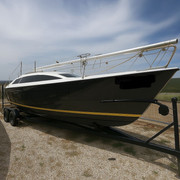
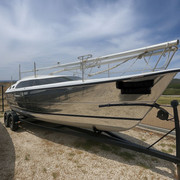
That would be interesting approach… sorta like a magician’s mirror trick…a disappearing MacGregor!
If one’s objective is reducing solar heat load I be making the top deck a mirror before the hull as it gets the higher solar exposure.
It would look like a sparkling gem! A real stand out to be sure!
I’d have reservations about doing it though as the maintenance/upkeep would be a major PITA as Russ an NiceAft already pointed out.
Another aspect is with the application of shiny wraps is that EVERY flaw gets amplified!
The prep work and application of wraps has to be perfect to make it work… not cheap… lots of work


This is generally why the GoTo color for fiberglass boats has been white.
It minimizes the heat load, hides the potential flaws, tend to clean up well, tends to age well ….
There is another aspect I’ve personally dealt with professionally with dealing with solar heat loading of equipment and structures.
Starting with fresh shiny polished aluminum level sheet with an enclosed base I rigged up a contact thermometer to the back face.
This set up was repeated for a dull etched exposed surface, a shiny white painted surface, a matte white painted surface, a shiny black painted surface and a matte black painted surface. All the examples were of identical dimensions and orientations. The data was auto logged.
The result was that the matte white painted surface had the consistently lowest recorded temperatures over several weeks.
The highest consistently recorded temperatures were in descending order was the polished shiny surface, the shiny black, the matt black, the etched aluminum and then the shiny white.
(This high temp position for the polished aluminum surface sorta matches the experience of anyone who remembers inadvertently leaning on cars with chrome bumpers in the summertime ….


Ouch!)

There is a bit of logic behind this in that the matt white has a higher refractive dissipative characteristic.
Now this was done with Rustoleum spray paints so other paint formulas may have potentially different chemistry and potentially different results… but I’m pretty sure the results would be similar.
Now add in the aspect that our boats have ceramic gelcoat which has its own inherent thermal barrier aspects over that of spray paints…. Which would actually make it a better thermal barrier than paint.
Remember that aside from anything else this is Your boat. Your rules apply.
There are seldom only one best solution…
Best Regards,
Over Easy


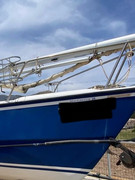


 . The only things I come up with is that will possibly reduce heat build up below deck, (a blue