

I have a 1996 mac 26x which I fitted a Yamaha 40 HP Enduro outboard last year. These are rough commercial engines only available in Asia, Africa and parts of Australia. It was cheap (about $2200 US), has 2 cylinders, only one carb, pre-mix @ 50:1, manual lift and no regulator.
I motored from Malaysia, past Langkawi and onto the South tip of Thailand (about 500 NM round trip) and found the battery voltage went off the scale.....upwards of 25v. My sport pilot packed up and although it was replaced under warranty I wondered if the excessive voltage contrubuted to its demise.
The question I have is:- Is it ok to isolate the batteries when they are fully charged to keep them from being damaged by overcharging and keep the voltage on my boat to normal levels or will this wreck the alternator? I know disconnecting the battery while running can wreck a regulator but I don't have one.
Other than that the motor performed perfectly, can be hand started easily and repaired by any outboard mechanic who can use a shifter.
Just one other problem on my trip, the centre ballast valve snapped off in heavy weather and I didn't notice until there was water sloshing around in my boat. Fixed it by going underneath when we got to port by hammering some wooden dowels in to the 2 holes but has this happened to anyone else? I am sealing it off permanently now as I only go to sea with the ballast tank full.
Yamah enduro 40 HP outboard alternator with no regulator
-
Don T

- Admiral
- Posts: 1084
- Joined: Fri Jan 02, 2004 7:13 pm
- Sailboat: MacGregor 26X
- Location: 95 2600 "SS OTTER" - Portland OR - Tohatsu 50 - Hull#64 (May 95)
Hello,
My advice would be to install a regulator. You could use a standard sealed automotive solid state unit or even a small sealed unit off of a motorcycle. If you are electronically inclined, a simple regulator with a 3055 transistor and 15v zener will be cheap and easy to build. The manufacturer may supply a regulator for another model that will fit.
I think the general idea is that the alternator doesn't put out enough current to overcharge a battery in good condition. Check your battery. If you are using more than one battery, make sure they are connected in parrallel and not in series.
Most of the electronics on board can survive 18v ~ 20v but 25v will most likely do them in. Some units have overvoltage protection that shorts excess voltage and current blowing the fuse.
good luck
My advice would be to install a regulator. You could use a standard sealed automotive solid state unit or even a small sealed unit off of a motorcycle. If you are electronically inclined, a simple regulator with a 3055 transistor and 15v zener will be cheap and easy to build. The manufacturer may supply a regulator for another model that will fit.
I think the general idea is that the alternator doesn't put out enough current to overcharge a battery in good condition. Check your battery. If you are using more than one battery, make sure they are connected in parrallel and not in series.
Most of the electronics on board can survive 18v ~ 20v but 25v will most likely do them in. Some units have overvoltage protection that shorts excess voltage and current blowing the fuse.
good luck
-
Frank C
I've read of other early models having the center ballast valve (hull bottom) sealed shut. I'm sure you're not referring to sealing the interior vent though? You need some way to exhaust air while filling the tank. Also, the air vent provides some pressure relief when the tank is compressed by slamming in heavy seas. You need to prevent pure hydraulic hammering of the liquid ballast.
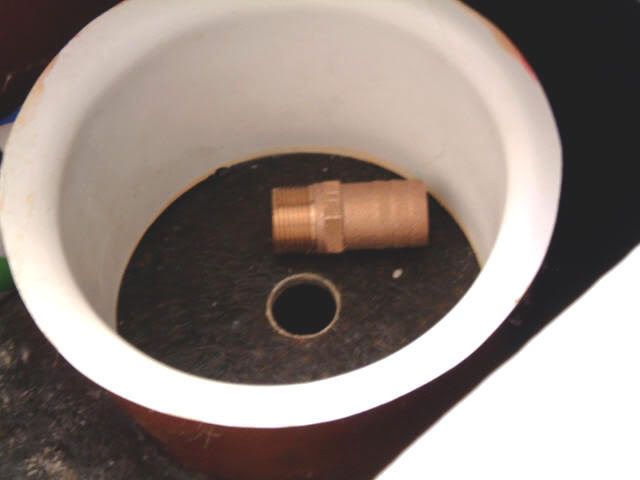
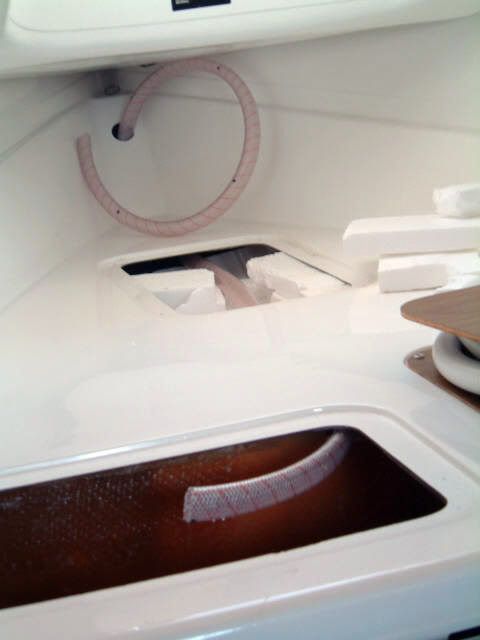
A good solution for this impact problem is to plumb a vent hose into the ballast tank and lead it high above the waterline. My vent hose (pictured below) is plumbed:
(#1) from the top of the forward ballast tank,
(#2) through the vberth flotation chamber,
(#3) and up to the thru-hull drain for the anchor locker.
This means the ballast tank is permanently open to atmosphere, and it shunts any ballast odors outside the cabin. (Since you always leave the ballast tank full, I hope you've added a quart of household bleach to that tank~!)

A good solution for this impact problem is to plumb a vent hose into the ballast tank and lead it high above the waterline. My vent hose (pictured below) is plumbed:
(#1) from the top of the forward ballast tank,
(#2) through the vberth flotation chamber,
(#3) and up to the thru-hull drain for the anchor locker.
This means the ballast tank is permanently open to atmosphere, and it shunts any ballast odors outside the cabin. (Since you always leave the ballast tank full, I hope you've added a quart of household bleach to that tank~!)