


Mark,
Did you inspect the top of the furler luff fitting? The opening section where the wire fits through the furler's luff. Perhaps some sharp edges there, etc? Can't think of anything else. This is really an odd rig failure based on the descriptions.
Dismasted Under Sail! Hate it when that happens . . . .
-
Frank C
As I observe the factory loops on my lifelines, where they "tried" to make loops as small as possible ... it causes the wire braid to untwist and flatten out. I'm sure that's not good for strength or wear patterns.
It appears that Mark's forestay top loop was rather "longer" than necessary. It seems that would enable the wire to "work" when slackened for trailering, though seems not an issue for tension -- JMHO. It seems also apparent from Mark's narrative that these individual wires broke sequentially, rather than catastrophically. The inference is that some individual wires might well have parted before mast raising, therefore evident upon pre-flight.
This much is certain. Based upon Mark's story, I will make it a new procedure ... immediately upon "feeling or hearing" any major rigging sounds ... to drop canvas and make inspections, or head-in.
Finally, FWIW, some of our earlier discussed "fail-safe" backups to the forestay "would have failed" in Mark's case. Only a separate 'inner stay' or one of the 'halyards to pulpit' would have kept his mast up.
It appears that Mark's forestay top loop was rather "longer" than necessary. It seems that would enable the wire to "work" when slackened for trailering, though seems not an issue for tension -- JMHO. It seems also apparent from Mark's narrative that these individual wires broke sequentially, rather than catastrophically. The inference is that some individual wires might well have parted before mast raising, therefore evident upon pre-flight.
This much is certain. Based upon Mark's story, I will make it a new procedure ... immediately upon "feeling or hearing" any major rigging sounds ... to drop canvas and make inspections, or head-in.
Finally, FWIW, some of our earlier discussed "fail-safe" backups to the forestay "would have failed" in Mark's case. Only a separate 'inner stay' or one of the 'halyards to pulpit' would have kept his mast up.
-
Lease

- First Officer
- Posts: 290
- Joined: Thu Nov 17, 2005 3:07 pm
- Location: Canberra Oz; 1995 26X "MACMAC" Tohatsu 50
Amazing how riggers have different views on what is 'safe'.
The only rig failure I ever had was a compressed terminal end that had cracked, so that aint necessarily the answer either. I find the stock swaging more than acceptable.
I actually replaced my forestay before last summer as it had broken a couple of strands. When I pulled the foil off they had unwound and were very messy in there. Right now, I'm trialling 'U-Bolt' type swages to see how they go. No probs so far.
Just a point about that wire in the picture. Is it right? Very hard to tell, but that tight winding kind of looks like 7x19 flex, rather than the 1x19 non flex that should be used in this application.
The only rig failure I ever had was a compressed terminal end that had cracked, so that aint necessarily the answer either. I find the stock swaging more than acceptable.
I actually replaced my forestay before last summer as it had broken a couple of strands. When I pulled the foil off they had unwound and were very messy in there. Right now, I'm trialling 'U-Bolt' type swages to see how they go. No probs so far.
Just a point about that wire in the picture. Is it right? Very hard to tell, but that tight winding kind of looks like 7x19 flex, rather than the 1x19 non flex that should be used in this application.
-
Matt19020

- Captain
- Posts: 576
- Joined: Sat Jul 15, 2006 1:29 pm
- Sailboat: MacGregor 26M
- Location: Middle River, Chesapeake Bay MD...2007 MacM Suzuki DF70 4-Stroke ..... "My Time"
- Contact:
As Gerald has done... I also have installed a second forestay.
We lost the clevis pin due to a faulty design or failure of pin when
we were under power. I NEVER want to expierience this again especially under sail. No one was hurt with my expierience. I am glad no one was hurt with your situation Since installing the second forestay I feel a little more secure about the rig....
We lost the clevis pin due to a faulty design or failure of pin when
we were under power. I NEVER want to expierience this again especially under sail. No one was hurt with my expierience. I am glad no one was hurt with your situation Since installing the second forestay I feel a little more secure about the rig....
-
James V
- Admiral
- Posts: 1705
- Joined: Sat Jan 22, 2005 9:33 am
- Sailboat: MacGregor 26M
- Location: Key West, Fl USA, 26M 06, Merc 50hp BF "LYNX"
This is only guessing so please if my words are unkind it is just for discussion.
Was the forstay loose? With no backstay, the bucking will cause the mast to move back and forth with the wave motion which creates execssive loads. Running backstays might help. How does one check the tension of the forstay with the roller fuller attached? What is correct?
Is it possible to over tighten the forstay? Could the roller fuller do it?
Older damage? Did the mast hit something like a bridge?
It is possible to over press the fitting but I doubt that this could have been done with these fittings.
Corrision? Other than salt, birds, chemicals, etc .....
I find it hard to believe that by trailering the boat would cause the wire to break. It is very strong.
When last inspected, how did it look?
When was the last inspection?
Was the forstay loose? With no backstay, the bucking will cause the mast to move back and forth with the wave motion which creates execssive loads. Running backstays might help. How does one check the tension of the forstay with the roller fuller attached? What is correct?
Is it possible to over tighten the forstay? Could the roller fuller do it?
Older damage? Did the mast hit something like a bridge?
It is possible to over press the fitting but I doubt that this could have been done with these fittings.
Corrision? Other than salt, birds, chemicals, etc .....
I find it hard to believe that by trailering the boat would cause the wire to break. It is very strong.
When last inspected, how did it look?
When was the last inspection?
-
Mark Karagianis

- Engineer
- Posts: 184
- Joined: Fri Oct 07, 2005 1:29 pm
- Location: Still trailering from Northridge, CA to MDR. 2005 M Suzuki DF50 "Definite Addiction"
Thanks to all for your sincere concerns and comments. I hope that something can be learned from this so that this situation won't happen again. Let me clear up some of the questions:
No loose rigging.
Rigging wasn't too tight either.
No accidents.
No corrosion.
Boat never left with rigging up, except a couple of overnights.
Boat always stored in Northridge, 32 miles from the Pacific, where it is hot and dry.
No sharp edges on the top of the roller-furler.
Rigging inspected every time I raise the mast!
I think that the whole side that is broken broke at once, and it took several minutes, maybe 10 minutes for the loop to come out. Frank, I'm pretty sure that the individual wires didn't break gradually.
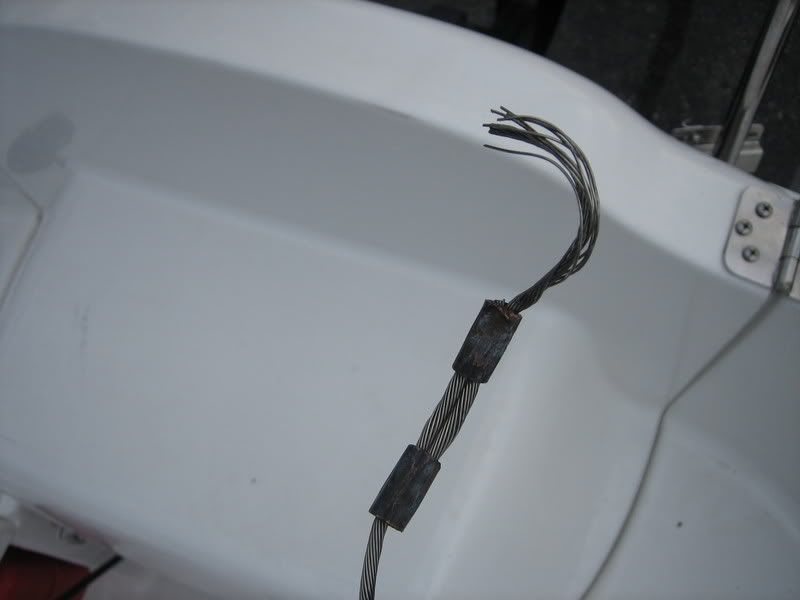
MacGregor dealer Mike Inmon (Inmon Yachts) is repairing the damage. The damage looks to be really very minor, I've decided not to make an insurance claim. Mike says that he is going to recommend that the factory instruct skippers to bungee the top of their roller-furlers tight to the mast when trailering to prevent the wire from working around or even flipping/folding up against the mast when the mast is horizontal. I think that he's got something there.
I'm taking the boat out Sunday and I'm hoping that there is no damage to the sails. I don't think that there was. Diane isn't going . . . .
No loose rigging.
Rigging wasn't too tight either.
No accidents.
No corrosion.
Boat never left with rigging up, except a couple of overnights.
Boat always stored in Northridge, 32 miles from the Pacific, where it is hot and dry.
No sharp edges on the top of the roller-furler.
Rigging inspected every time I raise the mast!
I think that the whole side that is broken broke at once, and it took several minutes, maybe 10 minutes for the loop to come out. Frank, I'm pretty sure that the individual wires didn't break gradually.
MacGregor dealer Mike Inmon (Inmon Yachts) is repairing the damage. The damage looks to be really very minor, I've decided not to make an insurance claim. Mike says that he is going to recommend that the factory instruct skippers to bungee the top of their roller-furlers tight to the mast when trailering to prevent the wire from working around or even flipping/folding up against the mast when the mast is horizontal. I think that he's got something there.
I'm taking the boat out Sunday and I'm hoping that there is no damage to the sails. I don't think that there was. Diane isn't going . . . .
-
Frank C
I don't understand.
Those wires didn't just pull loose from the swage fitting, did they?
It appears that each and every wire has broken free from the main length of forestay . . .
Sorry to hear the Admiral's now reluctant.
Maybe emphatic corrective measures(!) will help?
Like a spare halyard to the pulpit, or ??
Those wires didn't just pull loose from the swage fitting, did they?
It appears that each and every wire has broken free from the main length of forestay . . .
Sorry to hear the Admiral's now reluctant.
Maybe emphatic corrective measures(!) will help?
Like a spare halyard to the pulpit, or ??

-
James V
- Admiral
- Posts: 1705
- Joined: Sat Jan 22, 2005 9:33 am
- Sailboat: MacGregor 26M
- Location: Key West, Fl USA, 26M 06, Merc 50hp BF "LYNX"
Thanks, if you get a chance please post a close up of where the wires broke from.
I launched my '06 M in Jan 06. I have had it in the water, with me int it, more than 80 days, stored mast up on the trailer and have not had this problem. However my roller fuller is tied to the top of the mast and do not have the jib halyard attached. This might help.
I launched my '06 M in Jan 06. I have had it in the water, with me int it, more than 80 days, stored mast up on the trailer and have not had this problem. However my roller fuller is tied to the top of the mast and do not have the jib halyard attached. This might help.
-
Dimitri-2000X-Tampa

- Admiral
- Posts: 2043
- Joined: Fri Jan 02, 2004 5:36 am
- Sailboat: MacGregor 26X
- Location: Tampa, Florida 2000 Mercury BigFoot 50HP 4-Stroke on 26X hull# 3575.B000
Sorry to hear of your mishap. I'll bet that it is also possible that there was predisposed weakness at that spot when they first pressed the fitting on. Maybe some of the strands were kinked there during installation.
After my own mast incident, I inspected and then put the original forestay back on. And as someone else mentioned, this is the first time we have heard of such an incident after thousands of boats so hopefully, this is just an outlying case.
When I rebuilt my new mast, I drilled two more holes, one about 4 inches above the shroud attachment for the forestay (to get the mast standing more straight up) and another one about 8 inches above that for a spinnaker block/halyard. With the halyard 8 inches higher than the forestay, it gives sufficient clearance to tie the spin halyard to the bow pulpit, which is where I leave it when I'm not using the spinnaker. Something like this could give your mate more confidence again.
Btw, another thing to consider (I'm assuming it is the same way on a 26M as a 26X) is the fact that the stock forestay also has the jib halyard block on the same bolt. This could possibly work back and forth against the forestay loop I suppose, maybe causing stress. With my new design, only the forestay is on that bolt now, nothing to rub against it.
After my own mast incident, I inspected and then put the original forestay back on. And as someone else mentioned, this is the first time we have heard of such an incident after thousands of boats so hopefully, this is just an outlying case.
When I rebuilt my new mast, I drilled two more holes, one about 4 inches above the shroud attachment for the forestay (to get the mast standing more straight up) and another one about 8 inches above that for a spinnaker block/halyard. With the halyard 8 inches higher than the forestay, it gives sufficient clearance to tie the spin halyard to the bow pulpit, which is where I leave it when I'm not using the spinnaker. Something like this could give your mate more confidence again.
Btw, another thing to consider (I'm assuming it is the same way on a 26M as a 26X) is the fact that the stock forestay also has the jib halyard block on the same bolt. This could possibly work back and forth against the forestay loop I suppose, maybe causing stress. With my new design, only the forestay is on that bolt now, nothing to rub against it.
-
They Theirs

- Captain
- Posts: 790
- Joined: Tue Dec 27, 2005 1:42 pm
We found some of our shroud eye thimbles bent out of shape, distorted, from stepping the mast with flat strap tang adjusters, “Jackknifed” and kinked out of alignment on the standing rigging. We used tape to prevent the flat strap tang adjuster’s from folding, but found we had to be careful in preventing kinking the very inexpensive loose eye construction nicopress crimps. They present a less than yachty appearance.
Stainless strength is compromised to failure when kinked, and the clumsy, awkward CDI furling requires extra effort to avoid kinking the cheap, loosely crimped thimble eye at the hounds, together with both upper shrouds, on an oversize shackle. Special effort is required to avoid kinking and other problems, stepping the mast with a CDI furler system.
No doubt the Thimble deformed and fell out of the loosely made eye, and the 1 X 19 stainless continued to be compromised, wire-by-wire, until it failed.
With a standard forestay, the chance of kinks is significantly less, devoid of the furling acrobatics, compromised sailshape, excess windage presenting a huge headstay with a genoa wrapped around it. The performance trade-off for “Window-Shade Convenience” is further compromised by poor quality forestay construction with unsightly nicopress crimps.
The CDI FF2 manual illustrates a “ Swaged Marine Eye”, at the top of the forestay. Be careful when replacing cheap nicopress crimps with a true marine swaged fittings, and not a less expensive aircraft ends with less strength, requiring resizing the clevis opening by drilling. Marine fittings are more expensive, and stronger. We would have willingly paid extra for quality marine rigging over the cheap, unsightly, nicopress crimped standing rigging provided by the MacGregor Factory.
The lifeline crimps were cheap nicropress crimps, with sharp edges and bitter end wire snags, some without thimbles, but that may have been a dealer modification for a quick release pelican hook cockpit lifeline upgrade. The lifelines should be vinyl covered without the shoddy flat strap tang adjusters.
Stainless strength is compromised to failure when kinked, and the clumsy, awkward CDI furling requires extra effort to avoid kinking the cheap, loosely crimped thimble eye at the hounds, together with both upper shrouds, on an oversize shackle. Special effort is required to avoid kinking and other problems, stepping the mast with a CDI furler system.
No doubt the Thimble deformed and fell out of the loosely made eye, and the 1 X 19 stainless continued to be compromised, wire-by-wire, until it failed.
With a standard forestay, the chance of kinks is significantly less, devoid of the furling acrobatics, compromised sailshape, excess windage presenting a huge headstay with a genoa wrapped around it. The performance trade-off for “Window-Shade Convenience” is further compromised by poor quality forestay construction with unsightly nicopress crimps.
The CDI FF2 manual illustrates a “ Swaged Marine Eye”, at the top of the forestay. Be careful when replacing cheap nicopress crimps with a true marine swaged fittings, and not a less expensive aircraft ends with less strength, requiring resizing the clevis opening by drilling. Marine fittings are more expensive, and stronger. We would have willingly paid extra for quality marine rigging over the cheap, unsightly, nicopress crimped standing rigging provided by the MacGregor Factory.
The lifeline crimps were cheap nicropress crimps, with sharp edges and bitter end wire snags, some without thimbles, but that may have been a dealer modification for a quick release pelican hook cockpit lifeline upgrade. The lifelines should be vinyl covered without the shoddy flat strap tang adjusters.
Sorry to hear about the accident and glad to hear that there were no injuries. I have read all responses and all are very plausible. I thought i would throw one in left of field. I hope i am wrong (on the other hand i hope i am right- less chance of happening again). With some people's attitude towards Macgregors could it not be an act of vandalism or sabotage? I read that you said it looked like it was almost cut. Just a thought.
Good luck with the repairs and hope you find the reason for failure.
Cam
Good luck with the repairs and hope you find the reason for failure.
Cam
Don't blame the CDI furler. On the Mac, some of us here use the furling line to lift it toward the bow pulpit bolt or pin when mast raising, others use bungi cords to do the same. Keeps it straight and takes the weight load off the mast. With the shorter spreaders on the C-18, we can leave it laying on the side deck while raising the mast, by hand.
MacGregor's flat shroud adjusters can be kept from jamming in other than a straight position when mast raising by simply using the Davis turnbuckle covers or a section of clear plastic tubing to keep them and the loop above them straight. You can keep turnbuckles on shrouds from getting bent during mast raising by tying the jaw toggles together in a standing position above the chain plates with a short length of bungi cord. I personally prefer turnbuckles, but managed fine with the flat shroud adjusters.
Obviously, the thimble came out of the loop, but there's no sharp bend in the wire rope (from the bolt through the hounds) to indicate that happened before, and caused, the wire failure. More likely the wire failure loosened the loop causing the thimble to come out.
I won't debate the fittings issue, but will agree with those who use this as an example of why you should inspect your rigging carefully.
MacGregor's flat shroud adjusters can be kept from jamming in other than a straight position when mast raising by simply using the Davis turnbuckle covers or a section of clear plastic tubing to keep them and the loop above them straight. You can keep turnbuckles on shrouds from getting bent during mast raising by tying the jaw toggles together in a standing position above the chain plates with a short length of bungi cord. I personally prefer turnbuckles, but managed fine with the flat shroud adjusters.
Obviously, the thimble came out of the loop, but there's no sharp bend in the wire rope (from the bolt through the hounds) to indicate that happened before, and caused, the wire failure. More likely the wire failure loosened the loop causing the thimble to come out.
I won't debate the fittings issue, but will agree with those who use this as an example of why you should inspect your rigging carefully.