Had a great time watching the fireworks at the dam. Went back to the slip and went to bed.
Woke up at 2 am to raindrops on my arm (sleeping in cockpit) closed the hatches and climbed below.
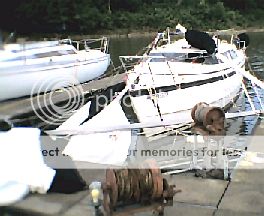
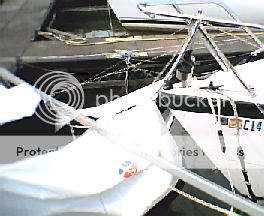
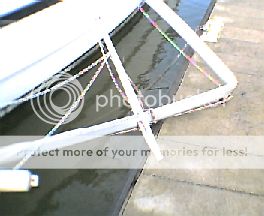
This morning found this at the other end of our dock.
Looks like the furling line rotted away at the cleat and allowed the jib to unfurl in 60+ MPHwinds, the results speak for themselves
I havent seen this fellow on his boat in about 2 years. Hope he doesnt see these before he sees his boat.
.
Ouch!
I saw a jib on a decent sized catamaran get torn up by a storm once because the owner did not furl the jib all the way. The wind caught the sail and worked it loose. It then blew out and tore to shreads. I only saw it the next morning, not the actual event of course or I would have tried to save it.
I wouldn't think the furling line would be rotten on an X yet. I would suspect either the sail was not furled all the way or maybe the furling line was cut by something sharp. The first bulls-eye fairlead at the base of the furler was wearing very badly on mine (actually it looked like the plastic was melting from friction of the furler line on the plastic fairlead). I replaced it with a fairlead with a stainless steel liner. It also made furling a lot easier since now the fairlead was nice and smooth.
I couldn't see a whole lot from the low resolution photos. Looks like the mast snapped in half. Did it look like it snapped from the fall or while it was standing? I'm guessing the rigging might not have been tight enough to prevent mast movements and maybe a spreader failed followed by the force of the sail pulling up high against the only resistance point remaining, the lower shroud. This then maybe bent the mast in half.
I'm just guessing of course.
It would be interesting to know exactly how the mast came down.
I've had a rope that was eaten by rodents...twice even. Granted, it was a cotton rope used to tie a helm cover and not the kind of nylon a furling line would be made out of. But you know rats, they will eat anything.
I always take the slack in the jib sheets and wrap it around the furling tying it into a knot. That way, even if the furling line/cleat/etc were to fail, the headsail would not come unfurled.
I would like to know if the fuling line was cleated with the regular cleat or a cam cleat. I've seen a few boats out there with cam cleats or sheet stoppers (cheap clutches) for the furler. The furler should be stowed with a real cleat, especially if your leaving the boat unattended.
Just a guess
It's too bad though... It looks like it was a nice North Sail as well. We all wish him luck with his insurance company.
From my forensic investigation, (Im a truck driver) I surmise that first the mast failed between the spreaders and step. The subsequent wind loading and lateral forces caused the mast step to fail. Then the starboard spreader failed as it hit the dock. The fact that the furling foil was connected at the dogs and deck allowed it to be bent hard over the pulpit causing it to shatter. Exactly when in the chain of events this occured has not been determined at the time of this posting, however it is suspected that it occured somewhere between the furling line breaking and the mast hitting the dock.
This catostrophic series of events was precipitated by a failed furling line. The tag end of the furling line remained fast inthe stock mac cam cleat. The stock mac fairleads had at some point been replaced by SS lined aftermarket fairleads. The initial breakage in said furling line occured at a point midway but not directly centered between the cam cleat and first subsequent fairlead.
The breakage of the furling line allowed full deployment of the rather large aftermarket Genoa. With wind speeds in excess of 60 mph from directly astern the loading on the rigging was substantial.
Refer to page 265 of the printed report for causeality graphing.
It appeared upon initial assesment that any and all rigging was damaged beyond repair. Stays shrouds plates and the like included. Some nuts and bolts potentially are reusable.
Prior to the commision convening, a computer graphic recreation of the events leading to this atrocity will be made available to all panel members for review.
Yours truly
Forensic accident investigations inc.
Scott
I had a similar thing happen to me two years ago ...the furling line snapped in a storm, the jib partially unfurled into a parachute and the rigging started flexing with every gust of wind. Fortunately, I had headed down to the boat to check on the fenders since one of them was a bit soft and I was worried about it in the storm. As we pulled into the parking lot I said to my wife "Oh, look at that poor b*st*rd's jib flailing in the wind" As we got a little closer she turned to me and said "I think you're the poor b*st*rd". Sure enough I was ...I was very lucky to get there before the mast came down...as it was I had to replace the jib which was shredded and two of the stays which were down to mere strands holding things together. I figure a few more minutes in that wind and the whole rig would have come down...
The lesson I learned that day is to always furl the foresail so that I get at least two wraps of the jibsheets around it. I then tie of the sheets at the cockpit. And, because I'm paranoid, if I know a storm is coming I'll also wrap a bungee around the furled sail.
When we first got our boat it had a hanked on jib. We got to the dock one evening and went to bed. That night they had a micro burst type storm and the jib came out of the bag and headed up the forestay. Luckily we were below watching the storm when it went up. It was kinda scary being up there next to a great lighting rod with it flashing all around us but we got the jib down before there was any damage. I can see how something like that could bring a mast down. It was a job getting it down. Another one of those memories we can laugh at now.
Thanks for the report Dr. Scott M.E. .
I guess "these rigs do come down" if enough bad things happen.
Did you dust for mouse prints near the rope failure?
BobCardz wrote: cam cleats or sheet stoppers (cheap clutches) for the furler.
Probably a good point Bob. One I discount to some degree because we didn't design our boat mods with leaving it in a slip in mind, strickly trailor sailoring was the idea.
I still like the little lance cleat we use for the furler. When securing the boat for a longer stay (docking/overnight) with the mast up but without flying the genoa, I was tying the line to the nearby port stancheon after the lance.
This thread is a good reminder that none of that would be good enough in a real blow. Securing the jib sheets around the furled sail makes much more sense if your boat is going to remain ready to go. I suppose our original plan also included a jib sock, and I suppose that would be just about as good.
Ouch!
That's gotta hurt.
I just bought my 97' Mac X, how is your furling line routed? Mine runs through a plastic thimble at the base of the furler but then it was ran through the bases of the life line stantions and back to a cam cleat next to the companion way. Is this normal or did the guy I bought it from do this wrong? Have you folks upgraded this?
I have my furling line led through the stanchion bases. Pretty common "Macgregor" tactic - those official Harken or Schaefer furler leads are expensive.
I've changed mine to only go through the foreward stanchion base now. It first goes through the bullseye, then around the outside of the aft bow pulpit support (stanchion?), then through the foreward stanchion base and then to the cam cleat. Works very smoothly like that...smoother than in my former O'Day which had all the fancy ball bearing roller thingees attached to each stanchion base...sometimes simplicity wins out!
This brings up a good point. Do the sheets even need to be cleated? It seems to me that having the sheets cleated tight would lead to this problem in the first place. If your furler line snaps the sail unfurls, then the sails fill to where the sheets are cleated. Thus having a full sail. The best practice would be to wrap almost all of the sheets around the furled sail and cleating just the ends of the sheets. This should allow the sail when unexpected unfurling to flap like a flag not causing as much damage. Just a thought.
Maybe Im on the conservative side, but when Catigale gets closed up after a sail, I
- Furl the sail including two turns of genoa sheet around
- Sailtie through the clew grommet - I use a six footer here so that I can really cover the clew up well and keep the wind from whipping it out.
- Another sailtie on top of grommet as high up as I can reach
- Two more sailties below grommet
...Tied with a loop knot they take me 15 seconds to release for sailing. I do this at slip, while Im checking my forestay pin and clip.
Do you guys really rely solely on the furler line to hold that big genny??





 ...the furling line snapped in a storm, the jib partially unfurled into a parachute and the rigging started flexing with every gust of wind. Fortunately, I had headed down to the boat to check on the fenders since one of them was a bit soft and I was worried about it in the storm. As we pulled into the parking lot I said to my wife "Oh, look at that poor b*st*rd's jib flailing in the wind" As we got a little closer she turned to me and said "I think you're the poor b*st*rd". Sure enough I was
  ...I was very lucky to get there before the mast came down...as it was I had to replace the jib which was shredded and two of the stays which were down to mere strands holding things together. I figure a few more minutes in that wind and the whole rig would have come down...


