Page 2 of 3
Re: How to fix Most blown out Mainsails!
Posted: Tue Dec 27, 2011 6:52 pm
by zephyr101
I just finished installing one. mine came off a 1976 26'hunter.i have seen one in a catalog of mast fittings, it has a eye on bottem for downhaul i installed a eye bolt in the bolt hole for mast support,had to ream out hole to 3/8"the sliding gooseneck has a 1/2"round piece that slides in mast groove yes the slugs are 3/8" but the mast will take a 1/2" slug. i chiseled off the rivits on the original boom end.closed up the slug gate and opened a new one down lower then put a cotterpin in the rivit holes to stop the boom from going too low. all works well and now i can raise the boom higher the clear my bimini witch is higher then stock and no getting hit in by boom.sorry no pictures yet!!
Flattening reef....
Posted: Wed Dec 28, 2011 1:49 am
by Judy B
Octaman wrote:.... When I say the draft moves forward, I mean that the draft moves from half way between clew and tack of the sail toward the tack. This efficiently makes for a greater forward force and a lesser sideways force thus less heeling and more speed. The outhaul cannot achieve this. The halyard/cunninghanm can.
If your outhaul is really loose and your draft is closer to the clew then, yes, tensioning the outhaul will bring the draft closer to midway between clew and tack but this is considered bringing the draft to the basic trim position for the sail to function and not regarded as draft being forward. The outhaul will not bring the draft beyond this point.
thank you for your input
Octaman

I'm in agreement with Octaman about the effect of the outhaul on the draft of the mainsail. The outhaul does not move the maximum draft position forward.
A cunningham increases tension parallel to the luff; that tension pulls the cloth and the location of the maximum draft towards the luff (forward).
An outhaul increases foot tension parallel to the boom (and at right angles to the luff). It doesn't pull the draft forward. On a loose-footed mainsail,the outhaul is used to flatten the draft in the bottom section of the mainsail (from the foot up to about the bottom batten ). It is often necessary to tighten the cunningham or mainhalyard when the foot is tightened by the outhaul, to move the draft forward, bringing it again to where it belongs.
On a mainsail with a rope foot the outhaul doesn't do much at all.... so in the old days, the sailmaker installed a "flattening reef" about 8 inches above the clew on a footed sail. .... and I think what is being called a "clew cunningham" in this thread is more commonly referred to as a "flattening reef."
In a sail with a rope foot, the flattening reef is a cringle about 8" above the clew. It's really an additional outhaul. When it's pulled tight, it makes the draft in the lower section of the mainsail shallower/flatter, pulls the draft aft, and tightens the leech so it hooks to windward more (for higher pointing but potentially more heel)
In a sail with a loose foot, a flattening reef is a "cheater" that allows the foot to be a little longer than normal, without breaking the racing rules or recutting the foot to make it conform to class measurements. Essentially, a flattening reef cringle allows the sailmaker to make the foot of the sail longer than the black bands in PHRF racing mains, so that the foot can be full off the wind and in moderate winds, but still be pulled flat in high winds (and in pointing mode in flat water and light breezes).
If the foot is cut a little too long, tightening the outhaul has the undesirable effect of pulling the clew beyond the black band on the boom. That would break rules for racing. But if you put the flattening reef in,rather than strapping on the outhaul as hard as possible, the foot of the sail stays inside the black band on the boom AND the foot of the sail is pulled flat. The amount of sail area lost to the 8" reef is insignificant when you're overpowered anyway.
(In that respect, a flattening reef is similar to a cunningham - the cunningham can be used to keep a "too-long" luff inside the black bands. Flattening reefs can be used to keep a "too-long" foot inside the black bands.)
Unless you're going to race, or you have a bolt rope in the foot of the sail, there's no compelling reason to have a flattening reef. A loose foot and a good outhaul will do the same thing as a flattening reef in terms of reducing the draft at the bottom of the mainsail. (And, BTW, I don't know of any advantages to having a bolt rope in the foot of a mainsail)
Fair winds,
Judy B
Sailmaker
Re: How to fix Most blown out Mainsails!
Posted: Wed Dec 28, 2011 7:28 pm
by Highlander
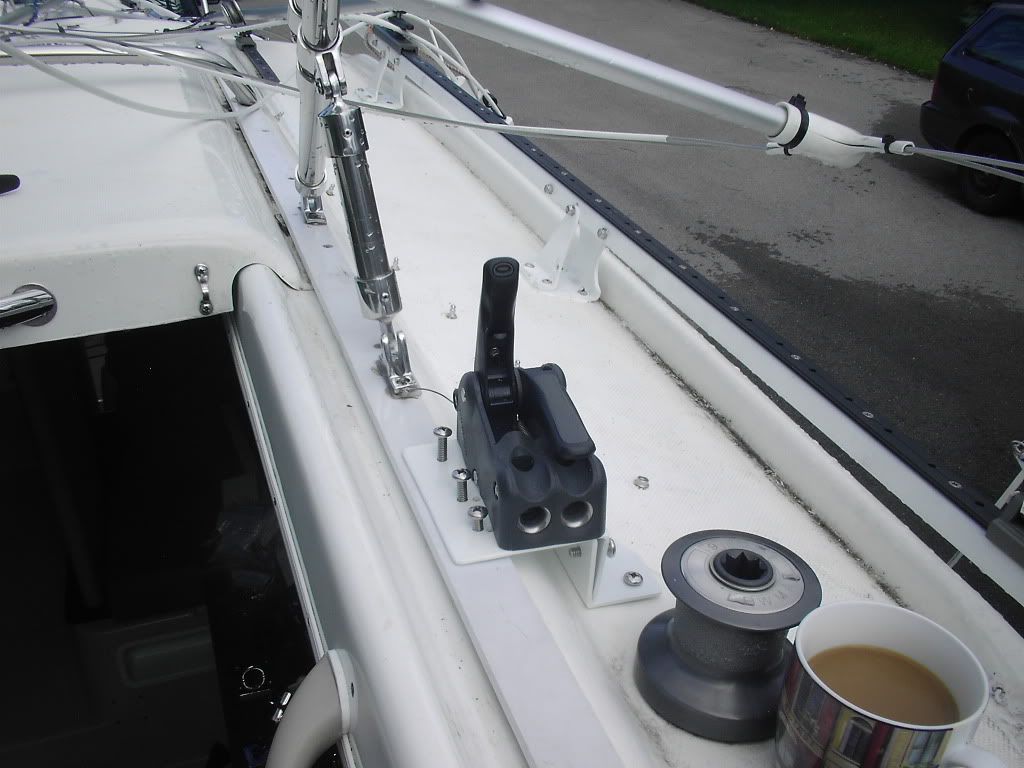
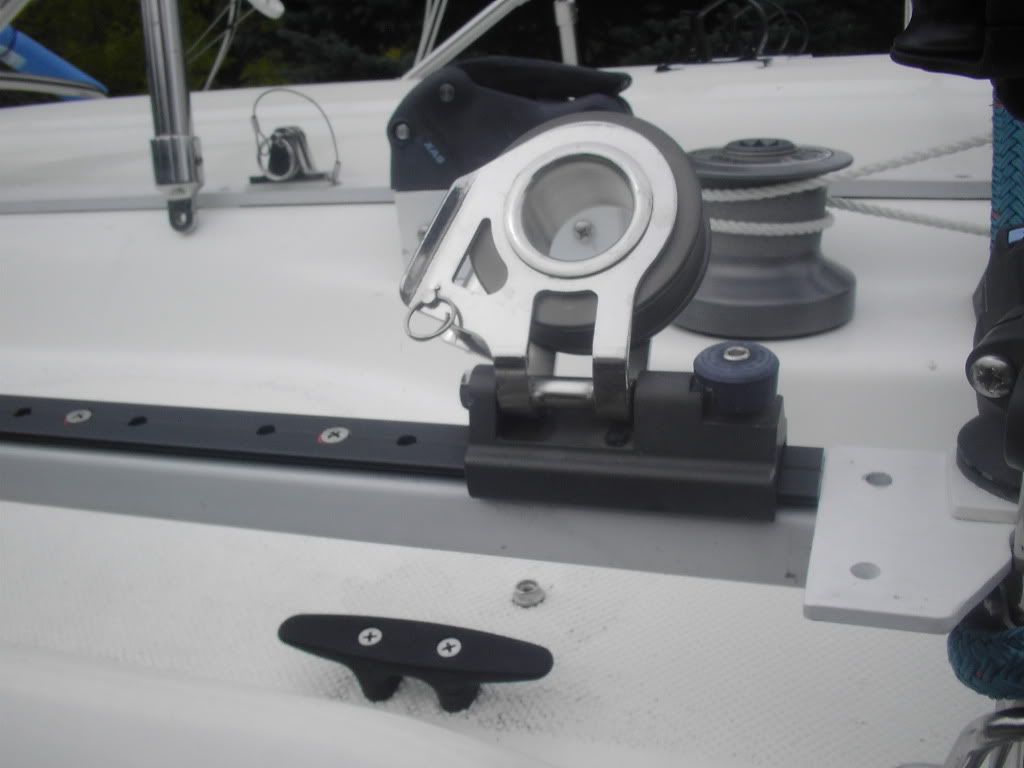
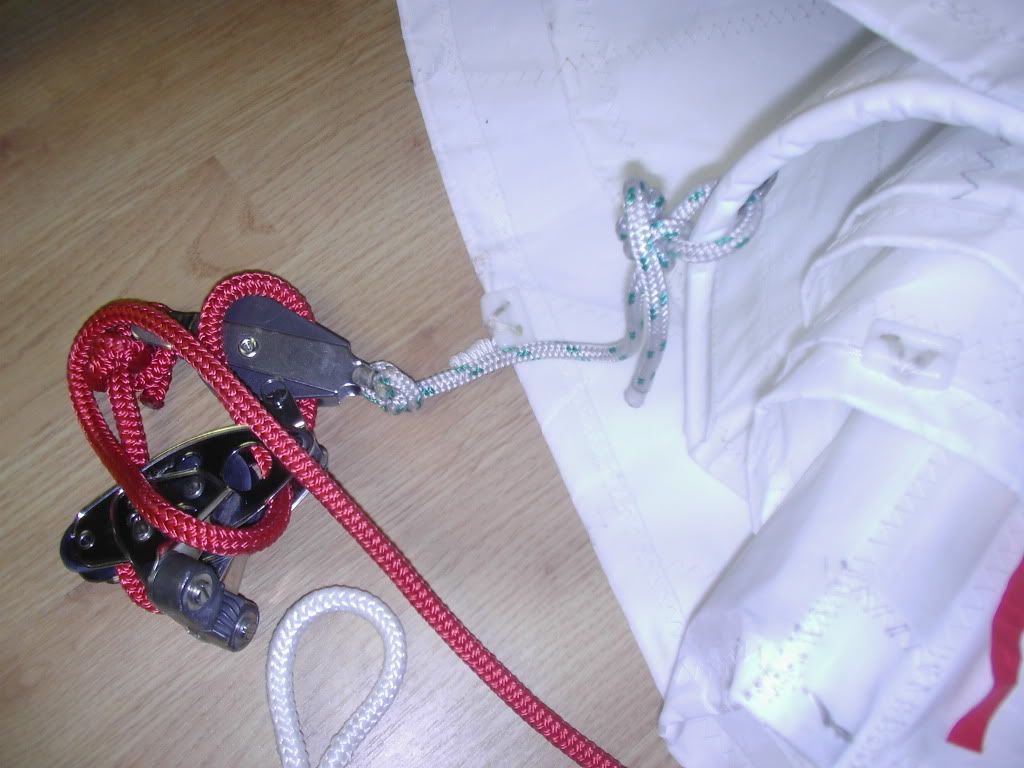
Here's my Cunningham set-up with a loose footed main
http://s235.photobucket.com/albums/ee20 ... 010099.mp4
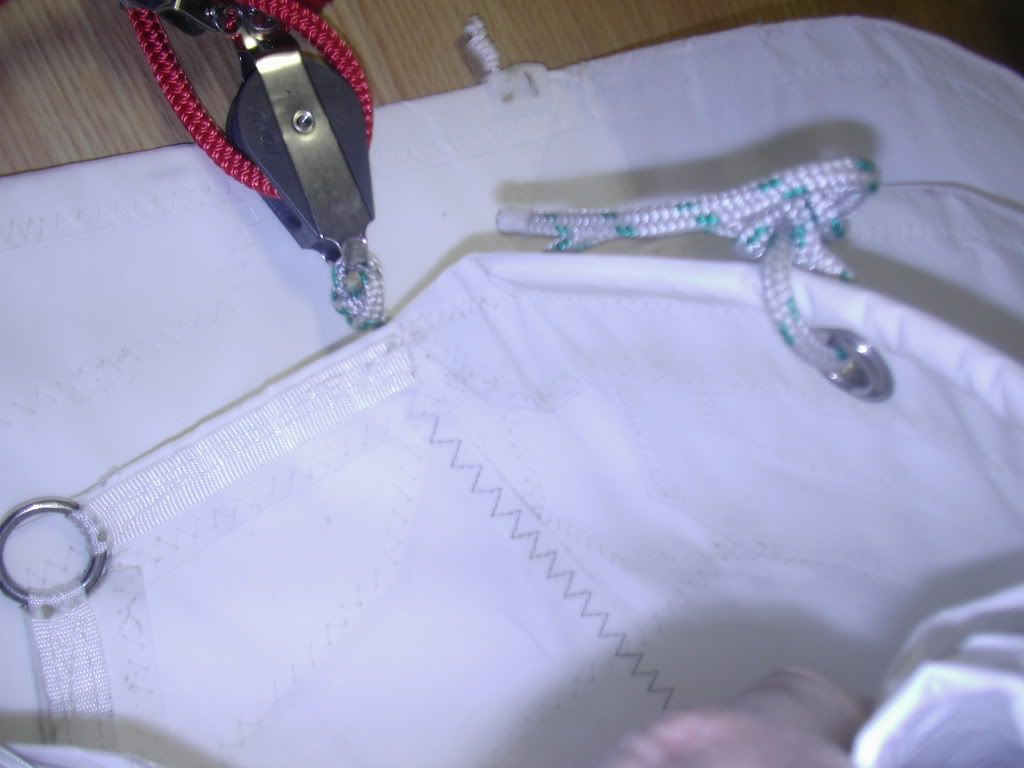
J
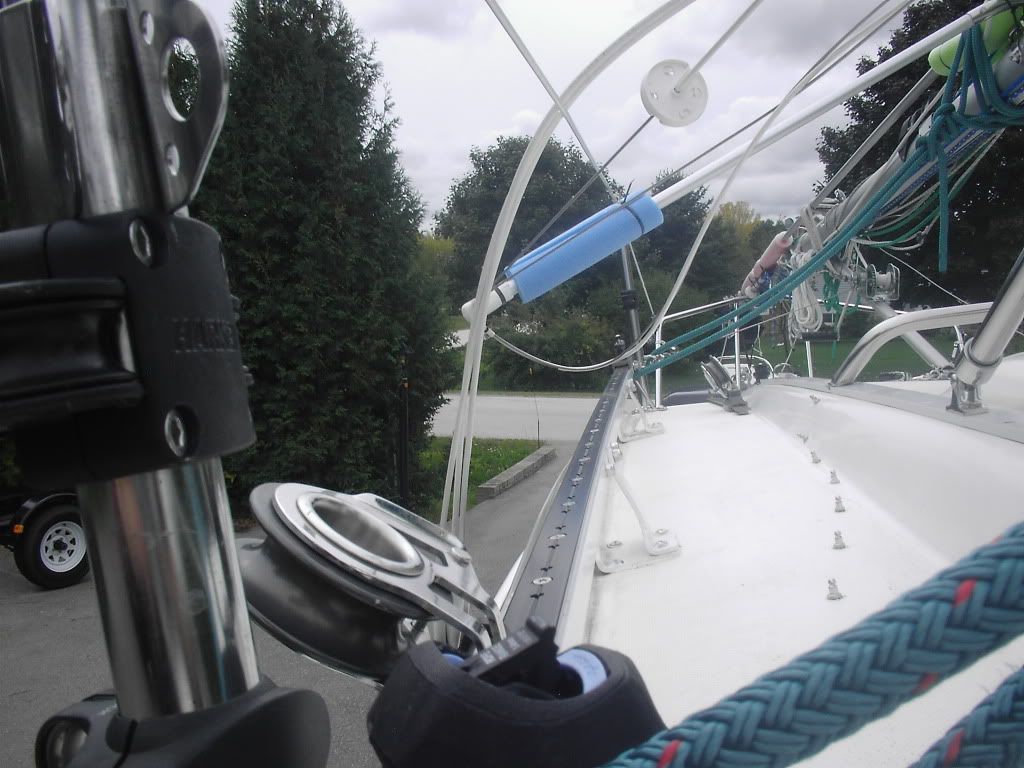
PS That video is two yrs old since then the Genny cars were moved up onto the cabin roof on 7ft genny tracks as with the genny being moved out three foot onto the bowsprit required that the genny cars be moved ahead to allow for proper sheet angle for the genny sheets
http://i844.photobucket.com/albums/ab1/ ... 010043.jpg
http://i844.photobucket.com/albums/ab1/ ... 010007.jpg
http://i844.photobucket.com/albums/ab1/ ... 010012.jpg
Re: How to fix Most blown out Mainsails!
Posted: Thu Dec 29, 2011 7:49 am
by Octaman
Thank you Judy for further clarifying this issue and adding so much value to this thread with your complete analysis. I very much enjoyed reading your posting.
I have to say, I have no black band restrictions, because I don’t race the Mac; so that allows me to be as flexible as I like with the 'size' and trim of the mainsail. As I feel most members of this forum are.
On the other hand I have been repeatedly urged by my local sailing club to have the Mac measured and to participate in the local regattas, but once you’ve raced on fixed keel boats, I think, in comparison, it becomes pointless on a Mac trying to challenge the fixed keel fleet.
If there were enough Macs in my neighborhood to form a class and race against each other as one designs, then, yes, that would be a different story and very interesting. Regretfully, I am alone in this respect. So, no black bands for me.
Thanks again for your very enlightening comments.
-------
Highlander, I was thinking of you when I asked if anyone has rigged a Cunningham (smile).
I was sure you were abreast of things! Thanks for the photos. However, we have yet to see photos of a true Cunningham on a Mac like the one Zephyr101 and Ronacarme describe.
Would be great to have some pictures from you guys if and when you can.
Happy Power Sailing & all the best to all for 2012
Octaman
Re: How to fix Most blown out Mainsails!
Posted: Thu Dec 29, 2011 9:56 am
by eddy
Are you actually saying that there is no need to put the bold rope from a stock mac mainsail in the boom, and also get more trim possibility on the mainsail?
Re: How to fix Most blown out Mainsails!
Posted: Thu Dec 29, 2011 11:24 am
by arknoah
Thanks for the clarification, Judy.
Re: How to fix Most blown out Mainsails!
Posted: Thu Dec 29, 2011 4:06 pm
by Highlander
eddy wrote:Are you actually saying that there is no need to put the bold rope from a stock mac mainsail in the boom, and also get more trim possibility on the mainsail?
I had the bolt rope removed & had the tack & Clew corners re-enforced , but I see no reason why u can not try it loose footed just to see if u like having the ability to have better trim on your main alot easier to trim the outhaul

J
PS You will need to put in slug into the boom at the outhaul to attach ur mains clew & O/H. My boom is also re-inforced in the center with 18" x 1/4" x 1" Threaded Alum Bar inside that the 18" track attaches to for my rigid vang
Re: How to fix Most blown out Mainsails!
Posted: Sun Jan 01, 2012 3:04 pm
by vizwhiz
Going back to the original post (or we could call it "page 1")

I had noticed that my mainsail - a stock Doyle with single reef point, bolt ropes on both the foot and the luff of the main, and slugs on the main luff - had always had a little...er, belly...to it, kinda just chalked it up to old age, like what's happened to my tee-shirts over time.

And I HAD noticed the wrinkled edges of the sail along the bolt rope, again, just assuming that wrinkles came with the age of the sails. Since I don't presume to race, I figured that what I had would be good enough to learn to sail on, and if handling were ever a real problem, then I'd deal with the sails.
But after reading this post, and the advice given about the bolt rope shrinkage in the sail, I decided to check mine out and see if something could be done. Well, my sail just got a facelift!!!

I started by pulling as much sail down around the bolt rope as I could...kinda like when you lose the drawstring in your shorts and have to fish it through the material to get it back to the little hole at the front... I pulled as much of the loose material down one section (between slugs) at a time until I had quite a little bundle of loose fabric at the bottom between the last slug and the tack, and the rest of the sail luff looked pretty straight and tight.
Then, I found where the bolt rope was sewn to the sail - on the stock Doyle, that was about 4" of thread at the top, and 4" at the bottom, sewn right through the rope. Carefully, so as not to cut the sail material, I used a small pair of sewing scissors and cut all of the threads loose at the bottom (tack) end of the bolt rope, leaving the top intact. I was amazed to find that the bolt rope moved up around 4" in the sail...it had shrunk quite a bit! And the sail stretched out and got tighter than I'd ever seen it. I lowered it, and went through the process again, hoisting the sail a few feet, pulling the sail down around the bolt rope, and then hoisting a few more feet, etc. By the time I was done, the bolt rope had moved about 6" up the sail, and the sail luff looked very nice and tight! (Even the Admiral was impressed!)
I was so excited to see this, that I slid the foot out of the groove in the boom, and did the same thing to the foot of the sail, sliding the sail around the bolt rope, and cutting the threads that held the sail and bolt rope together at the mast end of the foot. I slid the sail foot back into the groove on the mainsail, and pulled the outhaul tight. The foot didn't move as much, only an inch or so, but I was amazed at the final result, with luff and foot tight, the sail was back to a slim, trim, early-30's tummy, not like the mid-40's bulge it had before!
This was a great post, thanks for the insight!
Re: How to fix Most blown out Mainsails!
Posted: Sun Jan 08, 2012 7:08 pm
by Tom Root
@ vizwhiz....I am glad to have made a believer out of someone!
It sure works, doesn't it?
Re: How to fix Most blown out Mainsails!
Posted: Sun Jan 08, 2012 10:29 pm
by mastreb
Egads! I just hoisted my main this weekend for the first time in weeks, trimmed the sail, and could not get rid of the belly! Vang tight, mainsail tight, with a taught leech, and a 2:1 purchase on the halyard but the mainsail clearly bagged. This mainsail is only a year old!
Now I have to read and truly understand this post. So I never re-attached the boltrope to the bottom of the sail? Why is it attached in the first place?
Re: How to fix Most blown out Mainsails!
Posted: Mon Jan 09, 2012 2:22 pm
by Judy B
mastreb wrote:Egads! I just hoisted my main this weekend for the first time in weeks, trimmed the sail, and could not get rid of the belly! Vang tight, mainsail tight, with a taught leech, and a 2:1 purchase on the halyard but the mainsail clearly bagged. This mainsail is only a year old!
Now I have to read and truly understand this post. So I never re-attached the boltrope to the bottom of the sail? Why is it attached in the first place?
Could you post some pictures, please?
Not all baggy sails are caused by shrunken bolt ropes. Not all bolt ropes shrink excessively, good quality ones don't shrink much at all. Older, softer dacron boltropes tended to shrink, but modern hard rope don't shrink much at all, even after a decade or more.
So don't release the bolt rope unless you've ruled out other causes, of which there are many.
The are lots of other reasons with the most common ones being 1) inappropriate choice of sailcloth or 2)a mis-match between the way the luff is cut and the pre-bend curve (if any) tuned into the mast.
Why is a bolt rope needed? To keep the luff from stretching excessively under tension.... the bolt rope is the structural member that resists stretching.
The bolt rope is installed into the luff after a bit of pre-stretch is applied. That's to prevent the sailcloth from being overstretched. The amount of pre-stretch on the rope depends upon the composition of the rope and the properties of the sailcloth. For example: We typically design the finished luff length of a dacron sail to be 1% shorter than the fitted size, because we expect about 1% stretch as the cloth "breaks in". (The exact amount of allowance depends upon the characteristics of the cloth). We pre-stretch the bolt rope and match it to the luff length. Then we add 1% and cut it. then we seize to the luff at top and bottom.
(That's an oversimplification, but it illustrates my point).
After you release a shrunken bolt rope, you should pre-tension it to the "fitted length of the luff" and re-seize the ends. Leave a little bunched up sail around it to account for the rope stretch when you tension it or splice on some new rope to length it, if it's so shrunken that it's above the heavily reinforced area at the tack.
Fair winds,
Judy B
Hyde Sails of Northern California
Re: How to fix Most blown out Mainsails!
Posted: Mon Jan 09, 2012 2:47 pm
by vizwhiz
Tom Root wrote:It sure works, doesn't it?
Yes it does...sail looks great after releasing the bolt rope from the bottom.
Judy, I just released the bolt rope, and it was a lot different in length than the sail once it was released - the rope moved pretty far up the sail. If you're talking about re-seizing the rope to the sail, but the rope is too short to attach in the same reinforced area of the tack, are there any options?
I'm not necessarily afraid to go after the stiching and such, I just don't really want to do major surgery on the sail if I don't have to since it's old anyway (assuming it is original, it is 16 years old already). Would it be safe enough to sail with it as-is, and once the sail dies just plan to replace it?
Was part of the bolt rope's job for vertical strength to keep the luff from stretching when the sail is hoisted? I'm just thinking about what it would take to string a new piece of rope through the sail - not so hard, probably, if I can get the end of the rope slot in the sail open on both ends (so I can use the existing rope to pull the new one through)...
I have slugs on the sail, by the way.
Thanks...
Re: How to fix Most blown out Mainsails!
Posted: Sun Jan 22, 2012 11:46 am
by Tom Root
It should NOT be neccasary to thread additional bolt rope in the channel where the old one was. I had slugs in the sail I did as well. I suppose if you wanted to go through the trouble, you could, but see how it works/performs for you! I'd guess you would be fine like I and many others who have done this mod were!
Re: How to fix Most blown out Mainsails!
Posted: Sun Jan 22, 2012 1:30 pm
by Judy B
The bolt rope resists stretching. All mainsails need a bolt rope on the luff, Including the mainsails with slides/slugs. Without a bolt rope, the sailcloth along luff will not be able to withstand the strain. It's not designed to do that. without a bolt rope, the cloth will stretch to the point where the cloth is permanently deformed and ... keep right on stretching.
That's why sailmakers go to the bother of adding a bolt rope, even for a sail with slugs. Without a rope seized to the luff, the only thing resisting the strain along the bias is the resin on the cloth. The cloth is cut on the bias(the diagonal) at the luff, and it can't withstand a lot of strain along the bias, at a diagonal to the threads. The treads of the sailcloth aren't aligned along the luff so that they can resist stretching. That's why sailmakers install a bolt rope.
(The bolt ropes we install in Hyde sails with slides are made of a high tech, controlled extruded synthetic fiber, like luff tape, and they hardly stretch or shrink. They stretch 1-2% or so, just enough to move the mainsail draft position forward or aft with a cunningham or halyard tension. They resist stretch incredibly well and contribute greatly to the shape holding ability of the mainsail.)
That's why the the bolt rope is attached at both the top and bottom of the luff - to prevent stretching the cloth so much it is damaged and looses all its structure. To keep it from getting "blown out."
After releasing a shrunken bolt rope at the bottom, it should be reattached to the luff so it does the job for which it was intended. If the bolt rope has shrunken so much that it's no longer in the reinforced area at the tack, that's a very highly strained area of the sail without the proper structural materials to resist the strain.
I'm not an expert at repairing sails, so I'd ask the manager at the loft that handles my warranty work for his ideas. He might have a better idea than I do. My ideas come from reading books about all the possible ways to repair sails, not a lot of personal experience
Off the top of my head there are a couple of options.
1)Leave it alone and say "the heck with it" until it fails. Without the aility to resist stretching along the bias, the draft position will be less controllable. Tensioning along the bias of the cloth is one of the forces that keeps the draft forward, but only within the structural limits of the cloth. Once you go "too far" you will permanently deform the cloth. You'll have less ability to tension the mainsail along the luff. You'll heel more and have to reef earlier.
2)Sew some more reinforcing corner patches of sailcloth from the tack to the bottom of the bolt rope. Maybe add some low-stretch webbing like we do for passage makeing sails at all major strain points.
3)Replace the bolt rope or have a sailmaker do it for you.
4)splice in some rope to replace the missing section and then seize the bolt rope in the proper place. It's not that hard to do with three strand polyrope.
5)Replace the mainsail with a newer better one.
I'm all for fixing sails if they are worth it. If the sail is worth fixing, it's worth fixing properly.
Fair winds,
Judy B
Hyde Sails of Northern California
Re: How to fix Most blown out Mainsails!
Posted: Sun Jan 22, 2012 3:18 pm
by DaveB
Judy,
Since I bought your new Mainsail from Hyde Sails with the two top full battens, two reef points and a loose foot has performed very well beating to windward with a 105 jib.
I manage to get approx. 5 degrees closer to windward without speed lose.
My old main was not that out of shape, just missing the two top full battens and wanted less belly for windward performance.
True wind of 6 knots I can now do 45 degrees off wind and the boat to 4 knots or better in a 1-2 ft. sea.
10 knots I can easy do 5.5 knots at 42 degrees off true wind.
I have done as close as 38 degrees off wind but it was just right amount of wind. One can get closer but heel and speed will lack off.
Just shows the MacX can beat to windward under 45 degrees with correct sails and wind and sea conditions.
Dave
Judy B wrote:The bolt rope resists stretching. All mainsails need a bolt rope on the luff, Including the mainsails with slides/slugs. Without a bolt rope, the sailcloth along luff will not be able to withstand the strain. It's not designed to do that. without a bolt rope, the cloth will stretch to the point where the cloth is permanently deformed and ... keep right on stretching.
That's why sailmakers go to the bother of adding a bolt rope, even for a sail with slugs. Without a rope seized to the luff, the only thing resisting the strain along the bias is the resin on the cloth. The cloth is cut on the bias(the diagonal) at the luff, and it can't withstand a lot of strain along the bias, at a diagonal to the threads. The treads of the sailcloth aren't aligned along the luff so that they can resist stretching. That's why sailmakers install a bolt rope.
(The bolt ropes we install in Hyde sails with slides are made of a high tech, controlled extruded synthetic fiber, like luff tape, and they hardly stretch or shrink. They stretch 1-2% or so, just enough to move the mainsail draft position forward or aft with a cunningham or halyard tension. They resist stretch incredibly well and contribute greatly to the shape holding ability of the mainsail.)
That's why the the bolt rope is attached at both the top and bottom of the luff - to prevent stretching the cloth so much it is damaged and looses all its structure. To keep it from getting "blown out."
After releasing a shrunken bolt rope at the bottom, it should be reattached to the luff so it does the job for which it was intended. If the bolt rope has shrunken so much that it's no longer in the reinforced area at the tack, that's a very highly strained area of the sail without the proper structural materials to resist the strain.
I'm not an expert at repairing sails, so I'd ask the manager at the loft that handles my warranty work for his ideas. He might have a better idea than I do. My ideas come from reading books about all the possible ways to repair sails, not a lot of personal experience
Off the top of my head there are a couple of options.
1)Leave it alone and say "the heck with it" until it fails. Without the aility to resist stretching along the bias, the draft position will be less controllable. Tensioning along the bias of the cloth is one of the forces that keeps the draft forward, but only within the structural limits of the cloth. Once you go "too far" you will permanently deform the cloth. You'll have less ability to tension the mainsail along the luff. You'll heel more and have to reef earlier.
2)Sew some more reinforcing corner patches of sailcloth from the tack to the bottom of the bolt rope. Maybe add some low-stretch webbing like we do for passage makeing sails at all major strain points.
3)Replace the bolt rope or have a sailmaker do it for you.
4)splice in some rope to replace the missing section and then seize the bolt rope in the proper place. It's not that hard to do with three strand polyrope.
5)Replace the mainsail with a newer better one.
I'm all for fixing sails if they are worth it. If the sail is worth fixing, it's worth fixing properly.
Fair winds,
Judy B
Hyde Sails of Northern California