Re: fogging Honda 50 and winterizing Mac X
Posted: Sun Nov 06, 2016 7:33 pm
Fortunately, squaring away and tucking in a Honda 50 hp outboard for a winter snooze is about as easy as I imagine it must get. The manual is very straightforward and freely available online for all model years by serial number at http://marine.honda.com/support/manuals/models/BF50. My specific 2001 BF50A manual (serial numbers BAZS-3210001 through 3219999) is found at http://cdn.powerequipment.honda.com/mar ... ZW4604.pdf, but really there seems very little if any substantive difference among them.Phil M wrote:The Honda 50 is more prone to having the carburetor Jets clogging up than other engines and therefore winterizing is more important on a Honda 50.

Each of the Honda 50's three carbs has an easy-to-get-at screw to drain their little fuel reservoir bowls, and they take only a few seconds to drain, so that the fuel in them doesn't evaporate over time, leaving a cloggy gummy residue--made truly super-craptastic if there's even a hint of ethanol in the fuel. I will personally only run ethanol-free "real 100% gasoline" treated with Sta-Bil 360 Marine and just a dash of Marvel Mystery Oil (say, about 4 ounces per 10 gallons) in my outboard and other small engines, like lawn mowers and generators, that may ever sit around more than a couple-few weeks unstarted. Ethanol is just the kiss of death for that, even treated with Sta-Bil. I'll grudgingly use the blended 10% ethanol spew in my daily drivers that burn it off quickly, but make a special fuel run down to rural Fauquier County (about an hour south of here) every now and then for the good stuff for those motors I feel I need to pamper. If you're wondering where you might find ethanol-free gasoline, check out the definitive list of stations that sell pure, ethanol-free gasoline in the U.S. and Canada maintained by the good folks over at Pure-Gas.org. I guess it's a good thing that Vermont isn't first batter up in the presidential party primaries instead of Iowa, or maybe the rest of us would all be forced to pump maple syrup derivatives into our tanks instead of corn-based ethanol.
Pop Quiz! Guess which carb bowl was using ethanol-blend fuel:
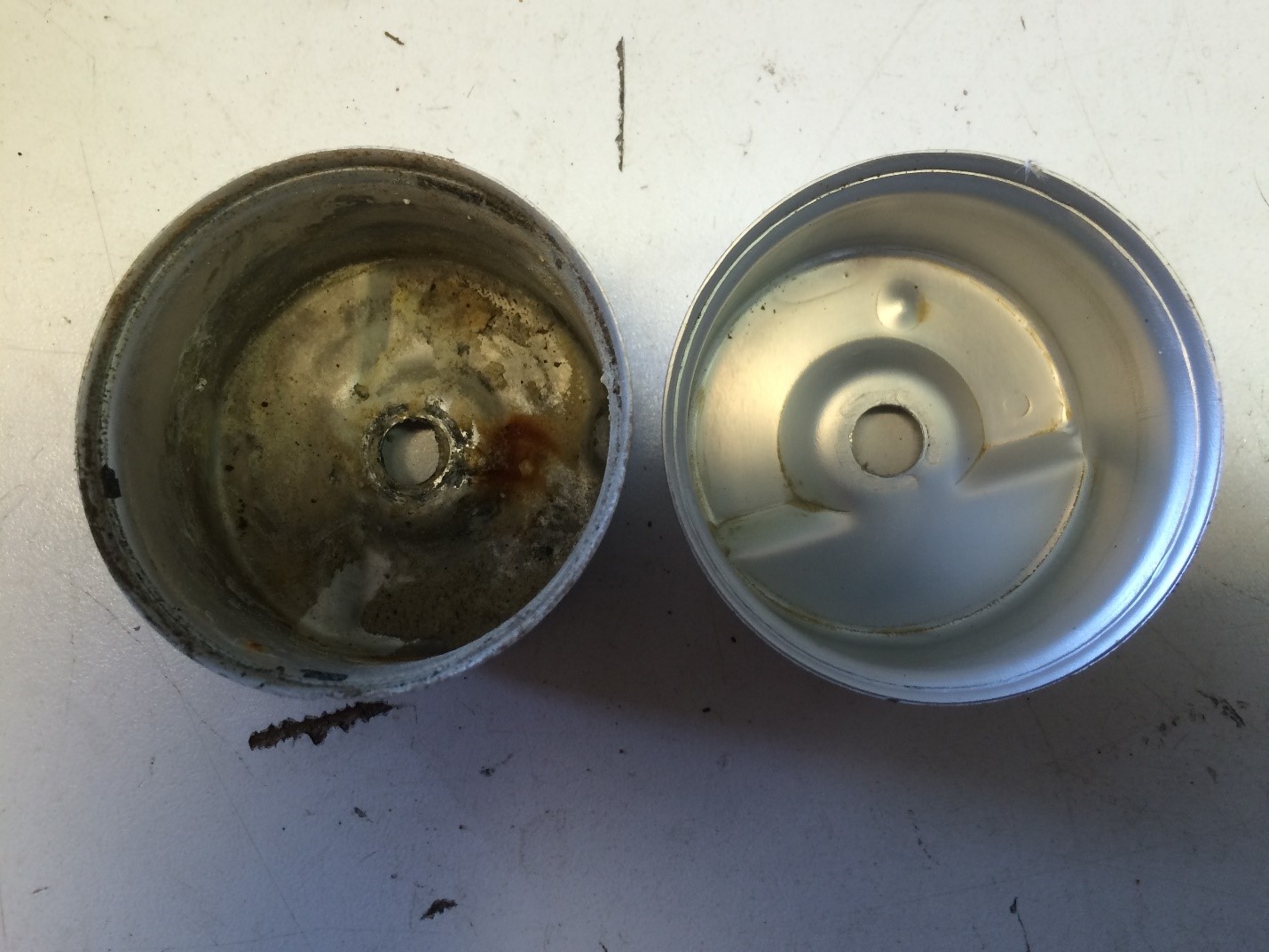
And yes, I do have a "Say NO to Ethanol" bumpersticker on the tow beast. Why do you ask? But enough ranting...
As for changing the engine oil and lower unit drive fluid, this is also pretty straightforward, and described quite well enough in the manual. The oil drain plug access cover held in with a single screw, once removed doubles as a perfect little drain tray spout which directs the flow neatly and handily to your waiting bucket. I spilled nary a drop. I would only offer the following tip for a slightly trickier mess-free oil filter change, which I picked up from some other forum:
Having first let the oil drain from the main drain plug a good long while with the unit trimmed fully down (prop close to ground) and having temporarily replaced the drain plug finger-tight and moved the bucket with the used oil out of harm's way and tipping range, once you get the filter just loose enough to turn easily by hand, trim up the unit (prop away from ground) and turn the engine so that the filter is pointing downward (threaded side of the filter up). Now take a regular flexible plastic cup of about the right size and place it over the filter so that the lip of the cup goes all the way up to and touches the engine block. Squeeze the cup and turn to remove the filter. Any oil that spills will go into the cup. So will the filter once it spins free. All nice and tidy. I had tucked a few paper towels strategically under and around the filter area, but since I didn't lose a single drop with this Plastic Cup Technique, I ended up using them later to just sort of wipe down this and that around the engine, as I treated it to a little silicon spray here and there. Just for the hull of it, once I had the new filter on (in my case a Napa Gold 1365, though a "cardboard-instead-of-steel-construction" Fram PH6017A might also do, as well as an OEM Honda 15400-PFB-014), and before putting in the new oil, I trimmed the engine back down and pulled that main drain plug again and got maybe another ounce or two of used oil out that the trimming up and down and moving side to side must have coaxed out of the motor's nooks and crannies. After buttoning back up the drain plug and cover, just add 2½ quarts (American) of 10W30, and she's all honey gold for next season.
I've only had my 26X in the drink beginning this year, and have already drained and refilled the drive unit twice this season--the second time just to size up if there may be any problems down there once she'd had a few hours on her There weren't, so I might pull just the bottom drain plug for a looksee at a few slow drips. If milky or watery, I'll drain and refill. If not, then not. I'll pull the spark plugs for a looksee and maybe fog up the cylinders while I'm in there anyhow some weekend soon. I might even run a quick cylinder compression test. Then again, I might not.
 . So after reading this thread, and having to change the fuel filter anyway, I decided to have a look at it.
