Lots of "weather helm"?

A forum for discussing topics relating to MacGregor Powersailor Sailboats
User avatar
seahouse
Admiral
Posts: 2182
Joined: Sun Dec 07, 2008 9:17 pm
Sailboat: MacGregor 26M
Location: Niagara at Lake Erie, Ontario. 2011 MacM, 60 hp E-Tec
Contact:

Re: Lots of "weather helm"?

Post by seahouse »

Dave – This is an oversimplification of an interacting complexity (adjust one thing, and another needs to be adjusted), but I hope it might answer some of your questions...

:arrow: Reefing the main …

If, when you first set out the conditions look like you might have to reef, you can reef the mainsail before you leave in the safety of the harbour. Then it's easier to let it out later if you find the conditions calmer than expected.

Your boat can be configured to be reefed from the cockpit by lines led aft as well, but that has compromises, and is not a sure-fire, foolproof method in all conditions. I think.

:arrow: Flattening the mainsail …

These depend on the point of sail, the conditions, and sometimes they affect only one area of the sail and not another. I recommend a good sail trimming manual for more details, and I'm subject to correction by other posters (please and thank you), and as I said, I don't have an “X”, but an “M”, which is a bit different to trim in several ways.

Tighten the outhaul; tighten the boom vang. The boom vang flattens the mainsail and reduces twist by pulling downward on the boom, but its effectiveness at doing this only increases as the boom moves away from the centreline of the boat. That counters the mainsheet's loss of effectiveness at doing this as the boom moves away from the centreline. Study the geometry of the lines (of the mainsheets and boom vang) and the mechanical advantages at the various boom positions and this might become easier to understand.

:arrow: Increasing mast bend …

This is easier on an “X” because you can control it within limitations in real time using and adjustable backstay while you sail. Otherwise it is done ahead of time by balancing the tensions between the capshroud (upper) stays, and the lower shrouds (stays), and the forestay, and backstay. But you must first set and fix the mast rake by adjusting the length of the forestay. (Again... books!)

The mainsail is tailored with a cupped, concave form that gives it an airfoil shape with maximum chord when the mast is slightly pre-bent (forward in the middle). Bending it past this point partially cancels this shaping and reduces the chord, making it flatter, which is desirable in higher winds. Note that the long, limber mast is made to do this- it does not harm the mast in any way unless done to extremes.

:arrow: Easing the mainsheets …

This will have the most immediate effect on reducing heel and WH, and will instantly get you back in control in case of a broach. Hold the mainsheet in one hand while sailing along and continuously adjust it as needed, just let it out to depower a bit if you start to round up or get a gust. This is done most commonly on smaller sailboats than ours, but it works well, and adds a “fun” factor. At least for me. Of course, when you're just cruising this is no longer your priority, so just cleat in at a point where you're comfortable.

Know that the sails perform most efficiently when on the verge of collapse - but you might be more comfortable with the greater tolerance you get from being a bit away from this point. 8)

I'll assume you're wearing sailing gloves at all times in higher winds. I find them useful and wear them in almost all conditions, even when only powering, for handling daggerboard and rudder lines.

- Brian. :wink:
User avatar
Judy B
First Officer
Posts: 304
Joined: Thu Mar 31, 2011 8:37 pm
Sailboat: Other
Location: San Francisco Bay area and any where my hybrid SUV can tow my boat
Contact:

That's called rounding up. Caused by too much heeling.

Post by Judy B »

davesisk wrote:Did a few hours of sailing on the Cape Fear river today! The wind was blowing around 15-20 knots I believe, with some occasional gusts of more. I probably averaged about 4 knots up the river (presumably against the current), and hit 7.5 knots a few times on the way back (presumably with the current).

Now, maybe something on mine isn't quite "tuned" right (or maybe it's the operator! :P ) but sure seems like the 26X has a LOT of weather helm (ie. when the wind blows hard and the boat heels hard, it automagically points itself into the wind). A small daysailor passed me easily because I kept turning into the wind unintentionally. Now, this is not necessarily bad I think...for instance, in an accidental overboard at least the boat would point itself into the wind and stall. So, I think a little bit weather helm is probably good. Maybe it was designed to do this to keep us from getting too stupid? 8)

The "weather helm" response seems to happen very quickly though...the boat heels hard, and next thing you know it has pointed itself into the wind. Steering against it to correct doesn't seem to have any effect either. It seems it happens a little too fast for comfort though...I could see accidentally hitting something that you didn't intend!

Is this just me, or do other folks get the same behavior?

Cheers,
Dave
What you describe is called rounding up. The immediate and proximal cause is excessive heeling. It's tempting to fiddle with the rake of the mast or the tune of the shrouds, but what you really need to do is learn how to balance your fore and aft sail trim or depower your sailplan. Sail Power controls heel, and heeling causes the boat to round up unexpectedly.

You positively, abosolutel CAN'T round up unless you are heeling too much. Excessive heeling is the ONE thing that will round up every boat. From that we can conclude that the first thing to do is control heel by controlling sail power. Conversely: Excessive heeling will always cause you to round up even when the mast is raked the proper amount,

Too much heel is almost always caused by being overpowered. (Less frequently, heeling is is caused by crappy old sails behaving badly in aearodynamic rude ways) . So first, learn how to depower your sails.

#1 Learn to reef the main and foresail. That's the any-body-can-do-it way to reduce power.
#2 Concurrently, work on your sail trim and shape to reduce power. learn to use the traveller and outhaul together (to increase the angle of attack whilst simultaneously controlling twist) and using the outhaul (and mastben) to reduce the power of the mainsail. Make sure your forestay isn't sagging because that will increase the draft in your jib, which in turn increases power.
#3. If #1 and #2 are impossible to achieve, you probably need new sails.
#4. After getting #1-#3 right, adjust the mast rake for fine tuning. Mast rake affects the forward and aft position of the COE, and therefore acts as partial compensation to the horizontal component created when heeled. The horizontal component is the primary one. (unless the sails are as soft as bedsheets with no shape stability)


Here's some simplified physics, to set the record straight. A yacht is not a weather vane, with the bow pointing to windward.... rounding up is caused by too much heeling. I refer you to CJ Marchaj, Sail Performance, 2003, page 269 " The center of effort and its relation to the directional balance of a yacht" for a more rigorous discussion. (in other works, gimme a break 8) as you read this. I am avoiding using precise technical terms to dumb it down :wink: enough that non-mathematicials and non-physicists can understand it)

1. Effect of heeling on directional stability.
1a) Well tuned yachts have "lee helm" if they are sail upright. They will turn downwind. This is normal.
1b1) this happens because the sailplan's COE (center of effort) is in front of the hull's CLR (center of lateral resistance = pivot point)

1b) Well tuned yachts heeling 15-20 degrees tend to have very slight weatherhelm. they will sail a straight course, with the rudder turned 2-4 degree off center line, with minimal pressure on the helm. (the shape of the rudder determines the amount of pressure caused by being a few degrees off, not the degree of deflections)

1c) Well-tune Yachts heeled 20+ degrees will tend to turn the bow into the wind, and require constantly correcting the course with the rudder. The more the boat heels, the greater the skipper will have to turn the rudder. At a certain degree off centerline, the rudder will stall out, and the boat will round up suddenly and uncontrollably. .


2) Directional stability of a yacht when not heeling. The boat will tend to turn downwind, exhibiting lee helm.
2a) When not heeling the COE of the sailplan is in front of the CLR by a little bit.
2a1) The Pivot point: The Hull rotates around an imaginary vertical line running passing through the front section of the keel. same as always.
2a2) The force: The wind provides the dynamic force.
when the boat heels, there's a horizontal couple formed by the center of lift of the sails vs the center of resisitance of the underwater hull & appendages.

3) Directional stability of a yacht when heeling. The boat is stable when heeled 15-20%, rounds up when heeled more than 15-20
3a) The tendency of the boat to change directions is caused by "moment arm" acting around a pivot point overwhelming other vectors. When the boat heels, the "imaginary" center of lift of the sails is outboard and to leeward of the pivot point of the hull, the bow of the boat will yaw into the wind.
3a1) The Pivot point: The Hull rotates around an imaginary vertical line running passing through the front section of the keel. We call that spot "imaginary" spot the center of lateral resistance. Think of the CLR as the pivot point for the hull. (it moves when the boat heels, but it's convenient to think of it as wandering around somewhere just a little aft of the leading edge of the keel)
3a2) The force: The wind provides the dynamic force. is generally designed to be located somewhere forward of the CLR. When the boat heels, this point moves outboard of the hull, to leeward.

4) The boat rounds up if it's heeling too much.
4a) If the boat is heeled too much, the horizonatal moment arm is longer, and the torque is greater, causing a round up.

I'm out of time. don't have time to write a primer on sail trim. but that's really what's needed next, now that we've cleared up the confusion about the physics of directional stability of yachts. Brian (Seahorse) has written some good stuff on trim, so read it. :D

Fair winds,
Judy B
Salmaker
Last edited by Judy B on Tue Aug 27, 2013 10:26 am, edited 3 times in total.
User avatar
133bhp
First Officer
Posts: 225
Joined: Thu Jan 12, 2012 4:20 pm
Sailboat: MacGregor 26X

Re: Lots of "weather helm"?

Post by 133bhp »

New sails would be nice but its not going to happen anytime soon, but the weather helm no matter what was tiring and slow. plus roundng up with slightest provocation, so soemthing had to done.

I've moved the rake temporaily to 2 deg and from intial reports, albeit with a slack rig and no pre bend, it feels like a bit better (not to say looks better frankly) and was sailing itself happily at times with a lighter feel, although its early days.

I've had to pin the forstay on the bow roller for now and the backsaty is something like a foot too short now. but both can be sorted easily.

did a rough image to see difference, Note, lines behind masts is to figure out bend.


Image
User avatar
Hamin' X
Site Admin
Posts: 3464
Joined: Sat Aug 27, 2005 6:02 pm
Sailboat: MacGregor 26X
Location: Hermiston, OR-----------2001 26X DF-50 Suz---------------(Now Sold)
Contact:

Re: Lots of "weather helm"?

Post by Hamin' X »

Judy is correct about the overpowering aspect and I find that many people carry too much cloth for conditions. Xs are particularly susceptible to rounding up when heeled too much. Nature of the beast, do the swept back center board. I think that you will find that the reduced mast rake will help, along with trimming to reduce heel to 15-20º. Anything over that on the scream-o-meter is a waste on these boats.

~Rich
User avatar
bscott
Admiral
Posts: 1143
Joined: Mon Mar 08, 2004 2:45 pm
Sailboat: MacGregor 26X
Location: Arvada, Colorado 2001 X, M rotating mast, E-tec 60 with Power Thruster, "HUFF n Puff"

Re: Lots of "weather helm"?

Post by bscott »

Hardening up the main halyard, tensioning the top 2/3 of the luff of the main will also depower the main--and a cunningham will depower the bottom 1/3. If you have a true jib halyard you can improve pointing by hardening up the jib halyard. Winching with the help of a grinder on the tail is necessary. None of the above works with blown out, deep draft sails.

Bob
User avatar
BOAT
Admiral
Posts: 4969
Joined: Fri Oct 19, 2012 5:12 pm
Sailboat: MacGregor 26M
Location: Oceanside, CA MACMJ213 2013 ETEC60

Re: Lots of "weather helm"?

Post by BOAT »

Look carefully at this picture:

Image

'boat' is accelerating thru 5.9 knots and will be at 6.3 knots in a matter of seconds (see the chartplotter). Now, take a look at the cabin hatch and see my tilt meter - the bubble is barely 13 degrees. It's all about the heel angle. At 6.3k the angle will go to 15. I have the bimini up (notice the black strap attached to the lifeline stanchion) and probably am loosing about 1/2 a knot to the bimini, but I did not want a sunburn.

I'm sailing very flat in a good wind near hull speed.

If you notice the angle of the mainsheet block in the picture (easier to see in the video clip link below) you will see that I am NOT trying to beat the crap out of the boat by pointing as high as I can - I COULD point a lot higher, but that would just move the heel pressure of the wind from my rear to my side and push the boat over sideways.

https://www.youtube.com/watch?v=JZkfQ7hzeI4

Like I said, if I'm okay with taking a few more tacks and in no need to point directly into the wind and kill myself, I don't. I can still achieve a pretty good speed with a more beamy or broader tack if I trim the sails properly and move the wind from blowing directly over the side of the forward quarter boat to a little bit more to aft. If I must beat into the wind I will reef the main. With the main reefed I will still get the same 6 plus knots but a much higher coarse into the wind. It's all about the heel angle.

Same wind hauled in tight at 30 degree heel and my speed would drop to 5 knots. It's all about the heel angle. If I had a nice WIDE boat that was 38% as wide as she was long like my old A23 I could actually gain speed at 25 degrees but poor 'boat' is only 30% as wide as she is long - my waterline does not improve as I get deeper and 'boat' will round up when the heel angle gets too steep. Sure, I can hold it there at 30 degrees with the helm, but I end up loosing speed. She wants to round up after 25 degrees and after 33 degrees I really need to muscle the helm to hold course. That's no way to sail. Hard on the skipper and hard on the boat, but the worst part is that it's hard on your ETA. The basic goal is transportation after all.

It's my experience that you can't really just reef the genny and get a good balance in heavy wind - If your gonna reef, you really need to do the main too, or eliminate the main altogether and use only the genny. If your on the genny alone it does work well as a reefing storm jib - you can work it pretty good and eliminate heel very fast, but if you have the main up the only way to stop heel is to get the pressure off the top of the mast. You gotta reef that main. I got sea sick my first outing on 'boat' because I refused to reef the main in 25knot winds - my old A23 would handle that easy, I was expecting the MAC to do it too, but I learned. The MAC is a TALL rig, treat it like a TALL rig. Once I started treating 'boat' like a tall rig all my problems went away.
User avatar
Tomfoolery
Admiral
Posts: 6135
Joined: Tue Jul 05, 2011 7:42 am
Sailboat: MacGregor 26X
Location: Rochester, NY '99X BF50 'Tomfoolery'

Re: Lots of "weather helm"?

Post by Tomfoolery »

I've always thought it mostly had to do with the sailplan, and the resulting forward thrust vector, moving outside the COR, and once too far outside, the rudder(s) stalling and allowing the boat to round up. At least as it applies at great angles of heel.

Image
User avatar
Judy B
First Officer
Posts: 304
Joined: Thu Mar 31, 2011 8:37 pm
Sailboat: Other
Location: San Francisco Bay area and any where my hybrid SUV can tow my boat
Contact:

Re: Lots of "weather helm"?

Post by Judy B »

bscott wrote:Hardening up the main halyard, tensioning the top 2/3 of the luff of the main will also depower the main--and a cunningham will depower the bottom 1/3. If you have a true jib halyard you can improve pointing by hardening up the jib halyard. Winching with the help of a grinder on the tail is necessary. None of the above works with blown out, deep draft sails.

Bob
It would be more accurate to say that tensioning the Cunningham moves the draft forward. Same with the jib and mainsail halyards. When you tighten the luff of a sail, it pulls the draft forward.

For most folks. a good "general" positioning of the draft is between 35-40% of the chord. Put a band on your boom at 40 percent of the chord, put draft stripes on your mainsail, and keep the position of the deepest part of the bottom stripe just in front of that 40% mark on the boom. For the jib, the position of the max draft should be a little further forward, around 35% of the chord, maybe.

To depower the bottom third of the sail, and if your sail has a loose foot, use the outhaul to reduce the depth of the draft. When you tension the outhaul, it pulls the draft in the botton half of the sail aft, so you should compensate by tightein the Cunningham or mainhalyard a little. I recommend only a little more tension on the Cunningham, not a lot!!!, The most common sail trim mistake I see on boats under 30' and especially on trailerable boats is that the draft is pulled WAY too far forward on the mainsail due to too much luff tension.

(The outhaul has no effect on a sail with a bolt rope foot. On a bolt-rope footed sail, you would need to install a flattening reef to accomplish the same thing. (estimated cost at a loft is $100 + shipping and handling)

Moving the draft doesn't help pointing, per se, unless the draft was already in the wrong place. Moving the draft significantly too far forward reduces pointing and is slow. Having the draft in the right place for the water conditions and wind conditions maximizes pointing. For punching through chop in In rough water or sailing in gusts, you move the draft slightly forward, by a few percent of the chord, for more acceleration and power. To maximize pointing ability in flat water, you move it a few percentage points aft.

That's what trimmers are talking about when they talk about "shifting gears". They're changing the sail shape (draft, twist, angle of attack) either for power, to avoid stalling, or to point high. It's a trade off between the three, in terms of sail shape.

If you can control the shape of your sails well, you have good sails. If you have good sails, you can control heeling, weather helm and rounding up with proper sail trim and rig tune. For the Mac's reefing early is key to controlling heeling. Try that first! next try better trim. Next try reducing mast rake. The Mac is a well designed set of compromises, you should be able to get upwind unless it's screaming out

(The one thing you can't compensate for on a Mac 26 X or M is the effect of wind on the big, tall sides of the hull. That's the price you pay to have all that lovely room inside the cabin and in the cockpit. When the winds get strong, it's gong to affect performance because the hull has a huge profile compared to the size of the sailplan. At some point over 25-30 knots of wind, :o you need to use that big OB to get upwind comfortablely. I've seen the Mac dealer here on San Francisco Bay sail a 26X with great skill in our typical 25 kts of wind, but he was working really hard at it!!!)

If the draft is moving around in every slight wind shift, the sail cloth isn't doing its job well anymore. It's lost its structural stability. Reconditioning/re-resining them will not restore the original shape and strength of the cloth.

Gotta go back to taking care of paying customers.... you guys don't pay me for this!!!

Fair winds,
Judy B
Sailmaker

PS. I didn't proof this, so check back in a few hours to see if I found any egregious errors. I often type away at lightning speed and my thoughts get garbled! :|
Last edited by Judy B on Tue Aug 27, 2013 11:59 am, edited 4 times in total.
User avatar
BOAT
Admiral
Posts: 4969
Joined: Fri Oct 19, 2012 5:12 pm
Sailboat: MacGregor 26M
Location: Oceanside, CA MACMJ213 2013 ETEC60

Re: Lots of "weather helm"?

Post by BOAT »

Yeah, I thought so, but there are some things about the MAC that make things a little different., if the boat was wider with a round bottom like a normal sailboat that would not be such a big deal - the boat would just keep going even with the sail pressure all goofy like that. There would also be a much smoother curve on the ratio between heel angle and rounding up.

The MAC hull just can't take the heel angle - it goes to a certain point and then "POP", she's rounding up. There is no smooth transition when the bottom is flat. We used to sail little Sabot's in Alamitos Bay when I was a kid (11 years old) and they had similar characteristics of rounding suddenly because the hull did not have a smooth transition. We got used to letting out the little main and pumping it back in to spill wind for the sole purpose of putting the hull back flat on the water. People who sail Hobie cats do this as a matter of habit to gain acceleration - they let out the main to make the hull drop then they violently yank the main back in for a crazy fast burst of acceleration. I have seen guys in second place win regattas doing this at the committee boat line.

On the MAC it just came natural to me to "drop the hull" back into the water (flatten it out) and then haul it back in. That puts the weight of the boat back in balance against the sail. If I need to do that very often it's time to reef. It's the boat, not the sails. On my A23 I could blow through it (albeit the A23 was a lot slower than the MAC with a LOT less acceleration) but short squatty rigs are always gonna be better in heavy wind. In this normal 10 knot Pacific breeze we have around here I can blow by all those squatty Cal's and Jensens all day long - the MAC was MADE for the moderate Pacific air. She's a tall rig. Keep the mast in the air.

(P.S. hey Judy! Hi - I missed your post - mine was not done when you posted) I still need to talk to you about a loose footed main!!
User avatar
seahouse
Admiral
Posts: 2182
Joined: Sun Dec 07, 2008 9:17 pm
Sailboat: MacGregor 26M
Location: Niagara at Lake Erie, Ontario. 2011 MacM, 60 hp E-Tec
Contact:

Re: Lots of "weather helm"?

Post by seahouse »

Hi Judy!
Brian (Seahorse) has written some good stuff on trim, so read it.
Thank you for taking the time to post and sharing your knowledge. And I appreciate the endorsement :D . Hope your custom-designed Potter is coming along well!

Tom-
I've always thought it mostly had to do with the sailplan, and the resulting forward thrust vector, moving outside the COR, and once too far outside, the rudder(s) stalling and allowing the boat to round up.
Yeah, that is another of the major considerations; it was in my head too- good for you to mention it - it falls under my "oversimplification of an interacting complexity" category above :wink: :D . Your diagramme illustrates the point perfectly.
User avatar
Judy B
First Officer
Posts: 304
Joined: Thu Mar 31, 2011 8:37 pm
Sailboat: Other
Location: San Francisco Bay area and any where my hybrid SUV can tow my boat
Contact:

Judy's new sport Potter

Post by Judy B »

seahouse wrote:Hi Judy!
Brian (Seahorse) has written some good stuff on trim, so read it.
Thank you for taking the time to post and sharing your knowledge. And I appreciate the endorsement :D . Hope your custom-designed Potter is coming along well!
It's awesome. I'm flying spinnakers from the comfort of the cockpit. She's stable as heck.

Apropos of this thread, I do need to increase the mast rake a half degree or more to increase weather helm so it has more "feel" in the helm (tiller) when heeling at 15 degrees. The helm is a little too neutral for my taste.

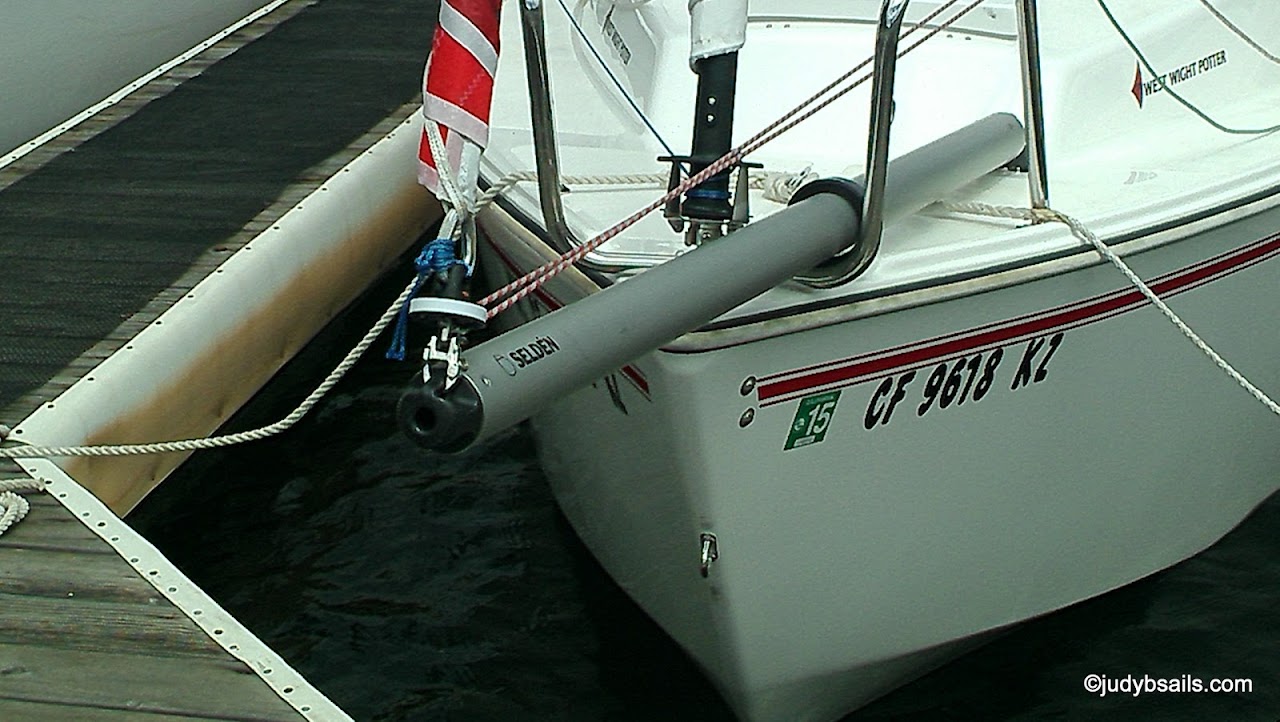
Below: A close up of the extended bowsprit, with the Code 0 spinnaker ready for deployment. Usually, the sprit is retracted when the boat is in the slip.

Image

Below: at the dock with the bow sprit extended, just for this photo. Usually, the bow sprit is retracted in the slip and during docking maneuvers. The furled spinnaker stays on the bow sprit when the sprit is retracted. It's easy to extend the bowsprit after we leave the dock

Image

Below: The sprit retracts for docking and trailer retrieval. Once we're in open water, it slides forward. The pulpit incorporates a roller to support the mast for trailering.

Image
User avatar
mastreb
Admiral
Posts: 3927
Joined: Wed Feb 09, 2011 9:00 am
Sailboat: MacGregor 26M
Location: Cardiff by the Sea, CA ETEC-60 "Luna Sea"
Contact:

Re: Lots of "weather helm"?

Post by mastreb »

Judy B wrote:[quote="bsc

Gotta go back to taking care of paying customers.... you guys don't pay me for this!!!

Fair winds,
Judy B
Sailmaker
Well Gosh Judy, you need to cash my check :D :D (Got the sails yesterday, btw--very fast!)
User avatar
Catigale
Site Admin
Posts: 10421
Joined: Fri Jun 11, 2004 5:59 pm
Sailboat: MacGregor 26X
Location: Admiral .............Catigale 2002X.......Lots of Harpoon Hobie 16 Skiffs....Island 17
Contact:

Re: Lots of "weather helm"?

Post by Catigale »

Hey Judy...bringing the kids out Tues Wed to the Bay......how about we fire up that WWP for a sail

:D :D :D
ronacarme
Captain
Posts: 501
Joined: Sat Jan 03, 2004 2:19 am
Location: southwest Michigan

Re: Lots of "weather helm"?

Post by ronacarme »

In our 2000 26X to control weather helm, we .....

(1)Reduce sail area in high winds to limit heel to15-20 degrees or so. In high winds we run a factory reefed main (about 90 sq ft) + a 25 sq ft storm jib (for closer windward course keeping and more positive tacking) flown on about a 4 ft tack pennant to locate it closer to the main for more slot effect. As winds drop a bit, we fly the full main (151 sq ft) with or without the storm jib.
(2)Adjust centerboard fore/aft location to balance the sailplan....centerboard line out 3/4 to full to balance main and a headsail, or out 3/8 or not quite 1/2 to balance main only (no heasdsail). Balance here means boat holds desired course above a beam reach with helm centered (rudders fore and aft) and boat (given say 2+ mph speed) tacks cleanly.
To adjust centerboard requires getting the side force off of it , as by heading upwind momentarily. So centerboard adjustments can easily be made all day long, as wind speed and sail changes require, to maintain helm balance. So I have made no attempt to change (or even measure) mast rake or worry about replacing 12 year old stock sails,

Obviously, we don't race...boats our 1988 D would sail circles around leave our X behind, so why bother. So we prefer to sail comfortably, at a modest pace, with the X steering itself to windward, as we take half hour lunch breaks and incidently perhaps bolster the ego of a skipper pushing one of those rapidly overhauling boats .

Incidently, to illustrate the importance of balancing sailplan and centerboard on our X.....
(3) Sailing on a reach with main and working jib, with the centerboard line 7/8 to full out, dropping the jib locks our X in a hove-to condition.
(4) Again with the same setup, but motoring at 3-4 mph, one day I dropped the jib and almost ran down another boat because our X would not change course in response to my increasingly panic stricken wheel twirling.

Ron
User avatar
seahouse
Admiral
Posts: 2182
Joined: Sun Dec 07, 2008 9:17 pm
Sailboat: MacGregor 26M
Location: Niagara at Lake Erie, Ontario. 2011 MacM, 60 hp E-Tec
Contact:

Re: Lots of "weather helm"?

Post by seahouse »

(4) Again with the same setup, but motoring at 3-4 mph, one day I dropped the jib and almost ran down another boat because our X would not change course in response to my increasingly panic stricken wheel twirling.
Hey Ron -

Yeah, such things can get hairy. :cry:

I'm sure you are aware of it, some might not be, but in this situation easing the main by releasing the mainsheets will instantly put you back in control.
Post Reply