RussMT wrote:NiceAft wrote:
Other sailboats aren't capable of reaching the speeds needed to remove the excess growth like a Mac can
I have read this before. What speed is that?
Ray
88 MPH

You guys sound sceptical, not that there's anything wrong with that

. So you are thinking that the maximum rate of growth release from friction with the water happens at slow sailing speeds, and does not increase with speed above that? I'm not sure that that's the case. Note I used the plural of speed in the post above, speeds.
Not sure exactly what you are asking, but to deconstruct, here's a loose colloquial line of logic.
1- at zero mph (in the marina) the rate that growth will be shed at will be less than at 65 mph (say, on a Sea-doo). The faster you go, the more friction there is, and the more growth will be shed.
2- the more time spent at speed, the more the growth will be shed. I don't think it gets shed instantly upon reaching a particular speed.
3- the more frequently you take your boat out for a run, the more the growth will be shed. There might even be an early stage in the growth and attachment life cycle where the organism has not yet had a chance to securely attach, so taking the boat out for a run at this stage might shed it, where a week later it might not. (or it might take a higher speed, and more friction with the water, to do it) Also, if the growth gets too severe, you might not be able to reach any where near the speed you need to be to shed the stuff.
4- a boat that has a top speed limit of, say, 9 knots (most sailboats our size) will therefore be less able to shed its growth than a boat that has a top speed of, say, 18 knots (like our Macs)
These are generalities for my area, salt water organisms might be different, and might attach more solidly (I know some attach and eventually penetrate the surface better than adhesives). If you walk around a marina, it's easy to see which boats get taken out, and which don't, by the amount of growth hanging from them.
I haven't been able to confirm it, but I was told years ago that, after waxing the under hull of a Sea-doo, that within the first few miles at 60 mph (maybe slower too) most of the wax will have been stripped from the bottom by friction with the water. That was regular boat wax, no special waxes that I knew of at that time.
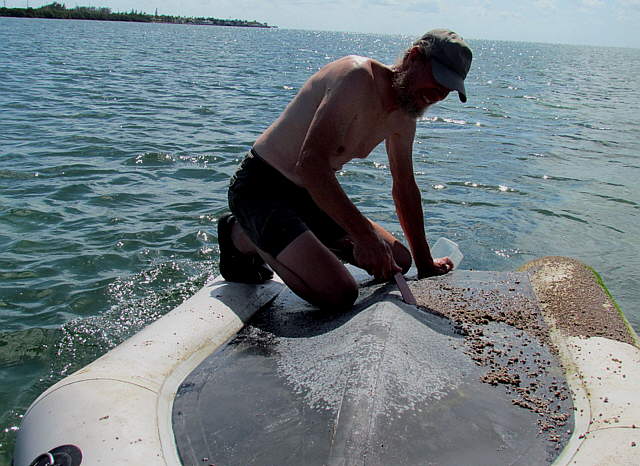
Also, when I went to take my boat out of the water last fall that there was some growth on the bottom (maybe and inch or two of “beards”) so I went out for a fast run, and it was considerably less less than 1/4” when I pulled it out. The beards peel off, the slimy round blotchies, and low-profile growths seem to stay attached more tightly, but they all come off easily from the anti-foul coat with the pressure washer. There is a slight possibility that if I had gone out at much slower sailing speed that it would have peeled it off too, but I doubt it.
I guess keeping your hull clean by regular high speed runs seems to be more in the domain of power boats, than sailboats.