Thank you very much for this information! When I Googled thermal conductivity of fiberglass the number was 0.04. For comparison thermal conductivity of Iron is 80. I didn't worry about units. Higher number means higher conductivity. Now I looked up thermal conductivity of fiberglass insulating board and it is 0.048. So that original number (0.04) was more for insulation type of fiberglass, not solid. So my original idea of circulating ballast water could work...Stevenhigbee wrote:I've considered doing this for a refrigerator. The compelling reason vs a thru-hull, is that it would work while the boat is beached.
Also, the thermal conductivity of solid fiberglass is pretty high. Heat would be lost through the hull through conduction, which is a lot more efficient than the convection into the cabin.
Recycling ballast water with AC sea water pump.
-
dxg4848
- First Officer
- Posts: 228
- Joined: Wed Feb 13, 2013 6:58 am
- Sailboat: MacGregor 26M
- Location: Cleveland, OH; 2009 26M; 60HP Etec
Re: Recycling ballast water with AC sea water pump.
- Russ
- Admiral
- Posts: 8342
- Joined: Thu Oct 11, 2007 12:01 pm
- Sailboat: MacGregor 26M
- Location: Bozeman, Montana "Luna Azul" 2008 M 70hp Suzi
Re: Recycling ballast water with AC sea water pump.
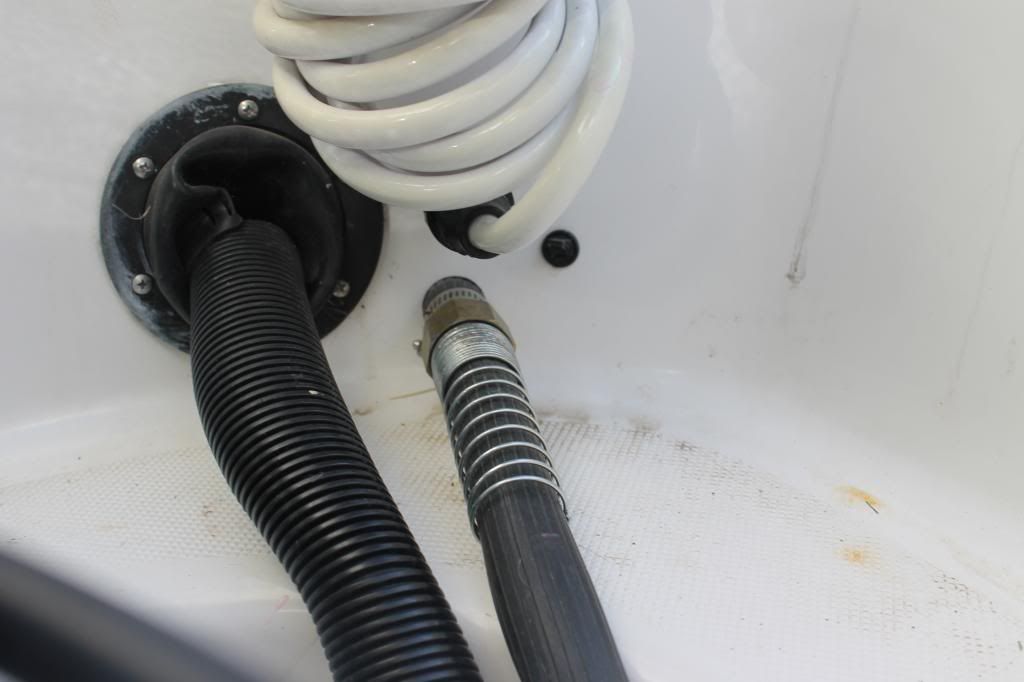
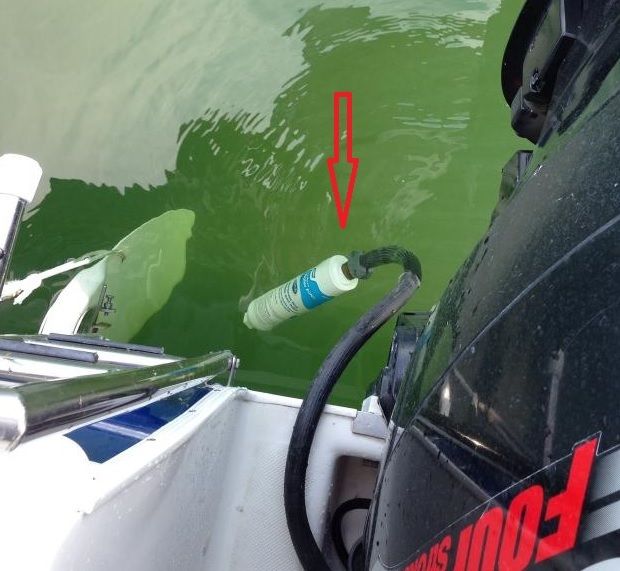
Interesting concept. I too don't want more holes than necessary. That's why my washdown pump uses a "toss over the side" intake when we use it.dxg4848 wrote:I thought through hull would be just above the water (similar to sink drain), then a 90, and about a foot of pipe with a strainer submerged in the water. Then inside the boat shut off valve first, then finer strainer, check valve, and self-priming pump. Then hose ran to the AC unit under the v-berth, and discharge through hull at the bow. Self-priming pump should be able to pull water in easily, and the check valve would prevent system from draining and re-priming when AC is not in use.
Manual recommends using regular pump (not self-priming) installed at least a foot below water line, which is not possible on our boats. But I think self-priming pipe should work for the above setup. Really appreciate your thoughts, help me think this through.
Here I attached a RV water filter to it and toss it over the stern when we turn it on. You could do something similar if you want to remember to toss it over the side when in use. Truth is, my original had a strainer on the intake and I forgot to take it up and started the outboard and chewed it up. Now I used this filter which filters better than a strainer. In your case it might add too much resistance.


That 90 degree elbow complicates things. Like I said, maybe use a hose like above. Personally, I don't like more complicated and would just drill a hole and mount a proper valve.
I've never installed one of these. Doesn't it come with its own raw water pump, strainer and such. I had a friend who had his A/C strainer clog up with jellyfish. But the strainer was inside the boat and I'm sure his unit wasn't below the water line, just the intake. If it comes with a pump, perhaps it is self priming to some extent. Maybe not to pump 6' up, but enough to get started.
--Russ
- Jimmyt
- Admiral
- Posts: 3402
- Joined: Sat Jul 18, 2015 9:52 am
- Sailboat: MacGregor 26M
- Location: Mobile AL 2013 26M, 60 Etec
Re: Recycling ballast water with AC sea water pump.
After Stevenhigbee's post, went back to scouring for a reliable U-value for fibergalss panels/sheets (the resin variety - not insulation). This is not a material I routinely work with, so I don't have a ready number. Had a tough time finding something that gave me a warm fuzzy feeling.
Having said that, I will concede that a couple of sources show the k-factor as 1.5 for one inch thickness, which turns into a U-value of 6 for 0.25 inch. If that is correct, Stevenhigbee is the man of the hour and you WILL be able to use your tank as the heat source/sink. With these properties, you'll get about a 10 degree rise in the ballast tank over the body of water to move out 6,600 btu/hr (cooling capacity will be less - this includes compressor heat). As he points out, the air transfer is less than the water-to-hull-to-water transfer, and I'm getting about 5% loss of capacity due to heating the cabin through the floor.
This Calc is based on the entire bottom of the boat being available for heat transfer. This is probably not the case (I haven't studied the ballast layout). At any rate, as the area goes down, the temperature difference goes up. Half the area - twice the temperature difference.
These are napkin scratch numbers, just for conversation.
So, two questions: First, how confident are you in the thermal properties of your hull?... and second, where can I get some ketchup for this crow I'm trying to eat?
Looks like Russ has your pumping issue solved, so when do you start drilling holes in your ballast tank? We want pic's!
Having said that, I will concede that a couple of sources show the k-factor as 1.5 for one inch thickness, which turns into a U-value of 6 for 0.25 inch. If that is correct, Stevenhigbee is the man of the hour and you WILL be able to use your tank as the heat source/sink. With these properties, you'll get about a 10 degree rise in the ballast tank over the body of water to move out 6,600 btu/hr (cooling capacity will be less - this includes compressor heat). As he points out, the air transfer is less than the water-to-hull-to-water transfer, and I'm getting about 5% loss of capacity due to heating the cabin through the floor.
This Calc is based on the entire bottom of the boat being available for heat transfer. This is probably not the case (I haven't studied the ballast layout). At any rate, as the area goes down, the temperature difference goes up. Half the area - twice the temperature difference.
These are napkin scratch numbers, just for conversation.
So, two questions: First, how confident are you in the thermal properties of your hull?... and second, where can I get some ketchup for this crow I'm trying to eat?
Looks like Russ has your pumping issue solved, so when do you start drilling holes in your ballast tank? We want pic's!
Last edited by Jimmyt on Mon Aug 31, 2015 6:50 pm, edited 1 time in total.
- Highlander
- Admiral
- Posts: 5998
- Joined: Wed Sep 21, 2005 8:25 pm
- Sailboat: MacGregor 26M
- Location: Maccutter26M 2008 75HP Merc. 4/S Victoria BC. Can. ' An Hileanto'ir III '
- Contact:
Re: Recycling ballast water with AC sea water pump.
here,s my water intake above the water level
http://i235.photobucket.com/albums/ee20 ... 0073-1.jpg
the pump & bilge blower above it
http://i235.photobucket.com/albums/ee20 ... 0016-1.jpg
At the end of this vid u can see the p/u tube & inlet screen for the pump
http://vid844.photobucket.com/albums/ab ... 1jbasf.mp4
J
http://i235.photobucket.com/albums/ee20 ... 0073-1.jpg
the pump & bilge blower above it
http://i235.photobucket.com/albums/ee20 ... 0016-1.jpg
At the end of this vid u can see the p/u tube & inlet screen for the pump
http://vid844.photobucket.com/albums/ab ... 1jbasf.mp4
J
-
dxg4848
- First Officer
- Posts: 228
- Joined: Wed Feb 13, 2013 6:58 am
- Sailboat: MacGregor 26M
- Location: Cleveland, OH; 2009 26M; 60HP Etec
Re: Recycling ballast water with AC sea water pump.
Nice setup! What pump is it? Thanks!Highlander wrote: the pump & bilge blower above it
http://i235.photobucket.com/albums/ee20 ... 0016-1.jpg
-
Wayne nicol
- Captain
- Posts: 645
- Joined: Thu Feb 14, 2013 9:21 am
- Sailboat: MacGregor 26M
- Location: Queen CHarlotte Islands,B.C.---------------- lightning white 2012 26M "Merrylegs"
Re: Recycling ballast water with AC sea water pump.
if you are going to use a thru hull- pse make sure it is a bronze one- with a proper- easily accessible sea cock attached directly to it- faulty thru hulls have caused their share of mayhem on the waters. avoid the plastic/ nylon thru hulls!!!!
-
dxg4848
- First Officer
- Posts: 228
- Joined: Wed Feb 13, 2013 6:58 am
- Sailboat: MacGregor 26M
- Location: Cleveland, OH; 2009 26M; 60HP Etec
Re: Recycling ballast water with AC sea water pump.
I am considering 9000 BTU/hr unit:RussMT wrote: I've never installed one of these. Doesn't it come with its own raw water pump, strainer and such. I had a friend who had his A/C strainer clog up with jellyfish. But the strainer was inside the boat and I'm sure his unit wasn't below the water line, just the intake. If it comes with a pump, perhaps it is self priming to some extent. Maybe not to pump 6' up, but enough to get started.
http://www.westmarine.com/buy/webasto-- ... --12634457
Nothing else is included, but you can get WEBASTO Seawater Kit:
http://www.westmarine.com/buy/webasto-- ... P012634630
I am going to buy everything separately to get what works best for me. As far as standard pumps I see two choices:
WEBASTO pump:
http://www.westmarine.com/buy/webasto-- ... P014137301
And MARCH pump:
http://www.westmarine.com/buy/march-pum ... 61_001_515
From my research most people install MARCH.
Both pumps have zero priming capability. They will stop working even with a little bit of air. They must be installed below the water level, or they will not work.
For now I am considering two approaches:
1) Ideally to circulate ballast water. Clean install, less hoses, everything fits around v-berth area, no through hulls... just love this idea. Major concern is heat exchange.
2) Installing intake through hull 90 similar to Highlander's, but low almost next to the sink drain. And use self-priming pump. Pump has to be 110 VAC, 60 HZ, about 300 GPH to work with above unit. That would probably be the right way to do it. Even WEBASTO says it is the best to use self priming pump. If somebody can recommend such pump I would appreciate it. It looks like Highlander may have one in previous post.
- Russ
- Admiral
- Posts: 8342
- Joined: Thu Oct 11, 2007 12:01 pm
- Sailboat: MacGregor 26M
- Location: Bozeman, Montana "Luna Azul" 2008 M 70hp Suzi
Re: Recycling ballast water with AC sea water pump.
I can't get my head around this.dxg4848 wrote:1) Ideally to circulate ballast water. Clean install, less hoses, everything fits around v-berth area, no through hulls... just love this idea. Major concern is heat exchange.
How would it be cleaner? I don't know how you would plumb this into the ballast tank. The vent? Do you drill a hole in the ballast tank? That would be difficult in my opinion.
You still need 2 hoses (in/out). Would the water circulate in the ballast tank. There are several channels and water doesn't (by design) move around the tank easily.
I'll let the engineer types chime in, but the heat exchange might work, however as pointed out, it would have to heat up the ballast water. Once you shut down the A/C and go sailing, you have a hot water bottle inside your boat. So you would probably want to dump the water and refill.
I just doesn't seem clean at all to me.
I get it that you don't want to put holes in the boat.
So how about dipping a hose into the vent to draw water in and discharge out via the anchor locker drain. No new holes and you have positive flow of new water. You would have to leave the gate valve open, but that's no big deal.
--Russ
- Jimmyt
- Admiral
- Posts: 3402
- Joined: Sat Jul 18, 2015 9:52 am
- Sailboat: MacGregor 26M
- Location: Mobile AL 2013 26M, 60 Etec
Re: Recycling ballast water with AC sea water pump.
I know I waffled on this due to having the wrong transfer coefficient. But, now that I know you're considering a 9,000 btu/hr unit in addition to the fact that the ballast tank probably doesn't cover the whole bottom; I'm getting on the shaky side again. If one of the "old salts" can give you an estimate of how much of the ballast tank is directly exposed to the bottom, and how thick the bottom is, we might be able to refine this a bit. Right now, assuming the 9,000 btu/hr cooling capacity (heat rejection is higher due compressor heat, etc.), and 50% of the bottom area @ 1/4" thick, I'm getting a 35 deg F rise. This may, or may not be acceptable to you. Down here, when I need A/C, the water temp is near (or over) 80...
This assumes a homogeneous temperature over the whole surface; and as Russ points out - this might not be a good assumption. He also brings up a point (you may have also considered this) of separating the two connection points to promote good circulation.
If you have an engineer buddy nearby that has more than just a few minutes and a napkin to scratch on, you might want to get him/her to run better numbers before you drill.
I realize that you're just drilling the ballast tank, so you could fix it without worrying about cosmetics. However, it will be a bit of a pain to undo, so you might want to get some more competent advice first.
This assumes a homogeneous temperature over the whole surface; and as Russ points out - this might not be a good assumption. He also brings up a point (you may have also considered this) of separating the two connection points to promote good circulation.
If you have an engineer buddy nearby that has more than just a few minutes and a napkin to scratch on, you might want to get him/her to run better numbers before you drill.
I realize that you're just drilling the ballast tank, so you could fix it without worrying about cosmetics. However, it will be a bit of a pain to undo, so you might want to get some more competent advice first.
-
dxg4848
- First Officer
- Posts: 228
- Joined: Wed Feb 13, 2013 6:58 am
- Sailboat: MacGregor 26M
- Location: Cleveland, OH; 2009 26M; 60HP Etec
Re: Recycling ballast water with AC sea water pump.
AC unit fits nicely on flat area of ballast tank under v-berth next to vent on starboard side. It looks like the ballast tank is almost rectangular in that area (except for bottom) and probably holds close to half of ballast water. I was going to plumb through the top of that rectangular area in aft-port corner for intake, and forward-starboard corner for return. I was going to use two SS flanges for 3/4" pipe (one for intake and one for return). I was going to weld 3" long 3/4" SS pipe on flat side of the flange, drill 3/4" hole through the tank, insert 3" pipe, and epoxy flange to the tank. Then I would have exposed 3/4" pipe connection to install 90, and shut off valve.RussMT wrote:I can't get my head around this.dxg4848 wrote:1) Ideally to circulate ballast water. Clean install, less hoses, everything fits around v-berth area, no through hulls... just love this idea. Major concern is heat exchange.
How would it be cleaner? I don't know how you would plumb this into the ballast tank. The vent? Do you drill a hole in the ballast tank? That would be difficult in my opinion.
You still need 2 hoses (in/out). Would the water circulate in the ballast tank. There are several channels and water doesn't (by design) move around the tank easily.
I'll let the engineer types chime in, but the heat exchange might work, however as pointed out, it would have to heat up the ballast water. Once you shut down the A/C and go sailing, you have a hot water bottle inside your boat. So you would probably want to dump the water and refill.
I just doesn't seem clean at all to me.
I get it that you don't want to put holes in the boat.
So how about dipping a hose into the vent to draw water in and discharge out via the anchor locker drain. No new holes and you have positive flow of new water. You would have to leave the gate valve open, but that's no big deal.
--Russ
I would install sea water pump 2 feet away from intake in the lower storage area on port side across from head. And return would be inches away from AC unit. This is what I mean by clean install.
I have no way to estimate heat exchange capabilities of water ballast tank in that area (the largest part of tank under v-berth). It probably holds close to 500 gallons and in full contact with outside water. I may just try it, run AC for 12 hours on hot day and measure tank water temperature before and after by submerging thermometer through the vent. And if it doesn't work then deal with through hulls.
- Russ
- Admiral
- Posts: 8342
- Joined: Thu Oct 11, 2007 12:01 pm
- Sailboat: MacGregor 26M
- Location: Bozeman, Montana "Luna Azul" 2008 M 70hp Suzi
Re: Recycling ballast water with AC sea water pump.
Well, it sounds like you have it planned out. Just seems like a lot of work to poke holes in the ballast tank and thread/epoxy fittings into it.
The boat has 1150 pounds of water ballast at ~ 8 lbs per gallon, that's 143 gallons of ballast water. Not that much. Ever see a 150 gallon fish tank? I'd estimate 45% of that is in contact with the external hull. It may transfer heat. Certainly more while moving. It would probably work, however it seems complicated and inefficient with possible heat build up in the storage comparments.
Like I said, If I were afraid of drilling holes in the bottom, I'd just draw from the vent and dump it out the locker drain. Many have rigged permanent vents on the vent hole. Wouldn't be hard to stick a tube in there.
Thru hulls are very common and few boats sink from a modern fitting. Generally the failures are in winter and freezing.
But hey, when you do it please report how it works. I'm sure lots of us are curious.
--Russ
The boat has 1150 pounds of water ballast at ~ 8 lbs per gallon, that's 143 gallons of ballast water. Not that much. Ever see a 150 gallon fish tank? I'd estimate 45% of that is in contact with the external hull. It may transfer heat. Certainly more while moving. It would probably work, however it seems complicated and inefficient with possible heat build up in the storage comparments.
Like I said, If I were afraid of drilling holes in the bottom, I'd just draw from the vent and dump it out the locker drain. Many have rigged permanent vents on the vent hole. Wouldn't be hard to stick a tube in there.
Thru hulls are very common and few boats sink from a modern fitting. Generally the failures are in winter and freezing.
But hey, when you do it please report how it works. I'm sure lots of us are curious.
--Russ
- Jimmyt
- Admiral
- Posts: 3402
- Joined: Sat Jul 18, 2015 9:52 am
- Sailboat: MacGregor 26M
- Location: Mobile AL 2013 26M, 60 Etec
Re: Recycling ballast water with AC sea water pump.
Love your tenacity! I would suggest temporary piping to 'test' the idea. Drill a hole to accommodate a 1/2" copper pipe or similar in the ballast tank for the suction, and epoxy it in on the surface (so you can pull it back out and patch, or install the permanent connection if it works). Just pipe the return line to the vent hole with an expansion stopper or other removable means. If it goes south, just one hole to fix. Basically, you're going to do the rest of the install the same regardless of whether you go thru-hull or not, so you have nothing much to lose by trying it. Just monitor your ballast temp as you commented to make sure you don't damage your brand new A/C unit due to high head pressure.
Good Luck, and like Russ said, we want to hear how it plays out. Personally, I hope it works. I don't usually enjoy being wrong, but this time I would.
- Highlander
- Admiral
- Posts: 5998
- Joined: Wed Sep 21, 2005 8:25 pm
- Sailboat: MacGregor 26M
- Location: Maccutter26M 2008 75HP Merc. 4/S Victoria BC. Can. ' An Hileanto'ir III '
- Contact:
Re: Recycling ballast water with AC sea water pump.
The biggest issue I see here is that the ballast tank has 4 walls & only one "the bottom of the hull" is in contact with the outside water for cooling purposes the other three top & sides r releasing or transferring heat exchange into the open bilge area which will help with moisture or maybe cause condensation to build in that area & as heat rises it will rise into the cabin
, really can,t see that as being efficient . But I,ll let the HVAC guy,s figure that one out , interesting concept though ! .
keep us all posted
J
keep us all posted
J
- mastreb
- Admiral
- Posts: 3927
- Joined: Wed Feb 09, 2011 9:00 am
- Sailboat: MacGregor 26M
- Location: Cardiff by the Sea, CA ETEC-60 "Luna Sea"
- Contact:
Re: Recycling ballast water with AC sea water pump.
Put a ball valve on the ballast tank, opposite the gate valve on the stern. Now your ballast tank will always fill, even if you leave the gate valve shut. Great safety feature.
Put your intake hose into the ballast tank vent. Now you don't actually have a "thru hull" that will sink the boat.
Eject your hot output water above the waterline or into a T on the sink drain.
Solves all problems.
Put your intake hose into the ballast tank vent. Now you don't actually have a "thru hull" that will sink the boat.
Eject your hot output water above the waterline or into a T on the sink drain.
Solves all problems.
- Jimmyt
- Admiral
- Posts: 3402
- Joined: Sat Jul 18, 2015 9:52 am
- Sailboat: MacGregor 26M
- Location: Mobile AL 2013 26M, 60 Etec
Re: Recycling ballast water with AC sea water pump.
So the ball is mounted outside on the stern - mirroring the large gate. I like it! A through hull that can't sink you! To be clear, do you propose the valve stay open all the time, or only when stationary? Seems like it might wind up with a partially full tank if open underway.
Building on your genius, if he only wants cool at anchor or dock, just open the gate and take suction through the vent as you propose. Then he puts no holes in the boat (discharge as you propose also).
In any event, your approach seems to be a great melding of objectives to get cool water in with zero risk of sinking. Excellent.
I've searched the site for hull thickness, but found several different answers. Some indicate the bottom near the ballast tank could be 1/2 to 3/4 inches thick. Other spots are reported to be as little as 1/8" thick. Also appears that the majority of the bottom exposed to ballast water is located from just behind the dagger board forward. At 1/2" thick, the small bottom area, and 9.000 btu capacity works out to over 50 deg rise. I don't see the boat requiring a continuous 9,000 btu/hr to stay comfortable, which may reduce the temp rise slightly. But, if the bottom is 1/2" or thicker, and the area as small as some older posts indicate, the Mastreb' solution offers a way to beat the problem.
Building on your genius, if he only wants cool at anchor or dock, just open the gate and take suction through the vent as you propose. Then he puts no holes in the boat (discharge as you propose also).
In any event, your approach seems to be a great melding of objectives to get cool water in with zero risk of sinking. Excellent.
I've searched the site for hull thickness, but found several different answers. Some indicate the bottom near the ballast tank could be 1/2 to 3/4 inches thick. Other spots are reported to be as little as 1/8" thick. Also appears that the majority of the bottom exposed to ballast water is located from just behind the dagger board forward. At 1/2" thick, the small bottom area, and 9.000 btu capacity works out to over 50 deg rise. I don't see the boat requiring a continuous 9,000 btu/hr to stay comfortable, which may reduce the temp rise slightly. But, if the bottom is 1/2" or thicker, and the area as small as some older posts indicate, the Mastreb' solution offers a way to beat the problem.