Sloop John B wrote:And for hauling gas, if youre going to Mexico, fill the cabin up with as many 2.5 gallon containers you can cram in there. Besides your PFD, youll want to strap on a small fire extinguisher and a parachute.
Thanks SJB... now I have to wipe the spit off my monitor!
Mark....The smell of peameal bacon drifting across a misty lake in the early morn .Only with a cup of Folgers. LIfe is good in the frozen north..BTW can you buy clamato juice in the US yet??
mark. Bloody Ceasar) a jigger of vodka over ice with a dash or worcestershire sauce, couple of drops of tobasco sauce , celery salt, or a sprig of celery and top with clamato......mmmmm a taste to behold, but not too many.tend to sneak up on you, then it dont matter if you have any gasoline or not
Sloop John B wrote:
And for hauling gas, if youre going to Mexico, fill the cabin up with as many 2.5 gallon containers you can cram in there. Besides your PFD, youll want to strap on a small fire extinguisher and a parachute.
If you're carrying that much fuel you can skip the fire extingusher. It won't be of much use and you probably will never know you needed to use it anyway.
If I understand you correctly, at speed, when the ballast is empty, the valve will be above water? This obviously makes it a lot easier to tell. I guess I've never checked the level of the valve at speed, only while sitting still filling and of course then it's under water.
When our is on plane, the ballast fill valve is completely above the water. Ours drains within 5 minutes of getting up on plane (~ 11 mph or faster) -- I always check it after pulling out, and there's nary a dribble.
Regardless of whether the ballast tank is empty or full, once boat is on a plane the waterline is below the ballast valve. As I mentioned above, when you lean out to view it. be sure you have a restraint holding you aboard. You'll be leaning far enough to take an unexpected dive, should the boat hit an unexpected wake or wave.
=========================================================
ModsNote:
Older thread from 2005 above this point.
=========================================================
On a six day cruise along the Maine coast last year, in addition to my two running 6 gal fuel tanks, I brought a full spare 5 gal carry tank. I secured this spare tank to the mast with a cam tension strap as well as across-deck stanchion to stanchion with another cam strap. Additionally, I had secured a milk crate in the area under the stern seat for additional supplies & stern anchor.
I was wondering where, if anyone does, do you carry spare / portable fuel tanks for long trips?
EDIT NOTE: I chose to revive & add on to this older post rather than start a new one because of the fuel tank related content. Only after did I realize that it is also about ballast dumping as well. Sorry for the confusion! -K9
Last edited by K9Kampers on Sat Aug 09, 2008 11:33 am, edited 1 time in total.
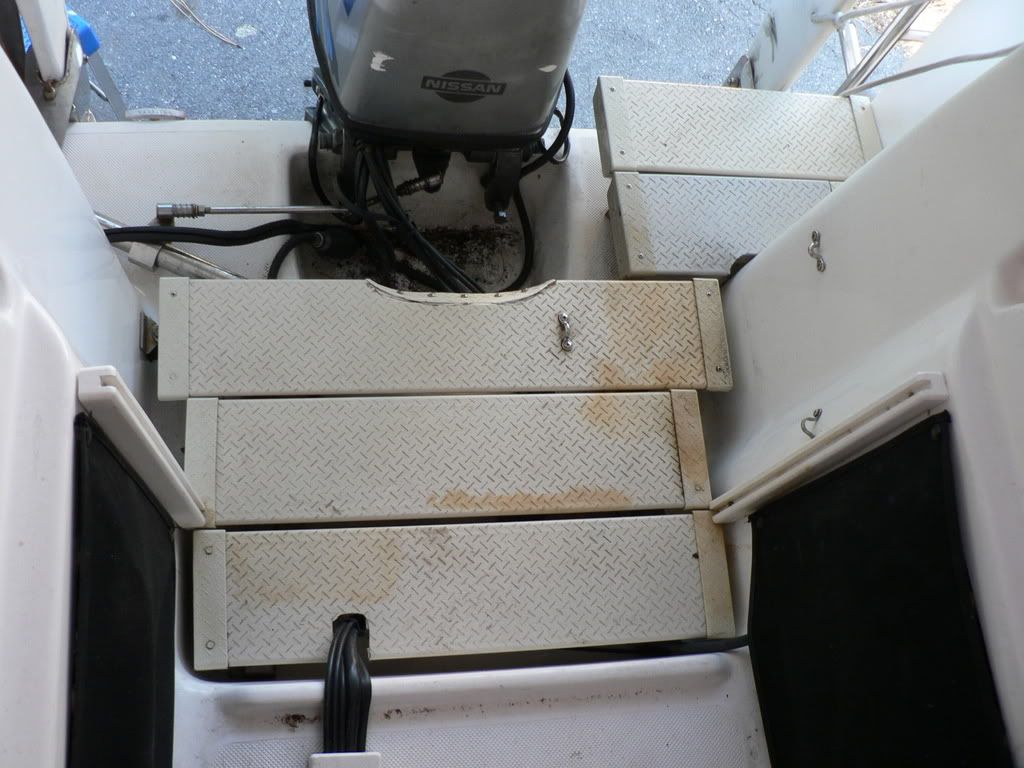
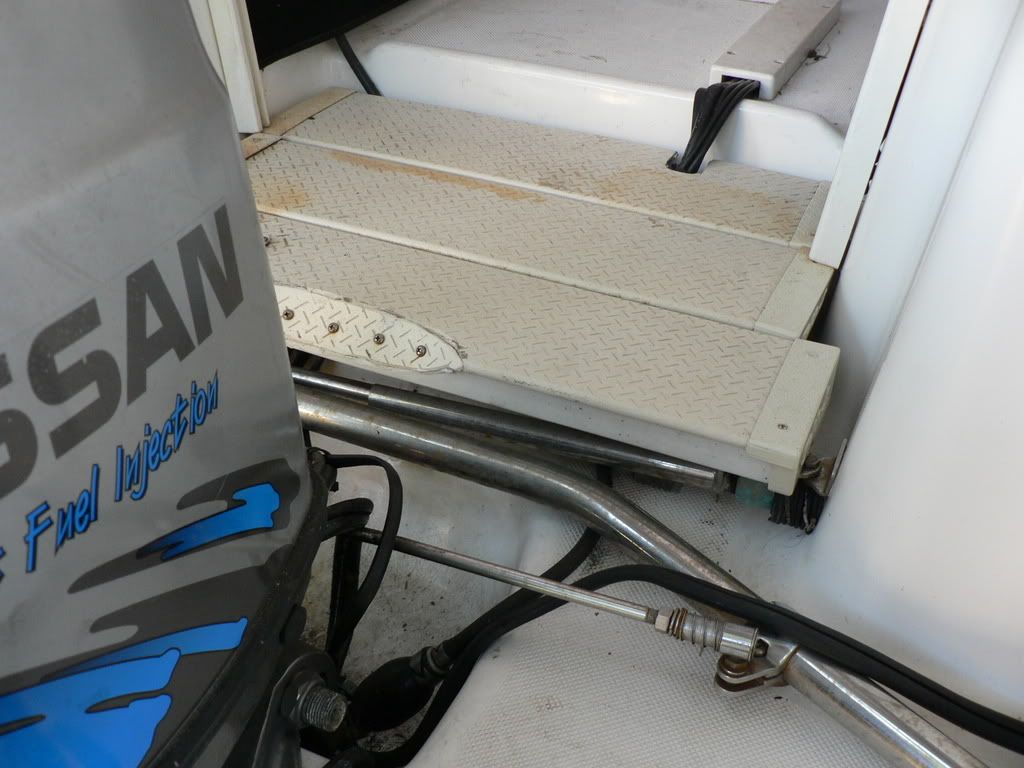
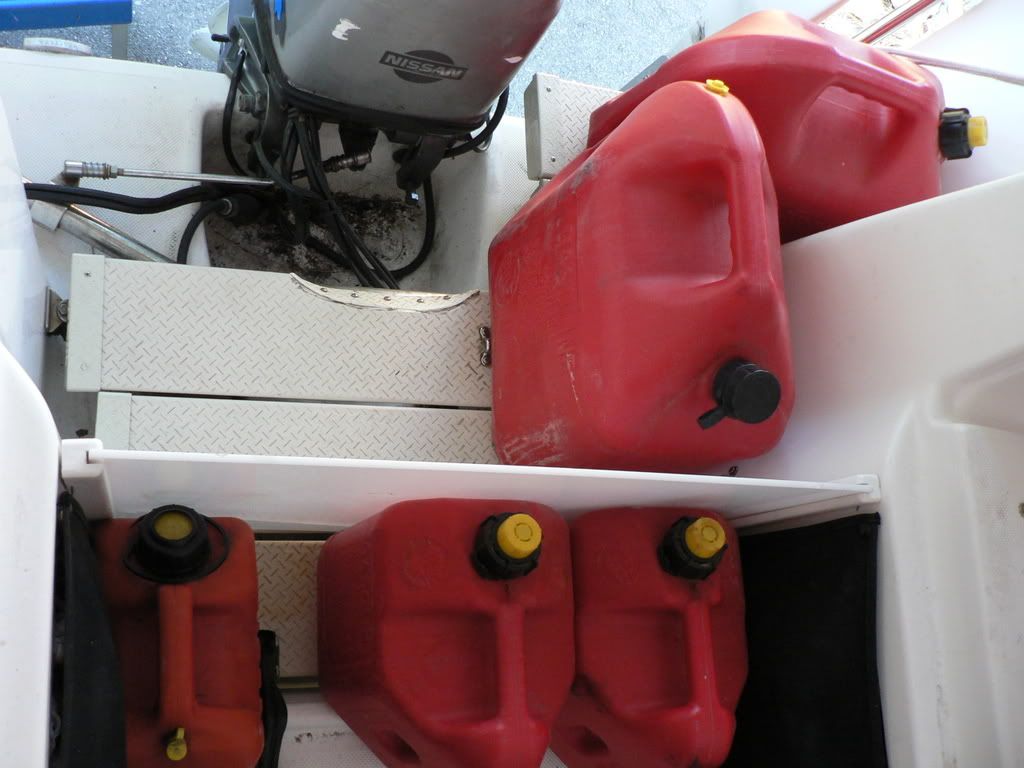
In preparation for our cruise up the Inside Passage to Alaska I had to figure out how to increase the amount of gas on board our X. We have a pair of 12 gallon tanks for primary fuel supply, but the distance between fuel docks in a couple of places (over 150 miles) made it important to carry more. I built a platform on the stern, above the steering arms, which provided a flat place to tie down a pair of upright style 5 gallon jerry cans. The platform also makes it easier to step in and out of the boat, without worrying about stepping on the steering linkage. It was tight, but the jerry cans fit on the port side, one at right angles to the boat, and one parallel to the hull. There's just enough room for my Nissan TLDI 50 to still tilt up. I also carried a pair of 2.5 gallon jerry cans under the steering seat, and a 1 gallon can with mixed gas for the 3.5 hp kicker motor. It also fit under the seat. I didn't want gas cans strapped down on the foredeck or somewhere in the cockpit. Space is just too limited, and I wanted to be able to move around on deck as easily as possible, and also not obstruct visibility. This fuel arrangement has worked well for two extended trips. I use one of those siphon tubes that you shake to get the fuel flowing when transfering gas from jerry can to main tank. Works great and completely eliminates spillage.
...I built a platform on the stern, above the steering arms, which provided a flat place to tie down a pair of upright style 5 gallon jerry cans. The platform also makes it easier to step in and out of the boat, without worrying about stepping on the steering linkage. It was tight, but the jerry cans fit on the port side, one at right angles to the boat, and one parallel to the hull...
Chinook-
That's a great idea! Any pics? I couldn't find it in the Mods library. I know Tahoe Jack did something like that.
There was a Mac owner out of Colorado, a school teacher, who posted drawings for his "back porch" mod a few years ago. I made one out of redwood in 2003 and still going strong.
1. Our 2001 X runs a Honda 9.9 4 str. Averaged 12 mpg over 2006 and 2007 seasons and this year 14 mpg so far ( more motor sailing). Obviously we cannot motor above hullspeed (7.4 mph). We normally motor 4.5-6 mph. Mpg calculated from GPS miles motored and a calibrated tank dipstick.
2. Test results I have read over the years suggest to me that a carb'd 4 str will likely give more mpg (hence more range per tank) as you decrease speed further and further below hullspeed....tho as you get down close to motor idle speed, dropping fuel and prop efficiency may interfere ....so why not test mpg at say 7, 6, 5, 4 mph and see?
3. Test results I have seen suggest to me that reducing mph with a carb'd 50 hp 2 str might not improve mpg as much, and with fuel injected 4 str might improve mpg better, even down to idle speed, due to differences in fuel metering precision.
4. When motoring because winds are too light for good sailing speed, raise and trim the mainsail, as motorsailing may give more mpg than mere motoring.
Ron
I always struggle trying to post photos, but here goes. If this works, you'll see several views of the stern platform, both with and without gas cans. The 5 gallon cans are just sitting there, but would be bungeed in during a trip.
I never guess if mine is empty, I just look out the back at the valve. The speed you need to run to dump under way will bring the transom valve completely out of the water. I simply look at it every so often and when no more water is running out you are done. There is no need for guess work or timing.
The process is simple, speed up to around 10 knots, open the transom valve, open the vent (it makes no difference if it is the old one at the step or forward at the vee berth), wait until no more water is coming out the transom valve (your speed will now be 3-4 knots faster), close the transom valve, plug the vent. I never get a drop of water out later at the ramp.
Anytime I need to motor further than a mile or so I always dump the ballast (if I even have it in to begin with). Depending on speed, I get 3 - 5 Nautical Miles per gallon with an empty tank. With my four 6 gallon tanks (those are mine in the photo above) I have 75 to 120 miles of fuel. For planning purposes I assume a range of 80 Nm with full tanks. This allows me to choose what ever speed I want and not worry about currents and other factors.
We have many many hundreds of miles motoring with empty ballast in our X and have never experienced any bad behavior from the boat. The only time I'll run any distance with ballast is in rough seas of 4'-6' that are closely spaced. In those conditions you need the weight to keep the boat in the water. Without it, it will launch off the wave tops and slam down. Other than that, ballast is only for sailing and less rolling at anchor. Dump it for all motoring.


 a jigger of vodka over ice with a dash or worcestershire sauce, couple of drops of tobasco sauce , celery salt, or a sprig of celery and top with clamato......mmmmm a taste to behold, but not too many.tend to sneak up on you, then it dont matter if you have any gasoline or not


 is on plane, the ballast fill valve is completely above the water. Ours drains within 5 minutes of getting up on plane (~ 11 mph or faster) -- I always check it after pulling out, and there's nary a dribble.