Page 2 of 2
Posted: Wed Sep 26, 2007 3:55 am
by ALX357
You might try this later ....
In addition to the standard CDI Roller Furl 150 Genny, I also have a regular secondary jib, hank on, allready attached to a forestay wire, and with all the hardware needed to hoist it behind the furled Genny, all rolled up in a deck bag.
A very strong low-stretch hoist line hauls the top of the jib wire up to its (added) block on the mast at the jib-head, gets cleated off when the jib-wire is tight, and the deck bag holds the hanked on jib ready. Unzip the bottom of the deck bag, attach the halyard to the jib, and thread the sheets, then stow the deck bag, hoist the jib,and then you have a standard head-sail instead of the Genny, for tighter sheeting, and better sail shape. Stow the jib the same way, in reverse, and when removed, you have the sail and the wire in the deck bag again, to keep below and out of the way.
It takes only a couple of extra minutes to rig and hoist this headsail, it allows using the regular hank-on jib leaving the Genny alone, on its furler with the sheets and everthing still ready.
Posted: Sat Sep 29, 2007 4:33 pm
by Terry
I found this thread on another site regarding the higher end furlers. Kind of interesting I think.
http://www.sailboatowners.com/forums/pv ... 70135422.5
tested them all!
Posted: Mon Oct 08, 2007 1:25 pm
by mikelinmon
Some time ago, 3 or 4 years, Roger MacGregor bought each roller furler available for the Mac 26. I put them together, tested each one and we still use only the CDI. Most important problem with the other units is the number of parts that can fall off the boat when lowering the mast and the extra time involved. Harkin and Shaffer did not get the idea of trailersailing a boat! If you keep your boat in a slip, never take down the mast then, OK. You get the ability to more easily change sails and with the units which have a roller bearing swivel at bottom as well as top, the reef is better looking. Costs a egrat deal more and you must change the luff tape size!
Now for the latest, Roger has invented his own furler, even less parts and very easy assy. Lighter than the CDI with more durable roller, might cost less! So if you are going to buy a new one check out the MacGregor unit! I will be testing the new unit today!
Please don't block this, it is available to all dealers as of next week or so. If I have an unfair advantage it is for only a few days, all dealers will have this soon!
Mike Inmon
Posted: Tue Oct 16, 2007 2:09 pm
by Divecoz
Wow what a break through. . . I guess I should down down to
Ar Keen Saw more often to help ageing in-laws.
Thanks Mike I will contact my dealer .
Posted: Tue Oct 23, 2007 9:00 am
by tangentair
There are several related (IMO) posts right now that have interelated issues. The failures of the forstay on the M, jib down hauls and jib furlers could all roll or fall (OK no more humor) under a dual forstay system. It would provide the redundancy for safety, and could be rigged with a 150/100 hank on combination or storm hank on/150 furler or fulrer/furler combination etc. The question that comes immediately to mind is the connection at the top of the mast and how to provide clearence between the stays while providing a uniform downward pull when one stay is loaded and the other isn't.
Posted: Tue Oct 23, 2007 5:43 pm
by Highlander
I am happy to say I've resolved these issues
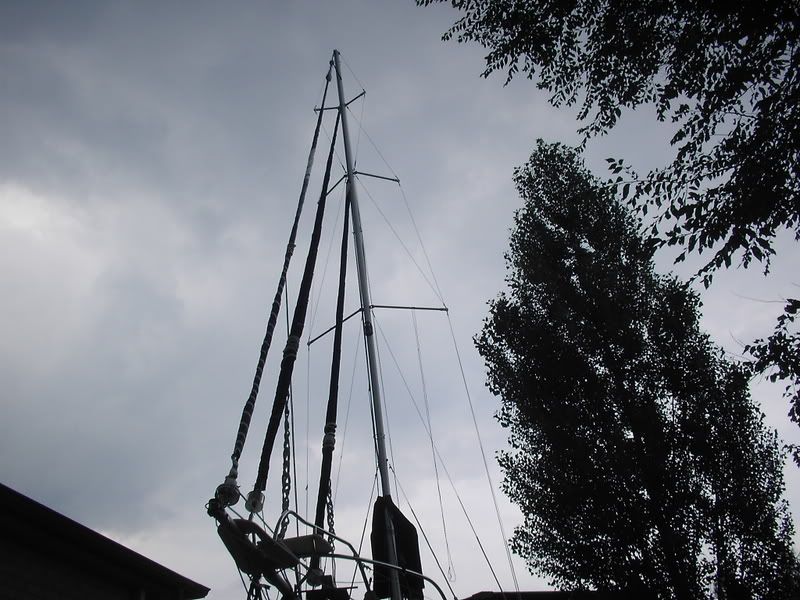
Cheers John
Posted: Wed Oct 24, 2007 1:26 am
by delevi
Alex,
How do you attach the bottom of the second forestay with the furling drum in the way? Where do you secure the tack for the jib? Do you use two jib halyards.. one for the wire and one for the sail? The setup sounds intriguing. If I can pull it off, I would do the same, only keeping the jib on the furler and using a hank-on genoa.
Dive,
I use the CDI unit in high winds and don't think I'm suffering much performance loss. Of course, I haven't used the higher-end models. The jib works great partially furled, thanks in part to a luff pad. To be fair, I spent some time making the luff really tight. I also have running backstays which alleviates most of the forestay sag. I also use a 5/32" forestay wire which is very tight (2” shorter,) along with 600 lbs of upper shroud tension, 320 lbs lower shroud tension. The downside is the luff is tight all the time since it is way too much work to relieve tension after the sail is rolled up.
Mike,
Does the MacGregor furler use an internal halyard like the CDI or the boat's halyard w/ swivel like on the Schaefer, Harken, etc. ?
Leon
Posted: Sat Oct 27, 2007 9:46 am
by mikelinmon
Internal halyard sim to but better. Good looking stainless steel parts, works great, perfect for trailering, get one.
Mike Inmon
Posted: Sat Oct 27, 2007 10:24 am
by Divecoz
mikelinmon wrote:Internal halyard sim to but better. Good looking stainless steel parts, works great, perfect for trailering, get one.
Mike Inmon
Please post some sources Mike. Links and photos too please.
Posted: Tue Nov 06, 2007 10:19 pm
by ALX357
Delevi,
here are some photos of the rig I set up.
You need two halyards, one for the wire, and one for the sail.
I used a very low-stretch Amsteel like line for the wire halyard.
The jib-wire has to stop short of its jib-head block, for obvious reasons.

The aux jib wire is attached to the stirrup shackle at the aft end of the chainlpate tang.
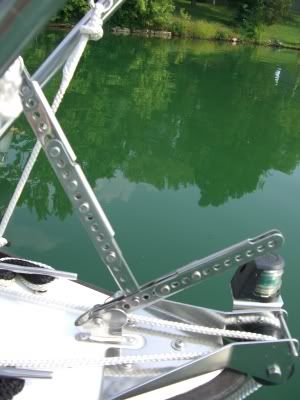
The furler drum is mounted forward on the made-up lever arm a few holes. (spare Mac vernier plates overlapped and pinned in two places.)

This separation is enough for the jib wire to clear the furler drum, with space for the hanks to pass also.
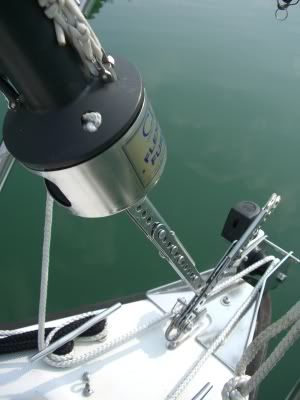
Keep in mind that the Furler sail is going to be nearly impossible to use until the auxilary wire is taken down. It is an either/or set-up, just easier and faster than changing the furler sail off the foil.
I guess on an extended down-wind run, they could both be flown wing-and-wing. But not easy to manage the windward sheet of the Furler sail, which would have to pass back forward around the aux wire, and thus be EXTRA long.
Posted: Wed Nov 07, 2007 8:35 pm
by delevi
Thanks ALX. Very nice work.
Leon
Posted: Thu Nov 29, 2007 2:17 pm
by Terry
Well, I did some Google research and even read some old archived opinions on other sites about roller furlers. Some swear by the CDI while others swear by the higher end ones. One thing about the CDI and others that use an internal halyard is the inability to tension the luff sufficiently. Another thing I
perceived is the inability to easily change headsails while on the water with the mast up (at the slip).
So I did some research on the Schaefer Snapfurl CF-700, found one for $714.00 at Trotac Marine in Victoria B.C. A slick unit that easily allows for changing the headsail because it incorporates the use of your headsail halyard, you simply pull down your genoa, remove it, and connect the jib and haul it up. The use of your own halyard also allows for adjusting the luff tension on the headsail. I did not read any negative comments about it so I think I am sold.

On edit one more thing:
You don't have to have a UV strip sewn onto the foot & leach since all you have to do is drop the sail and bag it.
Posted: Thu Nov 29, 2007 4:45 pm
by Highlander
Yup! must be fall out there Terry's picking the money tree again

Re: Roller Furler
Posted: Thu Jul 09, 2009 10:52 am
by Kilblaan
We are the new owners of a 2001 26X.
We find that feeding the jib into the furler is difficult as the line within the furler seems to stick.
Is their some sort of lubricant (i.e. spray white grease) that can be used so that the rope and the metal piece moves more smoothly?
Re: Roller Furler
Posted: Thu Jul 09, 2009 11:23 am
by Don T
Hello,
Try "sail coat" a dry teflon lube.