Page 3 of 6
Re: Rudder Attachment to 26M Hull
Posted: Tue Jun 10, 2014 11:49 pm
by seahouse
Sorry Wandering. For my role in the hijacking of your topic. You must be thinking to yourself “what kind of a Frankenstein thread have I created by asking a simple question”

. Of course, it's not you. And it looks like you've been around here long enough to know that this is not the usual tone and tenor of our great forum.
- Brian.
Re: Rudder Attachment to 26M Hull
Posted: Tue Jun 10, 2014 11:55 pm
by seahouse
So far as machining hardened SS...well, that's what happens when you pick up odd bits to make some project with. It's already been treated for whatever it's intended use was, and now I come along and try to drill it, or cut it and it's impossible. I have two sections of tubing I used in my new sunshade that are so difficult to work, you practically can't using cordless tools which is all I keep aboard. Trying to drill a hole in the stuff was insane. I knew the tubing was good when I picked it up. Just felt good. The tubing i had to cut for my recent cockpit table, on the other hand, cut like butter.
Ix
Ixneigh – I too frequently use scavenged or found parts of unknown origin in the field. There are ways of narrowing down its identity. I enjoy the challenge. A magnet helps. Spark testing on a grinding wheel can be useful for identifying the carbon percentage (low, medium or high) and even some of the alloying elements. I used to routinely identify 01 from A2 (harder to do) from D2 (easy to do) tool steels that weren't identified this way. They all have distinctive sparks and patterns, like fingerprints.
While spark testing can tell you something about the hardenability of the piece, the actual hardness is better judged by using a file. I use a fine file because it's easier to judge differences with when you get into harder materials, and I use the same file for comparison and uniformity.
With a little practice, you can get good at judging the hardness range, and save yourself some aggravation later when you try and work it. You'll have to file through some materials to get through the skin, which can either be harder (from case hardening, plating etc), or softer (from decarburization during heat treatment) than the surface below it, to get a more accurate reading.
Start by file-testing the two metals you just mentioned, you already know one is hard to work, and the other is easy – it takes just three or four strokes on an edge; you will feel (and maybe hear) the difference, but you can also judge by the width of the swath removed, being careful to keep other things (like the area of the corner, firmness of holding) consistent between the two. It's easier than you might think. So next time you're out material hunting take a file along and check it for hardness before you buy.
Good luck – B.

Re: Rudder Attachment to 26M Hull
Posted: Wed Jun 11, 2014 11:40 am
by raycarlson
Well I would like to offer you an honest apology. Although I have never solicited any help from you, as you state you do offer advice freely to many many threads in this forum in a spirit of helping others. While I don't even know what one would call a degree consisting of 8 years of post secondary graduate work, I do have many years of practical working experience with metal science as an airframe mechanic and after one or twohundredthousand times of drilling out alum,stainless,monel,inconel,titanium rivets,bolts and blind fastners I can just about tell you what the alloy is in the first 15seconds of drilling. Needless to say many times I see you giving out advice I disagree with or way over complicating a simple issue, 99 times out of 100 I will say nothing but occasionally will comment that I have had a different solution work for me. Apparently I have gone overboard in my quest to define your term of Soft and how it relates to a stainless steel bolt. Per your request I will not ruffle your feathers again, but I won't let a fellow forum member receive bad advice either, I guess i'll have to modify the presentation somewhat. As for your most generous advice on my personal conduct and taste in humor all I can tell you is we grew up on different sides of the street, and most assuredly wouldn't be seen sipping a beer together at the local tavern.
Re: Rudder Attachment to 26M Hull
Posted: Wed Jun 11, 2014 12:36 pm
by Ixneigh
Interesting info on the spark testing.
I love stainless and other durable material. I have a pretty good feel for the quality stuff. No formal training though. It's actually pretty difficult to find nice SS. There's a second hand boating shop nearby where I look for old stock to repurpose.
Have you umm, seeing as how you are a welder and all, and seem to know metal, considered making a set of custom rudder brackets, the way they ought to be, double thickness? Extra bead of weld here and there? I would be very interested in a set for my boat.
Ix
Re: Rudder Attachment to 26M Hull
Posted: Wed Jun 11, 2014 1:15 pm
by BOAT
Cast Brass or Bronze rudder brackets would be nice. Stainless sucks. I hate it - I put my impact driver on a stainless screw and seems I am always throwing away 30% of all the screws I screw more than twice because the head strips.
I won't set a screw in the boat that has any wear at all on the head - I want to always make sure I can get that screw out if needed, so I replace EVERY screw that is worn. I have BOXES of brand new stainless screws and Bronze too (bronze is even worse). It sucks! The stainless and bronze are all so soft they always strip! I hate them.
Stainless makes nice counter-tops though.
It's true - the stainless suck on the MAC, I replace a lot of the hardware all the time if it has any sign of rust or bending or stripping it's removed ASAP and replaced (sometimes replaced twice because I strip out the new hardware too!!) Stainless is soft.
Does titanium rust?
Re: Rudder Attachment to 26M Hull
Posted: Wed Jun 11, 2014 1:54 pm
by Wandering
To Seahouse and DXG4848
Thanks Seahouse, I was wondering as well what I had created! Certainly appreciate very much this forum, I have had my boat for 4 years and it has taught me a lot, and I have saved money by doing it myself with the benefit of this site from gelcoat repairs to outboard maintenance to tensioning my rigging with a loos gauge... And the list goes on...
The job that bugs me the most remains the smallest, the replacement of those screws on the plastic lining on the companionway, I think I will either replace it with another plastic liner, minus the holes and apply an adhesive, or drill out (around the screws and repoxy the holes).
To DXG4848: I will check my boat re whether fittings are fully under water. From a picture I had of my boat, it seems that the fitting that attaches to the boat is under water. I will check when I am down there, it is the metal plate that is affixed to the boat.
Re: Rudder Attachment to 26M Hull
Posted: Wed Jun 11, 2014 2:15 pm
by Crikey
Ditto on the stripped threads thing... I always thought I was applying too much force at the time. Drove me craazy!

I'm still in the (thought) process of modifying my rudders for power applications only now, and I'll pose this:
Which type of stainless or heat treatment gives the best long term fatigue resistance if flexing is commonplace?
I'm going to wrap a band of SS around the pintle bend with matching pivot bolt holes, and hang a substantial foil blade off one side of it (on each side). That'll be two canted rudders outboard of the outboard. Doel-fins seem good for the purpose and are cheap if they get whacked.
The small flange of stainless (thickness X) that they'll be attached to is bound to be torqued about under load but if I can get it right it will simultaneously bulk up the thin factory rudder stock.
On my earlier post here the picture showing the upper set of holes that are presently filled with bolts, will house an inverted flange that will carry the extra rearward loading.
R.
Re: Rudder Attachment to 26M Hull
Posted: Wed Jun 11, 2014 3:53 pm
by Crikey
Don't worry, I'll post a new-mod entry right after the stainless bendability wiki.

Re: Rudder Attachment to 26M Hull
Posted: Wed Jun 11, 2014 3:58 pm
by RobertB
BOAT wrote:Does titanium rust?
Titanium is a PITA. I had to use it to attach the slings for the YF-22 tail sections. The threads strip easily and it will definitely corrode if it comes into contact with cadmium (think common steel hardware plating).
Re: Rudder Attachment to 26M Hull
Posted: Wed Jun 11, 2014 4:31 pm
by BOAT
Postby RobertB wrote: Titanium is a PITA.
CRAAP! Well if titanium is no good watz left??
And what the hull has crikey got going on here??? Look at those holes! Whatz up with that??
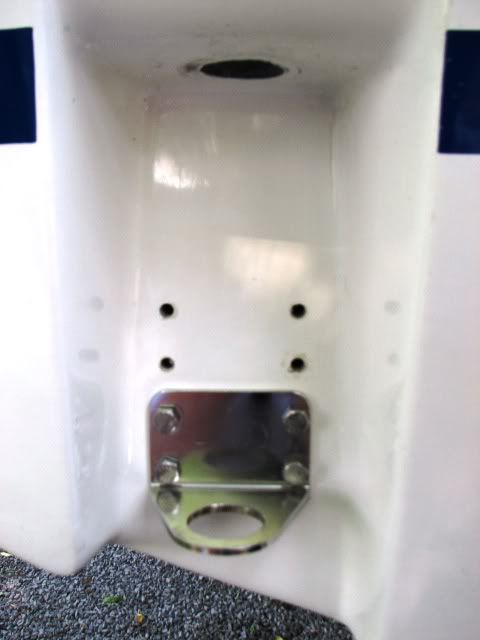
Is he making a secret rudder mount to fix all problems??
I must admit that in a really bad storm or a really bad following sea I would be greatly tempted to pull the rudders up out of the water and just use the outboard to steer because I am so afraid of damaging my rudders.
Re: Rudder Attachment to 26M Hull
Posted: Wed Jun 11, 2014 5:03 pm
by Crikey
Stock rudder height
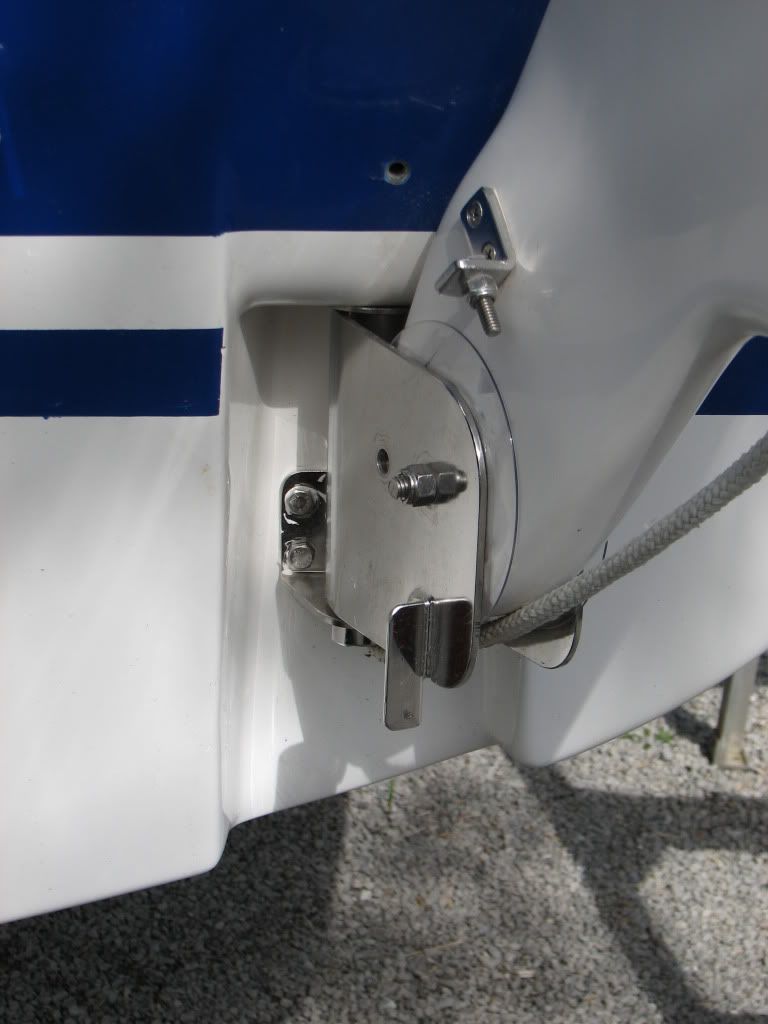
Lowered two inches (one bracket width)
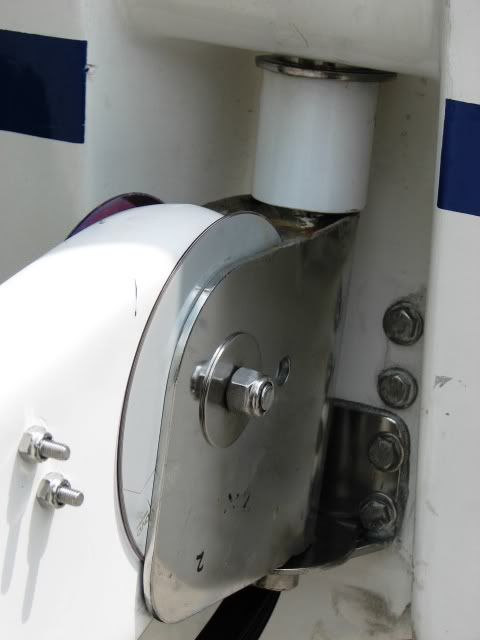
Re: Rudder Attachment to 26M Hull
Posted: Wed Jun 11, 2014 5:16 pm
by BOAT
Lowered two inches (one bracket width)
Okay . . . the question in my mind is . . why do i want to do this? ...... (I want to do this, right?)
So, if the rudder sticks down into the water even FURTHER won't that slow 'boat' down cuz of drag and also put MORE pressure on Mr. Rudder during a turn ?? (I think ? ? )

Okay, I'm not the sharpest knife in the drawer

so I will noodle on this a little more and see if i can figure out why this is a good idea.
Re: Rudder Attachment to 26M Hull
Posted: Wed Jun 11, 2014 9:18 pm
by seahouse
All good over here at this keyboard then, Ray. We are among gentlemen on the same page working together.
My replies...
8 years post-secondary. Yup; maybe 'cause I was a slow learner

. (That, or it was degrees in two separate disciplines).
As I grew up, I made sure I crossed all the streets, so no one would be from the other side of the street from me.
On those occasions when I do drink beer, I don't care who sees me with whom, whichever side of the street he's from; we're all the same.
Regards- Brian.
Re: Rudder Attachment to 26M Hull
Posted: Wed Jun 11, 2014 9:20 pm
by seahouse
dxg4848 wrote:Wandering wrote:If it weren't for the sealant (3m 4200 I would guess) on the washer and the nut of the bolt on the inside, I could very well have sunk or filled up with water.
Just looked at my 2009

it is in a slip with ballast full. As far as I can see from the dock both rudders' brackets are above the water line. Is there part I can't see that is below water line

DXG – there are only 4 screws, you're seeing at all of them, so no worries there. Depending on the variables (loading, rum, accessories, rum, engine weight, rum, ballast, rum, salinity, rum, weight distribution etc) some boats sit higher or lower in the water at the transom.
- B.
Re: Rudder Attachment to 26M Hull
Posted: Wed Jun 11, 2014 9:22 pm
by seahouse

Ix- Thanks for your vote of confidence. Did the snugged pivot bolt on the spacers not solve the spreading of the rudder tangs problem? I still haven't seen the bending (pix, anybody?), so I'm just guessing at where the weakness lies in those brackets.
I haven't seen anything bend on my own brackets. I must admit that I have been careful not to overstress them by being easy on the wheel, and not letting them ride up above their full-down stops. But I'm sure others have too, so I'm not sure.
Ross- are those tangs bent out? – the picture looks like they are pretty straight, did you have an issue with the setup in the photo that you need it stronger?
- B.


