Page 5 of 6
Posted: Fri May 25, 2007 9:03 pm
by Zoran
I also had a rudder failure (twice). Both time it happened on heavy seas. First time I was going against 5-6kt current with 15kt winds, standing waves up to 6'. We were surfing some, cutting some, getting rounded once (I was powering with only jib out) and at the end had a rudder broken. Interestingly enough it actually split vertically, right were two halves were glued together on the upper part where it is mounted to the bracket. I guess I might be better if I had both rudders in the water, but I had only one down. Second failure was after really good sailing on 20+ winds (I do not have a wind speed instrument). I was on a broad reach, full sails main and 100% jib, speed from 7.6 on couple moments (usually when waves were stopping me) mostly between 9 - 9.6 kt. This time both rudders were down. For the rest of the trip next 10 days I had no more luck, light winds only, however on the last day I noticed that the port rudder is looking weird and of course it was broken, this time split again and one half was broken about 10" below the bolt. I can only assume that it happened on the best sailing day of the trip since I have not hit anything or have any problems after that.
Knock on wood last year I hit 25+ winds, single handed, 6=8' seas, reefed main and reefed jib. Couldn't get the boat move faster than 4.5 kt close hauled. Nicely sailed 6-9 kt beam reach and lower. Rudders were fine.
Zoran
Posted: Fri May 25, 2007 10:12 pm
by They Theirs
Chip Hindes
Not sure what you’ve reasoned from the classic rudder replacement Photo?
The post two days prior, along with the Farr 40 sleeping on the beach, associates all boats have failures. Each new model features improvement.
Steering hardware appears stronger on the X and even more robust on the M, both absent of gudgeons and pintles, while maintaining the redundancy of dual rudders and the advantage of a central engine mount. Some may overlook the compatibility of common steering linkage, with an option to motor or sail combined or independent of motor from the helm.
The GRP (Glass Reinforced Plastic) rudders could benefit from some extra glass for strength with polyester resin keeping the cost low. Both designed with linkage low/lower in the hull, and at least one rudder deep when pointing or reaching in a breeze.
Wood has been used for strength with GRP, for example; in the M between the forward windows and cockpit floor, plywood is sandwiched in resin and glass. The rudder might benefit some wood structural stiffener.
Deck in Mold with wood stiffener between forward windows.
 Plywood Stiffener laminated under cockpit floor to add strength for helm pedestal and footwell.
 M rudder molds waiting glass and plastic during production.

Posted: Fri May 25, 2007 11:52 pm
by marsanden
kevperro wrote:
There is some middle-ground somewhere. Its between 40-45 knots and your proposed 18-20 knot limit. Exactly where depends upon your skills, how you maintain and understand your boat and how much tolerance for risk you have.
I agree with you,kevperro.
i love sailing , and i love wind.
But sailing a mac is different.
The CE certificate is "C" class.
If i like i could try to sail across the ocean too, everything is possible.
If i want i can take my risks.
Luna Rossa its a wonderfull sailing boat, strong enough for racing in some, certificated, range of sea and wind conditions. Luna Rossa can't sail with more than 25 knots wind. Better, it could sail, but takin lots of risks .
I don't want take risks when i sail. If the wind is more than 20kn i start my engine and run away to my marina. On the other hand, i want be sure that my boat is safe and well buit for sailing in the right conditions.
Posted: Sat May 26, 2007 2:06 am
by Frank C
marsanden wrote: ... Luna Rossa its a wonderfull sailing boat, strong enough for racing in some, certificated, range of sea and wind conditions. Luna Rossa can't sail with more than 25 knots wind.
I don't want take risks when i sail. If the wind is more than 20kn i start my engine and run away to my marina.
Zoran wrote:I also had a rudder failure (twice). Both time it happened on heavy seas.
First time I was going against 5-6kt current with 15kt winds, standing waves up to 6'. We were surfing some, cutting some, getting rounded once (I was powering with only jib out) ... might be better if I had both rudders in the water, but I had only one down.
Second failure was after really good sailing on 20+ winds (I do not have a wind speed instrument). I was on a broad reach, full sails main and 100% jib, speed from 7.6 on couple moments (usually when waves were stopping me) mostly between 9 - 9.6 kt. This time both rudders were down.
... last year I hit 25+ winds, single handed, 6-8' seas, reefed main and reefed jib. Couldn't get the boat move faster than 4.5 kt close hauled. Nicely sailed 6-9 kt beam reach and lower. Rudders were fine.
Zoran
Zoran and Marsanden sail 25 kts in coastal conditions, seas at 6' to 8'.
Sailing SF Bay is about half that sea-state in 25 kts.
Ergo .... 25 kts does not always equal 25 kts. 
Also, it seems the rudders suffer worse fate going downwind ... counter-intuitive?

Posted: Sat May 26, 2007 5:37 am
by Moe
Rudder designed for high winds/heavy seas...

Posted: Sat May 26, 2007 6:47 am
by beene
Now that is one high MTC boat.
Someone sure has done a nice job maintaining all that wood etc.
Very pretty indeed.

G
Posted: Sat May 26, 2007 7:03 am
by marsanden
Moe wrote:Rudder designed for high winds/heavy seas...
Right.....and better: that boat is designed for high winds/heavy seas : that boat cant sail fast, cant plan with a big engine, no ballasts, more than 1100 kg for trailing.....its another kind of sailing boat.
Posted: Sat May 26, 2007 7:46 am
by Billy
The Mac classics have a wood core in their rudders. When it rots, it fails. I've seen it.
As for the X, like Zoran, I've had 2 failures. Always on the lee side. First time was from Oriental to Ocracoke. The Pamilico Sound was about 4-6 feet and wind was probably around 20 kts. Full main and 150. After docking in Silver Lake, I noticed one of my rudders looked a little weird. Pulling it up it wobbled like a broken limb. Broke near the pivot bolt. Unbolted, took it home, reglassed it.
The second time was from Chub Cay to Andros Island over Tongue of the Ocean. Winds probably around 25 kts. and seas well in excess of 8 feet. I accepted I was part of the problem as we were surfing some of the waves reaching speeds of 10.2 kts. with 150 only.
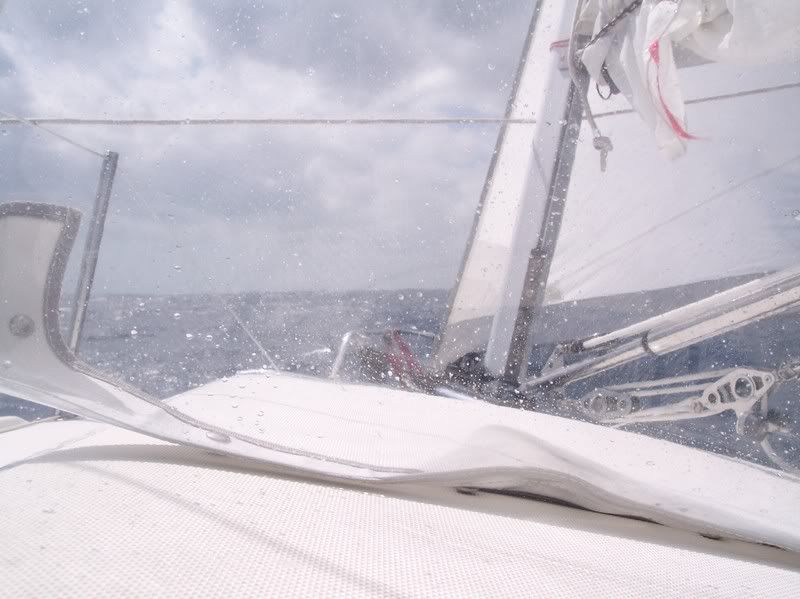
Upon anchoring behind Morgan's Bluff, I discovered the same rudder problem:
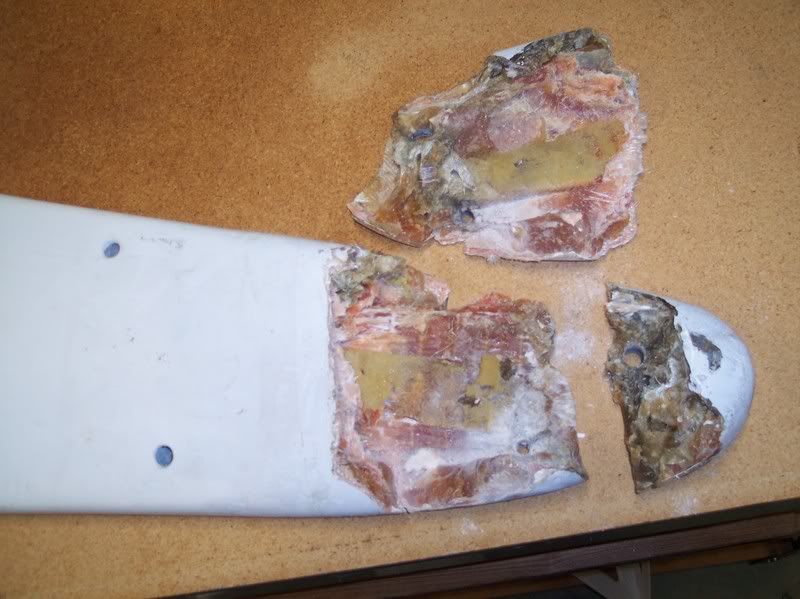
As stated earlier, the rudder is 2 thin fiberglass pieces filled with resin at the head. No real strength. You can see the foam core in the pic.
The other X with me, Luke's
DreamChaser carried a spare and offerred it to me as I was carving one out of a board with a machete. LOL
BTW, Luke had the earlier ss rudder brackets and both broke but rudders themselves remained intact.
I ordered 2 new rudders from MacGregor and so far haven't had the problem re-occur. (I also carry a spare now.)
So, FWIW, there has been some X rudder failures.
Posted: Sat May 26, 2007 7:49 am
by Bawgy
You can always throw out that pretty red Anchor (Calloway ) you have
Posted: Tue May 29, 2007 8:47 am
by They Theirs
Rudders and board damage can occur when sailing or boating in very heavy weather or shallow conditions. We consider repairing or replacing a damaged foils part of owning a versatile shoal sailor. Repairing a slow, heavy displacement, turn of the century design, with full keel and barn door rudder, would be a heavy price for accepting its sailing performance compared with modern sailing design, or motoring and limited boating potential when compared with Mac versatility. I dread the unpleasant task of placing an old-world behemoth on a trailer.
Foil Design Tips
Because of sailing characteristics, the fin keel boat is a sportier design and is preferred over full keel boats for performance and racing.
From the Net:
Inspecting and Surveying a Used Sailboat
The keel and rudder should also be inspected. A repair job or damage on the bottom part of the leading edge of the keel is an indication that the boat has been involved in a grounding, a common enough occurrence for boats which sail in shallow bodies of water. Depending on how the boat is constructed and the severity of the grounding, this may be nothing to worry about, or it could be an indication of more serious damage in other parts of the vessel (a surveyor should be able to figure this out). Also check the hull-keel joint. If the joint appears to be wider at the forward end, it could be further evidence that the boat was involved in a hard grounding. If you are looking at a trailerable boat with a swing keel, try to get under it to take a look into the keel housing (a flashlight will come in handy for this).
Give the rudder a good shaking to see if the pintles and gudgeons (hinges) are worn have become loose, or if there's too much play in the rudder stock. Swing the rudder back and forth to make sure that it moves freely and has not been damaged in any grounding or collision with floating debris.
Note that it is common for rudders on older boats to have absorbed moisture over the years. This can cause damage with freezing and thawing cycles over a number of winters. Some people successfully deal with this problem by using a fairly long drill bit to make one or two small drain holes in the bottom edge of the rudder in the fall. They plug up the holes with an epoxy mixture in spring. But sooner or later most water-logged rudders will have to be rebuilt in order to ensure the boat is fully seaworthy.
Boards and Keels
M sheets tight, hard over on the beam, exposing port rudder with starboard rudder deep

Posted: Sun Jul 22, 2007 11:25 pm
by delevi
Well I got my rudders back from IDA sailor marine. They basically chopped off the top portion where the rudder broke and recut that area, on both rudders of course. Good as new and they're only just a bit shorter. Now 51 inches.
I am replacing the damaged bracket along and drilling additional holes in them as well as the rudders. In the down position, I will insert a bolt an tighten w/ wing nut. This should accomplish a reduction in sideways movement, using the support of the entire bracket rather than just the top part which has the pivot bolt. It will also prevent the rudders from trailing aft due to line stretching when under heavy load. It will be a bit of a pain to bolt and unbolt every time I want to lower and raise rudders, but I think this is the price to pay for carrying the added loads due to the bigger blades. Hoping they'll stay in one piece for a long while.
Leon
Posted: Tue Jul 24, 2007 1:21 am
by Jack Sparrow
When we fitted the rudders they didn't fit neatly between the forks they touched the sides of the rudders at the aft edge but at the fwd edge (forks tapered from front to back) there was a gap. I knew they were going to give me trouble over the season and they did, rudder slop on the forks needed constant tightening at the end of the season I'd managed to mushroom the the forks around the attachment bolt. Working on the up grade at the moment.
Jack Sparrow
Posted: Tue Jul 24, 2007 2:54 pm
by delevi
Let me know what you come up with Jack. What are your thoughts on the second bolt?
Posted: Tue Jul 24, 2007 4:17 pm
by Frank C
I'd surely NOT want a 2nd bolt through my rudders, preventing them from kicking up. I COULD imagine a swinging yoke that pivots on the original, single rudder bolt.
Picture a second rudder bracket with fwd-facing ears sliding over the ears of the factory bracket.
It might be costly to fabricate, but a stainless "cage" might swing down after the rudder and "grip" the rudder bracket ears, just to add tensile constraint to the aft section of the rudder bracket. Properly designed, it could just swing with the rudder. Couldn't have any added bolts though, or it would impair the kick-up.
Posted: Tue Jul 24, 2007 7:33 pm
by delevi
Frank. Just to clarify...I'm not talking about a permanent bolt. One I would insert, tight with wing nut when rudders are down and remove when I need to kick the rudders up. The only drawbacks I see is the added hassle involved in the process (well worth it to prevent rudder breakage and reduce lateral and fore/aft movement.) The second drawback would be if I hit something. Of course, with a daggerboard vs centerboard, I already have this issue to deal with so just have to be careful. I just uploaded Garmin's blue chart software to my GPS so I can see charted depths of all my surroundings. Awesome! Haven't used it on the water yet.
Leon