Thanks Starscream!
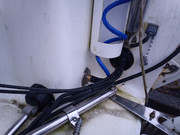
My engine line & control boots seem to be original and a tad short. There is a somewhat annoying puddle in the aft berth area after rain storms.
It seems to be following the cables back in. That and at the base of the pedestal where the engine controls and steering cables feed through.
I'd like to put new longer boots on but would like to avoid having to disconnect everything to sleeve them on if possible.
I replaced a torn boot on my car CV joints and it came in a split seam version that saved HOURs of time.
I just removed what was left of the old boot, wrapped the new one around it, applied an adhesive RTV to the seam and clamped it at either end.
It lasted for at least 8 years as far as I know (I sold the car

.....).
I have routed my bilge pump discharge lines up above the chine as far as I can and with as short a run for each as I can figure out.
All are at amidship, one each Port and Starboard of the ballast transfer lines, one centered under the aft dinette seat in the space between the ballast transfer lines. Port discharge line is less than 3 feet and runs up under the galley. Center and Starboard discharge lines are less than 5 feet and run up under the head sink. All are gradual rise without any loops or check valves.
My automatic bilge pumps seem have a turn on/turn off differential float switch which I presume is to reduce cycling.
I didn't install check valves or loops based upon what I have been able to find from bilge pump manufacturers and what I have seen on new "big" boat bilge installations. It seems even the duckbill check valves have a roughly 20% line loss effect and can also result in air locks even if placed right at the pump discharge. the small amount of water that comes back down the discharge hoses also can aid in "clearing potential debris at the pump/screen.
I added a small "weep/bleed" hole to the top of the discharge port on each pump as has been suggested. (Mine didn't come that way). I have seen theses "weep/bleed" holes on the higher end bilge pumps and have also seen these on the newer "big" boat installations. as has been mentioned by others the hole allows air to escape and allows the centrifugal pump to prime. I added a "deflector" over the holes using the hose clamp to keep the little jet of water from A) making a mess and B) from p*ssing into my eyes (

) when I check operation.
The discharge head rise is about 2 feet and the smooth inner surface hose results in a calculated 30% discharge rate loss (or less) which is reasonable.
(For those like myself, Centripetal Bilge Pumps are flow rated at "ZERO" head rise to discharge which means that they loose discharge capacity with every foot of rise to the actual discharge height overboard.)
Now the ideaa of a critter guard is intriguing.... we has dem pesky wasps around called "Mud Daubers" which "LOVE" to find and fill-up holes with their larval nests. I have also heard of others (rare) who have had the unfortunate experience of mice getting into their bilge discharge lines from the outside and clogging them. (Yuk!

).
To aid in drying the bilge areas I am adding three vacuum lines next to the pumps that I can access from the companionway with a little 1 gallon Wet/Dry Vac.
Gotta get back to the day's tasks!!!