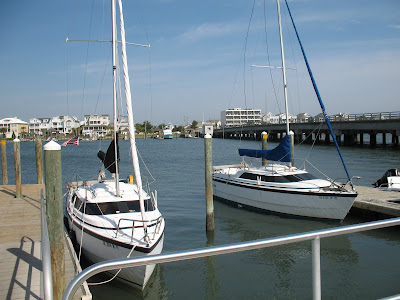
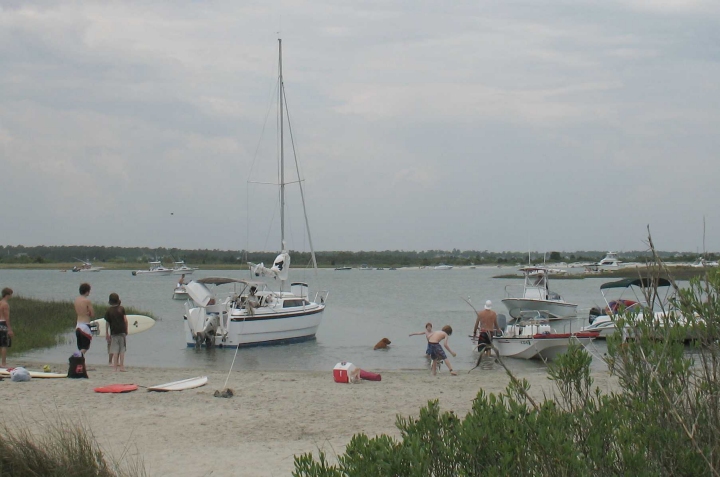
Comments below picture. (Click for larger image.)

Masonboro Sound and Masonboro Island- (with regard to Macgregor Sailboats)
1 - Recommend not going to this area on a summer Saturday or Sunday afternoon and especially not Memorial Day or Fourth of July weekends. It is a madhouse, by any description. On busy weekends, you can almost walk across the sound on the decks of boats in there, plus jet skis going by plus boaters dropping anchors on yours.
2 - Great place on Monday thru Thursday if not a holiday.
3 - (A)(refers to photo) this is the green buoy before entering Masonboro Inlet. To get into the sound without getting into shallow water that can be seen in the picture to the west of (A), head toward but not past the green buoy and then follow the red path to (B) which is normally 6 feet even at low tide. It is a bit scary because 20 feet away there will be seagulls sitting on the sand spit that appears at low tide, but the dropoff is quick and the best water is here if you pay attention to your depthfinder. Definitely avoid (Q) or you will find yourself walking.
4 - (P) looks like a nice area and many boats will be in this harbor, but stay out of there with your sailboat. It is very, very shallow. Use your kayak or tender only. For similar reasons,stay away from(C).
5 - The wind may determine which anchorage you choose. I tend to prefer a lee shore, which sounds dangerous, but the wind turns my boat into the wind. And the shores that show sand do not have oyster shells. Oyster shells abound in the grassy shore areas and they will cut your bare feet or scratch your boat bottom in a flash.
6 - Before I mention places I have anchored, I must say that I stay away from all boats when anchoring. I have plenty of bad experiences when I anchored and then another (power) boat anchored nearby. Big problems. The reason for this is the high freeboard and swinging characteristics of the Macgregor. When the tides change and the wind blows the Mac wants to move. The smaller power boats throw out a tiny anchor and just sit there like they are in concrete. Unreal. Whereas, my Mac goes back and forth. And even if I string the two anchors tight, when leaving, I have to release one of the anchors first, and that is a problem if another boat is nearby. My standard procedure is therefore, go to the sound early in the morning to anchor and walk on the beach, say, before 8am, and leave the beach before noon. I then either leave the sound or else anchor out in the sound away from the shores and have lunch and sit and watch the scenery.
7 - The white sand of (D)(M)(F)(H)(K)are all nice and (H) is where I beach my boat. But, I have only done it twice since I prefer now, having proven I can do it, to anchor very close to shore, stern first, and just step off the stern ladder into 2 feet of water and not even get my shorts wet. I keep the tide in mind and adjust the two anchors to keep the boat exactly where I want it. (More on anchoring specifics later.)
8 - (E) is the "COVE" and very tempting. Many boats go in there. There is shallow water at the mouth, but the north side of the mouth has enough depth for our Macs. Water depth in the cove is 4 to 5 feet. By yourself, with NO WIND, it is a very nice place to go. But with other boats and some heavier wind and you will not enjoy getting out. Once I was blown into the grass for quite a ways and had to push the boat out by hand over oyster shells in 2 feet of water. Another time I got surrounded by power boats on all sides and had to get 4 guys to push me around and in and out until I had a clear shot out. I avoid this nice cove altogether now.
9 - (G) is the path out of the sound back to the ICW. You MUST study the charts and Google Earth carefully to get thru this channel. There are shoals in a couple of places. Go slow and watch what others do, if you think they know what they are doing. I can do it now, after grounding only once in the past near the ICW end of the channel.
10 - My favorite anchorage is (F). Again, it is best when I am there alone or only with two or three other boats. (Or if we all are Macs someday, we should all swing the same way and have a good time without too much trouble.) (F) is very narrow, you can see the shoals on either side.
11 - To anchor at (F) or any of the other white sandy beaches shown here, what I do is this: (caveat - I accept no responsibility for damage or injury. Boating and anchoring have inherent risks.) I pull up and tie off one rudder. I loosen the other rudder and tie it loosely. I raise the engine some but still have strong "pee" from the indicator. (Some of the prop wash will churn up the water in the rear.) I slowly go until about 60 feet from the beach and study how the tide and wind are affecting the boat. (If this is not obvious to a new captain, then just sit there in idle and watch what happens to your boat.) I throw out the bow anchor and then, either by drift or motor, I get the stern near the beach and in a frantic display of crazy action I simultaneously throw the stern anchor to the beach or at least into very shallow water and lift the remaining rudder and kill the engine (after putting it in neutral) and raise the engine and go into shore, step off the stern ladder, take the stern anchor and bury into wet sand up the beach (never dry sand) and then adjust the anchors for the position you want. If staying with the boat, adjust the anchors as the tide changes or wind changes. If leaving the boat to go to the ocean side of the island, I put the stern anchor in deeper water in a way so that the boat can not touch shore before I return. I may have to get wet to go get this anchor later. You MUST know the tide tables or else you risk having your boat stuck on the beach, unless you want that to happen...... You can see how much easier this will be if you are on a lee shore meaning that the wind is driving you to the beach. Then you do not need the engine or rudder and you can raise them both out of the water and with the bow anchor holding, just drift near the beach and step off and secure the stern anchor. This is by far the easiest method. (about 80 feet of bow anchor and 30 feet of stern anchor.)
12 - I have the "local" knowledge now, after being in the sound area shown many times, to go in to any anchorage at any tide, high or low. I like going in at low tide, because there is much less current and I know the boat will be floating when I return. Going in at high tide means you will have to stay with the boat and adjust, or do other things and worry a bit about what happens when the tide goes out.
13 - With sufficient wind, you can sail the Mac in this sound around high tide if you know where the shoals are.
14 - (L) Shoal area, exposed at low tide. Other shoals are visible in the Google Earth image of the sound.
15 - Finally, (N) is 7 miles !!! of pristine beach, with no access by car, only boat. Meaning, most of the time, after walking 1/2 mile, you are almost the only one there. Great shelling. Great sea treasures (read: sea junk) after a storm or if you are the first one there in the morning. Dogs are FREE to roam with you on the beach year-round!!! But, if they do not behave and stay with you, there is danger they will go into the dune system and disturb wild nesting shore birds. Don't let them do that. And try to stay of the dunes as well, except the paths that are well used to get to the ocean from the sound. Be responsible and keep Masonboro Island as clean or cleaner than when you got there.