

I know there has been lots of good advice in the past, but does anyone have any new experience on winterizing a 2001 Suzuki DF50.
Recent advice from local Suzuki dealer:
- add fuel stabilizer and top us tanks
- run engine 15 minutes to get stabilizer throughout engine
- do not fog fuel injected engines
- do not run carburetor dry or disconnect fuel lines
- he says nothing more is required
Recently I have been using Salt-Away in/on all our engines, as well as the trailer. http://www.saltawayproducts.com/MarineApp.htm
Winterize Suzuki DF50
-
Wind Chime

- Captain
- Posts: 866
- Joined: Sun Jan 21, 2007 4:30 pm
- Sailboat: MacGregor 26X
- Location: Vancouver, B.C. Canada. 2000-26X, Suzuki-50hp, 8' Walker-Bay tender (with sailkit)
- Contact:
-
Hamin' X

- Site Admin
- Posts: 3464
- Joined: Sat Aug 27, 2005 6:02 pm
- Sailboat: MacGregor 26X
- Location: Hermiston, OR-----------2001 26X DF-50 Suz---------------(Now Sold)
- Contact:
Re: Winterize Suzuki DF50
His advice is what I do and I run non-ethanol fuel year-round. Also, store with the engine in the lowered position, as this allows all water to drain from the cooling passages. I've been doing mine this way for a number of years and she's never let me down.
~Rich
~Rich
-
davidbourne

- Chief Steward
- Posts: 73
- Joined: Sun Jul 03, 2011 12:19 pm
- Location: Asheville, NC - 90HP Suzuki
Re: Winterize Suzuki DF50
Store the motor in the down position so it can drain completely and not catch more moisture inside it.
Cover the cowling to keep it out of the sun.
Keep the dang wasps out of it somehow! This may not be a problem in Ontario.
Cover the cowling to keep it out of the sun.
Keep the dang wasps out of it somehow! This may not be a problem in Ontario.
-
Russ

- Admiral
- Posts: 8301
- Joined: Thu Oct 11, 2007 12:01 pm
- Sailboat: MacGregor 26M
- Location: Bozeman, Montana "Luna Azul" 2008 M 70hp Suzi
Re: Winterize Suzuki DF50
That's what I've done with my 2008 DF-70 for the past 5 years.Wind Chime wrote:I know there has been lots of good advice in the past, but does anyone have any new experience on winterizing a 2001 Suzuki DF50.
Recent advice from local Suzuki dealer:
- add fuel stabilizer and top us tanks
- run engine 15 minutes to get stabilizer throughout engine
- do not fog fuel injected engines
- do not run carburetor dry or disconnect fuel lines
- he says nothing more is required
Recently I have been using Salt-Away in/on all our engines, as well as the trailer. http://www.saltawayproducts.com/MarineApp.htm
Mine has a garden hose connection for running it out of the water. So I pump RV antifreeze through it. They don't say to, but I feel better having some of this stuff in there (old habits) even if it all drains out. I also learned the hard way that the RV antifreeze will kill your grass.
I remove the fuel line. It's rubber and I don't like it exposed to the sun and elements over the winter.
And as mentioned, tilt down. My skeg is burried in the sand.
This is a good time to change the oil. Having dirty oil with acids in it all winter is not a good idea. I'm no mechanic, but I've become quite proficient at changing the oil. I still spill oil when removing the oil filter. Put her to bed for the winter with nice clean oil.
--Russ
-
seahouse

- Admiral
- Posts: 2182
- Joined: Sun Dec 07, 2008 9:17 pm
- Sailboat: MacGregor 26M
- Location: Niagara at Lake Erie, Ontario. 2011 MacM, 60 hp E-Tec
- Contact:
Re: Winterize Suzuki DF50
Hey Wind Chime –
The dealer one-size-fits-all advice sounds good. You can tweak it to your personal preferences. Here are mine.
Add fuel stabilizer anytime you fill your gas tanks expecting to not use the fuel up within the next few months. I have 2 – 12 gallon tanks and have used less than 24 gallons a season, so I add fuel stabilizer whenever I fill the tanks. Start adding stabilizer part way through the season if you can't judge when your last fill-up of gas will be. This is much better than adding stabilizer to fuel that's already been aged and had a head-start on the degrading process.
Note that it's safe to use stabilizer at higher than suggested concentrations, so don't sweat that part. Buy Sta-Bil at Canadian Tire when it goes on sale – I buy a spare bottle (1 litre, IIRC) because, well, it's stabilizer, it never goes bad!
Leaving the fuel tank empty, and sealed (I usually add a dash of stabilizer to the empty tank, but I'm a belt and suspenders type) is an alternate acceptable method of over-wintering. The physics is simple - no air gets in, no air gets out, ergo no condensation. It's sometimes more convenient than filling the tanks, and guarantees fresh fuel, bought in the spring, on start up.
This year I ended up with one tank full, and one tank empty; I kinda worked it that way, planning towards the end of the season. Take the opportunity to inspect the bottom of the empty tank with a flashlight, you'll see any guck if there is any; if clean it will confirm that your fuel storage and handling methods are sound.
In your particular case, doing the above will increase the finite lifespan of your engine by 15 minutes (actually more than that, in real life) every year (over following the dealer's advice), because you won't have to run it unnecessarily for that length of time.
I don't follow the logic in not disconnecting the fuel line (prime will not be lost, and is not an issue with these engines), unless there is no quick-connect fitting present. I don't see how that might harm, or help, but there could be some science there that I am unaware of. Might help keep dirt/ water out, if you are careless with the hose end fittings. I wrap the fitting end in a heavy plastic bag and coil the hose and bulb.
In a fuel injected engine the fuel downstream of the fuel pump is designed the be held under very high pressure, so there is little danger of it degrading from exposure to air or evaporation during storage; it's in a well-sealed container!
- Brian.
The dealer one-size-fits-all advice sounds good. You can tweak it to your personal preferences. Here are mine.
Add fuel stabilizer anytime you fill your gas tanks expecting to not use the fuel up within the next few months. I have 2 – 12 gallon tanks and have used less than 24 gallons a season, so I add fuel stabilizer whenever I fill the tanks. Start adding stabilizer part way through the season if you can't judge when your last fill-up of gas will be. This is much better than adding stabilizer to fuel that's already been aged and had a head-start on the degrading process.
Note that it's safe to use stabilizer at higher than suggested concentrations, so don't sweat that part. Buy Sta-Bil at Canadian Tire when it goes on sale – I buy a spare bottle (1 litre, IIRC) because, well, it's stabilizer, it never goes bad!
Leaving the fuel tank empty, and sealed (I usually add a dash of stabilizer to the empty tank, but I'm a belt and suspenders type) is an alternate acceptable method of over-wintering. The physics is simple - no air gets in, no air gets out, ergo no condensation. It's sometimes more convenient than filling the tanks, and guarantees fresh fuel, bought in the spring, on start up.
This year I ended up with one tank full, and one tank empty; I kinda worked it that way, planning towards the end of the season. Take the opportunity to inspect the bottom of the empty tank with a flashlight, you'll see any guck if there is any; if clean it will confirm that your fuel storage and handling methods are sound.
In your particular case, doing the above will increase the finite lifespan of your engine by 15 minutes (actually more than that, in real life) every year (over following the dealer's advice), because you won't have to run it unnecessarily for that length of time.
I don't follow the logic in not disconnecting the fuel line (prime will not be lost, and is not an issue with these engines), unless there is no quick-connect fitting present. I don't see how that might harm, or help, but there could be some science there that I am unaware of. Might help keep dirt/ water out, if you are careless with the hose end fittings. I wrap the fitting end in a heavy plastic bag and coil the hose and bulb.
In a fuel injected engine the fuel downstream of the fuel pump is designed the be held under very high pressure, so there is little danger of it degrading from exposure to air or evaporation during storage; it's in a well-sealed container!
- Brian.
-
yukonbob

- Admiral
- Posts: 1918
- Joined: Mon Feb 14, 2011 6:54 pm
- Sailboat: Other
- Location: Whitehorse Yukon
Re: Winterize Suzuki DF50
For our 70 we do the same as above but also the low pass fuel filter every two years and high every four, check zincs for replacement and give the entire engine (inside the cowling) a light spray of wd40. Also did anyone mention the leg oil? I replace that every season, throw grease through all the connections (pick a different colour each year so you know when its all the way through. Pull the prop and give it a bit of grease on the shaft so it doesn't become a permanent fixture. If you're up to it pull the leg and check the impeller (not as scary as most people think) replace if needed…hmmm if i think of anything more ill post. Might throw a fuel h20 separator on this fall. Ill post pics if I remember.
-
Russ
- Admiral
- Posts: 8301
- Joined: Thu Oct 11, 2007 12:01 pm
- Sailboat: MacGregor 26M
- Location: Bozeman, Montana "Luna Azul" 2008 M 70hp Suzi
Re: Winterize Suzuki DF50
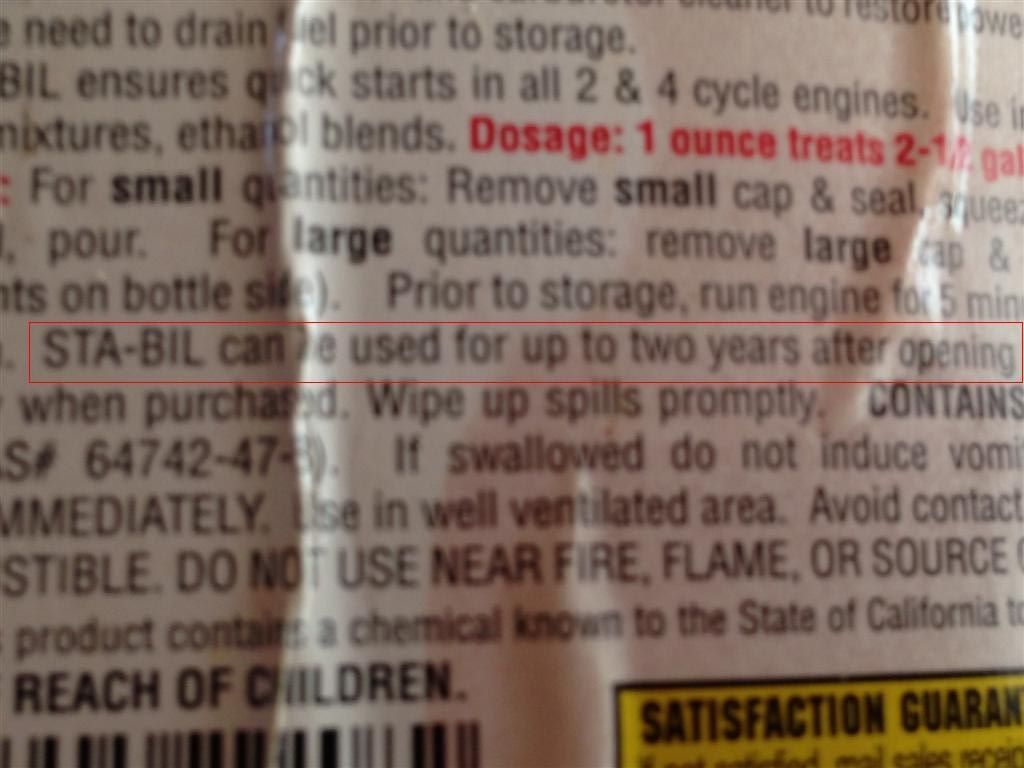
That's what I thought, then I read this on the bottle. Is it just marketing to get us to buy more product? I suspect STA-BIL lasts longer than 2 years. I sure keep it longer.seahouse wrote: Buy Sta-Bil at Canadian Tire when it goes on sale – I buy a spare bottle (1 litre, IIRC) because, well, it's stabilizer, it never goes bad!
-
Russ
- Admiral
- Posts: 8301
- Joined: Thu Oct 11, 2007 12:01 pm
- Sailboat: MacGregor 26M
- Location: Bozeman, Montana "Luna Azul" 2008 M 70hp Suzi
Re: Winterize Suzuki DF50
Oh, and I've been starting to use Seafoam for fuel stabilizer lately. Seasoned mechanics swear by this stuff. It's pricey, but reading testimonials it's pretty compelling.

--Russ
--Russ
-
seahouse
- Admiral
- Posts: 2182
- Joined: Sun Dec 07, 2008 9:17 pm
- Sailboat: MacGregor 26M
- Location: Niagara at Lake Erie, Ontario. 2011 MacM, 60 hp E-Tec
- Contact:
Re: Winterize Suzuki DF50
Hi Russ -
Have used Seafoam – it's good stuff too, a highly rated product as well (Practical Sailor et al.) and it is becoming as widely available, but I don't personally have the 3+ decades of successful experience with it like I do for the (MIL Spec'd) Sta-bil product.
Note that some 2-cycle oils have the stabilizers already present in them (like Stihl, IIRC) so once the gas and oil are mixed that's it, it's good for storage whenever you are. Shmart!
Yeah-- 2 years after you open it. Maybe multiple times that if you don't open it. Likely marketing, but some products are packed with nitrogen or argon (like potato chips) that escapes when you open the container, or have a (tamper proof) thermally fused foil seal that is better than just the cap.
Lots of stable stuff that lasts “forever” is required to state a best before date or shelf life, but are just as effective well after it - toothpaste comes to mind. Consumer Reports publishes such a list every few years.
I'd like to know how the product works exactly, but stuff like that is proprietary and it's hard to find a white paper or detailed explanation of the chemistry behind it. Anyone?
The upside is, you can roughly judge whether gas is good or bad by just smelling it; not that I am endorsing that anyone deliberately inhale gasoline fumes, the smell of fresh gas is highly variable, while the smell of bad gas is pretty consistent and recognizable to anyone who has encountered it. The intermediate stages are more difficult to judge. Use stabilizer and you'll probably never have to find out.
- B.
Have used Seafoam – it's good stuff too, a highly rated product as well (Practical Sailor et al.) and it is becoming as widely available, but I don't personally have the 3+ decades of successful experience with it like I do for the (MIL Spec'd) Sta-bil product.
Note that some 2-cycle oils have the stabilizers already present in them (like Stihl, IIRC) so once the gas and oil are mixed that's it, it's good for storage whenever you are. Shmart!
Yeah-- 2 years after you open it. Maybe multiple times that if you don't open it. Likely marketing, but some products are packed with nitrogen or argon (like potato chips) that escapes when you open the container, or have a (tamper proof) thermally fused foil seal that is better than just the cap.
Lots of stable stuff that lasts “forever” is required to state a best before date or shelf life, but are just as effective well after it - toothpaste comes to mind. Consumer Reports publishes such a list every few years.
I'd like to know how the product works exactly, but stuff like that is proprietary and it's hard to find a white paper or detailed explanation of the chemistry behind it. Anyone?
The upside is, you can roughly judge whether gas is good or bad by just smelling it; not that I am endorsing that anyone deliberately inhale gasoline fumes, the smell of fresh gas is highly variable, while the smell of bad gas is pretty consistent and recognizable to anyone who has encountered it. The intermediate stages are more difficult to judge. Use stabilizer and you'll probably never have to find out.
- B.
-
seahouse
- Admiral
- Posts: 2182
- Joined: Sun Dec 07, 2008 9:17 pm
- Sailboat: MacGregor 26M
- Location: Niagara at Lake Erie, Ontario. 2011 MacM, 60 hp E-Tec
- Contact:
Re: Winterize Suzuki DF50
Found some "new" information - in going through the E-tec owner's manual, I came across a WARNING regarding disconnection the fuel line.
It not only specifies disconnecting the fuel line during storage (where a quick -connect fitting is present, as I mentioned above), but also any time the motor is not in use; or when trailering. Maybe Suzuki recommends otherwise, but that's doubtful.
Possibly this is to minimize the risk of fuel leakage. (But it also guarantees some spillage of a few drops when the fuel line is disconnected).
- B.
information - in going through the E-tec owner's manual, I came across a WARNING regarding disconnection the fuel line. It not only specifies disconnecting the fuel line during storage (where a quick -connect fitting is present, as I mentioned above), but also any time the motor is not in use; or when trailering. Maybe Suzuki recommends otherwise, but that's doubtful.
Possibly this is to minimize the risk of fuel leakage. (But it also guarantees some spillage of a few drops when the fuel line is disconnected).
- B.
-
Chinook

- Admiral
- Posts: 1730
- Joined: Sun Feb 26, 2006 7:20 pm
- Location: LeavenworthWA 2002 26x, Suzuki DF60A
Re: Winterize Suzuki DF50
I use a siphon hose and empty my 2 12 gallon fuel tanks at the end of the season. I transfer the gas into 5 gallon jerry cans and fuel the car with the left over gas. That way, I start the next season with completely new gas.
-
Russ
- Admiral
- Posts: 8301
- Joined: Thu Oct 11, 2007 12:01 pm
- Sailboat: MacGregor 26M
- Location: Bozeman, Montana "Luna Azul" 2008 M 70hp Suzi
Re: Winterize Suzuki DF50
That is prudent advise. There was a post here years ago of a member who's fuel line leaked into the cockpit, then into the motor well. This gasoline then found its way into the drain where it either leaked or melted a hole in the drain tube. It then flooded the inside of the cabin with gasoline (and fumes). If I recall, his boat was on the trailer. A very dangerous situation. Disconnecting the fuel hose from the tank would be a simple way of reducing this risk.seahouse wrote:Found some "new"
It not only specifies disconnecting the fuel line during storage (where a quick -connect fitting is present, as I mentioned above), but also any time the motor is not in use; or when trailering. Maybe Suzuki recommends otherwise, but that's doubtful.
Possibly this is to minimize the risk of fuel leakage. (But it also guarantees some spillage of a few drops when the fuel line is disconnected).
- B.
Also smart advise.Chinook wrote:I use a siphon hose and empty my 2 12 gallon fuel tanks at the end of the season. I transfer the gas into 5 gallon jerry cans and fuel the car with the left over gas. That way, I start the next season with completely new gas.
I used to do this. Problem is, my tanks are 12 gallons and I often don't plan end of season well and wind up with lots left in the tanks. I would drain the tanks into smaller jugs and then pour into my truck. It was a mess and probably dangerous to handle those large amounts of fuel (it's heavy) and hoses with gasoline. So now I tighten up the caps (prevent evaporation) and add stabilizer. Ideal is to drain and use fresh fuel. I find doing that is not very safe for me.
--Russ
-
seahouse
- Admiral
- Posts: 2182
- Joined: Sun Dec 07, 2008 9:17 pm
- Sailboat: MacGregor 26M
- Location: Niagara at Lake Erie, Ontario. 2011 MacM, 60 hp E-Tec
- Contact:
Re: Winterize Suzuki DF50
Good suggestion Chinook, it's another option, though I also find that siphoning is somewhat of a nuisance. Takes time waiting for it to drain (I'm impatient), even with a larger diameter hose. Lots of fumes released during the process. Hard to get the last bit out, so you have to invert the (now lighter, though) tanks at the end for that anyway. You have to thoroughly drain the hose, let it dry, and/or cap or plug the ends.
Also tried a thing called "fill 'n go" for siphoning that works OK, but it's slow, and it's meant more to fuel up lawnmowers, etc.
I once had a proprietary spout dedicated to boat gas tanks years ago that I sold with the last boat, it fit the bayonet cap on the tank, let air in as the gas poured out (it was fast, and no glugging), and had a longer flexible spout so you didn't spill at the start while tipping the tank over. It worked well, and if the tank was half full or less (weight) you could easily pour gas directly into your car (or whatever) with it. I'd like to have a similar thing for this boat.
I've been looking for a cap with threads that match the Evinrude tanks, but haven't come across one yet (I'm sure these things are available to buy, likely at a high price) but I'll be making my own once the parts show up sometime.
I suppose you could also use an old fuel line (if you had one) with the quick connector to drain the tanks in place in the boat to a can on the ground, or directly into your car tank. Even without the bulb to prime it, you could close the tank vent and kneel on the tank to start the siphoning, then open the vent to let it drain.
-B.
Also tried a thing called "fill 'n go" for siphoning that works OK, but it's slow, and it's meant more to fuel up lawnmowers, etc.
I once had a proprietary spout dedicated to boat gas tanks years ago that I sold with the last boat, it fit the bayonet cap on the tank, let air in as the gas poured out (it was fast, and no glugging), and had a longer flexible spout so you didn't spill at the start while tipping the tank over. It worked well, and if the tank was half full or less (weight) you could easily pour gas directly into your car (or whatever) with it. I'd like to have a similar thing for this boat.
I've been looking for a cap with threads that match the Evinrude tanks, but haven't come across one yet (I'm sure these things are available to buy, likely at a high price) but I'll be making my own once the parts show up sometime.
I suppose you could also use an old fuel line (if you had one) with the quick connector to drain the tanks in place in the boat to a can on the ground, or directly into your car tank. Even without the bulb to prime it, you could close the tank vent and kneel on the tank to start the siphoning, then open the vent to let it drain.
-B.
-
Wind Chime
- Captain
- Posts: 866
- Joined: Sun Jan 21, 2007 4:30 pm
- Sailboat: MacGregor 26X
- Location: Vancouver, B.C. Canada. 2000-26X, Suzuki-50hp, 8' Walker-Bay tender (with sailkit)
- Contact:
Re: Winterize Suzuki DF50
Some great new information in this thread folks, many thanks!
The local Suzuki dealer specifically told me not to diconnect the fuel line. I believe it was something about the fuel injection system being under pressure? He went on to say the newer model engines fuel line is hard wired. Maybe someone with a newer model can confirm this.
He was a young guy at the service counter, so maybe I am getting bad advice ... and is why I have turned to all you experts
The local Suzuki dealer specifically told me not to diconnect the fuel line. I believe it was something about the fuel injection system being under pressure? He went on to say the newer model engines fuel line is hard wired. Maybe someone with a newer model can confirm this.
He was a young guy at the service counter, so maybe I am getting bad advice ... and is why I have turned to all you experts
by seahouse » Tue Oct 22, 2013 9:24 am
Found some "new" information - in going through the E-tec owner's manual, I came across a WARNING regarding disconnection the fuel line.
It not only specifies disconnecting the fuel line during storage (where a quick -connect fitting is present, as I mentioned above), but also any time the motor is not in use; or when trailering. Maybe Suzuki recommends otherwise, but that's doubtful.
-
seahouse
- Admiral
- Posts: 2182
- Joined: Sun Dec 07, 2008 9:17 pm
- Sailboat: MacGregor 26M
- Location: Niagara at Lake Erie, Ontario. 2011 MacM, 60 hp E-Tec
- Contact:
Re: Winterize Suzuki DF50
Wind Chime - by "hard-wired" do you mean that there is no quick-connect fitting to make removal of the fuel line simple? If that's the case, then it makes sense that the line should stay connected - little to no risk of fuel leakage then.