BWY's "Big Jib" and Rolly Tasker Lite Skin sails mod review
Posted: Wed Oct 19, 2022 9:33 am
Review of Blue Water Yacht’s “Big Jib” rig and Rolly Tasker Lite Skin sails combo
Rigging:
I was very excited when BWY introduced the Big Jib re-rig kit, as it was something Todd McChesney had in the works for some time. The final roll-out was particularly impressive as it featured “Lite Skin” higher-performance sails from Rolly Tasker.
The centerpiece of this mod is a taller and larger foresail with bigger dimensions overall, the idea being to obviate the need for a genoa. BWY touts less heeling, better pointing, and more consistent performance across greater wind conditions among other benefits. This requires a replacement of all the shrouds and the forestay, spacers for the winches and cleats, and addition of rails and cars on both sides. Everything needed is included in in the kit (see BWY web site), except a longer 60’ jib halyard. In my case, I had already installed rails, and Todd gave me a reasonable discount for leaving them out of the kit.
The instructions received generated some confusion, but Todd was very generous with his time on the phone and got me set straight. I installed the new gooseneck assembly, winch/cleat spacers, shrouds and forestay, and everything went together with relatively little fuss.
Moving the forestay up to 26 feet on a mast that is 27.5 tall makes it more a masthead than fractional rig, and I was doubting I could bend the mast with only 1.5 feet of lever arm distance. I found I was able to introduce additional (see explanation below in the sail review) bend to the mast with this rig using the 1:4 block and tackle rig that BWY provides for a nominal charge.
Changing the rigging was simple enough. Take off the old shrouds and forestay, drill some holes in the mast as instructed, install the new rigging and re-step the mast.
The kit includes spacers for the winches and jib sheet cam cleats to raise them an inch above the deck. When used with the low profile blocks (included in the kit), this helps reduce override when hauling in the jib sheets. I had previously removed the stock cleats installed Harken swivel cam cleats, so had to fashion my own spacers from ½ plastic material. Removing and inserting nuts and washers through the holes in the liner is a challenge, but do-able.
I made the modifications to the mast with the boat on the trailer. I think it would be pretty difficult to do it with the boat in the water.
Overall, I give the kit an A plus and the instructions a B minus. Todd was available to answer questions, which was very helpful.
Sails:
BWY can supply the Big Jib and mainsail in standard Dacron, but recommends the new Lite Skin sails manufactured by Rolly Tasker. Think of these sails as the “poor man’s Kevlar”. They are significantly more expensive than Dacron sails and less expensive than Kevlar and other laminates, but boast greater dimensional stability and longevity than Dacron. See BWY’s and Rolly Tasker’s websites for more information.
Mainsail - I found fitting the mainsail to be a bit problematic. If the sail I received is actually the standard cut, there is a lot more curve in the luff than my 5-oz Dacron Rolly Tasker main. This causes the luff at the 3rd and 4th battens up to push towards the mast while the upper and lower portions of the luff have about a 1-inch gap. I found I had to apply extra tension to the upper shrouds to curve the mast back to correct for this, thus the “additional” comment regarding the mast bend. I am still able to apply additional bend to the mast using the backstay, but not as much as I might otherwise.
Because the Lite Skin material does not flex as much as my 5-oz Dacron main, I found myself making little tweaks to halyard and outhaul tensions to get “perfect” shape to the sail. I will make no attempt to quantify performance improvement, but logic would dictate that a smoother, more well-shaped sail will push the boat faster, and it feels that way to me. Good, but not earth-shattering, so if you aren’t pursuing maximum performance, don’t like futzing with your mainsail and want to save money, you might want to stick with a standard Dacron sail.
The top two battens are full-length, and maintain a better sail shape than my current Rolly Tasker Dacron mainsail.
Having two reefing points is great. In fact, I would say necessary. See remarks in “Sea Trials” below.
Jib – I chose to custom order the jib from Sail Warehouse, extending the foot and the leach for a 7% increase in square footage. Todd advised against this, telling me the sail he offers is as big as will work. I found that my sail fit with a few inches to spare at the lower shroud but needs to be tailed over the lifelines if not hauled in quickly enough (EDIT - After getting the cars properly set, I found the jib tailed over the lifeline stanchions just fine. The following statement still holds, though). Todd says that his is cut so as to avoid this, so if this is something you simply don’t want to deal with, best to stick with BWY’s offering. BWY’s Big Jib calculates to 96%, while the standard jib calculates to 97.5%, which I find quite interesting, especially since the Big Jib is 6 inches longer in the foot.
The jib I order came with stainless steel clips. They go on and come off much easier than piston hanks, but in my sea trails I found that one particular clip sometimes came off when hoisting, and in one instance two actually clipped together. So far, I’m not a huge fan, and will have to find ways to avoid these problems.
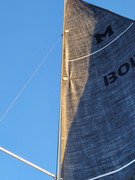
The shape of the jib is beautiful under sail. Having 33% more square footage than the standard jib provides significantly greater power but feels no less manageable. I would say the Lite Skin jib is definitely the way to go if you feel you can afford it.
Both sails have the look and feel of higher-end sails, with beefier reinforcements at points of stress and the stiffness characteristic of laminate sails. Leach lines and cleats are of good quality.
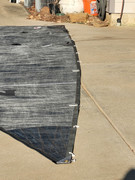
Lite Skin sails are stiff. You will definitely want to flake the main. If you don’t use roller furling, folding and rolling the jib will be necessary as well.
The tell-tales on both sails are, in a word, crap. They curl up like pig’s tails, so are useless in most wind conditions. I complained to Rolly Tasker about this more than two years ago and they apparently still use whatever material they were using then. It irks me that I have to replace the tels on my brand new and somewhat costly sails. Good thing I like futzing with stuff.
Sea Trials
Sea trials were conducted on a day with moderate to fresh breezes (13 mph with gusts to around 19). The most noticeable improvement was in speed. I was able to add between .2 to .4 knots of speed over my standard rig when close-hauled, even with the main reefed. I am looking forward to seeing how things behave in gentle breezes and other points of sail.
Most of the time I had the main reefed at the first point, and later at the second. Naturally, the second was more manageable, but at the first point I was able to achieve better speed, and dumped wind as needed without an undue effect on overall pointing. Later, the wind slacked off to moderate (12 mph judging by the lack of cresting waves) and sailing under full main was easily managed.
The Lite Skin mainsail is stiff, so being able to adjust halyard tension is more important in maintaining optimum shape between downwind and close-hauled points of sail than with a Dacron sail.
Pointing was definitely improved, but just how much is difficult to quantify given the variability of the winds that day. Also, I could not arrive at an optimum setting point for the jib sheet cars due to non-performing tels. More research is needed.
My jib hanks on, so can’t comment on how this rig performs with the jib partially furled.
Bottom Line
This Big Jib rig package does not turn a water ballast boat into a keelboat, and BWY does not make any such claim. It improves both pointing and speed performance to a significant, though not earth-shattering, degree. I did not get the impression that heeling was that much improved, but it did feel more manageable, even when it edged beyond 30 degrees. Having some crew on the rails would have helped, I’m sure.
Adding a bigger foresail means better performance in lower winds, but also means you will have to reef the main a bit sooner, so that is a change you will need to adapt to. I would say having two reefing points on the main will be very desirable if you intend to sail in fresh breezes while flying the Big Jib. Otherwise, being able to go to something like a storm jib may be an option you want to consider if you change out sails like I do.
This was an early retirement gift to myself, so I went whole hog with the sail upgrade. I think one could get 80 to 90% of the advantage by keeping one’s existing main (assuming it is in good condition and has two reefing points) and just going for the re-rig and Lite Skin Big Jib. This would be significantly less expensive given the price of the Lite Skin main sail.
I think this is a worthwhile mod, but it does take some getting used to, as would any significant change to rigging and sails. I’m glad I did it and would recommend it to anyone wishing to get optimum performance from their Mac, has the money and resources to do it, and is willing to adapt to the changes.
Rigging:
I was very excited when BWY introduced the Big Jib re-rig kit, as it was something Todd McChesney had in the works for some time. The final roll-out was particularly impressive as it featured “Lite Skin” higher-performance sails from Rolly Tasker.
The centerpiece of this mod is a taller and larger foresail with bigger dimensions overall, the idea being to obviate the need for a genoa. BWY touts less heeling, better pointing, and more consistent performance across greater wind conditions among other benefits. This requires a replacement of all the shrouds and the forestay, spacers for the winches and cleats, and addition of rails and cars on both sides. Everything needed is included in in the kit (see BWY web site), except a longer 60’ jib halyard. In my case, I had already installed rails, and Todd gave me a reasonable discount for leaving them out of the kit.
The instructions received generated some confusion, but Todd was very generous with his time on the phone and got me set straight. I installed the new gooseneck assembly, winch/cleat spacers, shrouds and forestay, and everything went together with relatively little fuss.
Moving the forestay up to 26 feet on a mast that is 27.5 tall makes it more a masthead than fractional rig, and I was doubting I could bend the mast with only 1.5 feet of lever arm distance. I found I was able to introduce additional (see explanation below in the sail review) bend to the mast with this rig using the 1:4 block and tackle rig that BWY provides for a nominal charge.
Changing the rigging was simple enough. Take off the old shrouds and forestay, drill some holes in the mast as instructed, install the new rigging and re-step the mast.
The kit includes spacers for the winches and jib sheet cam cleats to raise them an inch above the deck. When used with the low profile blocks (included in the kit), this helps reduce override when hauling in the jib sheets. I had previously removed the stock cleats installed Harken swivel cam cleats, so had to fashion my own spacers from ½ plastic material. Removing and inserting nuts and washers through the holes in the liner is a challenge, but do-able.
I made the modifications to the mast with the boat on the trailer. I think it would be pretty difficult to do it with the boat in the water.
Overall, I give the kit an A plus and the instructions a B minus. Todd was available to answer questions, which was very helpful.
Sails:
BWY can supply the Big Jib and mainsail in standard Dacron, but recommends the new Lite Skin sails manufactured by Rolly Tasker. Think of these sails as the “poor man’s Kevlar”. They are significantly more expensive than Dacron sails and less expensive than Kevlar and other laminates, but boast greater dimensional stability and longevity than Dacron. See BWY’s and Rolly Tasker’s websites for more information.
Mainsail - I found fitting the mainsail to be a bit problematic. If the sail I received is actually the standard cut, there is a lot more curve in the luff than my 5-oz Dacron Rolly Tasker main. This causes the luff at the 3rd and 4th battens up to push towards the mast while the upper and lower portions of the luff have about a 1-inch gap. I found I had to apply extra tension to the upper shrouds to curve the mast back to correct for this, thus the “additional” comment regarding the mast bend. I am still able to apply additional bend to the mast using the backstay, but not as much as I might otherwise.
Because the Lite Skin material does not flex as much as my 5-oz Dacron main, I found myself making little tweaks to halyard and outhaul tensions to get “perfect” shape to the sail. I will make no attempt to quantify performance improvement, but logic would dictate that a smoother, more well-shaped sail will push the boat faster, and it feels that way to me. Good, but not earth-shattering, so if you aren’t pursuing maximum performance, don’t like futzing with your mainsail and want to save money, you might want to stick with a standard Dacron sail.
The top two battens are full-length, and maintain a better sail shape than my current Rolly Tasker Dacron mainsail.
Having two reefing points is great. In fact, I would say necessary. See remarks in “Sea Trials” below.
Jib – I chose to custom order the jib from Sail Warehouse, extending the foot and the leach for a 7% increase in square footage. Todd advised against this, telling me the sail he offers is as big as will work. I found that my sail fit with a few inches to spare at the lower shroud but needs to be tailed over the lifelines if not hauled in quickly enough (EDIT - After getting the cars properly set, I found the jib tailed over the lifeline stanchions just fine. The following statement still holds, though). Todd says that his is cut so as to avoid this, so if this is something you simply don’t want to deal with, best to stick with BWY’s offering. BWY’s Big Jib calculates to 96%, while the standard jib calculates to 97.5%, which I find quite interesting, especially since the Big Jib is 6 inches longer in the foot.
The jib I order came with stainless steel clips. They go on and come off much easier than piston hanks, but in my sea trails I found that one particular clip sometimes came off when hoisting, and in one instance two actually clipped together. So far, I’m not a huge fan, and will have to find ways to avoid these problems.
The shape of the jib is beautiful under sail. Having 33% more square footage than the standard jib provides significantly greater power but feels no less manageable. I would say the Lite Skin jib is definitely the way to go if you feel you can afford it.
Both sails have the look and feel of higher-end sails, with beefier reinforcements at points of stress and the stiffness characteristic of laminate sails. Leach lines and cleats are of good quality.
Lite Skin sails are stiff. You will definitely want to flake the main. If you don’t use roller furling, folding and rolling the jib will be necessary as well.
The tell-tales on both sails are, in a word, crap. They curl up like pig’s tails, so are useless in most wind conditions. I complained to Rolly Tasker about this more than two years ago and they apparently still use whatever material they were using then. It irks me that I have to replace the tels on my brand new and somewhat costly sails. Good thing I like futzing with stuff.
Sea Trials
Sea trials were conducted on a day with moderate to fresh breezes (13 mph with gusts to around 19). The most noticeable improvement was in speed. I was able to add between .2 to .4 knots of speed over my standard rig when close-hauled, even with the main reefed. I am looking forward to seeing how things behave in gentle breezes and other points of sail.
Most of the time I had the main reefed at the first point, and later at the second. Naturally, the second was more manageable, but at the first point I was able to achieve better speed, and dumped wind as needed without an undue effect on overall pointing. Later, the wind slacked off to moderate (12 mph judging by the lack of cresting waves) and sailing under full main was easily managed.
The Lite Skin mainsail is stiff, so being able to adjust halyard tension is more important in maintaining optimum shape between downwind and close-hauled points of sail than with a Dacron sail.
Pointing was definitely improved, but just how much is difficult to quantify given the variability of the winds that day. Also, I could not arrive at an optimum setting point for the jib sheet cars due to non-performing tels. More research is needed.
My jib hanks on, so can’t comment on how this rig performs with the jib partially furled.
Bottom Line
This Big Jib rig package does not turn a water ballast boat into a keelboat, and BWY does not make any such claim. It improves both pointing and speed performance to a significant, though not earth-shattering, degree. I did not get the impression that heeling was that much improved, but it did feel more manageable, even when it edged beyond 30 degrees. Having some crew on the rails would have helped, I’m sure.
Adding a bigger foresail means better performance in lower winds, but also means you will have to reef the main a bit sooner, so that is a change you will need to adapt to. I would say having two reefing points on the main will be very desirable if you intend to sail in fresh breezes while flying the Big Jib. Otherwise, being able to go to something like a storm jib may be an option you want to consider if you change out sails like I do.
This was an early retirement gift to myself, so I went whole hog with the sail upgrade. I think one could get 80 to 90% of the advantage by keeping one’s existing main (assuming it is in good condition and has two reefing points) and just going for the re-rig and Lite Skin Big Jib. This would be significantly less expensive given the price of the Lite Skin main sail.
I think this is a worthwhile mod, but it does take some getting used to, as would any significant change to rigging and sails. I’m glad I did it and would recommend it to anyone wishing to get optimum performance from their Mac, has the money and resources to do it, and is willing to adapt to the changes.