Page 1 of 1

Polyester epoxy resin.

Posted: Sun Apr 14, 2024 9:56 am
by warfin
My 1999 X has some damage to the leading edge of the centreboard which I intend fixing shortly.
Do I use polyester or expoxy resin? Has anyone done such a repair and what are your tips? Thanks.

Re: Polyester epoxy resin.

Posted: Sun Apr 14, 2024 5:21 pm
by OverEasy
Hi Warfin

Original boat construction was done with polyester resin…. That was back in 1999 :wink:
That a few years back in history and if there were any POs then there may have been prior repairs accomplished that may or may not have been with polyester &/or epoxy resin. There is no simple non destructive test one can do to determine one over the other type of resin.

So one generally applies a logic tree
- Determine the original construct material
—> polyester resin
- Take a look at the at the area in question to see if there is a prior repair
—> No — then good chance that it’s still a polyester surface and one could repair with polyester resin
—> Yes — then it’s a bit more complicated as it’s now a bit of a dice toss as to whether it is a polyester or epoxy resin surface
=== one can only apply polyester resin over polyester resin ( Why? ———- polyester resin applied over epoxy will fail to bond properly)
=== one can apply epoxy resin over either polyester OR epoxy resin surfaces

So if you don’t know for certain and you might just want to go ahead and use epoxy resin for your repair or modification.
Given the limited area the cost differential between polyester and epoxy is minimal.

When you go to do your repair I assume that you will grind or sand back to good material to bond to.
I’d highly suggest that you start with a biaxial cloth layer or two for strength of structure.
If you have to reconstruct a lot of thickness for the leading edge geometry one can then use chopped fiber (sometimes called ‘hair’) with resin like a putty to do shaping. (This is something one can buy or make from scrap biaxial cloth). This can be a bit messy but if done carefully it makes a very strong intermediate substructure.
Once you’ve allowed the resin to fully cure one would then sand it to the desired shape and a little bit less than final shape.
Then on the cleaned scuffed surface one can apply a final layer, overlapping the repair by about an inch or more, of biaxial cloth fully pressed to surface as smoothly as possible.
Allow to get tacky then apply fresh resin to make a thicker resin only topcoat to provide material for final sanding to shape and minimize any sanding into the cloth layer.

After the resin has fully cure (and a bit more time if possible) paint with an epoxy barrier paint. Two coats or more is recommended to avoid any osmotic issues.

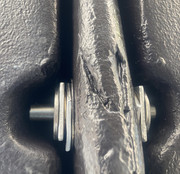
Disclosure: Our own keel needs some TLC. At sometime prior to our adopting Over Easy one of the POs made a resin only repair to the keel leading edge…no real prep and no glass fiber… :? :o :| It’s brittle and has been degrading over time. While there is no safety or structurally at risk.. it just looks like Fido’s chew toy at that location. We’re gonna take care of it before the start of next season. A good winter in the garage project.
Image

Good Luck and post pictures if you can!

Best Regards
Over Easy 8) 8)

Re: Polyester epoxy resin.

Posted: Tue Apr 16, 2024 12:19 pm
by warfin
Hi Over Easy,
Thank you for your prompt, helpful reply.
On your advice, I will use the EPOXY technique as it bonds with both poly and epoxy and I'm familiar with its use.
The history of this problem:The boat lives in a slip in salt water. A PO attached an aluminium shield to the leading edge of the CB, either as protection or a repair. It was screwed to the original material and sealed but over time critters have made a home in there, grown large and deformed the alloy. This, in turn has expanded the device to the point where it was binding on the cb case which eventually jammed the cb in the up position.
I was away from my marina slip at the time (having rested on a sandy bottom over a few days) but managed to motor home successfully with the cb in the up position. I won't go into the docking procedure but suffice to say that it wasn't pretty.
A fix was effected with the use of a large hammer, new screws and Sikaflex for a repair which (hopefully) will last until my next lift and antifoul recoat. This is due in 12 months but I'll monitor the situation and carry out a permanent repair then. I'm thinking of removing the shield and reprofiling the cb to its original shape.The process will be documented and posted at that time.
Again, many thanks and I'll keep you informed.
Regards,
Warfin.

Re: Polyester epoxy resin.

Posted: Tue Apr 16, 2024 4:44 pm
by OverEasy
Hi Warfin!

Boy! That must have been a real task un jamming your swing keel! Sheesh! :| :| :? :o

From a 2 cent perspective I could see wanting to protect the leading edge from direct impact damage to the fiberglass, especially if I were in rocky waters with hidden or poorly charted submerged rock structures just waiting to prang ya… :o :o :| :|
At the same time from a practical engineering perspective I don’t think I would have used aluminum rather I would have opted for a SST or even a compliant (think rubber or resilient plastic) option. Aluminum tends to be susceptible to corrosion in saltwater and the marine critters (who start out incredibly small) seem to like latching onto aluminum in static areas.

On our little Sunfish I’ve had the unfortunate experience(s) of sailing along at a good clip only to be catapulted up and out into the water when the Center Board struck a rock. (Fortunately the trunk was undamaged but the centerboard kind of sustained some forced shape modifications :o :? :D :D as did my ego…. 8) 8) ) When people occasionally ask about the unconventional leading edge of the center board I tell them it was from a fresh water shark nibble… :D :D :D :D

Best Regards
Over Easy 8) 8)

Re: Polyester epoxy resin.

Posted: Wed Apr 17, 2024 10:49 am
by warfin
Hi Over Easy,
Thank's for your 2 cents worth regarding the use of aluminium underwater. You are correct about its negative aspects but I think the PO attached it as a matter of expediency for a damage cover-up rather than protection. Time and further inspection will tell.
I employed a diver to free it prior to lifting the boat as I hopped the issue was simply jetsam causing the jamming. Diver cost $100.
In the mean-time I'll continue as usual, in fact I plan to sail today or tomorrow in typical Queensland Spring conditions of 10kts under chroma-key blue skies @ 27 deg C.
Regards,
Warfin.

Re: Polyester epoxy resin.

Posted: Wed Apr 17, 2024 9:16 pm
by OverEasy
Sounds like an absolutely great day! 8) 8)

Re: Polyester epoxy resin.

Posted: Fri Apr 19, 2024 5:42 pm
by Ixneigh
As an aside, there are some different kinds of polyester resin also. The best is vinylester resin. Its adhesion to old polyester resin is nearly that of epoxy. For anything important I’d use that on large areas, and West epoxy on smaller areas. I used west to bond two partial bulkheads to the hull and deck, because they were plywood. But if I was to do that major mod by raising part of the cockpit, I’d use all vinylester resin (as an example) because there is no, or very little, structural wood in that project.

Ix