Centerboard Klunk Revisited, plus cable idea ... ?
Posted: Fri Jun 21, 2024 8:57 pm
There are threads about the klunk. I've perused most, if not all of them. It concerns me both when sailing, but also, likely more importantly, at anchor.
A fairly common mention is that play is to be left to keep the various twisting forces from being transmitted to the hanger bolt and the fiberglass through which it depends.
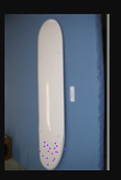
When you see these photos, know I have not bedded anything in 5200 yet. I plan to take it apart. Putting it in was easy, and I wanted to test the feel of it, and make sure my knot (double overhand) and its melted end cleared as it should. It does.
However, I noticed a new thing: The board is actually harder to pull up, and I think I know why: The previous owner had put a bowline loop in, and the board was being raised from a center position, hanging straight down. With the new line in from the stbd side, the first motion the board exhibits when the line is pulled taut is to twist the centerboard to the side, rotating it clockwise. This causes friction against the inside of the well, and makes it more difficult to raise. There are marks on the centerboard and the inside of the well that suggest this was the case (before the bowline install, which didn't fully work for obvious reason)
So I'm revisiting the cable idea. I've got a spool of 3/32 stainless downrigger rope. I love this stuff. Super duper strong, and I've never broken it. The idea here would be to insert a stainless bushing into the hole of the centerboard, and run a loop of the stainless wire rope through it, and swage it together just above the centerboard. The two bitter ends would then be passed up through the tube and exit cabin top, over what should be a block, around the block 90 degrees horizontal to a loop termination, where a nylon line is attached to pass through to the cockpit. This would make the centerboard not twist when being raised.
I'd like to know the potential reasons for failure ... it has been mentioned that the cable was not as reliable as the all-rope version. Was this for boats that spend most of their time in the water by any chance? Or on land?
To fix the klunk I've done a couple things, easily undo-able, and plan to do one more ... that being the most risky, since I can't test it until on the water, I say to you this: Similar to the person who put furniture slider pads on the inside of the trunk ... but in my case I've got two hard rubber furniture "feet" and I think they would be attached to the forefoot of the centerboard (with GFlex Epoxy), just below the jutting out snout stopper that keeps the board from overextending.
These rubber pads would combine with the PEX bushing on the pin (I clearanced some 1/2" PEX) as well as the two spacers I made for the "cheeks" that ride on the pin. By themselves, the bushing and the spacers allow considerable slop .... from what was previously unbelievable ... there is still quite a lot of play. The bushing is not tight on the pin, nor is it tight in the centerboard. The spacers are not tight between the hangar and the centerboard sides. Pics below.
But together with the furniture pads (or something else if I find the better right thing in my junk stash) I think they would spread the leverage and force.
Or would I just break my boat?
Not looking for "You can't do that" unless there is a real reason. For both of these ideas. But I'm listening!
Thanks for the eyeballs and time. : ) .
A fairly common mention is that play is to be left to keep the various twisting forces from being transmitted to the hanger bolt and the fiberglass through which it depends.
When you see these photos, know I have not bedded anything in 5200 yet. I plan to take it apart. Putting it in was easy, and I wanted to test the feel of it, and make sure my knot (double overhand) and its melted end cleared as it should. It does.
However, I noticed a new thing: The board is actually harder to pull up, and I think I know why: The previous owner had put a bowline loop in, and the board was being raised from a center position, hanging straight down. With the new line in from the stbd side, the first motion the board exhibits when the line is pulled taut is to twist the centerboard to the side, rotating it clockwise. This causes friction against the inside of the well, and makes it more difficult to raise. There are marks on the centerboard and the inside of the well that suggest this was the case (before the bowline install, which didn't fully work for obvious reason)
So I'm revisiting the cable idea. I've got a spool of 3/32 stainless downrigger rope. I love this stuff. Super duper strong, and I've never broken it. The idea here would be to insert a stainless bushing into the hole of the centerboard, and run a loop of the stainless wire rope through it, and swage it together just above the centerboard. The two bitter ends would then be passed up through the tube and exit cabin top, over what should be a block, around the block 90 degrees horizontal to a loop termination, where a nylon line is attached to pass through to the cockpit. This would make the centerboard not twist when being raised.
I'd like to know the potential reasons for failure ... it has been mentioned that the cable was not as reliable as the all-rope version. Was this for boats that spend most of their time in the water by any chance? Or on land?
To fix the klunk I've done a couple things, easily undo-able, and plan to do one more ... that being the most risky, since I can't test it until on the water, I say to you this: Similar to the person who put furniture slider pads on the inside of the trunk ... but in my case I've got two hard rubber furniture "feet" and I think they would be attached to the forefoot of the centerboard (with GFlex Epoxy), just below the jutting out snout stopper that keeps the board from overextending.
These rubber pads would combine with the PEX bushing on the pin (I clearanced some 1/2" PEX) as well as the two spacers I made for the "cheeks" that ride on the pin. By themselves, the bushing and the spacers allow considerable slop .... from what was previously unbelievable ... there is still quite a lot of play. The bushing is not tight on the pin, nor is it tight in the centerboard. The spacers are not tight between the hangar and the centerboard sides. Pics below.
But together with the furniture pads (or something else if I find the better right thing in my junk stash) I think they would spread the leverage and force.
Or would I just break my boat?
Not looking for "You can't do that" unless there is a real reason. For both of these ideas. But I'm listening!
Thanks for the eyeballs and time. : ) .