Page 1 of 2
Rigging stay attachment: to bolt or not to bolt
Posted: Mon Sep 22, 2025 4:18 pm
by JamesToBoot
One of the last things before lake trials.... replace rusty pins, ring-dings, cotter pins, bolts on the standing rigging stay adjusters.
It seems that some of you use bolts with nylock lock nuts. On my new-to-me boat, there is every fastener you can imagine (with every metal you can imagine) Is this OK to replace w ss bolts and nylock lock nuts?
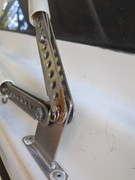
Some threads like 'rigging failure - demasted under sail' and others make me think that bolts and nuts might be a good idea.
I do worry about ring-dings. I have had many close calls because something catches on one of them... A line, a sail, my shirt, life jacket... I would very much like bolts and nuts where I can use them.
I guess being all proper became engrained in me with my first sailboat (no bolts, no nico pressed stays, no big engines, etc, etc...)
So... Back to the question:
to bolt or not to bolt?
Re: Rigging stay attachment: to bolt or not to bolt
Posted: Mon Sep 22, 2025 4:47 pm
by Maraquita
I see no problem with bolts, BUT!
1. Definitely use lock nuts, because……
2. Don’t try to “neaten things up” and make the bolts tight. Those fittings need to be somewhat sloppy and loose so they can flex as the rig loads and unloads.
3. Don,t use “grade 8” or whatever the SS equivalent is. Those bolts will get shock loaded and high strength leads to higher brittleness, which is not good for shock loads. “Grade 5” has adequate strength, and is much less brittle (a good hardware man can give you the Stainless equivalent of those steel ratings)
Re: Rigging stay attachment: to bolt or not to bolt
Posted: Mon Sep 22, 2025 4:52 pm
by JamesToBoot
Maraquita wrote: ↑Mon Sep 22, 2025 4:47 pm
I see no problem with bolts, BUT!
1. Definitely use lock nuts, because……
2. Don’t try to “neaten things up” and make the bolts tight. Those fittings need to be somewhat sloppy and loose so they can flex as the rig loads and unloads.
3. Don,t use “grade 8” or whatever the SS equivalent is. Those bolts will get shock loaded and high strength leads to higher brittleness, which is not good for shock loads. “Grade 5” has adequate strength, and is much less brittle (a good hardware man can give you the Stainless equivalent of those steel ratings)
That is great information sir. Thank you.
I had no idea about grade 8 vs grade 5. Great argument for going with a lower grade. There's a logic that would not have occurred to me but makes perfect sense.
Re: Rigging stay attachment: to bolt or not to bolt
Posted: Mon Sep 22, 2025 9:10 pm
by kmclemore
I agree with Maraquita, with regards to if you're using bolts with Nyloc nuts. The only thing I'd add is that you can only use a Nyloc nut ONCE. Many folks try to use them over and over again, and yeah, they MAY work... but do you want to trust your life to it? Use once only... safest bet.
Now as to using nuts and bolts at all, I'd say... NO. There's a reason boat manufacturers and racers never use nuts and bolts on rigging... they are simply not as safe as pins with rings. Yes, the rings can catch things - but that's why they make sail tape... tape the ring like a little flag to cover any sharp edges and you'll prevent any snags... that's what racers do, and it works.
Re: Rigging stay attachment: to bolt or not to bolt
Posted: Tue Sep 23, 2025 3:27 pm
by Be Free
kmclemore wrote: ↑Mon Sep 22, 2025 9:10 pm
I agree with Maraquita, with regards to if you're using bolts with Nyloc nuts. The only thing I'd add is that you can only use a Nyloc nut ONCE. Many folks try to use them over and over again, and yeah, they MAY work... but do you want to trust your life to it? Use once only... safest bet.
Now as to using nuts and bolts at all, I'd say...
NO. There's a reason boat manufacturers and racers
never use nuts and bolts on rigging... they are simply not as safe as pins with rings. Yes, the rings can catch things - but that's why they make sail tape... tape the ring like a little flag to cover any sharp edges and you'll prevent any snags... that's what racers do, and it works.
Preach it Brother! Pins, rings, and tape are the way to go. There is no upside to nuts and bolts on the stay adjusters.
Re: Rigging stay attachment: to bolt or not to bolt
Posted: Wed Sep 24, 2025 5:23 am
by kingtoros
Maraquita wrote: ↑Mon Sep 22, 2025 4:47 pm
3. Don,t use “grade 8” or whatever the SS equivalent is. Those bolts will get shock loaded and high strength leads to higher brittleness, which is not good for shock loads. “Grade 5” has adequate strength, and is much less brittle (a good hardware man can give you the Stainless equivalent of those steel ratings)
I would love this analysis on pins and shackles we use
kmclemore wrote: ↑Mon Sep 22, 2025 9:10 pm
Now as to using nuts and bolts at all, I'd say...
NO.
Be Free wrote: ↑Tue Sep 23, 2025 3:27 pm
Pins, rings, and tape are the way to go.
However, I agree with these gentlemen to use pins and rings. I used to have a hobie holder and it came with these nylon sleeves, I have since acquired and installed.

Re: Rigging stay attachment: to bolt or not to bolt
Posted: Wed Sep 24, 2025 6:27 am
by kurz
I use cable ties with the ringdings...
Re: Rigging stay attachment: to bolt or not to bolt
Posted: Wed Sep 24, 2025 7:35 am
by Be Free
kingtoros wrote: ↑Wed Sep 24, 2025 5:23 am
However, I agree with these gentlemen to use pins and rings. I used to have a hobie holder and it came with these nylon sleeves, I have since acquired and installed.
I have similar covers on my adjusters and underneath them are pins, rings, and tape.
Re: Rigging stay attachment: to bolt or not to bolt
Posted: Wed Sep 24, 2025 8:52 am
by tuxonpup
JamesToBoot wrote: ↑Mon Sep 22, 2025 4:18 pm
One of the last things before lake trials.... replace rusty pins, ring-dings, cotter pins, bolts on the standing rigging stay adjusters.
It seems that some of you use bolts with nylock lock nuts. On my new-to-me boat, there is every fastener you can imagine (with every metal you can imagine) Is this OK to replace w ss bolts and nylock lock nuts?
Some threads like 'rigging failure - demasted under sail' and others make me think that bolts and nuts might be a good idea.
I do worry about ring-dings. I have had many close calls because something catches on one of them... A line, a sail, my shirt, life jacket... I would very much like bolts and nuts where I can use them.
I guess being all proper became engrained in me with my first sailboat (no bolts, no nico pressed stays, no big engines, etc, etc...)
So... Back to the question:
to bolt or not to bolt?
My 26X came with plastic shroud covers on the stays and lifelines and the ones on the stays are brittle to the point where they come off the stay if I grab and put weight on them, so they need to come off. Looking at your photo I see you have loose plastic shroud covers, I assume just at the base, but I keep seeing advice to remove them due to what you're seeing there, they retain moisture and promote rust.
I have these small plastic caps above mine and I've seen plastic deflectors along people's lifelines, both I assume to prevent the foresail from pressing directly on the lifelines and shrouds without covering them. Don't know that helps any if you're running a jib inside your shrouds though...

Re: Rigging stay attachment: to bolt or not to bolt
Posted: Wed Sep 24, 2025 9:08 am
by JamesToBoot
tuxonpup wrote: ↑Wed Sep 24, 2025 8:52 am
JamesToBoot wrote: ↑Mon Sep 22, 2025 4:18 pm
One of the last things before lake trials.... replace rusty pins, ring-dings, cotter pins, bolts on the standing rigging stay adjusters.
It seems that some of you use bolts with nylock lock nuts. On my new-to-me boat, there is every fastener you can imagine (with every metal you can imagine) Is this OK to replace w ss bolts and nylock lock nuts?
Some threads like 'rigging failure - demasted under sail' and others make me think that bolts and nuts might be a good idea.
I do worry about ring-dings. I have had many close calls because something catches on one of them... A line, a sail, my shirt, life jacket... I would very much like bolts and nuts where I can use them.
I guess being all proper became engrained in me with my first sailboat (no bolts, no nico pressed stays, no big engines, etc, etc...)
So... Back to the question:
to bolt or not to bolt?
My 26X came with plastic shroud covers on the stays and lifelines and the ones on the stays are brittle to the point where they come off the stay if I grab and put weight on them, so they need to come off. Looking at your photo I see you have loose plastic shroud covers, I assume just at the base, but I keep seeing advice to remove them due to what you're seeing there, they retain moisture and promote rust.
I have these small plastic caps above mine and I've seen plastic deflectors along people's lifelines, both I assume to prevent the foresail from pressing directly on the lifelines and shrouds without covering them. Don't know that helps any if you're running a jib inside your shrouds though...
Thanks Tux,
Please note, the rust you see on my stay adjuster in this photo is from a cotterpin. It did not appear to be SS. I had already replaced it in this photo.
I did think those covers (look like pvc water pipe or similar) are a great idea. It will be the first time Ive had them on a boat (the 26s came with them) but I think they may be awesome for preventing stuff catching and / or wearing on the stays and adusters. I think they may be good for keeping clevis pins from falling out.
I am leaning toward using bolts / nuts instead of clevis pins. I had heard from more fancy people than I, that you shouldnt. But they couldn't really elaborate as to why. I just assumed it was done that way for a reason (and Ive never had to replace any) so I never changed it. My biggest concern was ware on the holes due to the ridges of the bolt thread. Macgregor seems to beef up the rigging by using these huge chunks of SS instead of going tradition turnbuckle (which I have bent several while raising masts). He doesn't beef up much, but normally trims things down. So due to the beef of the stay adjusters, I think my argument of wear is insignificant, if not moot.
Do we have any evidence either way? My argument for bolts would be the fragility of the ring-dings that some suggest need additional protection (tape, shrink wrap, pvc pipe, zip ties). So why not replace w bolts where able? Down sides?
Re: Rigging stay attachment: to bolt or not to bolt
Posted: Wed Sep 24, 2025 9:35 am
by OverEasy
Hi JamesToBoot
You bring up a good valid question!
I may be mistaken, and please feel free to correct me if I am, but pins and rings are the generally preferred option over bolts and self locking nuts on a lot of maritime applications mainly for the aspect that they work and work well without the need for tools. It reduces the items necessary to bring out on deck to adjust something.
The logic goes something like this:
I’m not saying that fiddling with a pin and a ring ding and a shroud adjuster on a bobbing boat is easy but it can be done… (generally with the ring ding pinched between the lips at one point of the process or other

…just don’t swallow

) whereas with a bolt and nut arrangement one will also have a wrench for the bolt AND a wrench for the nut so now you’ll have to contend with five loose objects on the bouncy boat deck instead of just three…. and we are still just at the dock, never mind out at sea…. Continuing that thought for a moment further consider what happens if you inadvertently “lose” one of the wrenches overboard… now what do you do? (While folks that have to work in hazard conditions often have their tools on lanyards attached to them this can get kind of awkward in practice even for experienced professionals.) Now try imagining the scenario being in pounding chop with blowing wind, spray, rain and in the dark and you’re gonna have to first go below deck to first find and select the appropriate wrenches before getting back up on deck to deal with the issue. A pin and clip you can do by feel alone without tools is beginning to look a lot better, eh?
Some enterprising folks have made pins with tootles, pins with spring ad toggles, pins with push button detent balls as well as pin and clip sets with a bit of wire or cable attaching the clip and pin together to reduce the number of ‘loose’ items to two…..(Not sure how that works with a ring ding) but you get the idea that the intent is to reduce the number of loose things that you will be contending with on the bouncy boat deck.
So, like a lot of things in life, there is some hard earned logic behind the use of pins and clips having a preference over bolts and nuts in maritime applications.
Many good maritime designers go to the effort to standardize what pins and clips they select for use on a vessel. This minimizes the need for unique spares and increases interchangeablity while standardizing operational procedures.
As always, It’s your boat so it’s your rules. Just be aware of the potential consequences of your choices for yourself and others into the future.
Best Regards,
Over Easy

Re: Rigging stay attachment: to bolt or not to bolt
Posted: Wed Sep 24, 2025 9:46 am
by JamesToBoot
OverEasy wrote: ↑Wed Sep 24, 2025 9:35 am
Hi JamesToBoot
You bring up a good valid question!
I may be mistaken, and please feel free to correct me if I am, but pins and rings are the generally preferred option over bolts and self locking nuts on a lot of maritime applications mainly for the aspect that they work and work well without the need for tools. It reduces the items necessary to bring out on deck to adjust something.
The logic goes something like this:
I’m not saying that fiddling with a pin and a ring ding and a shroud adjuster on a bobbing boat is easy but it can be done… (generally with the ring ding pinched between the lips at one point of the process or other
…just don’t swallow
) whereas with a bolt and nut arrangement one will also have a wrench for the bolt AND a wrench for the nut so now you’ll have to contend with five loose objects on the bouncy boat deck instead of just three…. and we are still just at the dock, never mind out at sea…. Continuing that thought for a moment further consider what happens if you inadvertently “lose” one of the wrenches overboard… now what do you do? (While folks that have to work in hazard conditions often have their tools on lanyards attached to them this can get kind of awkward in practice even for experienced professionals.) Now try imagining the scenario being in pounding chop with blowing wind, spray, rain and in the dark and you’re gonna have to first go below deck to first find and select the appropriate wrenches before getting back up on deck to deal with the issue. A pin and clip you can do by feel alone without tools is beginning to look a lot better, eh?
Some enterprising folks have made pin and clip sets with a bit of wire or cable attaching the clip and pin together to reduce the number of ‘loose’ items to two…..Not sure how that works with a ring ding but you get the idea that the intent is to reduce the number of loose things that you will be contending with on the bouncy boat deck.
So, like a lot of things in life, there is some hard earned logic behind the use of pins and clips having a preference over bolts and nuts in maritime applications.
Many good maritime designers go to the effort to standardize what pins and clips they select for use on a vessel. This minimizes the need for unique spares and increases interchangeablity while standardizing operational procedures.
As always, It’s your boat so it’s your rules. Just be aware of the potential consequences of your choices for yourself and others into the future.
Best Regards,
Over Easy
Great argument for clevis pins @Over Easy,
Not something I have thought over in great detail, needing it tool-less for ease while at sea. Addition things in hand would be bad during a replacement at sea. And it would be bad if the tools go overboard, or just not found in time. Two very good arguments.
To be honest, ring-dings are aweful to put on. Ive put on 20+ now over the years and they still are a pita. In that aspect, I would probably perfer something less tiny than a ring-ding to deal with. Something larger like a nut may be perfered.
Also, to put on a ring-ding, I think it requires you to see really well close up. So you have to get really close with good eye sight, in good light. Im not a mechanic, but I have and can still put in bolts / nuts in places I cannot see. I couldn't imagine that I will ever be able to do that with a ring-ding. Be sure to bring your glasses and a flashlight... a ring-ding maybe not as tool-less as I was first thinking.
Still, I would have though ring-dings a hazard with all the lines, sails, pant legs, life jackets, etc that catch on them. With as much as they seem to fail, I would have though they would have been as hated as quick-pins.
So besides tool-less-ness, what are the other downsides to a bolt and nut?
Re: Rigging stay attachment: to bolt or not to bolt
Posted: Wed Sep 24, 2025 10:23 am
by OverEasy
Hi JamesToBoot
While Ringdings have their issues they have their benefits…. It’s REALLY hard to have them fall off without considerable deliberate effort.
Consider a pin with a groove and a slip over a spring pin clip. The two pointy ends are both available to be snagged or pushed upon and either or both could easily disengage the spring clip and subsequently allow the pin to come free… Oppsies!


Hmmm…..
How about instead of a groove we make a hole in the pin and insert a spring pin clip into the hole. Hmmm…. The two pointy ends are still both available (albeit a little bit more difficult) to be snagged or pushed upon and either or both could easily disengage the spring clip and subsequently allow the pin to come free… Oppsies!
Hmmmm……
What to do…. Ah Ha! Let’s round over the end of the free side of the spring clip so it aligns with the insertion side of the spring clip! While that sorta works it’s also made it difficult to get the insertion side of the spring clip engaged/disengaged with the pin hole and we’ve also made a ‘hook’ that will inevitably be bent and exposed to snag or allow the spring clip to become disengaged from the pin. Drat!

Fribble……
Now what if we sorta make a spring clip into a spiral of sorts so the insertion is sorta easy but then to spring clip captures itself onto the pin? Hmm that sorta works. It makes it rather difficult to actually disengage the clip without considerable effort so the pin has a substantially improved opportunity to remain in place until the spring clip is deliberately removed. Voila! The primary function of retaining the pin in place has been accomplished. Now through repeated use we find that while this funny ring shaped thing spring clip works (a ring ding) it has an annoying habit of the snagging fabric of shirts and pants…Hmmm…..
“Hey!


How about we take a bit of sail repair tape and cover over the ring dingy thingy?” Some sailor said… The rest is history.

Best Regards,
Over Easy
Re: Rigging stay attachment: to bolt or not to bolt
Posted: Wed Sep 24, 2025 11:48 am
by JamesToBoot
OverEasy wrote: ↑Wed Sep 24, 2025 10:23 am
Hi JamesToBoot
While Ringdings have their issues they have their benefits…. It’s REALLY hard to have them fall off without considerable deliberate effort.
Consider a pin with a groove and a slip over a spring pin clip. The two pointy ends are both available to be snagged or pushed upon and either or both could easily disengage the spring clip and subsequently allow the pin to come free… Oppsies!
Hmmm…..
How about instead of a groove we make a hole in the pin and insert a spring pin clip into the hole. Hmmm…. The two pointy ends are still both available (albeit a little bit more difficult) to be snagged or pushed upon and either or both could easily disengage the spring clip and subsequently allow the pin to come free… Oppsies!
Hmmmm……
What to do…. Ah Ha! Let’s round over the end of the free side of the spring clip so it aligns with the insertion side of the spring clip! While that sorta works it’s also made it difficult to get the insertion side of the spring clip engaged/disengaged with the pin hole and we’ve also made a ‘hook’ that will inevitably be bent and exposed to snag or allow the spring clip to become disengaged from the pin. Drat!
Fribble……
Now what if we sorta make a spring clip into a spiral of sorts so the insertion is sorta easy but then to spring clip captures itself onto the pin? Hmm that sorta works. It makes it rather difficult to actually disengage the clip without considerable effort so the pin has a substantially improved opportunity to remain in place until the spring clip is deliberately removed. Voila! The primary function of retaining the pin in place has been accomplished. Now through repeated use we find that while this funny ring shaped thing spring clip works (a ring ding) it has an annoying habit of the snagging fabric of shirts and pants…Hmmm…..
“Hey!
How about we take a bit of sail repair tape and cover over the ring dingy thingy?” Some sailor said… The rest is history.
Best Regards,
Over Easy
One of those times I wish I were there in person to better understand. Thanks for working through your thought process for me. I will continue to read through this a couple more times to better understand.
I think its possible that I may have to experience it myself, only to end up right back at the same conclusion that the entire sailing world has already gotten. Then again, who would have though rope rigging would have gained popularity again, or that nico presses swages would be sufficent/safe, or that Macgregors' unique designs would be so popular, successful, and safe.
Its not that I don't believe you, I mostly certainly trust you and your experience (I very much enjoy reading the wisdom from your many, many posts) along w the rest of the sailing community. Im just inexperienced and continue to ask question after question, until I am able to wrap my mind around it. I think you've probably done an amazing job above, but it may take me a bit more experience to comprehend fully.
I think Macgregor has done a lot to change the minds of hard core sailors on many different topics with his designs. That may be what makes the Macgregor community so amazing here... the old school wisdom mixed with curiosity & love for the Macgregors unique differences / abilities, the willingness to share your wisdom and your patience to wait for others (me) to catch up. I wouldn't have asked this question on other forums due to the harshness of the responses. Nor would I have had the thought to revisit the topic unless I'd have seen others experimenting with bolts / nuts.
Re: Rigging stay attachment: to bolt or not to bolt
Posted: Wed Sep 24, 2025 12:10 pm
by JamesToBoot
Something else to mind,
Pins / bolts should enter the rigging from the high side, in-case the ring-ding, cotter pin, bolt, etc falls out, so that gravity will not aid in backing out the pin / bolt.
In the picture, you can see that the inside is blocked by the top-side of the bolt. I don't beleive I can put a ring-ding in here (between the stay adjuster and the boat). However, I could put on a lock nut with ease.
This particular area concerns me on the 26s as I could see lines / sails getting pinched here, causing more contact w the ring-ding (unsure of how different this area is on the x and the m).