Page 1 of 2
Posted: Sun Jul 03, 2005 8:37 am
by Bobby T.-26X #4767
We're go out tomorrow morning for a couple of days, will watch fireworks from the X...
regarding your dilemma:
this is a standard issue with the MAC. It wants to move around at slow speeds.
additionally, if it gets windy, the bow really gets pushed side to side.
most suggest (as I do) at slow speeds to drop the centerboard 1/4 to 1/2.
also, don't "over compensate". that is, I now know how to stay straight at slow speeds. however, if I allow a guest to steer, they make S's as we move along due to lack of "feel" and experience.
incidentally, the MAC is much less "squirrley" with the ballast full at slow speeds too.
however, personally, I only use ballast while sailing.
Posted: Sun Jul 03, 2005 8:46 am
by ALX357
... IMHO it works best to only use the CB halfway down and one rudder when docking, backing up, or trailer loading, the rest of the time, motoring at any speed, NO FINS are needed. Any use of rudders and CB with the motor only gets more unstable gradually as speed increases. I think the 7 mph "limit" is by necessity an arbitrary one, not a magic threshhold.
...Try that, it works fine on my X. I can see how having the centerboard down, with its usual bit of "slop" causing it to shift side to side, might cause the boat to yaw.
...Sailing always puts a consistent one-side force per tack on the board, while the wind never pushes directly from behind the transom on the center-line like the motor does. Even when running directly before the wind, the boom is to one side, the boat is pulled from the mast, mainsheet, foresail sheet, and chainplates, and the best position for the CB is up.
Posted: Sun Jul 03, 2005 9:10 am
by Sloop John B
I found that taping the dead ahead position on the wheel helped to curb the oversteer problem. It helps to understand and observe the slight 'delay' the boat has in making corrections.
Narrow rivers and channels were unnerving until I knew exactly where the rudders were positioned.
With the fins up motoring up and beyond 10mph, if there is a tendency for the boat to turn 'by itself' in one direction or another, try shifting the trim tab located just below the cavitation plate. Turn the tab just a little in the direction the boat has a tendency to go. Good time to check is on a windless glass morning surface. Let go the wheel. What's she doing?
The tab will compensate for what that right hand rotation of your prop is doing to you.
If you look, I bet the back of your tab is cocked a little bit to the right. That's the manufacturer trying to get you in the right direction.
Shifting weight, like the chubby mate changing seats, can cause the boat to steer, so try not to have this confuse the issue.
Posted: Sun Jul 03, 2005 9:08 pm
by ronacarme
The X is infamous for the tendency, at displacement speeds, of its heading to oscillate or hunt, i.e. swing slowly in response to a wheel input and then overswing. Knowing its tendency to overswing suggests how to compensate (more or less).
Example....Boat falls off course Y degrees. Turn wheel in correcting direction. Hold wheel there till boat slowly returns Y/2 degrees back toward course. Center the wheel. Boat's inertia in yaw continues to turn
it thru the remaining Y/2 degrees back to course. At least that is the theory...application is less exact.
Anticipate when boat is likely to fall off course again and in what direction. Turn wheel in correcting direction in advance, and so block or minimize the deviation from course. Gets a bit easier with practice....I still hope after 4 seasons.
Limit angle and speed of wheel rotation...a slow 1/4 turn, or better 1/8 turn...to change heading back onto course. Give the boat a second or two to overcome directional inertia...it will get the idea and respond pretty soon. Slow response to correction (because the correcting wheel rotation is small) desirably tends to limit the amount and speed of overswing.
To steer up and down the river in traffic, I need 3 inches of centerboard line out and one shoal rudder down. Carmen has substantially fewer hours steering the X, finds my combination inadequate, and demands at least one stock rudder down and at least half the CB line out. So I steer in shallow water at present.
All part of the fun of learning toget the most out of the X....makes boating less dull. Have fun.
Steering at displacement speeds in substantial following or quartering waves is a whole 'nother issue.
Posted: Mon Jul 04, 2005 7:09 am
by Greg
I noticed the last trip out how much someone moving around the boat affects direcional control under power. I noticed we were crabbing quite a bit when heading toward a landmark. My brother-in-law was sitting on one side so I asked him to move to center and the boat tracked straight on.
If you have people moving around the boat the directional control will be influenced and you will think the boat is wandering.
Greg
Posted: Mon Jul 04, 2005 8:18 am
by GARY WEEKLY

Welcome to the club,,i,ve tried every thing recomended on this board

what works for slow going is everything down! If you are running empty you can expect to swing alot,,add the ballest helps alot.
going in the 8-10 knot range with everything up seems to steady it more?
I,am thinking of trying one of those fins on the motor that encases the prop to see if that will help,,but at 265.00 i would want someone else to try it first good luck waddling duck
Posted: Mon Jul 04, 2005 9:27 am
by ALX357
Gary , take a look at my ring-prop $200, and "Power-Thruster" fins, ~ $ 75. Find them on the web by name and also on an earlier thread of this site. Could be used one or the other, or both as i have.... slow speed control is great... compared to before.
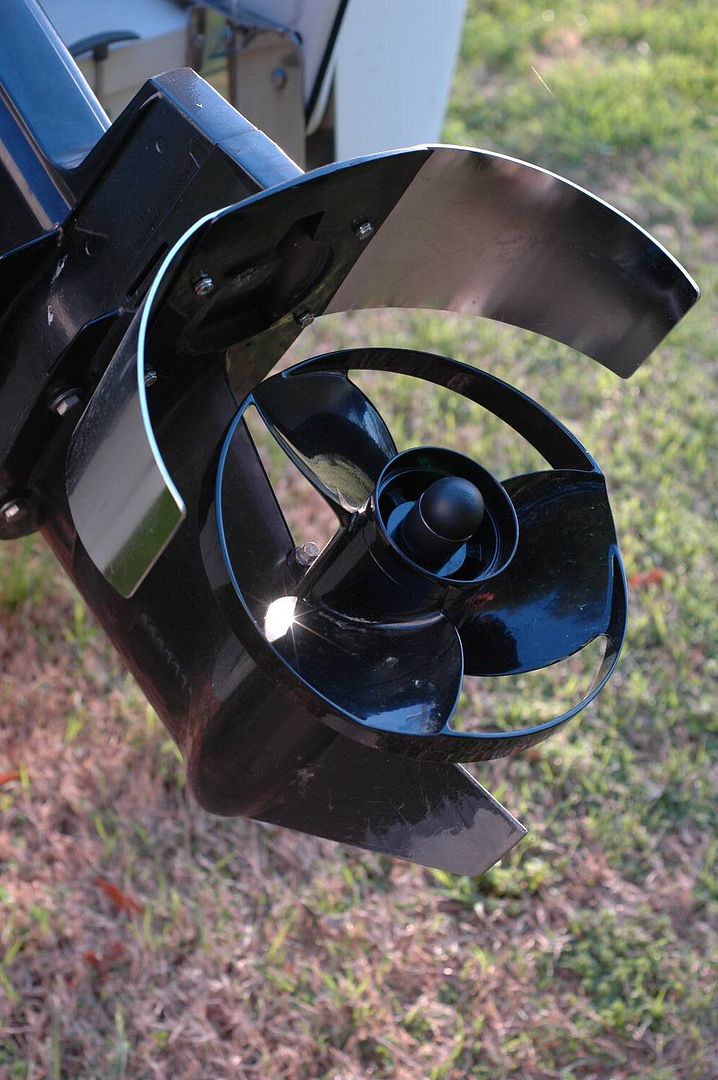
Posted: Mon Jul 04, 2005 11:13 am
by Duane Dunn, Allegro
The boat requires patience at the helm. You have to get past the tendancy to correct the course just because it has wandered slightly. Wait, and it will usually wander back the other way. Even a small wave, puff of wind, or someone moving below will affect the course.
I keep both rudders down and part or all centerboard around docks, etc. We run this way most of the time at any speed below 7 knots. (Also almost always ballast empty). One of the worst combinations is centerboard only at 6-7 knots. The board has far greater surface area than the motor does and it over powers the directional input coming from the motor.
Over 7 knots it all fins up. I find handling best around 12 knots. A this point the boat has build up some hull form resistance and settles down quite a bit.
I find one of the best ways to judge the directional stability is to take the human away from the wheel. Our course input opinions are too subjective. I turn on my auto pilot and watch it. The speeds, and configs I've listed above are the ones where the pilot makes the least corrections. Bad ones, like the centerboard only at 7 knots are the ones where the pilot looses control of the boat completely.
Over time you will find you will begin to feel the boat and what it is going to do. This will lead to your giving just a small bit of helm input before the boat wanders rather than reacting after it has wandered.
Don't be afraid of WOT. There is nothing nasty waiting for you. If anything the boat is easier to drive. When out towing the kids we run WOT doing loops with the helm thrown hard over from side to side with no problems.
Check out this GPS track from a day on the lake. Most of it was at WOT with the inner tube out back. (Part was even with me up on skis behind the boat.) It's a blast and the boat handles just fine.

Posted: Tue Jul 05, 2005 7:17 am
by mtc
I've found the same behavior to be true with Yin Yang (05M). She wanders like no other boat I've piloted, but then again, she's not like any other boat I've ever been on. Completely agree with the patience method of steering - let her settle down and see where she'll go. One common helm mistake is to think that the boat will round up and steer straight once you finish your turn. She'll just continue on the course you've set. Unlike a car, the Mac doesn't have any 'castor' built into the steering geometry to get the steering straight once the wheel turns. Additionally, that little prop (14") behind her huge hull has one hull of a job pushing the transom around the center of gravity to steer.
The best practices have all been listed above - let her go. Don't over steer, don't panic, no problem unless you have to hard over due to an obstruction, which she responds to very fast, by the way; way faster than a traditional keelboat.
My 14yr old daughter was at the helm last weekend while I was up on deck lowering our mast so we could get under the 17th ave train trestle ('graffiti bridge' for you, Moe) and she was driving us all over the bay. With the breeze around 15kts, it was rather exciting with me shouting back, 'where are you going?' It's real fun to have the mast in your hands, trying to keep the spreaders above the lifelines, and maneuvering the step plate into the pulpit bracket - all with a good chop that keeps changing!
By the way, we all know that it's much safer when on deck to keep your center of gravity as low to the deck as possible, especially in pitching seas. I started to use another launch point here in PNS, which requires me to raise the mast when out on the bay. Not as easy or convenient as doing it on the trailer, but a MUCH better launch point was worth it. To keep my balance on this tender, easy-to-heel boat, I started using kneepads. Unbelievable difference! Now I can have four points of stability rather than only my feet, or my knees on the deck diamond anti-slip surface. Give it a try. One thing I recommend, though, is to get the pads that have a rubber outer surface that will not slip or mar the deck.
She's a natural, though (Belle) and got it under control quickly enough.
You gotta love this stuff! Being out on Yin is one of the most important things I do anymore to get my chi back.
handling
Posted: Tue Jul 05, 2005 10:16 am
by Andy26M
The 26M definitely handles better at 9+ knots if all foils are up.
I find that below 7 knots, I like either no foils at all, or about a foot of daggerboard and one rudder down, provided I don't need any sharp turns. Coming into the slip, or maneuvering in tight spaces like a crowded mooring field, I leave 12-18" of daggerboard down and pull up both rudders - this allows extremely tight turns at the cost of having to work a lot to go straight.
All the posters above have got the clincher - patience is absolutely necessary. Driving a Mac at 5-7 knots is a lot like driving a big ship - put in corrections early, wait for them to take effect, learn where to take your rudder out so that she stops drifting right where you want her...
- AndyS
Posted: Tue Jul 05, 2005 11:28 am
by kmclemore
Yep, I agree on your handling comments, Andy. I love my

- it's the perfect boat for our family - but the d*mned thing handles like a barge at slow speeds. Ugh!
With ours, I use about 6" of centerboard down (actual board, not cable/line) and then at least one fin down for anything below 7 knots. Above that, all fins & CBoard full up.
How much daggerboard down for berthing?
Posted: Tue Jul 05, 2005 7:29 pm
by tidalwave
I have had my new

out just a few times from my marina.
I have to do three 90 degree tight turns to get her out and then back into her slip. I agree with the other members that the 'M' is squirrly when
doing slow tight turns with the board completely up.
Do most 'M' owners use about a foot of daggerboard down to help control sideslip when lowspeed turning in tight quarters? Or should I drop the board down even farther? Why would using just one rudder along with the motor have better control than using both rudders to help turn?
Any experienced opinions?
When away from the docks...with full ballast...and board up completely...she turns around nearly in her own length at 3-6 knots, quite impressed as long as I don't have to thread a needle.
Posted: Tue Jul 05, 2005 8:58 pm
by ALX357
I have the x boat, but this is similar, //// using only one rudder is sufficient to turn the boat as well as two, at the slower speed, and even though i have rigged bungees as the hold-down lines to allow rudders' kicking up with return to down, i like to be able to raise all the fins as fast as possible, and one is quicker than two. thats the only advantage i can see, and it may not apply for your needs.