Delevi
The post was not to find fault with your first-rate Quantum Fusion Sails, but to bring back the fact ‘Furling~Reefing’ systems cause an unavoidable forestay sag. Furler Reefing is bad for many reasons…including windage, poor shape, new tack reefed sail weak point, lack of reefed luff tension, lack of block position for proper lead of reefed headsail, etc, etc, etc.
From~"The Old Salt" Spinnaker Sailing's Newsletter
Issue #2 May 2007
"Furling Mainsails and Jibs "
You’ll notice that I don’t call headsail furling “reefing.” While many people may use furling systems for reefing their jibs or genoas, it’s an unreliable system for regular use for this purpose for these reasons. First, it puts a HUGE amount of torque on the furling drum which is the focal point for all the stress from the sail being partially furled and then the sheets at the other end trying to unfurl it. Second, sails are cut with a prescribed shape at the luff (leading edge) and furling them moves the draft horribly too far aft, a problem exacerbated by the headstay’s flexibility.
If you use the headsail furler as just that, a furler, you’ll see years of trouble-free service out of it. When it comes to headsail furling we have an expression here at Spinnaker, either off or full. It means either set the sail fully, or furl it fully. All of our boats have, at most, a 90% blade on the forestay so these sails are well suited for the Bay’s fresh breeze.
One of the foremost problems that arises out of furling use, both jib and main is that you MUST have a tight halyard hoisting the sail during furl and unfurl. This requires that you actually CHECK the halyard both before unfurling AND furling. Save yourself a lot of grief by performing this simple task.
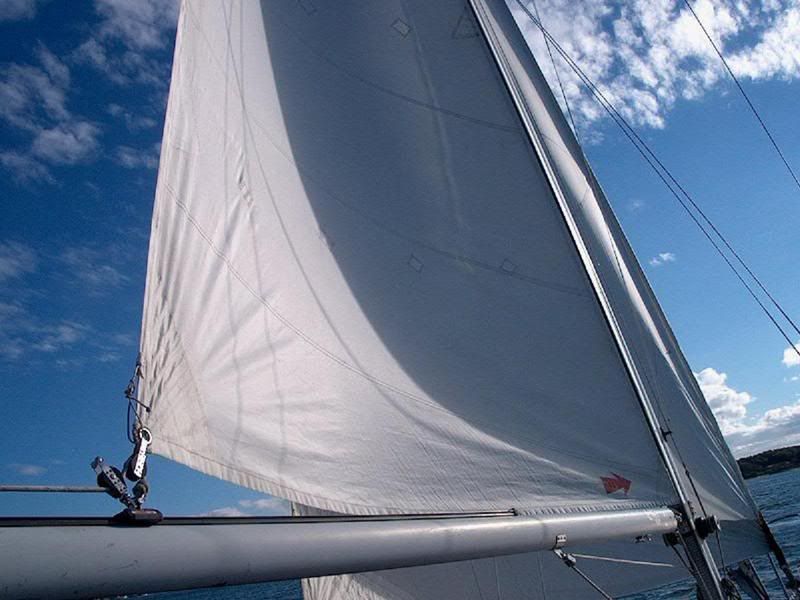
Furling , (not reefing) lighter sail, draft forward with great shape..All in or All out
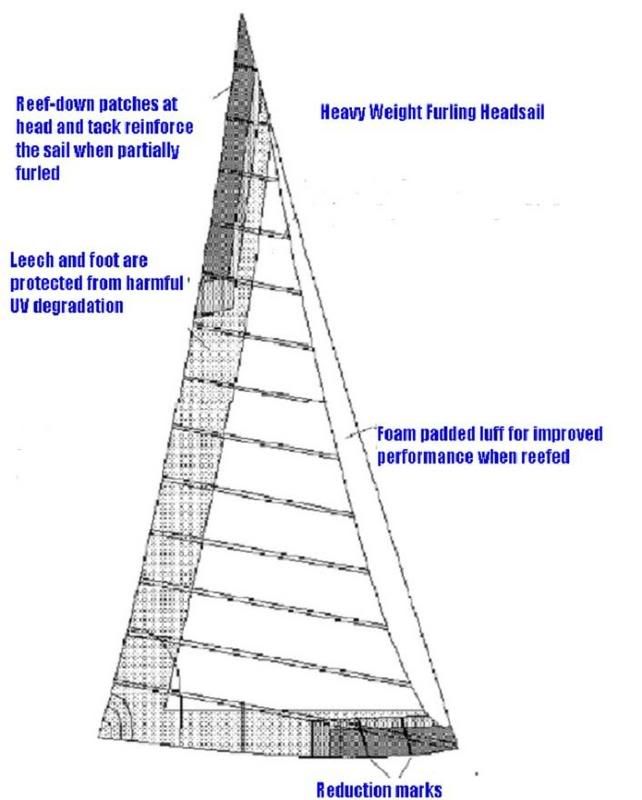
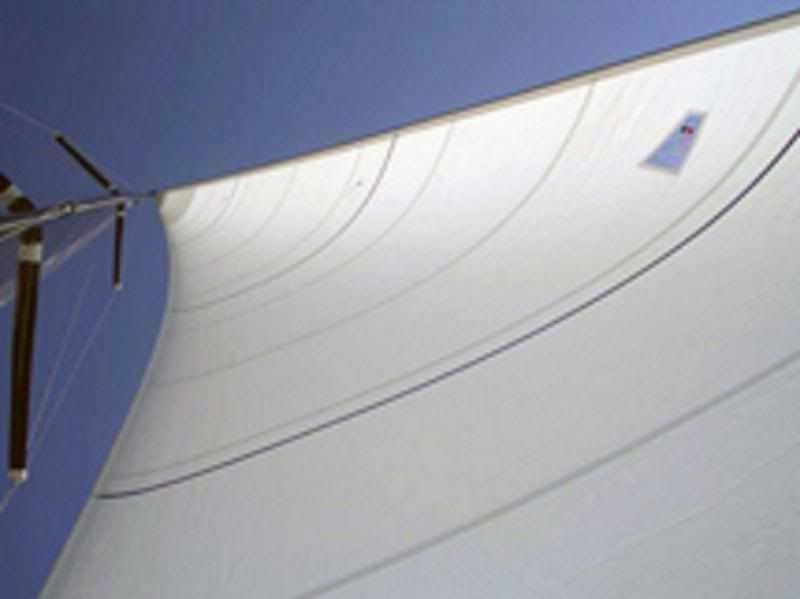 Heavy Reefing/Furling headsail with all the works
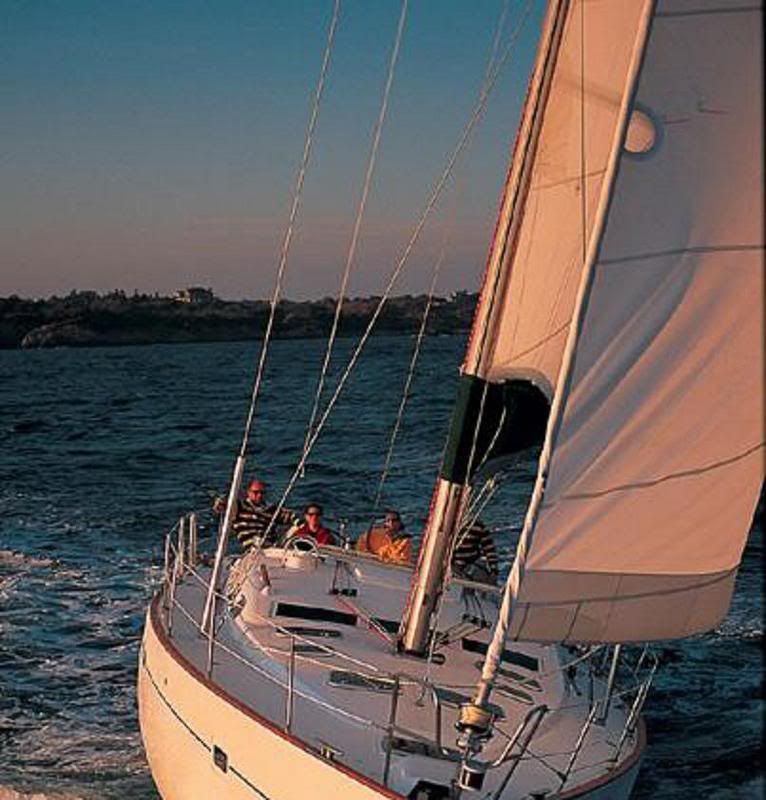
 Roller/Reefed Headsail with deep draft aft..Note stressed reefed tack area.
 Typical Deep Draft, Poorly shaped Mainsail Roller Reefed.
~~~~~~~~~~~~~~~~~
We feel CDI furling provides a window-shade benefit for those who care least about sail-shape and performance.
The same individuals fail to see the benefit of a proper lead or changing halyard tension for point of sail,
offering persistent attempts qualifying the genoa as best performer for ‘One Sail for all Conditions’.
The poorly designed CDI system
1. Flat extrusion design, centered, but extends beyond the headstay, and does not align with the wind as other furlers with luff foil designs.
2. The flat extrusion does not turn round or furl smoothly and rolled shape increases windage.
3. Bizarre single luff extrusion groove limits sail changing and use of double headsails.
4. Sail changes are difficult on the trailer, just about impossible on the water, requiring a messenger line and helper to pull the sail down, and again feeding and pushing the sail up.
5. Very small self-contained internal extrusion small line halyard and head shive are marginal quality, limiting static luff tension.
6. The static luff tension is set with archaic small line wraps.
7. Plastic extrusion assumes unacceptable shape when stored or on deck.
8. Extrusion can be easily broken if bent or struck carelessly.
9. Sail control is lost for the lack of the jib halyard luff tension.
10. No pre-feeder, and luff extrusion notch makes sail change difficult.
11. Extremely small cheap shackles make securing halyard and tack primitive.
Modern sailors furl, but do not reef…
Large mainsail with a big roach combines with small headsails and big assy spinnakers.


 whats the problem here, Do I know something nobody else doe's or is it just my little crazy streak lets me push this boat to the outer limits !!!
 I think I would need 3-4 crew to sail that Macpony of yours.


 on second thought that might not be such a bad proposition say on that nice PUMA boat