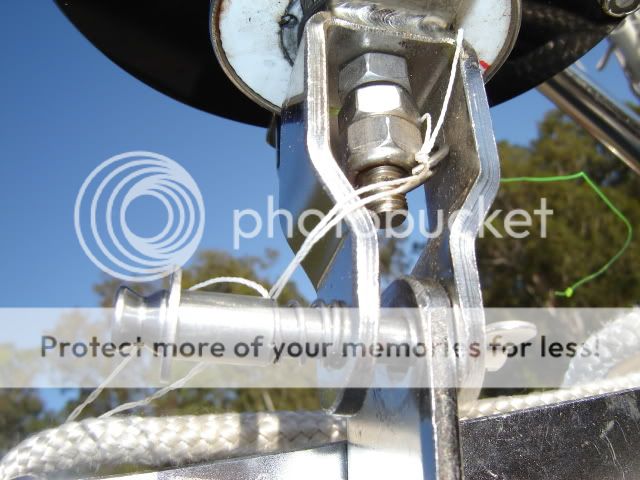
I have replaced the bolt and locking ring with a toggle pin as per photo. This I have done to simplify the operation while on the water. eg ease of use, less parts to fall overboard.
(I put an SS washer on the end of the pin to hold on a piece of plastic hose which spaces the pin so the end locks tight on the spring) & captive whipping twine.
The fact that you are douting should be your answer ! that pin is ok for a bimini or such but not for securing an forestay to easy for something to catch it the wrong way & out she comes
I would not be using that pin thats my personal decision !
I have replaced the bolt and locking ring with a toggle pin as per photo. This I have done to simplify the operation while on the water. eg ease of use, less parts to fall overboard. (I put an SS washer on the end of the pin to hold on a piece of plastic hose which spaces the pin so the end locks tight on the spring) & captive whipping twine.
I seek opinions and/or other ideas please.
Kind Rgds
Dave
08 26M
Try using a stainless steel bolt with a stainless steel wing nut. You won't need wrenches and it will be totally secure when finger tight.
Good luck,
Te
It should certainly be strong enough in shear, the direction of loading.
It seems you have addressed any backing-out issue, although (IMHO) I'd replace the securing twine with a piece of wire, perhaps.
My pin looks similar to that...with the flip-out end. Mine doesn't have the spring bit though...just a straight pin about that size with the flip-out end.
My issue with the toggle pin is security. That was also my issue with the original clevis pin; that and the frustration of having lost the little ring-ding overboard one too many times.
Now I use a screw-down shackle whose pin is the same size as the original clevis pin.
I would worry about any type of pin that didn't have a full ring ding. Any toggle or nut is not a good idea. These can work loose too easily. Likewise any type of hollow push button pin is too weak.
It is very strong and secure, the large end makes it easy to handle and the tapered end makes it easy to insert. I use a large 1" ring ding that is likewise very easy to handle. I drilled a small hole in the end plate and tethered the pin to the bottom of the furler so there is no way to drop it overboard. I have a bunch of ringding spares if I every drop one, but so far that has never been a problem. By the time the ringding needs to be installed the pin is in and you don't have to worry about the load on the rig anymore.
I use the same as above and also add a really small 1/16 inch stainless steel cable with cable cramp on stops to keep it from falling off in the water. it works everytime.
Dave, looks like you have a furler, so suppose a genoa. I found that the genoa sat below the bow and lifelines, so moved the whole lot up 200mm and purchased a special hifield lever. Now it is a breeze to connect the furler to the bow with a pin and wingding. Also the genoa goes over the bow, etc.
If you want to find out more do a search for hifiled lever on this site.
The spring on those clips tends to lose tension letting the pin slide out. I know you think because it bend down and is hard to keep it does not happen but I had to replace those pins off my bimini with screws. They kept falling out even when I replaced the dumb spring. A mast is an expesive thing to have to repair or replace for failure of a pin.



 to easy for something to catch it the wrong way & out she comes


