CB line wear point at base of CP - X boat question

A forum for discussing topics relating to MacGregor Powersailor Sailboats
Post Reply
User avatar
ALX357
Admiral
Posts: 1231
Joined: Thu Jul 22, 2004 6:09 am
Location: Nashville TN -- 2000 MacGregor 26X, Mercury two-stroke 50hp

CB line wear point at base of CP - X boat question

Post by ALX357 »

:macx: I might be able to figure this out, but with my board and line removed from the boat for so long now, I'll just ask.

:macx: :?: Does the CB line bear against the fore edge of the hole, or aft edge ? :?:

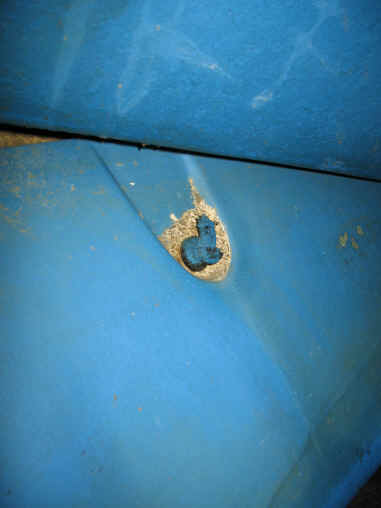
'Talking about the exit of the line in the CB trunk, where it leaves the tube of the compression post and extends down to the CB board attachment. Many owners have mentioned that their CB lift-line wears there, and attention is needed to that point. Depending on the geometry, the line under tension, (which it should always have), may bear against only one edge, the front or rear, or it might start at one edge extended, and end up bearing against the opposite edge, fore-or-aft, when retracted.
User avatar
40Toes
Engineer
Posts: 139
Joined: Tue Jan 22, 2008 9:08 am
Location: St. John's, Newfoundland, Ontario 28 - Formerly 2000 26X

Re: CB line wear point at base of CP - X boat question

Post by 40Toes »

I removed my centre board yesterday. I can take a picture of the line so you can see where it wears if you wish.

Rod
User avatar
ALX357
Admiral
Posts: 1231
Joined: Thu Jul 22, 2004 6:09 am
Location: Nashville TN -- 2000 MacGregor 26X, Mercury two-stroke 50hp

Re: CB line wear point at base of CP - X boat question

Post by ALX357 »

Well, thanks, that might be informative, but the real question is not about where the line wears, >> it is about which edge(s) of the exit hole wears the line. Specifically, which edge(s) does the wear come from. If the line were kept exactly oriented fore and aft to where it sat in the hole, and did not ever twist or rotate, then the wearing side(s) of the hole might be inferred from looking at the line, but that would assume alot about the line, and be nearly impossible to ascertain.

If you could show that rim around the exit hole, and any appreciable wear to the line were occuring there, maybe there would be some sign of it, re. which edge fore or aft, or side.

On the exit hole inside my X-boat's trunk, from the underside of the boat, I do not see any pattern of line wear or bearing against the gelcoat/fiberglass at the rim of the hole. I was wondering if others' boats showed that pattern.

Maybe someone who has had to smooth that area knows which fore/aft/side rim of the hole causes the wear, or maybe both.
User avatar
ALX357
Admiral
Posts: 1231
Joined: Thu Jul 22, 2004 6:09 am
Location: Nashville TN -- 2000 MacGregor 26X, Mercury two-stroke 50hp

Re: CB line wear point at base of CP - X boat question

Post by ALX357 »

I am considering installing in a fairlead there. Maybe a stainless steel flared type of one. Anyone have info on the specific hardware piece or methods used ?

I would think it would be important to not constrict the bottom of the hole, because stuff ( flotsam, marine life ) may get in the tube above, and jam the line, whereas the open bottom tube as is now will let stuff drop on out.
User avatar
40Toes
Engineer
Posts: 139
Joined: Tue Jan 22, 2008 9:08 am
Location: St. John's, Newfoundland, Ontario 28 - Formerly 2000 26X

Re: CB line wear point at base of CP - X boat question

Post by 40Toes »

I just did the measurements. The distance between the bracket bolt and the CB line in the hull is 14 inches . The distance on the CB between where the bracket attaches and the CB line attaches is also 14 inches. With the board full up the CB line will lead straight up. As the board lowers the line will run against the forward part of the hole slightly and it is over a lenght line not just in one place. By the MKII eyeball measurement tool, the line run between full up and full down is 24 inches. I am not sure how long the CB line has been on my boat (>3 yrs) and although faded and worn it only shows a little more wear at the hole. The hole doesn't look flared and I couldn't get my hand up there to feel the edge. If you have a particular chaffing problem there I would suggest and bit of sand paper. I can't see any defineable benefit to trying to put a fairlead up there. Hope this helps and I can PM pictures if you wish.

Rod
User avatar
ALX357
Admiral
Posts: 1231
Joined: Thu Jul 22, 2004 6:09 am
Location: Nashville TN -- 2000 MacGregor 26X, Mercury two-stroke 50hp

Re: CB line wear point at base of CP - X boat question

Post by ALX357 »

Thank you for taking the time to find that info. :macx:
Odd that on my boat, there is almost no edge wear around that hole on the front edge, where it would have been expected. There was almost no noticable wear on the line either, for the two feet that pass over that edge. The place where my line wore its outer weave is across the back edge of the board, where it was previously rigged coming up from the unrelieved side of the board. That wear on the line was always in the same few inches, not spread across any appreciable length. Maybe now with the line coming more vertically from the relieved side, it will not bear against the top edge of the board as much, but head more straight up into the hole above.
Apparently, if the gelcoated exit hole for the line is not burred nor has sharp edges, the wear over that 2 feet of line travel is minimal on both the hole and the line. One would think the line could eventually saw its way thru the gel-coat and get cut up by the fiberglass, but that apparently does not normally occur.

:macx:
User avatar
opie
Captain
Posts: 895
Joined: Tue Nov 16, 2004 5:40 am
Sailboat: MacGregor 26X
Location: Wilmington, NC

Re: CB line wear point at base of CP - X boat question

Post by opie »

ALX357,
I just realized that I may have a picture that adds to your info search. But it may not be the answer you need.

Image
picture of my knot while I had cb dropped and the hanger out for replacement recently.

Image

Background - My MacX C.B. line broke last year. I had not replaced it in 3 years. The line I put in last year was used a lot as I was actively sailing more than years before, so I replaced it this spring, but only turned it around. So I could take the picture above for you to show you the 1 year wear pattern. This is the end I pull on now, but it was knotted on the cb end for a year. In my opinion, from the picture of where I tie my knot on the cb above, the wear is on the side of the line, not fore or aft of the line, and the wear is exactly at the top of the board. My guess is that the CB line wears, not by use, but by non-use, meaning that the wear is attained by the cb rocking in the pocket while at anchor, motoring, etc. Your guess?
Last edited by opie on Sat Apr 24, 2010 5:44 am, edited 1 time in total.
Kelly Hanson East
Admiral
Posts: 1786
Joined: Sat Apr 19, 2008 2:35 pm
Sailboat: MacGregor 26X
Location: Kelly Hanson Marine........Mac 26M Dealer......Freedom Boat Works

Re: CB line wear point at base of CP - X boat question

Post by Kelly Hanson East »

Opie - I think you are right on this one. My :macx: board took 7 years before I replaced it (and it hadnt broken yet) - three years in a slip, and the rest trailered. Im sure the wear point is the famous FG hole it feeds up at the top of the board. Maybe a piece of heat shrink sheath could provide some chafe protection there?
User avatar
ALX357
Admiral
Posts: 1231
Joined: Thu Jul 22, 2004 6:09 am
Location: Nashville TN -- 2000 MacGregor 26X, Mercury two-stroke 50hp

Re: CB line wear point at base of CP - X boat question

Post by ALX357 »

Kelly Hanson East wrote:Opie - I think you are right on this one. My :macx: board took 7 years before I replaced it (and it hadnt broken yet) - three years in a slip, and the rest trailered. Im sure the wear point is the famous FG hole it feeds up at the top of the board. Maybe a piece of heat shrink sheath could provide some chafe protection there?
I disagree with the most commonly held opinion that the line is wearing at the mast support tube exit hole at the top of the trunk.

My line was worn thru the sheathing at only one spot, and that was at same place it was dragged across the back edge of the board, whenever the board was raised or lowered.

Since the line moves about a two feet total, then the line would also be feeding two feet thru the hole at the top of the trunk, and its wear would be spread over the two-foot span of line, instead of the singular place of abrasion seen on the photo above, and on my line also. Therefore the wearing would not be due to its moving there. The wear would have to be static there, just due to the board hopping up and down a but, but most of us tighten it completely when raised, so I don't see the wear happening at that point.

But there is a explanation how the line would wear in only one spot, or only over a couple of inches, from raising and lowering the board each time.
The edge of the board where the line passes..... the line makes about a 75 degree arc from its pivot from up to all the way down, and the lifting line is attached near the center of the board, not at the edge, as is the case of the rudders if using a thru-shackle. Therefore the line has to drag across the back of the board in its motion coming up, and that sawing would occur across a foot or so of board edge, but only across an inch or so of line.

Part of the problem is that the line is not fed from the recessed part of the board which would allow it to pass more vertically and not drag across the edge of the board. The line has to bend over that edge of the board, since it comes from a hole where the board is fatter, and has to pass thru a hole centered at the top of the arc. In effect, the board edge is moving across the line in one place, not the line feeding across a point of wear. That trailing edge of the board is alot "sharper" than the radiused edge of the trunk's hole. One other member has done the same as I plan, after drilling a second hole in the board above the first, or next to it actually, depending on the board's position.

The hole I drilled is in the same direction as the line, when the board is completely lifted, and therefore slightly aft when the board is down. That second hole allows the line to be knotted on the recess side, and then pass thru the board, move only an inch or two on the all-curved side of the board, and back thru the board to exit upwards on the recessed side again. That way, the line does not have to bend across the edge of the board as much. The inch or so of line exposure on the offside of the board is not at the board's fattest point, so it should not be bearing against the trunk on the line, and I bedded a partial groove between the two holes there, to bury the line halfway, 3/16" being half of the 3/8 line diameter. .... Hopefully the line pulling from closer to the boards centerline will reduce the sawing across its edge.

It's a tricky question of whether the wear is coming from the hole at the top of the trunk, or from the edge of the board. Those two locations on the line are only a few inches apart. But the pattern of wear being only in one spot of the line indicates the wear is NOT coming from the line being drawn in the direction of its length over a point. It would have to occur from the board just being in the raised position and stressing the line in the one spot. When the board is tightly cleated in the up position, if the one place in the line was against that one place at the hole, the board might have some bouncing moment that stretches the line and relaxes it causing that wear. This wear would be worse if the edge was rough, but on my boat, the edge was smooth, and did not look like any appreciable wear to the edge had occurred there.

That is possible, that a smooth edge could still stress and eventually cut the sheath of the line, but doesn't seem as likely to me, as the wear of the line across the board's edge, which would be caused from the board being raised and lowered. Careful comparison of the worn place in the line puts it at the edge of the board, for my line, and it looks like the same in the photos in the post of this thread, taking into account the amount of line in the knot.

Added observations or opinions ?
Post Reply