

According to this document regarding sailing performance of the Macgregor 25:
http://macgregor.sailboatowners.com/ima ... f/1363.pdf
"Maximum heel angle is 10 to 15 degrees, more or less and the boat will sail slower."
Is this true? If so, should it be reworded to read," OPTIMUM heel angle is 10 to 15 degrees, more or less and the boat will sail slower."
In light air, or when sailing downwind, for max speed should I put crew on leeward side if needed to achieve 10-15 deg of heel? Will this always be faster than "flat"?
Thanks,
Mac25
Mac25: proper heeling angle for top speed.
-
vizwhiz
- Admiral
- Posts: 1388
- Joined: Mon Aug 23, 2010 9:48 pm
- Sailboat: MacGregor 26S
- Location: Central Florida
Re: Mac25: proper heeling angle for top speed.
Sounds odd to me - boat should be fastest through the water "flat" from the hull displacement point of view, then should be slower through the water at an increasing rate as boat heel angle increases. The combination of centerboard lift, rudder lift, reefing sails, etc. is to maintain as vertical as possible while powering the sails as efficiently as possible.
It's probably possible to design a boat so that it's lines would be "cleaner" through the water at 10-15 degrees, but it would have some funky shaping to it...monohulls that is.
Essentially, you're creating an offset when heeling - one side of the boat in the water is bigger than the other, which means the water on that side has to travel a longer distance, and follow a different shape (meaning different directions - each time the water turns costs energy) than the water on the side higher out of the water (relative to the centerline). Further, the pointy end of the hull (that would be the bow) is designed to efficiently separate the water in such a way that it presents little frontal area to the water, allowing it to "split" and go around the hull so that it can "re-join" once it reaches the back of the boat. The further you're heeling, the more the upper side of the water gets pushed vertically (not good) and you get separation (turbulence) which represents lost power.
Unless I'm missing something big time, the comment (max heel angle) was accurate, and the explanation offered (more or less...) was misleading. That was a comment reportedly coming from Roger. Perhaps not the best at explanations, but he really knows how to make the boat...
It's probably possible to design a boat so that it's lines would be "cleaner" through the water at 10-15 degrees, but it would have some funky shaping to it...monohulls that is.
Essentially, you're creating an offset when heeling - one side of the boat in the water is bigger than the other, which means the water on that side has to travel a longer distance, and follow a different shape (meaning different directions - each time the water turns costs energy) than the water on the side higher out of the water (relative to the centerline). Further, the pointy end of the hull (that would be the bow) is designed to efficiently separate the water in such a way that it presents little frontal area to the water, allowing it to "split" and go around the hull so that it can "re-join" once it reaches the back of the boat. The further you're heeling, the more the upper side of the water gets pushed vertically (not good) and you get separation (turbulence) which represents lost power.
Unless I'm missing something big time, the comment (max heel angle) was accurate, and the explanation offered (more or less...) was misleading. That was a comment reportedly coming from Roger. Perhaps not the best at explanations, but he really knows how to make the boat...
-
mastreb

- Admiral
- Posts: 3927
- Joined: Wed Feb 09, 2011 9:00 am
- Sailboat: MacGregor 26M
- Location: Cardiff by the Sea, CA ETEC-60 "Luna Sea"
- Contact:
Re: Mac25: proper heeling angle for top speed.
It should say "optimal". The boat can easily safely heel to at least 40 degrees. The optimal heel angle is the heel angle that has the lowest hull area in contact with the surface of the water because it reduces drag. So 15 degrees gets you on "half" of the hull compared to flat. Higher amounts of heel digs the hull deep into the water and increases drag.Mac25 wrote:According to this document regarding sailing performance of the Macgregor 25:
http://macgregor.sailboatowners.com/ima ... f/1363.pdf
"Maximum heel angle is 10 to 15 degrees, more or less and the boat will sail slower."
Is this true? If so, should it be reworded to read," OPTIMUM heel angle is 10 to 15 degrees, more or less and the boat will sail slower."
In light air, or when sailing downwind, for max speed should I put crew on leeward side if needed to achieve 10-15 deg of heel? Will this always be faster than "flat"?
Thanks,
Mac25
Matt
Re: Mac25: proper heeling angle for top speed.
This makes sense to me. But, in real practice, is this what you see experienced Mac owners doing when racing:The optimal heel angle is the heel angle that has the lowest hull area in contact with the surface of the water because it reduces drag. So 15 degrees gets you on "half" of the hull compared to flat. Higher amounts of heel digs the hull deep into the water and increases drag.
Matt
1) Putting crew to leeward side of boat when downwind or in light air to increase heal to 10-15 deg?
2) Depowering/easing the mainsheet to less efficient sail angle in stong breeze to decrease heal down to 10-15 deg?
Roger's statement is pretty strong and clear "any more or less and the boat will sail slower."
Thanks,
Mac25
-
Judy B

- First Officer
- Posts: 304
- Joined: Thu Mar 31, 2011 8:37 pm
- Sailboat: Other
- Location: San Francisco Bay area and any where my hybrid SUV can tow my boat
- Contact:
Re: Mac25: proper heeling angle for top speed.
AS others have pointed out, a heeling hull produces more resistance through the water. However, within certain limits, the negative effect of heeling (increased resistance) is more than compensated by reduced leeway. (see Marchaj, Sailing Theory and Practice , 1964) Thus, the boat is "faster" getting to upwind destinations when heeling between 10-15 degees.
The overall performance of a yacht is the sum of all the vectors acting upon the sails and hull and underwater foils. We want speed, and we also want to be able to get to windward. We don't want to slip sideways downwind (leeway), no matter how fast the boat seems to be going . Slipping sideways downwind is undesirable when the cold beer is upwind of you and you want to sail rather than motor.
A little heeling (when sailing higher than a run) is a good thing, because it produces a moment that torques the bow to weather, so that the bow of the boat is pointing a few degrees off from the course heading. This causes the keel pass through the water with a couple of degrees of attack. At 2-3 degrees of attack, the keel creates lift to the windward side of the boat. This lift is very important because it reduces leeway, the tendency of the boat to slide downwind sideways, despite the lateral resistance offered by the underwater profile.
As heeling exceeds a certain amount (typically more than 15-20 degrees), the rudder and hull drag offset and/or reduce lift to windward. The best conditions for low hull drag, forward drive, and minimal leeway is, for most boats, when there's sufficient sail power to cause the boat to heel 10-15 degrees.
Fair winds,
Judy B
The overall performance of a yacht is the sum of all the vectors acting upon the sails and hull and underwater foils. We want speed, and we also want to be able to get to windward. We don't want to slip sideways downwind (leeway), no matter how fast the boat seems to be going . Slipping sideways downwind is undesirable when the cold beer is upwind of you and you want to sail rather than motor.
A little heeling (when sailing higher than a run) is a good thing, because it produces a moment that torques the bow to weather, so that the bow of the boat is pointing a few degrees off from the course heading. This causes the keel pass through the water with a couple of degrees of attack. At 2-3 degrees of attack, the keel creates lift to the windward side of the boat. This lift is very important because it reduces leeway, the tendency of the boat to slide downwind sideways, despite the lateral resistance offered by the underwater profile.
As heeling exceeds a certain amount (typically more than 15-20 degrees), the rudder and hull drag offset and/or reduce lift to windward. The best conditions for low hull drag, forward drive, and minimal leeway is, for most boats, when there's sufficient sail power to cause the boat to heel 10-15 degrees.
Fair winds,
Judy B
-
yukonbob

- Admiral
- Posts: 1918
- Joined: Mon Feb 14, 2011 6:54 pm
- Sailboat: Other
- Location: Whitehorse Yukon
Re: Mac25: proper heeling angle for top speed.
I would agree on the upwind heeling angle, as 15' vs 20' is 10-15' difference upwind = less tacks. Although it does feel faster at 20-25 you can't point upwind as much. Being new to sailing I have one question...I prefer sailing upwind as it feels safer cause it is easier to point into the wind to kill the sails, so when running what is good procedure to kill power when winds pick up. (other than furling the jib) Tried reefing main while going downwind but got hung up on the spreaders (light winds) wouldn't dare try in moderate/heavy winds. When the winds pick up we can hit the 40's heeling over to get upwind, it's Ok but if the wind were stronger i might be concerned. Note that I haven't reefed going downwind yet. Any thoughts? thanks and sorry for hijacking the thread? 
-
c130king

- Admiral
- Posts: 2730
- Joined: Sun Nov 05, 2006 5:30 pm
- Sailboat: MacGregor 26M
- Location: Wiggins, MS --- '05 26M "König" w/ 40hp Merc
- Contact:
Re: Mac25: proper heeling angle for top speed.
But heeling at 30'+ = FUN!yukonbob wrote:I would agree on the upwind heeling angle, as 15' vs 20' is 10-15' difference upwind = less tacks. Although it does feel faster at 20-25 you can't point upwind as much.
 Who cares if it isn't quite as fast or as direct...
This is a tough situation. I would try to head up into the wind, and then tack into a "heave to". Then once "hove to" you could reef the main...works for me...done it many times. But if the winds are blowing hard and you are heeling in "the 40's" it can be difficult to get the bow that far into the wind (without soiling your britches...yukonbob wrote:Being new to sailing I have one question...I prefer sailing upwind as it feels safer cause it is easier to point into the wind to kill the sails, so when running what is good procedure to kill power when winds pick up. (other than furling the jib) Tried reefing main while going downwind but got hung up on the spreaders (light winds) wouldn't dare try in moderate/heavy winds. When the winds pick up we can hit the 40's heeling over to get upwind, it's Ok but if the wind were stronger i might be concerned. Note that I haven't reefed going downwind yet. Any thoughts? thanks and sorry for hijacking the thread?
 ). But that is probably what I would try.
The other option...for me...would be to crank the Mighty Merc, then turn into the wind with the main flapping hard and then lower or reef while motoring into the wind with the main flapping hard.
Good Luck.
Cheers,
Jim
Sailing on König
Re: Mac25: proper heeling angle for top speed.
Thanks Judy,Judy B wrote:AS others have pointed out, a heeling hull produces more resistance through the water. However, within certain limits, the negative effect of heeling (increased resistance) is more than compensated by reduced leeway. (see Marchaj, Sailing Theory and Practice , 1964) Thus, the boat is "faster" getting to upwind destinations when heeling between 10-15 degees.
A little heeling (when sailing higher than a run) is a good thing, because it produces a moment that torques the bow to weather, so that the bow of the boat is pointing a few degrees off from the course heading. This causes the keel pass through the water with a couple of degrees of attack. At 2-3 degrees of attack, the keel creates lift to the windward side of the boat. This lift is very important because it reduces leeway, the tendency of the boat to slide downwind sideways, despite the lateral resistance offered by the underwater profile.
Fair winds,
Judy B
Cruising Specialist, Hyde Sails USA
Your explaination took my research in new directions. However, my prelim findings seem to indicate that any amount of heel greater than zero should actually reduce the lateral lift on the keel (if all other variables are the same)... I'm geussing that it is the angle formed by the difference between the boat heading and leeway heading, (not the heeling angle itself), that is generating the 2-3 deg angle of attack on the keel you describe above.
For example, if you took a Mac25 heeling at 10deg in constant wind, sailing constant direction, and then you added 20 lbs of weight pushed 20 ft horizontally out from the upwind rail (and suspended vertically from the top of the mast (using the topping lift)), then I'd geuss that heeling angle would be reduced, and the keel would be more vertical, and lateral lift from the keel should be greater, and the boat should point better, and probably sail faster.
Am I understanding correctly?
Thanks,
Mac25
-
baldbaby2000

- Admiral
- Posts: 1382
- Joined: Sun Mar 28, 2004 8:41 am
- Location: Rapid City, SD, 2005 26M, 40hp Tohatsu
- Contact:
Re: Mac25: proper heeling angle for top speed.
It pretty much depends on the hull design what the resistance will be at various angles of heel. When I used to race c-scows and e-scows we would always try to maintain something like 20 degrees of heel; anyone sailing those boats flat was guaranteed to loose--too much wetted surface area when flat. When I used to race my Mac 25 we would normally try to maintain some heel on it. I would guess that many planing type hulls do better when heeled.
-
Judy B
- First Officer
- Posts: 304
- Joined: Thu Mar 31, 2011 8:37 pm
- Sailboat: Other
- Location: San Francisco Bay area and any where my hybrid SUV can tow my boat
- Contact:
Re: Mac25: proper heeling angle for top speed.
Hi Mac,Mac25 wrote: I'm guessing that it is the angle formed by the difference between the boat heading and leeway heading, (not the heeling angle itself), that is generating the 2-3 deg angle of attack on the keel you describe above.[...] Am I understanding correctly?
Thanks,
Mac25
Yup, you got it exactly right
Fair winds,
Judy B
-
Catigale

- Site Admin
- Posts: 10421
- Joined: Fri Jun 11, 2004 5:59 pm
- Sailboat: MacGregor 26X
- Location: Admiral .............Catigale 2002X.......Lots of Harpoon Hobie 16 Skiffs....Island 17
- Contact:
Re: Mac25: proper heeling angle for top speed.
Heeling doesnt always increase wetted area....hulls can also be designed with overhang that increases the LWL and thus increases the hull speed when heeling.
However, the Mac power sailor hull isn't race optimized and such discussions are a bit like putting racing tires on a garbage truck.
However, the Mac power sailor hull isn't race optimized and such discussions are a bit like putting racing tires on a garbage truck.
-
baldbaby2000
- Admiral
- Posts: 1382
- Joined: Sun Mar 28, 2004 8:41 am
- Location: Rapid City, SD, 2005 26M, 40hp Tohatsu
- Contact:
Re: Mac25: proper heeling angle for top speed.
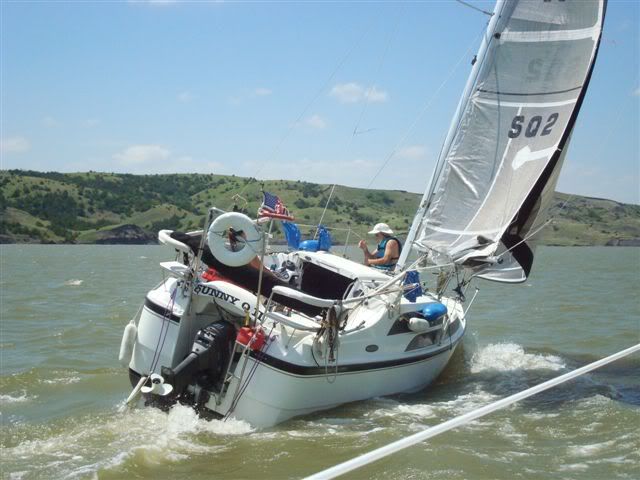
The question was really related to a Mac 25 which is fast boat and can probably be made faster with the proper heeling angle (I've owned 2 of them and raced them; normally we would try for some heel but I can't prove whether it helped or not). I would guess the 26X would benefit more from heeling since it has a flatter bottom than the M. One can make the argument that Mac Xs and Ms are so slow anyway it doesn't matter; or, one could argue that those Macs are slow and therefore need all the help they can get. The main thing on my M that seems to help is getting weight up front; get that sucking transom turbulence generator out of the water.
-
vizwhiz
- Admiral
- Posts: 1388
- Joined: Mon Aug 23, 2010 9:48 pm
- Sailboat: MacGregor 26S
- Location: Central Florida
Re: Mac25: proper heeling angle for top speed.
This is great stuff...I have an old paddle-wheel speedo on my transom, so when I get it in the water (soon!) I'll see if I can tell...
-
Catigale
- Site Admin
- Posts: 10421
- Joined: Fri Jun 11, 2004 5:59 pm
- Sailboat: MacGregor 26X
- Location: Admiral .............Catigale 2002X.......Lots of Harpoon Hobie 16 Skiffs....Island 17
- Contact:
Re: Mac25: proper heeling angle for top speed.
One can make the argument that Mac Xs and Ms are so slow anyway it doesn't matter; or, one could argue that those Macs are slow and therefore need all the help they can get.
Indeed, and good counterpoint.....
-
K9Kampers
- Admiral
- Posts: 2441
- Joined: Thu Apr 13, 2006 7:32 am
- Sailboat: MacGregor 26X
- Location: NH, former 26X owner
Re: Mac25: proper heeling angle for top speed.
Proper heeling angle for top speed for a blue hull is when the blue duzzn't touch th' water! 