in Macgregor 26X Sailboat
Abstract: An auto-pilot in a sailboat can maintain a course in open water and be programmed to make course corrections or adjustments. Lashing the helm on a tiller equipped boat, or on the Macgregor 26X, securing the wheel, can point the sailboat in a general direction, but can it maintain a course?
Background: Joshua Slocum, world famous navigator, in his book, Sailing Alone around the World, remarked often that his boat, the Spray, could regularly run with the helm lashed for hours, days or weeks. On page 87 of my copy (Slocum E-Book link he says he once sailed straight, in the Pacific Ocean, for 23 days and was at the helm only for 3 hours during that entire period.
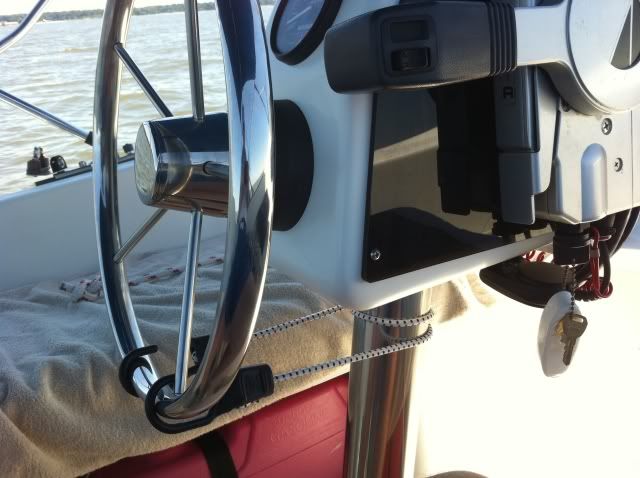
My Hypothesis: A bungee cord connected to a centered wheel, preventing it from turning, can be used to maintain compass course in a Macgregor 26X to allow the helmsperson to read, eat, fish or relax for periods of time, without fear of a sudden round-up or broach. (Others may wish to test the models Macgregor 26 and 26M and post their results to compare.)
Experimentation was done in the open waters off Wrightsville Beach, NC, in mid March 2012, with results recorded and presented below.
Conclusion: In conditions where wind is abaft of beam, or quartering from the stern, the Macgregor 26X will maintain a set course only for short periods of time. However, when the wind is ahead of beam, the Macgregor 26X will find an unattended “sweet” spot of approximately 65 degrees off the wind, port tack or starboard tack, and stay there practically all day. No weather helm or lee helm was detected on these windward legs of tests. Therefore, a bungee cord can not replace an autopilot unless you are content with only those two points of sail
Conditions: Completely original, stock, 1999 Macgregor 26X sailboat. Full water ballast. 2 days of tests. Sunny and fair. Temperature around 65 degrees F. Winds each day from south at 10 to 12 kts. Standard jib and mainsail (although results seemed the same with or without jib, the only difference was boat speed.) Rudders were centered at all times. 3 miles off the coast. Waves seemed 2 to 3 feet, but probably somewhat less. Sea depth, 40 feet. Centerboard in vertical position.
First Test Day – March 14, 2012

On March 14, 2012, I began the test heading northward on segment D. I turned the helm to track 20 degrees and set the bungee cord to hold the wheel with a 45 degree turn in the wheel to the left. The boat maintained a general heading but needed many corrections. I gave up on that and centered the rudders and bungee-corded the wheel after the point D above. The Macgregor took close to two hours, sailing unaided until it reached a steady track headed 100 degrees to point E.
As an experiment, I corrected to 30 degrees at point E and re-set the bungee cord to center. The Mac made a turn back to 100 degrees, or 80 degrees off the wind. I did not linger on this track for long because of time constraints, so I made a tack to head back in to the Masonboro Inlet rock jetty on a port tack. The resulting track is shown as F segment. The GPS track showed 245 degrees and the heading was also 245 degrees for the entire 1.3+ hours it took to sail segment F. I never touched the wheel during this time. At the end of the segment my Garmin GPS showed I was off track by only 18 feet in over 4.8 nm.
Comment: Macgregor 26X sweet spot for bungee cord straight rudders was observed to be 80 degrees off the wind on the two short starboard tacks shown near “E” and 65 degrees off the wind on the long port tack F segment.
Second Test Day – March 16, 2012

On March 16, 2012, I began the test heading northward on segment A. I set helm at about 17 degrees on compass and set the bungee cord to hold the wheel. I had to make course corrections often in order to maintain a straight course on this heading, just as happened on the March 14 test, needing a bit of left rudder to maintain course. At the end of segment A I decided to try to head back to the inlet. I was close to the shore, so I headed NE for a short way to get some room then tacked around and pinched as hard as I could to attempt to head back along the A direction. As can be seen on the short segment between A and B it was only possible to get to a heading that was parallel to my later heading on C. That was about 65 degrees into the wind. There was no way to avoid hitting the surf in this direction, so I gave up and began B segment and then C segment. On both of these segments, my rudder was centered, the helm bungeed and I sat back and observed the Macgregor settle into a complete sweet spot or groove of 64 degrees off the wind on segment B and 68 degrees off the wind on segment C.
Comment: Macgregor 26X sweet spot course for bungee corded straight rudders was observed to be 64 degrees off the wind on B and 68 degrees off the wind on C.
The accompanying video documents some of this test. http://youtu.be/RdxE0A6TdBk
Notes and questions:
If the sailboat has a sweet spot or groove when sailing to windward, then, if your boat has an autopilot, could it be possible to turn it off if that is the direction you choose? That could save battery power, yes?
I have read that Slocum's claim to have sailed 23 days with only three hours at the helm was widely doubted. However, I believe that in the right trade winds, steady from one direction, the Macgregor could do the same thing. (Just a mental exercise, of course.)
Since any course other than my boat's “groove” heading means the need to use rudders in a non-centered position, does that not mean that an auto-pilot must almost always be adding 'drag' to the sailboat?
Future testing could include adding varying amounts of rudder to simulate an auto-pilot course.
I know, I know.... many of you Mac owners can do better than 65 degrees off the wind. I do not dispute that. But I wonder, if you helmsmen/women are constantly holding the wheel in a non-centered position to achieve that windward improvement?
I had the sails fairly tight in, but future tests could include rigorous winching to tighten the sails further.
I did not experiment with the centerboard. I left it 100% down. Maybe raising it some would affect the angles involved.
Going on the upper deck while single handed and under bungee cord seems to me to be safer than if under an auto-pilot that could go out for some technical reason. I have never used an autopilot, so I would have to talk to someone who has one to get their opinion.
Happy sailing and fair seas
(edited to add the Slocum active link for free e-book)


 its so small that I've not found it
  but it does do better to wind likely near the 65 degrees you've empirically found. In my Columbia Sabre 32', the sweet spot was so wide that I could reliably lash off the tiller any time the wind was abeam anywhere and keep a reasonable course even in tight quarters (in the easy weather of San Diego Bay). The more the boat heeled, the better it would track straight along whatever course it was on, so I'd tighten up the jib and the mainsail to get the boat over to about 35 degrees, and then I could practically go to sleep. It was so good at course keeping that I fell into the bad habit of routinely tying it off rather than manning the helm.