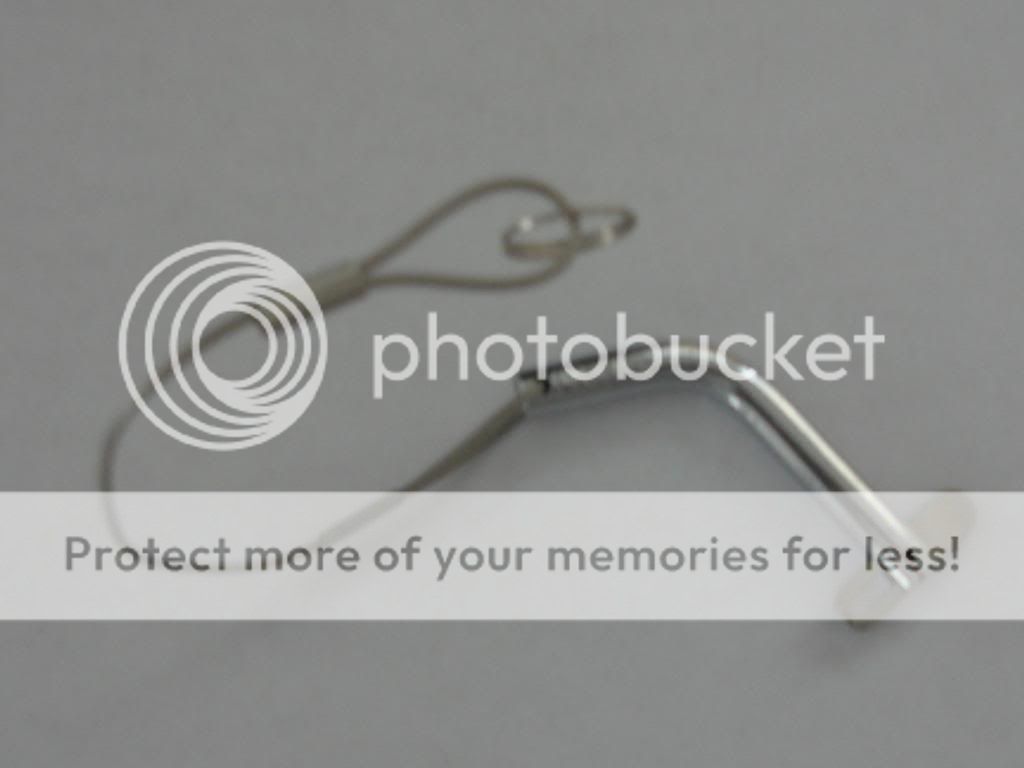
How does your forestay secure to your bow chainplate hardware? My MacM dealer equipped me with a SS carabiner which has served me well and it seems very secure. However, my dealer has since mailed me (free of charge - great guy) what he said was an upgraded, improved connector for this job. Here is a photo of this implement. (Hope it appears as I have never before tried to imbed a photo on a website using Img.) I cannot begin to imagine how to use this item, how it attaches, or how it can secure without a closed and locked loop. I surmise the small wings on the end are a locking device, but they rotate with ease and don't actually lock in place. Any ideas, guys? Getting back to my initial sentence, what do most of you guys use to secure that forestay? . . . thanks!
Last edited by Hamin' X on Thu Feb 28, 2013 4:51 pm, edited 1 time in total.
Reason:Repaired IMG link
How does your forestay secure to your bow chainplate hardware? My MacM dealer equipped me with a SS carabiner which has served me well and it seems very secure. However, my dealer has since mailed me (free of charge - great guy) what he said was an upgraded, improved connector for this job. Here is a photo of this implement. (Hope it appears as I have never before tried to imbed a photo on a website using Img.) I cannot begin to imagine how to use this item, how it attaches, or how it can secure without a closed and locked loop. I surmise the small wings on the end are a locking device, but they rotate with ease and don't actually lock in place. Any ideas, guys? Getting back to my initial sentence, what do most of you guys use to secure that forestay? . . . thanks!
I think you're using the wrong link from photobucket. Hit "quote" to see the difference in format.
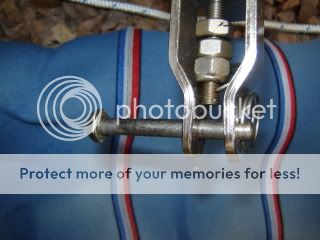
I use the long pin with the big head (from BWY) and a ringding. The toggle on that pin is supposed to foul against the clevis unless you hold it in alignment (like for removal). I'm not sure I would trust it as much as a solid, headed pin with ringding, but that pin sure looks easier to use. Hard to lose, too, with the tether.
mika wrote:My MacM dealer equipped me with a SS carabiner which has served me well and it seems very secure.
You're joking right? A carabiner? Is he a rock climber?
I don't know what that contraption is that you were sent, but the forestay pin needs to be something that can not come out. I've heard stories of the rings coming undone, pin working out and mast falling down. Suggestion was to use bent cotter pins and replace them each time. Those "wings" appear to easily flop around and the pin come out. I wouldn't use it if you paid me. I suppose it's more convenient, but not safe in my opinion.
Can I use as a replacement of pin a normal 6mm screw? I guess that it should be no problem, even the thread makes the bold thinner than 6mm. Becouse I have a 6mm screw with a ring, so I can fix the ring that it wont be lost. Just want to know that tha 6mm screw is stron enough. thanks.
kurz wrote:Can I use as a replacement of pin a normal 6mm screw? I guess that it should be no problem, even the thread makes the bold thinner than 6mm. Becouse I have a 6mm screw with a ring, so I can fix the ring that it wont be lost. Just want to know that tha 6mm screw is stron enough. thanks.
I would think the tensile strength of the bolt is critical. If the metal is not strong it could shear or wear down with friction.
I bought one of the big head pins from BWY and it made life a whole lot easier than the standard pin. When I recieved it in the mail, I remember thinking "this looks an aweful lot like a stock pin for a hatch pull". I later stopped at a marine supply store and sure enough, that's what it was....no worries, the price was about the same and the convienience is priceless. I do have a question though. My furler has larger holes where the pin goes through than the chainplate hole....there is a couple of non captured bushings in the furler and they are a real Booger when pinning....I'm sure I'll lose one eventually....should I just drill the chainplate hole to the larger size and use a larger pin?
How does your forestay secure to your bow chainplate hardware? My MacM dealer equipped me with a SS carabiner which has served me well and it seems very secure. However, my dealer has since mailed me (free of charge - great guy) what he said was an upgraded, improved connector for this job. Here is a photo of this implement. (Hope it appears as I have never before tried to imbed a photo on a website using Img.) I cannot begin to imagine how to use this item, how it attaches, or how it can secure without a closed and locked loop. I surmise the small wings on the end are a locking device, but they rotate with ease and don't actually lock in place. Any ideas, guys? Getting back to my initial sentence, what do most of you guys use to secure that forestay? . . . thanks!
I was using something similar but it was a straight pin with a little spring that held the the locking devise in the T position. Easy and quick to install, I think maybe it is called a quick pin. Worked great until one day I noticed that the pin was almost out and kind of jammed in the hole. Could have been a disaster!
I am going to order one of the large headed pins from bwy. Glad to hear people like them.
sometime ago I drilled out the tang a millimeter or so to equal the furler hole and use a small galvanised d shackle. its going nowhere but you can wire it shut if wanted do.
mika wrote:My MacM dealer equipped me with a SS carabiner which has served me well and it seems very secure.
You're joking right? A carabiner? Is he a rock climber?
Clarification Russ: My bad. I called it a "carabiner", which is essentially what it is. But in sailing jargon it is called a "spring clip". You will find it among catalogs of sailing hardware. But being a spring-loaded, heavy-gauge closed loop, with no force or tension available to reverse or open the spring lock, it seems like a safe and logical way to secure the forestay and it has served me well of for three seasons. There does not seems to be ANY possible way it could fail. (Famous last words! ) Apparently, the rest of you use some kind of bolt with cotter rings that have been known (it has been reported here) to work their way out of the bolt. With so much anxiety about forestay failure on this site, may I suggest that this topic may warrant more discussion. Thanks.
I see how it works guys = It's not such a bad idea if you think about it. The little "T" on the end swivels so that you can put THAT end into the hole on the foredeck plate. That little "T" swivil thingy has a slotted hole in it (yu can barely see it in the picture) So after you slide the whole thing into the hole you reset the "T" to the T position and then lock it like that by pudding the wingy dingy thingy (or whatever you guys call it) into the slotted hole in that "T" swivel.
I guess it probably works pretty good based on just what I can see - I would love to test one out.
BOAT wrote:I see how it works guys = It's not such a bad idea if you think about it. The little "T" on the end swivels so that you can put THAT end into the hole on the foredeck plate. That little "T" swivil thingy has a slotted hole in it (yu can barely see it in the picture) So after you slide the whole thing into the hole you reset the "T" to the T position and then lock it like that by pudding the wingy dingy thingy (or whatever you guys call it) into the slotted hole in that "T" swivel.
I guess it probably works pretty good based on just what I can see - I would love to test one out.
Hate to belabor this, since obviously very few are interested in speaking to this topic. I was just wondering if ANYBODY . . . just one sailor . . . had ever seen and tried out this gizmo. The locking device is of very small gauge and seems it could readily fail under the least amount of tension. How is that possibly superior to a closed, heavy gauge loop or a pin with a ring? I guess I have to conclude that most of you are entirely happy and feel perfectly secure with the pin and ring, despite reports that the cotter ring has been known to work its way out and release the pin.
1. I tape my rings shut because for some magical reason they seem to try and work their way off the pins. Don't know how but they try.
2. They make one of these for a trailer hitch pin…same design just bigger pin, and they fall out all the time (on my buddies truck). Twice coming out from hunting last year on the same trip. Good thing the chains were on snug.
Conclusion? If the ring dings can work themselves off, these absolutely will and probably faster.
The wing Ding is the only thing I have, but I would be willing to try that gizmo - I don't really know how common it is but the design does not scare me too much as long as there is a saftey wire in the end.
I would like to see a better solution to the wing ding - it's dificult for me to get the wing ding into the hole on the pin, so if there is an alternative that is just as good I would like to try it.
mika wrote:I guess I have to conclude that most of you are entirely happy and feel perfectly secure with the pin and ring, despite reports that the cotter ring has been known to work its way out and release the pin.
The ringdings with a starter bend in them can also work themselves out, in my experience.
Those without have never done that in my personal experience. Not as easy to get on, but losing a stay, especially the forestay, is really bad.






 ) Apparently, the rest of you use some kind of bolt with cotter rings that have been known (it has been reported here) to work their way out of the bolt. With so much anxiety about forestay failure on this site, may I suggest that this topic may warrant more discussion. Thanks.


