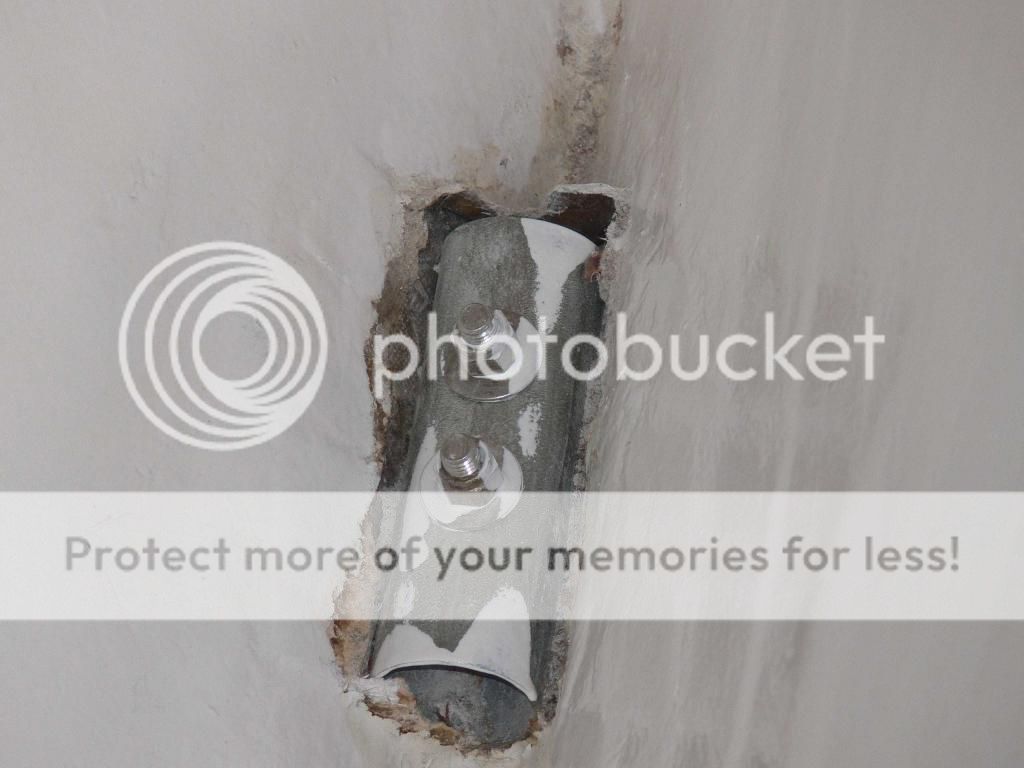
So I noticed that the bow trailer attachment for my new-to-me 85 Mac25 looks like this.
[/url]
The hook moves back and forth and is obviously anchored in the back, however since I am obviously new to this I am trying to ascertain if this remains somehoe watertight, as I can't seem to be able to get to the other/inside portion of this on the v-berth.
Before we bought our M we had a 25 which had the same problem. There is no backing plate behind the eye bolt, only a couple of small washers. You have to cut a small hole in the fiberglass liner to get access to the nuts, put in a backing plate and then cover the hole with a nice piece of finished plywood. After we did this never had any problems again.
That point is likely well above the normal water line, so any leaking would be intermittent during waves, washing, or rain, and small in quantity. With a proper backup reinforcement this is one of the most secure attachment points on a boat, but does not take sideways forces well.
Well I removed the liner....I am glad I did. The U bolt was held in place with 2 crappy washers that made themselves all the way through an inch of fiberglass...it's not pretty. I don't think I will be towing the boat until I make repairs otherwise I'll have two ginormious holes in the bow.
We had the exact same issue on our 25, and just repaired it. When we pulled it out of the slip last year, it was actually the first time we'd ever put it back on the trailer, and I don't know if it was because the lake was low or our inexperience, but we couldn't get the bow all the way up against it's stop on the trailer. We'd have it up there, and as soon as we'd pull the trailer out of the water, it would settle a couple of inches back. Tried it again remembering to lower the keel before pulling the trailer out, and it still did the same thing.
So then I had the bright idea of trying to winch it forward,after again raising the keel, and my bow eye strap wound up looking exactly like the picture you posted after some ugly crunching noises... I figured there was probably a wood backer that had rotted over the boats 30 year life, but this past weekend when I cut into the front wall of the v-berth, there was no wood, and there were no washers on the strap whatsoever. They either corroded away or were never there.
To repair, I used a 1 inch wide stainless steel repair strap as a backer and bedded everything in short fiber fiberglass. Feels very strong now, and will hopefully be useful for getting everything snug when trailering the boat. In the v-berth, I installed a six inch deck plate on the front wall directly behind the bow strap, so if I ever have to access it again, it'll be a lot easier.
ntzman28 wrote:<snip> I don't know if it was because the lake was low or our inexperience, but we couldn't get the bow all the way up against it's stop on the trailer. We'd have it up there, and as soon as we'd pull the trailer out of the water, it would settle a couple of inches back. Tried it again remembering to lower the keel before pulling the trailer out, and it still did the same thing. <snip>
Search this forum for "Mac bump" and you'll get a couple of hours worth of reading on why that happens, and what you can do about it.
Glad you fixed it better than new, though. That should be about the toughest bit of hardware on the entire boat.
Lots of folks do something like this. Use a THICK wall length of galvanized pipe (thicker than you see here).
Seal around Ubolt holes with something like 3M 4200.
Even the pictured pipe, not being super thick, is still pretty darn strong - much stronger than
the rotted block of ply that was in there before.
Had to repair mine when I first got the boat. I'm pretty sure I could hang the boat in the air using the bow eye now.
I bedded a long length of metal (forget if I used 3/16 aluminum or 1/8 stainless, close to 2 feet long about 2 inches wide) on the inside with multi-layered fiberglass and epoxy. I also installed a larger bow eye. It's probably the toughest part of the hull now. I use the bow eye for tying a dock line to my beach stake, when beaching. This keeps the line low so it's easy to step over and decreases the chance of the stake pulling out.


 [/url]