The actual odds of being hit by lightning

A forum for discussing topics relating to MacGregor Powersailor Sailboats
User avatar
Dimitri-2000X-Tampa
Admiral
Posts: 2043
Joined: Fri Jan 02, 2004 5:36 am
Sailboat: MacGregor 26X
Location: Tampa, Florida 2000 Mercury BigFoot 50HP 4-Stroke on 26X hull# 3575.B000

Re: The actual odds of being hit by lightning

Post by Dimitri-2000X-Tampa »

Hamin' X wrote:The problem with the statistics about dissipators, is that they don't indicate whether the they were used in conjunction with a grounding system. Most people do not understand the principle and either ground the dissipators, or use a separate ground system. It is one, or the other. If you use dissipators, DO NOT GROUND; you will only be making yourself more attractive to lightning.

~Rich
Rich, by what authority do you make this statement? :wink: I happen to have a boat that used to have a dissipator which was not grounded (sitting on a lift) and got hit. In fact, I think I may have taken a pic of the little wires at the end of the dissipator melted into nodules from the lightning blast. I guess the lightning blast weakened it enough that it fell off while trailoring within the next year...so now, I no longer have a dissipator...but obviously, I don't care about that. Since I got hit, I have attached ground wires to the shrouds on either side which dangle into the water, and I have not been hit since.

Dimitri
User avatar
Hamin' X
Site Admin
Posts: 3464
Joined: Sat Aug 27, 2005 6:02 pm
Sailboat: MacGregor 26X
Location: Hermiston, OR-----------2001 26X DF-50 Suz---------------(Now Sold)
Contact:

Re: The actual odds of being hit by lightning

Post by Hamin' X »

Hi, Dimitri. I remember your event. Nothing that we can do will prevent a lightning strike 100% of the time; we can only try to minimize the chances. Even dead, dry trees get hit in the middle of live forests. I have posted a picture of the tower in Toronto (can't find it right now) being struck way below the top. You pays ur money and take ur chances.

I hope that you have completely bonded the shrouds to the mast and to your grounding wires. By bonding, I mean that you have used an exothermic process to join the parts and are not just depending upon mechanical joining. anything less will invite side flashing, as the joints cannot carry the mega amp current. Once you go to the path path of grounding, you must spend a bunch of boat bucks to do it right and from my experience, most people just won't spend the money. Hopefully the wires that you are running into the water do not have any bends in them that are < 8" radius. if the bend is too sharp, the inductance will be too great and the overall impedance of the circuit will again, force side flashes.

All of this said, I am glad that you have not been struck again and chances are that you will not. However, this is like the J-walker that continues to cross in the middle of the block because they have never been hit.

Authority? I have none but experience and and you have the same. My advice may be worth just what you paid for it, so YMMV.

~Rich
walt
First Officer
Posts: 209
Joined: Mon Feb 05, 2007 9:05 am
Location: Colorado "Sea Eagle" 1990 26S

Re: The actual odds of being hit by lightning

Post by walt »

Once you go to the path path of grounding, you must spend a bunch of boat bucks to do it right
You may have heard of something called a “spark gap”? Two pieces of conductor placed closely together will carry a large charge by using ionized air between them. The gap can carry large currents as is easily seen by the fact that a one mile spark gap can carry all the current of a lightning strike. Some sort of connection to the shrouds does need a good mechanical bond.
anything less will invite side flashing,
So.. with an ungrounded boat that has the mast hit by lightning, you likely have a 100% chance of a side flash from the bottom of the mast through the air inside the cabin, through the hull and to the nearest water surface. When you add some sort of conductive path such as a battery cable with less than perfect bonding, now you “invite” side flashing (when it was already 100% chance of occurring if you did nothing)? Hmmm... What is more likely is that any conductive path that you add between the bottom of the mast and shrouds will carry some portion of the current. Remember Kirchhoff’s law, any path you add to a node will carry some portion of the total current. A poor conductive path from the bottom of the mast will carry less current so you may still have a side flash off the mast. However multiple good conductors may carry a majority of the current and either the energy in the side flash is much smaller or if the conductors did a good job and were very completive with ionized air, you may not have a side flash at all. These conductors from the bottom of the mast “could” have a spark gap and still work fine depending on what the spark gap is. They must have a very good mechanical bond.

For Dimitri, if you have only grounded your shrouds, this probably helps but this still wont prevent the bottom of your mast from side flashing to the water surface. The shrouds have both too high of resistance and inductance to discharge all the current that is mostly likely to be flowing in the mast. The most important place to try and ground is the mast itself as this is the most likely object for the lightning to attach to.

We asked earlier what someone’s qualifications are to give advice on lightning - especially when water is involved - and I am also not an expert on lightning but have the background to read the technical papers. I don’t also don’t have links on some of the stuff I posted so to be fair here is my background. I have a MS in electrical engineering (from good ol Cal State Long Beach), worked the first part of my career in Nuclear radiation effects and device physics, the second part in analog design of consumer electronics including lightning protection of electronics. Not an expert at all... but have tried to read a lot of the technical papers - as well as what gets posted on internet forums.
walt
First Officer
Posts: 209
Joined: Mon Feb 05, 2007 9:05 am
Location: Colorado "Sea Eagle" 1990 26S

Re: The actual odds of being hit by lightning

Post by walt »

Re: The actual odds of being hit by lightning
by Hamin' X » Sun Sep 07, 2014 9:30 pm

Walt, please don't try and tell me what I wrote, when it is there for anyone to read. You don't need to change my words. I did NOT say taller.

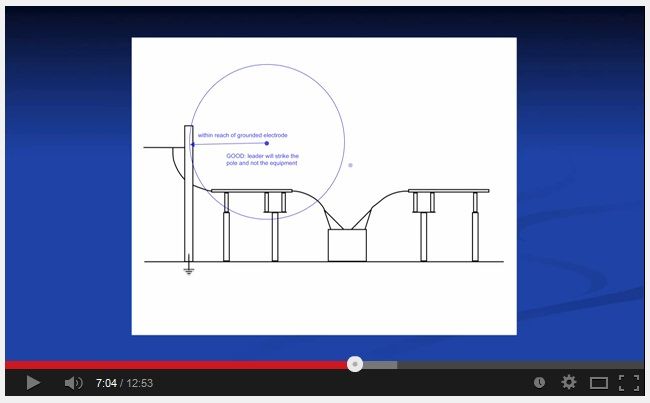
Ok, it has been many years since I have studied this stuff in depth, but you have made go and do your research. Here is a screen shot from a video on the subject.


Video link is complete with some of the math. It clearly shows that lightning will be attracted to the grounded structure, despite the fact that other structures are closer. It will also reveal that the lightning will be attracted to the closest grounded object. Refer to about 7 mins. in to the video. If a step leader is within strike distance of "ground", or "ground electrode". It means that even though you are within that sphere, IF YOU ARE NOT GROUNDED, YOUR HAVE NOTHING TO WORRY ABOUT.

https://www.youtube.com/watch?v=EtNxD08r0iY

~Rich

On Edit: I do not believe that any lightning protection, or avoidance scheme is 100% and that despite our best efforts, we can be struck.

~Rich
One more thing.. from what I understand, the backup for the advice that has been given on this forum for a long time that grounding a mast will increase your chances of getting struck vs. not grounding is the rolling sphere video in the above reference. I said I didn’t come to the same conclusion. So, in order to not leave this with the technical depth of a political advertisement, here is why I did NOT come to the same conclusion as Rich. My opinion is also no more valid than Rich's is so Ill give my details.

I have watched that video a bunch of times and it regards a method to protect equipment in a "substation". They find a sphere whose radius is based on a minimum strike distance. The strike distance is dependent on multiple things such as BIL (breakdown insulation) and stroke current but it’s the minimum strike distance used since this is where a lightning protection has its minimum area of protection.

Image

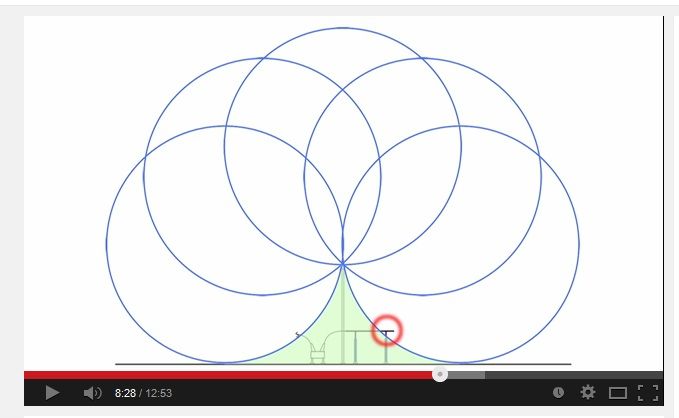
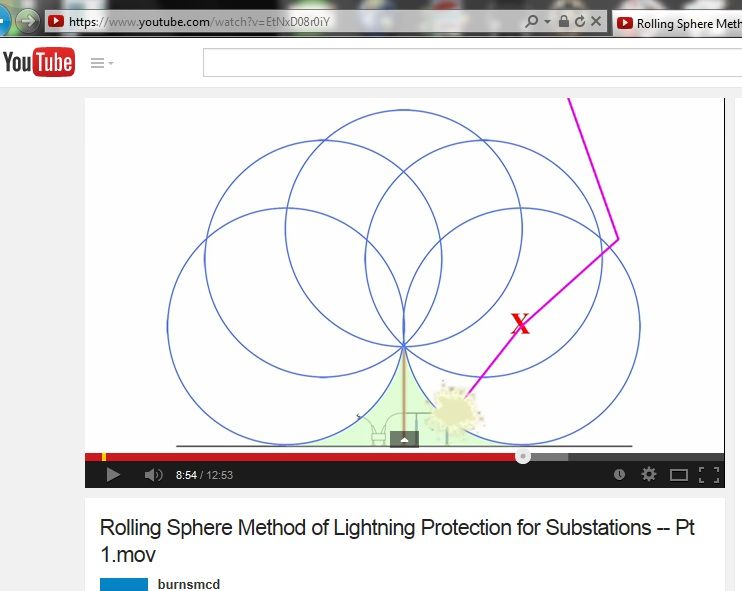
The figure above shows the rolling sphere around a lightning protection wire and in this case, the radius of the sphere is close to the length of the protection wire. The protected area from the protection wire/mast is shown by the green area under where the sphere rolled over the protection wire. The green area is protected by the wire because the leader would attach to the protection wire rather than anything in the green protected area. In this figure, they note some "equipment" that is outside the protected green area and it is noted in the video that this red object that is not in the protected green area is at risk. Please listen to the video, here is where that is shown

Image

Now, the picture in the original reference was in a section of the video where the "what if" was being discussed, here is that picture again:

Image

From the technical explanation in the video, any of the equipment that is not under the sphere but inside the sphere is NOT protected. Also, there is no reference at all that any equipment is not grounded. Equipment is always grounded. Metal roofs of building are always grounded. That is just basic AC safety. Brick walls might not be grounded... but there is no reference in the video to anything not being grounded.

So I have no idea where the backup for this is
IF YOU ARE NOT GROUNDED, YOUR HAVE NOTHING TO WORRY ABOUT
I could not find it in video and am not sure how it explained that a grounded mast is more likely to get hit than the same ungrounded mast. And.. both of these masts are on a body of water..
User avatar
Dimitri-2000X-Tampa
Admiral
Posts: 2043
Joined: Fri Jan 02, 2004 5:36 am
Sailboat: MacGregor 26X
Location: Tampa, Florida 2000 Mercury BigFoot 50HP 4-Stroke on 26X hull# 3575.B000

Re: The actual odds of being hit by lightning

Post by Dimitri-2000X-Tampa »

Well, what I am using is an old shroud cut in half with the tangs on either end attached to the shroud adjusters with quick pins. Becuse you see, it if is too much of a pita to put them on and off, then I won't use them or I wont' go sailing much and both of those defeat the purpose. So yea, crummy little mechanical connection, not bonded.. But I think the difference in what we are talking about is whether to make the boat mast less attractive, versus what happens when you actually get hit. Sure, those little wires aren't going to carry the power of even 1/10 of a lightning blast and lets face it, lightning goes through air so who cares whether its a wire or a dead tree.

But the way the mechanic who did a lot of my fixing two years ago when I got hit described it is that grounding just equalizes the potential with everything else (trees, houses, etc) that is attached to the ground. So, at least you have the same odds of being hit as something else that is grounded. But if you don't ground, then its like static electricity build up, he specifically referenced the wind causing friction which can build a static charge on the mast if it is not grounded. And if that happens, it might be more attractive than all the grounded objects around it. So, who knows...all I do know is that when I was not grounded, I got hit and since I've been grounded with my cheapo little wires, I have not been hit..so, as statistically insignificant as it is, it is still some sort of empirical evidence, right?

And btw, my lightning strike exited in a lot of places..at least 4 that I counted...but not through the bottom of the boat where the mast is closely attached to the compression post, etc. In fact the only place that it seems to have exited the hull was from an INOPERATIVE through-hull I had from the PO who had some sort of depth sounder. I think it was a brass transducer iirc. So, it had about a 20 foot wire attached to it that was connected to NOWHERE..it was just loose inside the hull, but somehow, the lighting liked the path through that transducer and blew it up out of the hull (it was all black and charred too. I suppose it was still better off exiting there and I have since had a professional glass job to fill in the through-hull hole. The other three places it exited were all active wiring for the boat lift. Both motors got fried (one right away and another took several months before it died) and where the conduit goes under the water to provide power to the offshore motor, the conduit was broken and blackened underwater right where it touched the ground (on both motor posts). And the last place was the conduit that goes to the house for power, that was smashed open by the blast right at the point where it entered the ground at the sea wall. The point is that in all four exit points, the lightning apparently followed a wire, connected to ground or not (as in the case of the thru-hull).

So yea, two shrouds are not going to be able to dissipate all the electricity in a blast so you are going to get the side flashes pretty much anyway you look at it, and no two strikes will ever be the same most likely either...the purpose of my grounding is to make it less attractive to the strike in the first place.
walt
First Officer
Posts: 209
Joined: Mon Feb 05, 2007 9:05 am
Location: Colorado "Sea Eagle" 1990 26S

Re: The actual odds of being hit by lightning

Post by walt »

the purpose of my grounding is to make it less attractive to the strike in the first place.
I think this is just as inaccurate as saying that not grounding protects you. You got hit ungrounded with the wire brush but this is statistically completely not significant. Dead trees getting hit? Maybe the tree was alive when it got hit.. but was dead when you observed it with burn marks :D

For some reason I thought your boat was on a lift over the water? Maybe not.

My opinion is that just having a long conductor oriented vertical to the electric field is why they get struck. It just doesnt matter that much if the bottom of the mast is grounded to ground or a wire somewhere off the boat is hanging in the water or the mast is four feet above the water surface. If you have that mast sticking up in the air - it will attract a lightning strike. However... it will only pull the strike in if the strike is close in the first place.

Put another way, a leader can propagate when the electric field ( volts per distance) is on the order of 440 Kv/M. Our masts are about 10 meters.

So in air, over that 10 meters, the voltage potential to keep air ionized is 4400 volts over that 10 meters. However, the mast a little ways away has ZERO volts across it since it is a conductor and essentially no current flowing. On top of that, the mast creates very high fields at its tips and lightning can "see" this from a distance. You mast is the "lowest resistance" path regardless if it is grounded or not. Leaders form off both ends the mast..

There may be some difference between grounded or ungrounded masts ** but I think the difference is just not significant. You cant find any source (other than your mechanic or on this forum) that will argue one way or the other.

My opinion - if you ground the boat, you are trying to protect the hull from damage if you get struck and keep people inside the hull from participating in conducting the current. You really cant do anything significant to change your odds. If you do get struck, there will be a huge magnetic field created that will blow out your electronics - no matter if you ground or not.

** Earlier I said and still think this is true - a grounded mast has increased Corona current at its top - which is supposed to delay a leader forming. An ungrounded mast has a spark gap at the bottom - which also might delay a leader from forming. How much do these really affect anything.. I really dont know. On a body of water, there is no way you are going to nuetralize charge in the water - once again its like trying to empty the ocean with a tea spoon - futile.
User avatar
Hamin' X
Site Admin
Posts: 3464
Joined: Sat Aug 27, 2005 6:02 pm
Sailboat: MacGregor 26X
Location: Hermiston, OR-----------2001 26X DF-50 Suz---------------(Now Sold)
Contact:

Re: The actual odds of being hit by lightning

Post by Hamin' X »

You need to get into consulting for the power companies and the wireless communications industry, Walt; you could save them billions of dollars in the labor, equipment and materials that they use in bonding, chemical grounds and single point grounding systems; if you can convince them that you're correct that is. Maybe my cellphone bill will go down? Good luck with that! :wink:

As I have said, I have practical experience in land-mobile communications work to guide me, as well as reading technical publications, mostly from the communications field. I have seen the results of poor grounding due to improper bonding of structures and the heat generated from the enormous current from lightning crossing even small gaps can melt guy wires and can cause tower failure. Most of these gaps are caused by corrosion due to poor, or improper bonding. I have worked on many commercial installations, some that have survived direct strikes, with no downtime at all. Others that I had the task of putting back together had massive failures that were traced to improper bonding, or incorrect grounding.

When I was asked to be the technical advisor for a ham radio repeater group (I am N7ZH) with a 110 ft mountain top tower, I decided to go with avoidance, rather than trying to handle a grounding project which was well beyond the scope of the volunteer organization's finances. As I have said, there is no guarantee against a direct strike and total replacement of our equipment would have been considerably less that the cost of proper bonding and grounding. The only lightning strike event that we have had was a strike to the power line transformer (which was grounded) that was well within rolling sphere of our (ungrounded tower). the result was a failure of the voltage regulator in the charging circuit of the UPS for our system. The system, which was bonded to a single point entry system, never went down and continued working for over 72 hours on batteries, at which time I was able to repair the UPS charging system. If we had ever taken a direct hit, we would have simple replaced the system. The only other major failure that we had during my 20 years as technical director, was a tower failure due to extreme icing.

Bonding is different from grounding. if all electrical equipment is boned to a a single entry point, all of it will remain at the same potential. Even sensitive electronics can be protected from lightning strikes with proper grounding and bonding techniques. What Walt described above was an EMP. Totally different from a lightning strike. What destroys electronics in a lightning strike is a difference in potential (and anything else for that matter). With proper bonding and grounding practices, all parts will rise and fall to the same potential, at the same time. No potential difference, no damage.

About your not being able to comprehend the video that I posted, I am not going to parse it again. Anyone can watch it and hear and see for themselves that they say that a step leader will favor the grounded electrode over your equipment (watch the segment from about 6:30-7:30, due to less resistance to ground. It really can't be clearer, it will favor the grounded electrode.

Anyway, this discussion has gone the way of others on the same subject and I really hate to become involved, because most people will not do the proper research to come to the proper conclusions and it always devolves into a "He said, She said" argument. Furthermore, most people will not, or are unable to spend the money to do it right. Despite what the schools, colleges and universities put out in the way of theory, it is empirical evidence that changes codes and they are changed/updated all the time, due to findings in the field. Only then do the schools, dragged kicking and screaming, update their curriculum.

I hope that no one has a lightning event happen to them and if you do, I hope you did your research.

~Rich
walt
First Officer
Posts: 209
Joined: Mon Feb 05, 2007 9:05 am
Location: Colorado "Sea Eagle" 1990 26S

Re: The actual odds of being hit by lightning

Post by walt »

There is a little beef in that response to discuss.
About your not being able to comprehend the video that I posted, I am not going to parse it again. Anyone can watch it and hear and see for themselves that they say that a step leader will favor the grounded electrode over your equipment (watch the segment from about 6:30-7:30, due to less resistance to ground. It really can't be clearer, it will favor the grounded electrode.
The rolling sphere method does say that lightning will favor the grounded electrode as long as the equipemment is under the sphere. Anything outside area under the spherre is not protected. That was always clear.

Image
IF YOU ARE NOT GROUNDED, YOUR HAVE NOTHING TO WORRY ABOUT.
It is the statement above that I tried to as politely as possible say is not at all described in that video. If you respond, maybe you can be very specific about how that is arrived at.
If you use dissipators, DO NOT GROUND; you will only be making yourself more attractive to lightning.
I was also hoping to find out why you said the above quote also.. Havent seen anything yet.
User avatar
Dimitri-2000X-Tampa
Admiral
Posts: 2043
Joined: Fri Jan 02, 2004 5:36 am
Sailboat: MacGregor 26X
Location: Tampa, Florida 2000 Mercury BigFoot 50HP 4-Stroke on 26X hull# 3575.B000

Re: The actual odds of being hit by lightning

Post by Dimitri-2000X-Tampa »

So this thread is called the "actual odds of being hit by lightning", not the theoretical aspects of whether grounding is better or not. I've been on this board a very long time and if you go back more than a couple years, we have had these discussions before and I was always in Rich's camp, slightly favoring the isolation'ers..if you can call 'em that. Not to mention that it is always an easier option to do nothing at all.... :P

But what triggered my latest rant is the statement about these diffusers and how you shouldn't ground when you use them...well, I ACTUALLY had my boat hit by lightning while using one of those (very goofy looking) diffusers and not being grounded with my boat up on a lift. So, you can rant and rave about all this high brow theory which ever way you want, but there is no doubt that I have personal empirical evidence that my boat was hit when it was isolated and using a diffuser. So, until I get hit again, with my little shroud wires dangling into the water, I have now done a 180 and due to my strike, now pay more attention to people like my mechanic who can come up with a plausible theory about why my boat got hit when it was isolated...and consequently, I'm in the grounding camp now.

Now maybe you laugh and say, oh, he will never get hit again merely due to the laws of probability. Well, keep in mind that I live in Tampa, FL...the lightning capital of the world. And in fact, I have lived at my property for almost 20 years now and this was not the first lightning strike. I had another one very early in my tenure here. Now at the time, I had no sailboat and I had no boat lift, so those were not even in the equation yet. But lightning hit an iron lamp post which was also close to my seawall. Turns out that the lamp post (which has since rusted away and been removed) was sitting only about 10-20 feet away from what would eventually become a dock with a boat lift on it that would get hit about 15 years later (2 years ago). The first strike did some damage to TV's and other electronics in the house but nowhere near as costly as frying all the boat's electronics (except for the motor electronics somehow). So, there are your ACTUAL odds...19 years, two strikes...at my house. :wink:
walt
First Officer
Posts: 209
Joined: Mon Feb 05, 2007 9:05 am
Location: Colorado "Sea Eagle" 1990 26S

Re: The actual odds of being hit by lightning

Post by walt »

Another guy on the Mac owners forum had a strike to his boat this summer sitting on the hard with the mast up. No grounding to the mast and it still got struck.

yep.. a lot of theory here especially when water is involved - which really cant be proved. Dimitri, your event is very interesting and significant. This would go into a bunch more theory but these guys studied actual lightning rods on a mountain top for a bunch of years and had some interesting results that actually may backup what you are currently doing. http://analogengineering.com/lightning/ ... tudy_1.pdf

One more thing about grounding since it is often said (on this forum) that you have to spend a lot of money to do it right - or don’t bother.

A side flash occurs when lightning enters some conductor such as a mast but then turns back into lightning on its path to ground. The problem with a side flash is that it’s very unpredictable. In a grounded "facility", you want to control where the current goes so you want to keep it in the conductors that you planned. But if you don’t bond and observe bend radius guidelines, you might have an unpredictable side flash. In the sailboat, this side flash would come off the bottom of the mast or shrouds/chainplates and if people are on the boat, it could be dangerous.

So with a building, you bond perfectly to get close to zero percent chance of a side flash.. Now if start to cut corners on bonding, the chances of a side flash start to increase. Or as has already been noted, if you don’t spend the money to bond well, you start to invite a side flash.

All of our water ballast boats are similar in that they have no bonding at all. I have an old S model but the M, D,S are all very similar and the X is significantly similar.

In our boats with no grounding or bonding at all, you start off with a 100% chance of a side flash. If lighting strikes the mast, it has no where to go but to turn back into lightning to get to ground. We noted that side flashes are bad since they are so unpredictable - yet we start of with a 100% chance of them happening.

However, as we add any sort of grounding (such as Dimitri did), we don’t reduce the chances of a side flash to zero - but we do REDUCE the odd's of a side flash. So any sort of grounding or bonding when you start out with 100% chance actually reduces your chances of side flash. The word "invite" would say you are increasing your odds but that is not the case, you are actually decreasing since you start off with the very worst possible configuration.

Now as you add and improve the bonding to the sailboat, the odds of the side flash continue to DECREASE. The idea that you have to spend a lot of money to do this correct has some merit - if your goal is to decrease the odds all the way down near zero. The point being that on the ungrounded water ballast trailer boat, since we start off with a grounding situation that is as bad as it can get, adding any grounding actually reduces the chances of a side flash.

One note for Dimitri that is a little far fetched.. but if you look at the paper I posted that has actual results (plus some theory - those PHD guys can’t help themselves), they had a bunch of sharp lighting rods and a bunch of blunt lighting rods spaced so as to not favor any type. All were grounded. In a bunch of years, the blunt lighting rods got struck numerous times but the sharp lighting rods did not get struck at all. That looks statistically significant to me..

I almost hate to say this since its some of the crazy theory stuff that I usually have a "problem" with but the very sharp tipped Franklin lightning rods were the ones that never took a strike. Maybe put a very sharp tip at the top of your grounded mast... Why not...

This is grounding.. and I still trying to understand the "avoidance" theory for a sailboat on water that is somehow based on a few words in some business's video describing how the rolling sphere method works.
Last edited by walt on Tue Sep 23, 2014 6:39 am, edited 1 time in total.
User avatar
Hamin' X
Site Admin
Posts: 3464
Joined: Sat Aug 27, 2005 6:02 pm
Sailboat: MacGregor 26X
Location: Hermiston, OR-----------2001 26X DF-50 Suz---------------(Now Sold)
Contact:

Re: The actual odds of being hit by lightning

Post by Hamin' X »

Dimitri-2000X-Tampa wrote:...So, there are your ACTUAL odds...19 years, two strikes...at my house. :wink:
You are absolutely correct, Dimitri. It is like reading the unemployment statistics; they may say 5%, or 8%, or pick a number, but if YOU have lost your job, the rate is 100%.

Walt, please study the image below from the video at 7:03. It clearly shows the strike going to the grounded mast and not the equipment that is outside the "protected" area under the sphere. The equipment is clearly inside the sphere and therefore within striking distance of the step leader, but the strike goes to the grounded mast. The grounded mast "invited", or convinced the step leader to dance with it, instead of the equipment. I will make one final post later, but I have a real life to attend to. You can lead a horse to water, but...

~Rich

Image
User avatar
dlandersson
Admiral
Posts: 4973
Joined: Fri Aug 27, 2010 10:00 am
Sailboat: MacGregor 26X
Location: Michigan City

Re: The actual odds of being hit by lightning

Post by dlandersson »

Some folks learn by readin' 'bout it.
Some folks learn by seein' it.
And some folks just have to pee on the 'lectric fence to see fo' theyselves.
Last edited by dlandersson on Tue Sep 23, 2014 7:06 am, edited 1 time in total.
raycarlson
Captain
Posts: 789
Joined: Wed Jul 30, 2008 1:42 pm
Sailboat: MacGregor 26M
Location: tucson,az

Re: The actual odds of being hit by lightning

Post by raycarlson »

Most all highly qualified scientific types I know of will freely admit there is no sure way to predict where lightning will hit and there is just not enough knowledge or research being done. If any tells you they have a device that will protect your property its best to turn around and walk away cause their just guessing.
User avatar
dlandersson
Admiral
Posts: 4973
Joined: Fri Aug 27, 2010 10:00 am
Sailboat: MacGregor 26X
Location: Michigan City

Re: The actual odds of being hit by lightning

Post by dlandersson »

For $5, I will make a "fur certain sure" prediction about whether lighten' will hit yore boat tomorrow. :P
raycarlson wrote:Most all highly qualified scientific types I know of will freely admit there is no sure way to predict where lightning will hit and there is just not enough knowledge or research being done. If any tells you they have a device that will protect your property its best to turn around and walk away cause their just guessing.
walt
First Officer
Posts: 209
Joined: Mon Feb 05, 2007 9:05 am
Location: Colorado "Sea Eagle" 1990 26S

Re: The actual odds of being hit by lightning

Post by walt »

(there are two posts to this response since there are more than three pictures, the second part of the post is on the next page

Did you stop watching that video after 7 minutes? That is just a "what if" section leading to where the actual description is - which I will have to repost. The rest of the video says that your conclusion is incorrect. It also has nothing to do with an object that is not grounded - seems that is made up. And it also has almost nothing to do with does a grounded mast have a higher chance of receiving a strike vs. an ungrounded mast - both of the same lenght and height.

If that is what your "avoidance" theory is based on... I think we can leave it at that. Its not a difficult video to understand so everyone can watch it again. I guess this is your basis to answer the two questions
IF YOU ARE NOT GROUNDED, YOUR HAVE NOTHING TO WORRY ABOUT.
If you use dissipators, DO NOT GROUND; you will only be making yourself more attractive to lightning.
Here is what the video actually says and where it says it. I find it a little foolish to spend so much time on some business's video (who makes money on this stuff - must be evil) which has almost nothing to do with grounded or ungrouned mast on water.. but oh well..

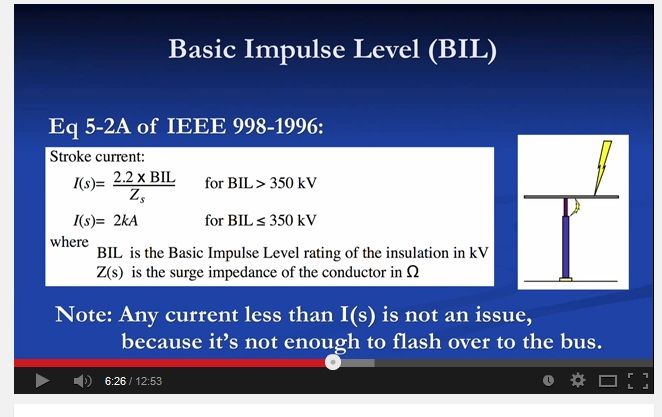
The pictures below (at 6:26 and 7:23) describe the equations for estimating the strike distance. One interesting thing is that the strike distance goes UP with the .65 power of the stroke current (ie, some where between linear and square root of the stroke current). So the radius of the sphere (related to strike distance) would increase with stroke current – but they use the smallest as this is worst case

Image

Image

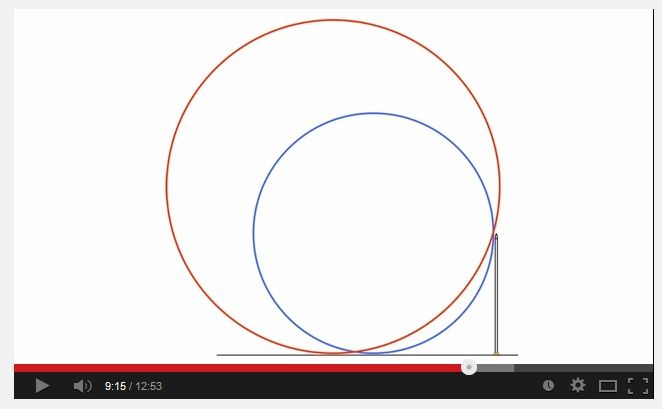
The next picture shows how the radius of the sphere increases with stroke current – and how the protection area under the sphere also increase with stroke current – and why you just use the smallest stroke current. (at 9:15)

Image
Last edited by walt on Tue Sep 23, 2014 7:41 am, edited 3 times in total.
Post Reply