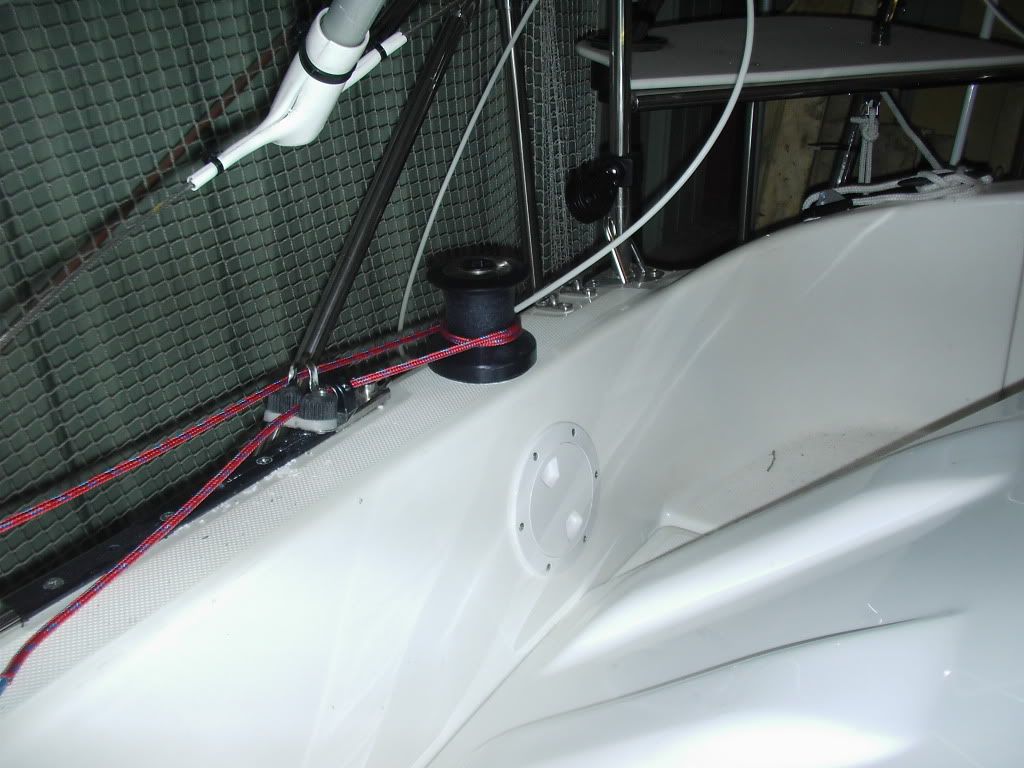
John, that is a thing of beuty. Is the round hatch there to get under the winch?
I am looking at Judy's turn block right now - I'm still trying to imagine it clearing the mast on a tack - I think it would work. I have thinking to do - (that takes a long time to happen in my puny brain).
I think Judy,s Idea is great , but with the short jib & genny tracks on the Mac,s I think u r going to lose a critical 2" or more of sheeting depending on the size of the blocks & u will want bearing blocks not cheap ones ! , I got my Lewmar # 7 winches for about 2/3rds off reg price off season so that was a no brainier cost wise for me !
Yes I used I think 6" deck plates cut out to give me access for mounting them I can check for u if u wish
U,ll notice that on the aft stern rail seats their r a ratchet block for thee spin sheets also !
If all goes well & weather wise for the MMOR 2016 Beene is gonna bring his Drone so maybe we will get my boat on film flying 4 head sails on furlers
BOAT wrote:I don't like that because the line gets in the way of leaning back in the cockpit. All the other trailer boats I sailed had a winch on each side of the cockpit - I think the MAC needs it too.
If you're not using the cabin roof jib fairleads, you could always put them on the same track as the genoa fairleads to make the departure point further forward. Assuming the genoa fairleads are not already there. Not much of a change, but a change nonetheless.
And I agree - a winch on the gunwales for the genoa would have been nice, but there isn't a whole lot of room there. And then there's the winch handle, and the proximity of my bimini supports.
Seem you could mount blocks on the cabin roof towards outside edge to guide the line further out and further forward to clear the seat back area?
The picture that Judy posted is for a regular jib with jib eyes on the deck. I don't have that kind of a rig. I run a huge 150 plus Genoa (California style - it practically wraps around the boat) so I need my sheets to turn as far to the aft as possible - the set up John has is the correct way to secure very large headsails - you need to tie off that head sail as far to the rear as possible so that the tack on the sail flies properly and does not put a big bend in the foot because your tying the sail off too close to the tack. These big sails need a LOT of room at the bottom to stay flat. That's why you will see the big ocean racers often dip the foot of their big head sails into the water every now and then when heeled over (watch old Americas Cup races) because they give those big sails all the foot room they want to keep the bottom in a nice gentle curve. If you tie it off to short the dang sail will get a huge curve in the bottom and become a lunch sack - then it vents to the top and tips you over and makes the whole thing sail crappy.
John goes even further by putting that turn block way way back there on the rear seat post and really that's where a big head sail belongs - I am seriously thinking of doing that somehow (but I don't have stern seats!). It's obvious John has already dealt with flying big head sails and even worse, MULTIPLE head sails and those kinds of things require moving stuff to the rear to give all that cloth some room to operate.
The other issue is getting a huge sail around the mast in a tack. When i tack I am (often in light winds) trying to blow that huge bed sheet all the way around the mast to the other side of the boat and adding more blocks to the sail tack and doubling the amount of line to get around the mast seems like that might make some trouble in my situation, I dunno, in my puny brain I am still trying to visualize it.. I really want the least amount of "stuff" trying to get around that mast, but it might work - I need to think it out.
My brain is making smoke right now - it smells like wood burning (that's what happens when block heads try to think)
I'm thinking with all the talk about the size and extra effort and hardware to use a 150 I might go with a furling 135 or 125 what ever is the next size down. Then I get th extra sail but with much less tacking effort and hardware. I cruise mostly and like it simple, mostly low wind 6-12knts but I'm always fidgeting to find the sweet spot and more speed. and as my comfort level increases I know I will want some extra speed more than the 100 jib can do. Can my hanked on jib be retro fitted for the furler. If I get the CDI FF2 I can change them out when needed it seems pretty easily.
Photoman369 wrote:I'm thinking with all the talk about the size and extra effort and hardware to use a 150 I might go with a furling 135 or 125 what ever is the next size down. Then I get th extra sail but with much less tacking effort and hardware. I cruise mostly and like it simple, mostly low wind 6-12knts but I'm always fidgeting to find the sweet spot and more speed. and as my comfort level increases I know I will want some extra speed more than the 100 jib can do. Can my hanked on jib be retro fitted for the furler. If I get the CDI FF2 I can change them out when needed it seems pretty easily.
There are lots of threads on this topic. and the long and short of it is this: There's no good way to fit a 135 or 125 to the Mac 26X or M unless you are willing to add more genoa tracks, and/or fit custom hardware. The tracks and shrouds on the 26M and 26X are positioned for only a 100 or an approx 150%. There's nothing in the middle that would accomdate a 125 or 135% genoa.
I'd love to be able to continue this thread, but I won't be able to post for several days to the forum. We're heading to a funeral and will be mostly off line for a few days.
Photoman369 wrote:I'm thinking with all the talk about the size and extra effort and hardware to use a 150 I might go with a furling 135 or 125 what ever is the next size down. Then I get th extra sail but with much less tacking effort and hardware. I cruise mostly and like it simple, mostly low wind 6-12knts but I'm always fidgeting to find the sweet spot and more speed. and as my comfort level increases I know I will want some extra speed more than the 100 jib can do. Can my hanked on jib be retro fitted for the furler. If I get the CDI FF2 I can change them out when needed it seems pretty easily.
There are lots of threads on this topic. and the long and short of it is this: There's no good way to fit a 135 or 125 to the Mac 26X or M unless you are willing to add more genoa tracks, and/or fit custom hardware. The tracks and shrouds on the 26M and 26X are positioned for only a 100 or an approx 150%. There's nothing in the middle that would accomdate a 125 or 135% genoa.
I'd love to be able to continue this thread, but I won't be able to post for several days to the forum. We're heading to a funeral and will be mostly off line for a few days.
Judy
How True!!
People here make fun of me because I have the sail all the way out in a blow and I admit I do that too much but I have that problem Judy said.
when I have my sail furled in to about the size of a 130 genoa I run out of track for the block! I feel like I need the track to go another three feet forward! One time I tried wrapping the line right on to the cabin top winch but that put a little too much bag in the sail I could not get out even when I messed with the furler - to do a sail that short (130) I really think you need to add more track.
When i am not too lazy in a blow I will furl the headsail down to a jib and move the lines to the cabin top - I'm usually just too lazy to move the lines, but really that's the best way to run the sail when it's furled in half way.
Photoman369 wrote:I'm thinking with all the talk about the size and extra effort and hardware to use a 150 I might go with a furling 135 or 125 what ever is the next size down. Then I get th extra sail but with much less tacking effort and hardware. I cruise mostly and like it simple, mostly low wind 6-12knts but I'm always fidgeting to find the sweet spot and more speed. and as my comfort level increases I know I will want some extra speed more than the 100 jib can do. Can my hanked on jib be retro fitted for the furler. If I get the CDI FF2 I can change them out when needed it seems pretty easily.
There are lots of threads on this topic. and the long and short of it is this: There's no good way to fit a 135 or 125 to the Mac 26X or M unless you are willing to add more genoa tracks, and/or fit custom hardware. The tracks and shrouds on the 26M and 26X are positioned for only a 100 or an approx 150%. There's nothing in the middle that would accomdate a 125 or 135% genoa.
I'd love to be able to continue this thread, but I won't be able to post for several days to the forum. We're heading to a funeral and will be mostly off line for a few days.
Judy
Sorry to hear of your loss. And thank you for that info on the mid size Genoa, that makes a big difference.
Photoman369 wrote:I'm thinking with all the talk about the size and extra effort and hardware to use a 150 I might go with a furling 135 or 125 what ever is the next size down. Then I get th extra sail but with much less tacking effort and hardware. I cruise mostly and like it simple, mostly low wind 6-12knts but I'm always fidgeting to find the sweet spot and more speed. and as my comfort level increases I know I will want some extra speed more than the 100 jib can do. Can my hanked on jib be retro fitted for the furler. If I get the CDI FF2 I can change them out when needed it seems pretty easily.
There are lots of threads on this topic. and the long and short of it is this: There's no good way to fit a 135 or 125 to the Mac 26X or M unless you are willing to add more genoa tracks, and/or fit custom hardware. The tracks and shrouds on the 26M and 26X are positioned for only a 100 or an approx 150%. There's nothing in the middle that would accomdate a 125 or 135% genoa.
I'd love to be able to continue this thread, but I won't be able to post for several days to the forum. We're heading to a funeral and will be mostly off line for a few days.
Judy
How True!!
People here make fun of me because I have the sail all the way out in a blow and I admit I do that too much but I have that problem Judy said.
when I have my sail furled in to about the size of a 130 genoa I run out of track for the block! I feel like I need the track to go another three feet forward! One time I tried wrapping the line right on to the cabin top winch but that put a little too much bag in the sail I could not get out even when I messed with the furler - to do a sail that short (130) I really think you need to add more track.
When i am not too lazy in a blow I will furl the headsail down to a jib and move the lines to the cabin top - I'm usually just too lazy to move the lines, but really that's the best way to run the sail when it's furled in half way.
Wow this newbie thanks you. I had not even considered what happens when you furl in the Genoa to a smaller size. So for full range of use I would need to add tracks running forward of where it is right now. Until finally I was near where the cabin tracks stop. Then switch over to the cabin tracks for high winds and closer sheeting. So would have a forward narrow set of tracks and an aft wider longer set of tracks.
Photoman369 wrote:Wow this newbie thanks you. I had not even considered what happens when you furl in the Genoa to a smaller size. So for full range of use I would need to add tracks running forward of where it is right now. Until finally I was near where the cabin tracks stop. Then switch over to the cabin tracks for high winds and closer sheeting. So would have a forward narrow set of tracks and an aft wider longer set of tracks.
To be honest, I could (almost) move the cabin roof winches to the coaming for the genoa, but I use the cabin roof winches as ratchet blocks of sorts when hand trimming the jib sheets, so I'd rather not do that.
If I could find a pair of cheap winches for the coaming, I'd probably do that. And even use them instead of ratchet blocks for spinnaker sheets, with just plain blocks off the deck cleats. Easy to hold the sheet by hand with a ratchet block or winch drum to assist.
The winch beds are part of the body mold for the boat (at least on the M) so that tells me that the sail plan was already finalized before they ever set up the head sail. The design tells me their original plan was a working jib only. The winches are in the right spot for that and also the tracks. I don't think the creators of the M boat ever dreamed that the boat would be able to take a big Genoa efficiently because the boat is too tall and to light and because experience told them the big head sails were not working too good on the previous model (the X). I would be interested in the history of the solid ballast decision in the M boat - my opinion is that is was an afterthought - something they decided on AFTER they sailed the first mold. I can tell you that when the ballast is empty my boat is really really tender at the dock - I can't imagine how bad it would be without the permanent ballast. (It does not have the weight of a swinging keel to help it). In many ways the X is even more stable than the M if your talking theoretical hull design. Before the M boat ever got into the water I think the designers were expecting the new M hull to be a lot more tender. The flat bottom of the X provides more stability against sail force but only to a point - once you reach that tipping point on the X everything goes to far in a hurry. On the M it's not like that - the boat does not accelerate it's heel at any time or have a hard spot at a particular degree before 45 degrees. On the M boat it just leans over at the same rate of incline until it hits it's legs. This is because of the round bottom on the M boat. I am VERY accustomed to round bottomed trailer boats so this design is not abnormal to me - but to modern sailboat drivers it would be undesirable.
On the X boat there is a spot well before 45 degrees where the boat gets stiff - but that spot is easily overcome with a big sail and then the boat can go over rather quickly before hitting it's "second pair of legs". I found this out from an X owner here named Nick I talked to over the weekend - Nick is like me - he sails only in the open ocean and he says on his boat the trick is to keep the boat up against it's first pair of legs to get best speed.
AFTER the M boat was finally put into production I assume the advent of more modern furlers made the concept of a huge headsail appealing - in particular in a marketing sense - it's it REALLY INTERESTING that the M boat was sold WITH NO HEADSAIL INCLUDED! I think that's very interesting.
This all leads me to believe the boat was never designed for winches on the gunnels because it's imagined sail plan did not call call them. It's (of course) just an opinion, but someday I would sure love to read a history about how they designed the boat and how they came to the configuration they did.
BOAT wrote:The winch beds are part of the body mold for the boat (at least on the M) so that tells me that the sail plan was already finalized before they ever set up the head sail. The design tells me their original plan was a working jib only. The winches are in the right spot for that and also the tracks. I don't think the creators of the M boat ever dreamed that the boat would be able to take a big Genoa efficiently because the boat is too tall and to light and because experience told them the big head sails were not working too good on the previous model (the X). I would be interested in the history of the solid ballast decision in the M boat - my opinion is that is was an afterthought - something they decided on AFTER they sailed the first mold. I can tell you that when the ballast is empty my boat is really really tender at the dock - I can't imagine how bad it would be without the permanent ballast. (It does not have the weight of a swinging keel to help it). In many ways the X is even more stable than the M if your talking theoretical hull design. Before the M boat ever got into the water I think the designers were expecting the new M hull to be a lot more tender. The flat bottom of the X provides more stability against sail force but only to a point - once you reach that tipping point on the X everything goes to far in a hurry. On the M it's not like that - the boat does not accelerate it's heel at any time or have a hard spot at a particular degree before 45 degrees. On the M boat it just leans over at the same rate of incline until it hits it's legs. This is because of the round bottom on the M boat. I am VERY accustomed to round bottomed trailer boats so this design is not abnormal to me - but to modern sailboat drivers it would be undesirable.
On the X boat there is a spot well before 45 degrees where the boat gets stiff - but that spot is easily overcome with a big sail and then the boat can go over rather quickly before hitting it's "second pair of legs". I found this out from an X owner here named Nick I talked to over the weekend - Nick is like me - he sails only in the open ocean and he says on his boat the trick is to keep the boat up against it's first pair of legs to get best speed.
AFTER the M boat was finally put into production I assume the advent of more modern furlers made the concept of a huge headsail appealing - in particular in a marketing sense - it's it REALLY INTERESTING that the M boat was sold WITH NO HEADSAIL INCLUDED! I think that's very interesting.
This all leads me to believe the boat was never designed for winches on the gunnels because it's imagined sail plan did not call call them. It's (of course) just an opinion, but someday I would sure love to read a history about how they designed the boat and how they came to the configuration they did.
Both the 26X and the 26M were offered with the optional FF2 furler and the optional 150% genoa, at least since 1998.
Two cabintop winches were standard equipment.
There is no mention of two extra winches in the list of optional equipment from the factory.