
Also asailboatmike wrote:Highlander has a 26MSignaleer wrote: Sell me the 19?
 , but the photo is an
  . I am not aware of a blue .
John,
Did you also take your
with you when you moved, or did you sell it?Ray


Also asailboatmike wrote:Highlander has a 26MSignaleer wrote: Sell me the 19?
, but the photo is an . I am not aware of a blue . with you when you moved, or did you sell it? mast during it's run. My 2002 spreader brackets are fastened to mast with screws. The early models had a bolt thru the mast to attach the spreader brackets, I think that was a weak point they corrected. , and 1 for the . I tried one for the , it did not fit my mast gate (I recieved an easy, quick refund). After seeing how it is supposed to fit, and checking the other sizes spec's, I think I have a shaped mast gate.
Just a few things that come to mind. But I'm no sailboat rigger, so take all that with a grain of sea salt.Signaleer wrote: Now another piece of data: empirical data...
1. X masts break at the spreaders (does everyone agree to this?) I believe my rig was adequately tight, perhaps over tight (and may have caused a pinch at the spreaders) and this is the impending failure.
I don't remember exactly what my spreader brackets look like, but I believe they are the two individual units with screws, like what BWY shows on their site for the X. High upper stay loads would put high compression load into the spreader, but that's mitigated by the lower stay, which is pulling the mast in the opposite direction the spreader is pushing. How balanced those forces are, I couldn't say, but I made a force diagram a few years ago just to see what's going on in there, and it looks like if the upper and lower stays have the same preload, which they normally don't, there shouldn't be much if any compression of the mast. If you relaxed the inner stays, the force component through the spreaders would only be taken by the mast that connects the two together.
The sketch is in two dimensions, and actual hardware is in three, but I found it interesting nonetheless.
2. I also believe I have visually seen more mast flex than I am comfortable with vs. my 105 lb Pearson 26 extrusion on that boat (which was also a masthead sloop). This flex makes me think this is a weak link.
3. When we calculate stresses are we accounting for headsail? mainsail? perhaps mainsail & Spinnaker? (I tend to be a conservative sailor, and respect the environment, but still enjoy sailing in good conditions). Because the flex in the forestay, this often creates a non-flat sail that is definitely stressing that mast. (again, my was as tight as I've seen on Youtube and tighter... but still our foresails have a ton of flex)
I made no attempt to account for actual sail loading into the mast; I was just playing with the mast sections and their mechanical properties. Actual sail loads into the mast would be distributed along the luff, and not uniform along the length I wouldn't think (force per unit length near the top would be much less than in the middle or near the foot, it would seem to me). Plus the forestay load in three dimensions. And maybe the outhaul, boom, and possibly leach load at the headboard. I'm not a boat rigger, and maybe they use simplifications and rules-of-thumb to make it more manageable, but it looks fairly complex to me. I might try modelling a mast with rigging just to see what it does under various loads, though.
I could be wrong but I don't think double spreaders will add additional windage worth worrying about and may help the mast stay rigid port and starboard. but I don't want to do that if it is dumb.
I don't know if more rigging aloft will make that much difference in the performance of these boats, as they're hardly racers. Jumper stays would stiffen up the cantilevered top 4 or 6 ft of mast, but add weight and windage up there. If mast crushing is an issue, perhaps a compression tube around the bolt that holds the tangs for the inner stays would be practical, just long enough to be flush with the outside of the mast, allowing that one bolt to be cranked tight without risk of squeezing the mast. You'd have to drill the mast slightly larger to fit the tube, or figure out a way to insert it all the way from the top or bottom (ugh), but it's doable.
Thoughts on my analysis?
Ed.


 mast. It was 100% operator error, I caught a sidestay on a marker. When it pulled the mast down the spreaders connection was the weak link where it broke. I don't think there is any other rigging combo that would have prevented it breaking though. I feel the stock setup is fine, the answer is not to run into stuff. ) and was back on the water sailing that weekend. Hindsight it was one of my easier mac mods/repairs. $200 for a used beachcat mast and swapped the hardware over to the stock macgregor locations in an afternoon, didn't even pull the boat from the slip. We sailed the heck out of it for 5 years afterwards. Point is even in a worse case scenario its really no big deal on such a simple boat. the mainsheet can be used to load the backstay after the rest of the rig is setup if you still want more tension.
Tensioning a backstay on a fractional rig does little to nothing for headstay tension on any boat.Seapup wrote:For decent headstay tension a winch has to be used when raising the mast. It should be easy to see the prebend in the mast. On the
Tensioning a backstay on a fractional rig does little to nothing for headstay tension on any boat.
though. 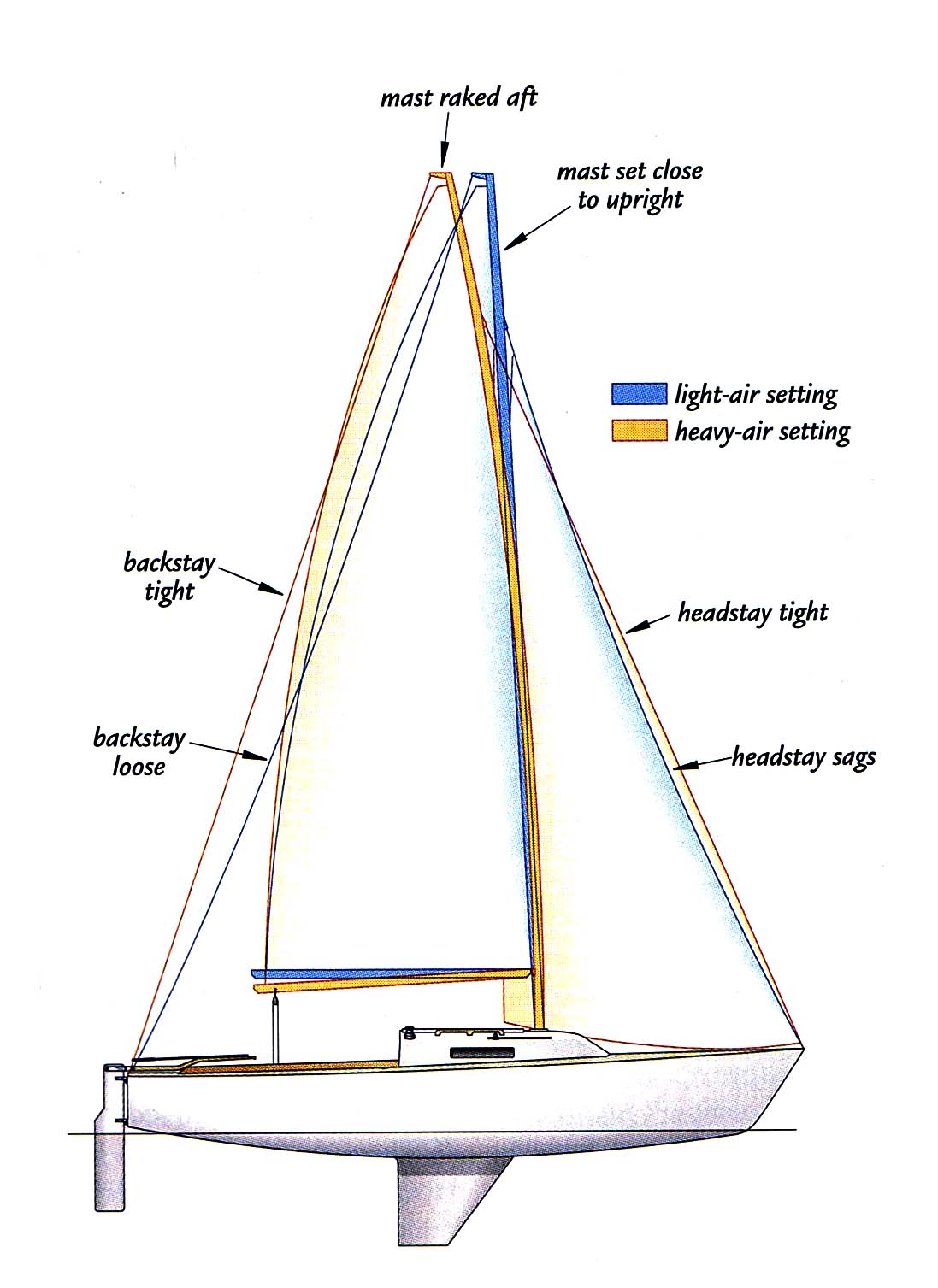


Hi RayNiceAft wrote:Also asailboatmike wrote:Highlander has a 26MSignaleer wrote: Sell me the 19?
John,
Did you also take your
Ray
mast from my modified 28ft mast back to it,s original 24ft size but still left it as a cutter rig & sold her , but i kepted the upper jumper struts kit 
I just don't understand the logic for trying to make the M mast stronger - it will not break - numerous accidents at launch ramps have already shown that the M mast does not break - it BENDS. There is no real reason to try to strengthen it because it's not going to break anyways.Ixneigh wrote:The spreader fittings need a compression stud. Else it will compress the sides of the mast.
I prefer masthead rigs. With twin back stays. I may eventually convert my M into such by making a rotating plate with a thrust bearing under it for top of the mast. Boat is correct when he promises us the mast as is will be strong enough the lift the whole yacht.
A possible dodge might be to reinforce any weak spot in the mast with an inner sleeve. If the tend to break at the speakers, insert a 3 foot long sleeve or plug into the mast and secure it with fastenings. I might be inclined to use an epoxy saturated soft wood plug.
Ix
