

Hmmmm. Looks like rocket science. From a cruising perspective though I’m not ready to make this change. The battery and power system is not my hobby. I just need it to work. I have success by having over charge capacity for cloudy days, and a gas driven dc generator if everything else fails. I use agm batteries and get about three or four years out of them, living on the boat seven mouths out of the year. I run a fridge, lights, fans, plotter, etc but no radar or fancy stuff. But thank you for the write up. It lets me know I should wait a few more years till these things get real world marine testing by experimenters such as yourself.
Ix
Lithium (LiFePO4) Battery Build
-
Inquisitor

- Captain
- Posts: 926
- Joined: Mon Apr 23, 2007 5:24 pm
- Sailboat: MacGregor 26M
- Location: North Carolina Mountains
Re: Lithium (LiFePO4) Battery Build
I quite agree on all your points. Building them from scratch... is really for a hobbyist. Between the RV market and boating, they're coming around. So far, I've only seen plug-n-play ones for the house system. Many here have commented wanting to be able to start the motor too. I've not seen one that can do both. The electronics is the limiting factor... not the chemistry.Ixneigh wrote: ↑Thu Apr 22, 2021 7:27 am Hmmmm. Looks like rocket science. From a cruising perspective though I’m not ready to make this change. The battery and power system is not my hobby. I just need it to work. I have success by having over charge capacity for cloudy days, and a gas driven dc generator if everything else fails. I use agm batteries and get about three or four years out of them, living on the boat seven mouths out of the year. I run a fridge, lights, fans, plotter, etc but no radar or fancy stuff. But thank you for the write up. It lets me know I should wait a few more years till these things get real world marine testing by experimenters such as yourself.
Ix
You get seven months of sailing! That's incredible.

Odysseus, expert on the Siren's call
-
Inquisitor
- Captain
- Posts: 926
- Joined: Mon Apr 23, 2007 5:24 pm
- Sailboat: MacGregor 26M
- Location: North Carolina Mountains
Re: Lithium (LiFePO4) Battery Build
This is the completed LiFePO4 battery. All is left is a case.
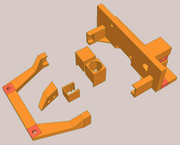
3D Printed brackets to hold the various parts.
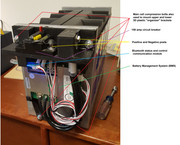
... and here is the installed components. Like the plastic parts to protect the top wiring, I was generally concerned about dangerously high short-circuit currents. On the DIY forum, the responses were mixed on the subject. Many believed that the BMS which claims short-circuit protecting and is controlled by Mosfet transistors could never pass the dangerous currents even if they are burned out. Others stated that one must always have a class-T fuse or circuit breaker on such a large battery bank capable of multiple thousands of amps when shorted. Instead of putting it on a separate panel as many here do, I thought it would be even better protection to totally hide any unprotected hardware. The buss-bars used to the input of the circuit breaker are encased in plastic. The only shorting possible (even accidentally) is between the circuit breaker protected positive and negative posts.
While many simply tape their BMS to the side of their cells, I thought I'd go the extra yard and make the upper and lower plastic brackets hold the BMS firmly. Thus, vibration cannot fatigue the wires. Also, spacing on the backside was provided to improve convection currents on the backside of the BMS's aluminum heat sink.
The positive and negative terminal are separated by large amount of plastic and are placed orthogonal to each other so that cables can not rotate about the bolt and make contact.
3D Printed brackets to hold the various parts.
... and here is the installed components. Like the plastic parts to protect the top wiring, I was generally concerned about dangerously high short-circuit currents. On the DIY forum, the responses were mixed on the subject. Many believed that the BMS which claims short-circuit protecting and is controlled by Mosfet transistors could never pass the dangerous currents even if they are burned out. Others stated that one must always have a class-T fuse or circuit breaker on such a large battery bank capable of multiple thousands of amps when shorted. Instead of putting it on a separate panel as many here do, I thought it would be even better protection to totally hide any unprotected hardware. The buss-bars used to the input of the circuit breaker are encased in plastic. The only shorting possible (even accidentally) is between the circuit breaker protected positive and negative posts.
While many simply tape their BMS to the side of their cells, I thought I'd go the extra yard and make the upper and lower plastic brackets hold the BMS firmly. Thus, vibration cannot fatigue the wires. Also, spacing on the backside was provided to improve convection currents on the backside of the BMS's aluminum heat sink.
The positive and negative terminal are separated by large amount of plastic and are placed orthogonal to each other so that cables can not rotate about the bolt and make contact.
Last edited by Inquisitor on Fri Apr 23, 2021 4:31 am, edited 1 time in total.
Odysseus, expert on the Siren's call
-
Starscream

- Admiral
- Posts: 1561
- Joined: Tue Nov 03, 2009 10:08 am
- Sailboat: MacGregor 26X
- Location: Montreal, Quebec. 2002 26X - Suzi DF90A
-
OverEasy
- Admiral
- Posts: 2873
- Joined: Mon Sep 28, 2020 11:16 am
- Sailboat: MacGregor 26X
- Location: NH & SC
Re: Lithium (LiFePO4) Battery Build
Again, This is SO cool! 
This is top notch stuff!
Well thought out and functional design!
Every step is something new!
This is top notch stuff!
Well thought out and functional design!
Every step is something new!
-
Ixneigh

- Admiral
- Posts: 2462
- Joined: Thu Sep 09, 2010 11:00 am
- Sailboat: MacGregor 26M
- Location: Key largo Florida
Re: Lithium (LiFePO4) Battery Build
I’m on the boat 7 months, but not moving all the time.
Ix
Ix
Inquisitor wrote:
I quite agree on all your points. Building them from scratch... is really for a hobbyist. Between the RV market and boating, they're coming around. So far, I've only seen plug-n-play ones for the house system. Many here have commented wanting to be able to start the motor too. I've not seen one that can do both. The electronics is the limiting factor... not the chemistry.
You get seven months of sailing! That's incredible.
Last edited by Hamin' X on Sun May 16, 2021 2:29 pm, edited 1 time in total.
Reason: Fixed quote
Reason: Fixed quote
"Shoal Idea"
2011 M, white
Tohatsu 20
South Fl.
2011 M, white
Tohatsu 20
South Fl.
-
Inquisitor
- Captain
- Posts: 926
- Joined: Mon Apr 23, 2007 5:24 pm
- Sailboat: MacGregor 26M
- Location: North Carolina Mountains
Re: Lithium (LiFePO4) Battery Build
Have you done a thread on your experience? I am real curious about just staying on board for long periods of time. Like... what would be needed to sail the ICW or maybe even the Great Loop. I think your insights and especially your ability to do extensive projects would be very educational and useful. What mods you did to support 7 month stays.
Odysseus, expert on the Siren's call
-
Cougar

- Engineer
- Posts: 161
- Joined: Mon Jan 12, 2015 3:02 am
- Sailboat: MacGregor 26X
- Location: Leeuwarden, Netherlands
Re: Lithium (LiFePO4) Battery Build
I built a 100 Ah LiFePO4 battery some 18 months ago. It now serves as the only battery on my  for the second season. One big advantage on my boat is that I only have a small outboard, a 15 HP Yamaha High Thrust. It has a lighting coil and I limited the max voltage to 14.2 Volts by fitting a different rectifier/regulator. The battery is charged by the lighting coil and two 40 Watt solar panels. We became virtually independent from shore power.
for the second season. One big advantage on my boat is that I only have a small outboard, a 15 HP Yamaha High Thrust. It has a lighting coil and I limited the max voltage to 14.2 Volts by fitting a different rectifier/regulator. The battery is charged by the lighting coil and two 40 Watt solar panels. We became virtually independent from shore power. -
OverEasy
- Admiral
- Posts: 2873
- Joined: Mon Sep 28, 2020 11:16 am
- Sailboat: MacGregor 26X
- Location: NH & SC
Re: Lithium (LiFePO4) Battery Build
Hi Inquisitor!
How goes the LiFePO4 Battery Build?
I apologize for not following up and asking sooner.
You previously explained the amount of draw down capacity that the LiFePO4 cells was considerably more than the SOP Lead-Acid variety’s 50% capacity before the cells start to degrade. Am I correct in recalling that the LiFePO4 voltage remains virtually constant or did I fumble this aspect?

How goes the LiFePO4 Battery Build?
I apologize for not following up and asking sooner.
You previously explained the amount of draw down capacity that the LiFePO4 cells was considerably more than the SOP Lead-Acid variety’s 50% capacity before the cells start to degrade. Am I correct in recalling that the LiFePO4 voltage remains virtually constant or did I fumble this aspect?

-
Inquisitor
- Captain
- Posts: 926
- Joined: Mon Apr 23, 2007 5:24 pm
- Sailboat: MacGregor 26M
- Location: North Carolina Mountains
Re: Lithium (LiFePO4) Battery Build
I've been pretty bummed about my sailing trip and haven't been back in the boat since returning from Florida. BUT, I can update this thread since there might be some interest.
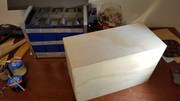
The size of the battery is 6.8" wide and the bay under the steps is 7.3" wide. I completed a wooden box to go around the battery because no off-the-shelf battery box would both hold the battery and fit under the steps. The following picture is the box using 3mm plywood and before I used several layers of fiberglass to reinforce and water proof the wood. Currently the top is still open as I wanted to use it a while and make sure all is well. I'm debating about sealing the top off with wood and fiberglass so as to eliminate risk of water intrusion. Haven't decided. The battery fits fine under the stairs and the stock wood hatch has about an inch of clearance to the battery.
The battery went into the boat and some trivial wiring was jury-rigged so we could use the refrigerator, head fan and to charge phones and tablets for the Mug Race. The refrigerator was already filled with essentials for the trip and cooled on AC power before switching over to the battery option at April 30th. I also installed the watt meter between the fridge and battery to isolate usage just for it. However, the USB charging port I wired came loose on the trip down. Fortunately, the fridge has a USB port on it... unfortunately, that muddied the testing I was trying to do on the fridge's usage.
The fridge viewtopic.php?f=8&t=28046&start=15 was set for 37F as we just had plenty of beer, Gatorade and snacks for the trip. No ice type requirements. It got opened quit a bit on Friday, Saturday and Sunday. I left it on and in the boat the following week to get seven days of usage. Although not opened during this period, and even though ambient wasn't in the 70's and 80's, the boat when closed up got considerably hotter.
Total usage on the battery for the 7 days was right at 120 Ah. This included composting head fan, charging three phones and a tablet a couple of times.
The fridge (and other trivial loads) averaged 8.6 watts over the seven days. Less than one of the stock bulbs in the boat.
Since turning off the fridge, the only thing on the battery is the fan that vents the composting head and an occasional Bluetooth hook up. BTW, I am currently getting these numbers from the battery from my office which is about thirty feet from boat and through three walls and the boat hull. I'm a little surprised it hooked up. The battery still has 152 Ah (56%) left. It has not been charged since placed in the boat on April 30th.
You are correct, a LiFePO4 battery has a far flatter curve and slightly higher curve for voltage as a function of SOC. The app uses the following values for estimating SOC and energy left.
14 to 14.6 volts = 100% SOC
13.6 = 80%
13.2 = 60%
12.8 = 40%
12.4 = 20%
11.2 = 0%
Unlike the bad situation of running a lead-acid battery to 0% SOC, the BMS protects the LiFePO4 battery and shuts off any load when the battery reaches this 0% SOC. This is still well above the cell manufacturers spec. Their test for 2500 cycles was drawn down to 10.0 volts.
The size of the battery is 6.8" wide and the bay under the steps is 7.3" wide. I completed a wooden box to go around the battery because no off-the-shelf battery box would both hold the battery and fit under the steps. The following picture is the box using 3mm plywood and before I used several layers of fiberglass to reinforce and water proof the wood. Currently the top is still open as I wanted to use it a while and make sure all is well. I'm debating about sealing the top off with wood and fiberglass so as to eliminate risk of water intrusion. Haven't decided. The battery fits fine under the stairs and the stock wood hatch has about an inch of clearance to the battery.
The battery went into the boat and some trivial wiring was jury-rigged so we could use the refrigerator, head fan and to charge phones and tablets for the Mug Race. The refrigerator was already filled with essentials for the trip and cooled on AC power before switching over to the battery option at April 30th. I also installed the watt meter between the fridge and battery to isolate usage just for it. However, the USB charging port I wired came loose on the trip down. Fortunately, the fridge has a USB port on it... unfortunately, that muddied the testing I was trying to do on the fridge's usage.
The fridge viewtopic.php?f=8&t=28046&start=15 was set for 37F as we just had plenty of beer, Gatorade and snacks for the trip. No ice type requirements. It got opened quit a bit on Friday, Saturday and Sunday. I left it on and in the boat the following week to get seven days of usage. Although not opened during this period, and even though ambient wasn't in the 70's and 80's, the boat when closed up got considerably hotter.
Total usage on the battery for the 7 days was right at 120 Ah. This included composting head fan, charging three phones and a tablet a couple of times.
The fridge (and other trivial loads) averaged 8.6 watts over the seven days. Less than one of the stock bulbs in the boat.
Since turning off the fridge, the only thing on the battery is the fan that vents the composting head and an occasional Bluetooth hook up. BTW, I am currently getting these numbers from the battery from my office which is about thirty feet from boat and through three walls and the boat hull. I'm a little surprised it hooked up. The battery still has 152 Ah (56%) left. It has not been charged since placed in the boat on April 30th.
You are correct, a LiFePO4 battery has a far flatter curve and slightly higher curve for voltage as a function of SOC. The app uses the following values for estimating SOC and energy left.
14 to 14.6 volts = 100% SOC
13.6 = 80%
13.2 = 60%
12.8 = 40%
12.4 = 20%
11.2 = 0%
Unlike the bad situation of running a lead-acid battery to 0% SOC, the BMS protects the LiFePO4 battery and shuts off any load when the battery reaches this 0% SOC. This is still well above the cell manufacturers spec. Their test for 2500 cycles was drawn down to 10.0 volts.
Whereas lead-acid likes being trickle charged and kept at 100%, all lithium chemistries like to say around 50% SOC for storage. The closer you bracket around 50%, the longer the battery life is. That is why Tesla is claiming a million mile battery when it is used between 20% to 80% SOC. For this specific battery, they can be routinely charged / discharged the complete 100% SOC. Tests show doing this at 1C rates (272 Amps in this battery's case) will yield a cycle life of 2500 cycles. Because I chose to use the compression plates, this goes up to 3500 cycles. There are no tests, but predictions are multiple tens of thousands of cycles are expected at lower charge/discharge rates and bracketing the 50% SOC number and avoiding 0% and 100% SOC as much as possible. Thus, me keeping it at the 56% SOC until I next need it is the best thing for the battery.OverEasy wrote: ↑Wed May 12, 2021 10:33 am You previously explained the amount of draw down capacity that the LiFePO4 cells was considerably more than the SOP Lead-Acid variety’s 50% capacity before the cells start to degrade. Am I correct in recalling that the LiFePO4 voltage remains virtually constant or did I fumble this aspect?
Odysseus, expert on the Siren's call
-
Cougar
- Engineer
- Posts: 161
- Joined: Mon Jan 12, 2015 3:02 am
- Sailboat: MacGregor 26X
- Location: Leeuwarden, Netherlands
Re: Lithium (LiFePO4) Battery Build
I think you are referring to the Xiaoxiang app. The scheme for determining SoC based on voltage is not entirely trustworthy. The charge and discharge curve is very flat. Besides, when charging a LiFePO4 battery you see a jagged pattern, with cell voltage rising, then slightly sinking, and then rising again. The best method to calculate SoC on a LiFePO4 battery is by using a battery monitor with a shunt, like a Victron BMV.
For most of the charge/discharge cycle the voltage will be around 13.2 to 13.3 volts. With a fully charged lead acid battery being at 12.8 volts, many, if not all 12 volt applications will thrive on this working voltage.
For most of the charge/discharge cycle the voltage will be around 13.2 to 13.3 volts. With a fully charged lead acid battery being at 12.8 volts, many, if not all 12 volt applications will thrive on this working voltage.
-
Inquisitor
- Captain
- Posts: 926
- Joined: Mon Apr 23, 2007 5:24 pm
- Sailboat: MacGregor 26M
- Location: North Carolina Mountains
Re: Lithium (LiFePO4) Battery Build
You are totally correct!Cougar wrote: ↑Fri May 14, 2021 1:08 am I think you are referring to the Xiaoxiang app. The scheme for determining SoC based on voltage is not entirely trustworthy. The charge and discharge curve is very flat. Besides, when charging a LiFePO4 battery you see a jagged pattern, with cell voltage rising, then slightly sinking, and then rising again. The best method to calculate SoC on a LiFePO4 battery is by using a battery monitor with a shunt, like a Victron BMV.
For most of the charge/discharge cycle the voltage will be around 13.2 to 13.3 volts. With a fully charged lead acid battery being at 12.8 volts, many, if not all 12 volt applications will thrive on this working voltage.
The shunt way is far more accurate, however, they have their issues also. At one point I considered adding a shunt based one to my system. I even considered integrating my bench version until I realized the microwave and inverter cooktop will go over its rated 100 amps.
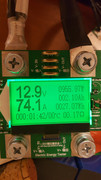
The "bounce back" while under load was far worse for my tiny 80 Ah lead-acid battery. For example, while doing the test pulling 25 amps I drove it down to 10 volts. Once relieved, it bounced back (after some time) to 12 volts. This large LiFePO4 battery doesn't even notice 25 amps. At 120 amps, its bounce back was only about 0.2 volts. All this means that I shouldn't put too much stock in the SOC when I'm using a Microwave, but with any marine electronic, stereo, lights loads, I feel the number quoted is "close enough" for what I need.
On the aspect of the "flat" curve. Yes, LiFePO4 batteries have a flatter curve than a lead-acid battery and that does making a SOC as a function of voltage less accurate, but it is linear and does have slope. Here is a sample curve:

I've obviously not used to this new huge battery enough to see if I can count on its built-in / BMS monitoring and until I get some really high load equipment on it over longer periods than a weekend, I doubt I'll ever get near its limits. Considering I'll have solar and may even experiment with wind turbines. I hope to be away from shore power for weeks without issue. Using the built-in monitoring just means, if I see its down around 20%, I might not have that night-time microwave popcorn.
Emily and Clark are starting a series of videos on DIY air conditioning. Maybe, I'll soon have an off-shore air conditioning and a way that might actually dent this battery's capacity to a point where I need to improve its monitoring system. We'll see.
Odysseus, expert on the Siren's call
-
OverEasy
- Admiral
- Posts: 2873
- Joined: Mon Sep 28, 2020 11:16 am
- Sailboat: MacGregor 26X
- Location: NH & SC
Re: Lithium (LiFePO4) Battery Build
Hi Inquisitor!
Suggestion: Emergency Back-up Plan ==> Jiffy-Pop!
(Also good for those beautiful sunset beach campfires)
In our cruising planning for the southern sections (such as Florida Coasts/ Keys) of the ICW we have also considered Air Conditioning and power consumption away from shore power.
In our case we aren’t as ambitious as you with developing and implementing as powerful a battery system as yours. We are looking at a small quiet generator tucked away under the rear swing-up seat for those occasions. But power draw and cooling efficiency in as turn-key a package, ease of use, purchase cost, installation, minimal modification, volume space and easy in/out are of concern to us.
Not sure of what type you are looking for but these three are currently at the top of our “portable-self-contained-A/C” units as they have the highest Energy Efficiency Ratings that we have found so far.

Our consideration for installed location on our Mac26X is aft of the galley seat/battery compartment on the Starboard side. System in/out Venting would be up ducted through the interspace between the cabin liner and the topside exterior hull and a flap hatch cover -or- through the aft berth wall to the cockpit with a flap hatch cover -or- back along the aft berth ceiling side slot and out through the high stern wall with a flap hatch cover.
Are you looking at a more permanent arrangement with a seawater condenser?
The EER for those we have seen so far have been better than the portables.
Some are even DC powered although we’re not sure about the specifics of how that is accomplished.
Our concern was in the seawater thru-hull fittings and the fixed permanent location these systems require as well as the cost and service aspects.
None so far seemed in the “plug-n-play” category though.
Or are you considering the “Buddy Box” approach in the companionway hatch or forward hatch with a window box type A/C unit. The EER for the small units are comparable to the portables we’ve found so far.
Regards,
Over Easy
Suggestion: Emergency Back-up Plan ==> Jiffy-Pop!
(Also good for those beautiful sunset beach campfires)
In our cruising planning for the southern sections (such as Florida Coasts/ Keys) of the ICW we have also considered Air Conditioning and power consumption away from shore power.
In our case we aren’t as ambitious as you with developing and implementing as powerful a battery system as yours. We are looking at a small quiet generator tucked away under the rear swing-up seat for those occasions. But power draw and cooling efficiency in as turn-key a package, ease of use, purchase cost, installation, minimal modification, volume space and easy in/out are of concern to us.
Not sure of what type you are looking for but these three are currently at the top of our “portable-self-contained-A/C” units as they have the highest Energy Efficiency Ratings that we have found so far.
Our consideration for installed location on our Mac26X is aft of the galley seat/battery compartment on the Starboard side. System in/out Venting would be up ducted through the interspace between the cabin liner and the topside exterior hull and a flap hatch cover -or- through the aft berth wall to the cockpit with a flap hatch cover -or- back along the aft berth ceiling side slot and out through the high stern wall with a flap hatch cover.
Are you looking at a more permanent arrangement with a seawater condenser?
The EER for those we have seen so far have been better than the portables.
Some are even DC powered although we’re not sure about the specifics of how that is accomplished.
Our concern was in the seawater thru-hull fittings and the fixed permanent location these systems require as well as the cost and service aspects.
None so far seemed in the “plug-n-play” category though.
Or are you considering the “Buddy Box” approach in the companionway hatch or forward hatch with a window box type A/C unit. The EER for the small units are comparable to the portables we’ve found so far.
Regards,
Over Easy
-
Inquisitor
- Captain
- Posts: 926
- Joined: Mon Apr 23, 2007 5:24 pm
- Sailboat: MacGregor 26M
- Location: North Carolina Mountains
Re: Lithium (LiFePO4) Battery Build
I never thought A/C would be an option. YourOverEasy wrote: ↑Fri May 14, 2021 7:38 am Hi Inquisitor!
Suggestion: Emergency Back-up Plan ==> Jiffy-Pop!
(Also good for those beautiful sunset beach campfires)
In our cruising planning for the southern sections (such as Florida Coasts/ Keys) of the ICW we have also considered Air Conditioning and power consumption away from shore power.
In our case we aren’t as ambitious as you with developing and implementing as powerful a battery system as yours. We are looking at a small quiet generator tucked away under the rear swing-up seat for those occasions. But power draw and cooling efficiency in as turn-key a package, ease of use, purchase cost, installation, minimal modification, volume space and easy in/out are of concern to us.
Not sure of what type you are looking for but these three are currently at the top of our “portable-self-contained-A/C” units as they have the highest Energy Efficiency Ratings that we have found so far.
Our consideration for installed location on our Mac26X is aft of the galley seat/battery compartment on the Starboard side. System in/out Venting would be up ducted through the interspace between the cabin liner and the topside exterior hull and a flap hatch cover -or- through the aft berth wall to the cockpit with a flap hatch cover -or- back along the aft berth ceiling side slot and out through the high stern wall with a flap hatch cover.
Are you looking at a more permanent arrangement with a seawater condenser?
The EER for those we have seen so far have been better than the portables.
Some are even DC powered although we’re not sure about the specifics of how that is accomplished.
Our concern was in the seawater thru-hull fittings and the fixed permanent location these systems require as well as the cost and service aspects.
None so far seemed in the “plug-n-play” category though.
Or are you considering the “Buddy Box” approach in the companionway hatch or forward hatch with a window box type A/C unit. The EER for the small units are comparable to the portables we’ve found so far.
Regards,
Over Easy
has a lot more opportunities for placing a generator. The  is too confining with the Mercury BigFoot taking the entire area.
 Although the fuel usage of a generator doesn't bother me so much as the noise. I've never really been around the newer Inverter / housed units (Honda and their clones) that are built to be quieter. I just can't imagine even them being quiet enough... especially for those quiet sunset moments when a twenty dB frog chorus wafting across the bay is your only background noise.
I'm also a bit price conscious. A thousand for a generator and another for high-efficiency A/C unit is just an over indulgence I can't quite bite down on and certainly not the $4k marine units.
Some time ago, Clark mentioned making a battery/solar A/C unit for a couple of hundred dollars as a teaser... They have finally started a series that is leading up to it. So far he has done three vid's to get us comfortable with the theory as well as the cutting, moving components around, soldering and charging a system. The first is here: https://www.youtube.com/watch?v=jTKT3w-6Bl0.
Also, I really like his DIY level of build.
 I'm definitely more in the chaos theory / jury-rig level of designs.
Anyway, he mentions his unit is only to cool one cabin (enclosed berth) down in the tropics. I'm betting, he will be building it using one of these car, chest fridge units like I have. They already have all the 12 VDC, computer control and complete compressor/condenser/evaporator ready to just disassemble and re-orient the components in an A/C usable arrangement. Max load of my fridge when operating to freeze something is only 4 amps. Even if it runs 100%, that would only be 40 amp-hours over night. Theoretically, it would be usable on a relatively small 12 VDC system and might be capable of cooling a small volume. If we were to enclose either the V-berth (an X's or my enlarged M berth) ... OR... the aft berth, a small system like that might be able to handle it.
I'll wait to see what he comes up with...
Odysseus, expert on the Siren's call
-
Inquisitor
- Captain
- Posts: 926
- Joined: Mon Apr 23, 2007 5:24 pm
- Sailboat: MacGregor 26M
- Location: North Carolina Mountains
Re: Lithium (LiFePO4) Battery Build
I was looking over your portable A/C units. Have you some gauge saying we need this many BTU's or do they just not make them smaller? I have a 12k BTU heat-pump in my house that takes care of about 700 sq-ft. It has no problem with the hottest/coldest days we experience. It does have a SEER rating of 23 however which might account for some efficiencies since its about twice as efficient as these portable units.
I don't really have a sense of what may be required. Thermodynamics was not one of my strong suits. If its linear with respect to room volume...
700 sq-ft x 8 ft ceiling = 5600 cu-ft needing 12k...
Rear berth of an M estimate it at
7 x 7 x 3 = 147 cu-ft...
BTU needed = 147 * 12,000 / 5600 = 315 BTU.
I'm just figuring on cooling at night time in the confined/stagnant berth. I think if we ever get to hot while up top and sailing, its time to move the boat north... say Maine or Nova Scotia.
I don't really have a sense of what may be required. Thermodynamics was not one of my strong suits.
If its linear with respect to room volume... 700 sq-ft x 8 ft ceiling = 5600 cu-ft needing 12k...
Rear berth of an M estimate it at
7 x 7 x 3 = 147 cu-ft...
BTU needed = 147 * 12,000 / 5600 = 315 BTU.
I'm just figuring on cooling at night time in the confined/stagnant berth. I think if we ever get to hot while up top and sailing, its time to move the boat north... say Maine or Nova Scotia.
Odysseus, expert on the Siren's call