OK, Roger covers it thus:
"When you watch the tell tales on the jib and the streamers at the rear of the mainsail, you will notice that the top ones don’t always
flow in the same manner as the lower ones. This means that the sail is not at the same angle to the wind at various heights. Wind
blows harder as you go higher, and there will be a different apparent wind (and wind angle) up there. (This is because the friction
of the earth and water slows wind down at low levels.) You may see the upper mainsail streamers trying to hide behind the
mainsail, and the lower ones flowing nicely to the rear. This means that the top of the sail is in too tight. The boom vang controls
this.
Loosen the vang, and watch the upper part of the sail sag outward away from the wind. Tighten the vang, and it pulls down on
the boom and pulls in on the upper part of the sail. When the vang is set right, all the streamers will behave the same. Fortunately,
sailcloth is a bit stretchy, and the top will usually sag off just about enough to match the angle change caused by stronger winds
higher up.
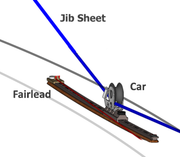
The jib has no boom, therefore there is no vang. But you can use the position of the jib sheet pulley on the deck track to control
twist. If you move the sliding pulley forward on the track, the top part of the sail will be pulled in tighter. Move it to the rear, and the
top part sags off downwind. Move the jib pulley on the track so that all of the telltales flow the same. If the top one on the upwind
side flutters before the bottom one, move the pulley forward. If the bottom one is the first to flutter, move the pulley to the rear."
It really does seem a case of if I had the Big Mac out on the water I could figure this stuff out in an afternoon; it's learning about sailing boats in general and all the weird names that's confusing me.
OK, so I've found (with Russ's help) the answer to my 3 basic questions:
Yes, we adjust both sails for twist
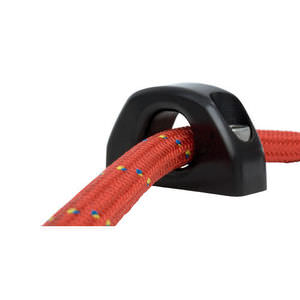
The fairlead is the pully and we do have them
Yes the Mac has a vang
And yes, my general understanding was correct - but critically he answers the question the course failed to cover. I've highlighted it in bold - "Loosen the vang, and watch the upper part of the sail sag outward away from the wind"
Right, NOW I understand, you increase the 'twist' to DECREASE the tension up high and let the sail SAG, and you want it to sag AWAY from the wind.
I've been thinking the tension would increase the twist and that you're trying to resist the wind. Seems you are letting it fill up with air while more loose, so you're not creating a sharp shaped blade to cut the air, you're opening it up to
catch the air.
I think it's the word 'twist' that got me, cos if you twist a cloth you're putting tension on it and making it shorter. Here you 'twist' by ALLOWING it to twist, by reducing tension.
Clear as a mud.
Side note, rather funny to see Russ assure me you're a friendly bunch. I've known that from a thread started 10 years ago, and now 27 pages...






 . Australia comes to mind
 . Beseech the Oz Mac owners to take you under their wings for experience. It should only take you a day to get the feel. It will be like riding a bicycle, once you get the hang of it, it stays with you forever; then you can learn the names of everything, instead of pointing to that thingy, or this thingy
 .
.