

A question for you electronics people out there:
I currently have 2 Magnacharge 24DC 140 AGM Size 24 batteries on my X. I've also installed a dual battery charger. A friend of mine purchased an RV trailer that came with an AGM battery, and he's offering the battery to me for free. Free battery! Bonus! So, here is my question:
My battery charger can only charge 2 batteries. Can I get away with wiring the 2nd and 3rd batteries in parallel, and still use a dual battery charger? Or do I need to upgrade to a charger that can charger 3 separate batteries?
My current thinking would be to have battery #1 as my starter, and batteries 2 and 3 as my house bank, with my dual charger having battery 1 hooked up to one charging outlet, and batteries 2 and 3 hooked up in parallel to the second outlet. To me, it seems like this should work. As far as I can see, the battery charger would simply think that the house bank was one battery that had twice the capacity.
My dual charger is a ProMariner ProSport 12 Dual Bank, and when I contacted the company they told me that I would have to upgrade to a 3 battery charger. Am I being upsold by the company here? Or is there just something technical that I don't understand that would prevent a smart charger from being able to charge a pair of batteries that are wired in parallel?
Going from 2 batteries to 3
-
PhysicsTeacher

- Chief Steward
- Posts: 63
- Joined: Fri Sep 02, 2016 6:09 pm
- Sailboat: MacGregor 26X
- Location: Abbotsford, BC, Canada 1999 26X, 60 HP Yamaha
Going from 2 batteries to 3
No trees were killed to send this message, but a large number of electrons were terribly inconvenienced.
-
WinSome
- Engineer
- Posts: 180
- Joined: Thu Jul 07, 2016 7:35 am
- Sailboat: MacGregor 26X
- Location: Hamilton Ontario Canada
Re: Going from 2 batteries to 3
Answer this question first : How do I use the current two batteries ? Are you currently short of power? Are you currently using Led lights? If your power consumption is high go for the third battery.
Otherwise properly store the donated battery for now.
Otherwise properly store the donated battery for now.
-
wakataka
- Chief Steward
- Posts: 53
- Joined: Mon Jul 06, 2015 10:06 pm
- Sailboat: MacGregor 26X
- Location: Redding California
Re: Going from 2 batteries to 3
IF the two batteries in parallel are the same capacity and ideally the same brand, it should work OK. If one battery is weaker than the other, putting it in parallel with the more powerful battery will hasten it's demise. Here's an article that explains a lot - https://www.impactbattery.com/blog/post ... n-parallel
-
Be Free

- Admiral
- Posts: 1890
- Joined: Fri Nov 23, 2012 6:08 pm
- Sailboat: MacGregor 26X
- Location: Steinhatchee, FL
Re: Going from 2 batteries to 3
Wakataka has it right.
If your original batteries are the same size (AH), the same age, and have been used the same then they can safely be paralleled. You are correct that you could then treat them as a single, larger battery with twice the AH rating.
Hook the positive cable of your charger to the positive cable on one of them and the negative cable to the negative post on the other. The charging current should run through both batteries. Don't charge one and let it charge the other. You will destroy them both in different ways.
If your batteries are not the same size (AH) then nothing else matters. Best case you will have a bank with 2X the smaller batter. Worst case the smaller battery will tend to be discharged too deeply which will shorten its life.
If they are not the same age then they will probably not have the same AH rating even if the sticker says they do. AH capacity decreases with age so an older battery will probably have less capacity than a newer battery that is otherwise identical. All things being equal, a couple of months difference is probably not a show stopper; a year or more almost certainly is.
How the battery is used will also have an effect on its actual AH rating. A start battery that is used a couple of times a trip for a couple of seconds each and then almost immediately charged back to 100% will decrease much slower than a house battery that regularly uses 20% to 50% of its capacity and does not get charged again until you get back to the dock.
The dealer is correct that the right way is to use a charger that is designed to charge three batteries that are to be used independently. If he did not ask how the batteries were to be used then yes, he was up-selling you but he still may have given you the right answer.
If the house batteries are connected as a single bank (best for the long term anyway) then they can be charged as a single bank with no significant problems. Keep the jumper between the batteries short and large to decrease resistance, hook up the charger as described above, always use them as a single bank and you will have something that is almost like a larger, single battery.
If you plan to have two, smaller house batteries then you will need the 3-battery charger. There are times when two house banks make sense but it's usually better to set it up as one large bank.
If your original batteries are the same size (AH), the same age, and have been used the same then they can safely be paralleled. You are correct that you could then treat them as a single, larger battery with twice the AH rating.
Hook the positive cable of your charger to the positive cable on one of them and the negative cable to the negative post on the other. The charging current should run through both batteries. Don't charge one and let it charge the other. You will destroy them both in different ways.
If your batteries are not the same size (AH) then nothing else matters. Best case you will have a bank with 2X the smaller batter. Worst case the smaller battery will tend to be discharged too deeply which will shorten its life.
If they are not the same age then they will probably not have the same AH rating even if the sticker says they do. AH capacity decreases with age so an older battery will probably have less capacity than a newer battery that is otherwise identical. All things being equal, a couple of months difference is probably not a show stopper; a year or more almost certainly is.
How the battery is used will also have an effect on its actual AH rating. A start battery that is used a couple of times a trip for a couple of seconds each and then almost immediately charged back to 100% will decrease much slower than a house battery that regularly uses 20% to 50% of its capacity and does not get charged again until you get back to the dock.
The dealer is correct that the right way is to use a charger that is designed to charge three batteries that are to be used independently. If he did not ask how the batteries were to be used then yes, he was up-selling you but he still may have given you the right answer.
If the house batteries are connected as a single bank (best for the long term anyway) then they can be charged as a single bank with no significant problems. Keep the jumper between the batteries short and large to decrease resistance, hook up the charger as described above, always use them as a single bank and you will have something that is almost like a larger, single battery.
If you plan to have two, smaller house batteries then you will need the 3-battery charger. There are times when two house banks make sense but it's usually better to set it up as one large bank.
Bill
2001 26X Simple Interest
Honda BF40D
"If I were in a hurry I would not have bought a sailboat." Me
2001 26X Simple Interest
Honda BF40D
"If I were in a hurry I would not have bought a sailboat." Me
-
PhysicsTeacher
- Chief Steward
- Posts: 63
- Joined: Fri Sep 02, 2016 6:09 pm
- Sailboat: MacGregor 26X
- Location: Abbotsford, BC, Canada 1999 26X, 60 HP Yamaha
Re: Going from 2 batteries to 3
Thanks, everyone!
Based on this, I think I'll do the following:
Since both of my current batteries were purchased at the same time and are the same size, those are the two I'll wire in parallel. They'll become my house bank. The new (free) AGM battery is what I'll treat as my starter.
Again, thanks for everyone's advice!
Kelvin
Based on this, I think I'll do the following:
Since both of my current batteries were purchased at the same time and are the same size, those are the two I'll wire in parallel. They'll become my house bank. The new (free) AGM battery is what I'll treat as my starter.
Again, thanks for everyone's advice!
Kelvin
No trees were killed to send this message, but a large number of electrons were terribly inconvenienced.
-
Be Free
- Admiral
- Posts: 1890
- Joined: Fri Nov 23, 2012 6:08 pm
- Sailboat: MacGregor 26X
- Location: Steinhatchee, FL
Re: Going from 2 batteries to 3
OK, now that you have decided here's another thing you may want to consider adding.
If you put an ACR (automatic charge relay) between the house bank and the start battery your engine can charge the house bank after the start battery reaches 13 volts (simplified description). They are not very expensive, fairly easy to install, and are mostly "set and forget" once they are installed. It works the other way too. When you are charging the house bank (from whatever source) it will charge the start battery at the same set point.
Alternatively you could use a manual switch but using it incorrectly can be very expensive or at the least inconvenient.
If you put an ACR (automatic charge relay) between the house bank and the start battery your engine can charge the house bank after the start battery reaches 13 volts (simplified description). They are not very expensive, fairly easy to install, and are mostly "set and forget" once they are installed. It works the other way too. When you are charging the house bank (from whatever source) it will charge the start battery at the same set point.
Alternatively you could use a manual switch but using it incorrectly can be very expensive or at the least inconvenient.
Bill
2001 26X Simple Interest
Honda BF40D
"If I were in a hurry I would not have bought a sailboat." Me
2001 26X Simple Interest
Honda BF40D
"If I were in a hurry I would not have bought a sailboat." Me
-
PhysicsTeacher
- Chief Steward
- Posts: 63
- Joined: Fri Sep 02, 2016 6:09 pm
- Sailboat: MacGregor 26X
- Location: Abbotsford, BC, Canada 1999 26X, 60 HP Yamaha
Re: Going from 2 batteries to 3
That's a great idea. I need to do some research on how that all works, but that sounds like a great future mod.
No trees were killed to send this message, but a large number of electrons were terribly inconvenienced.
-
OverEasy
- Admiral
- Posts: 2873
- Joined: Mon Sep 28, 2020 11:16 am
- Sailboat: MacGregor 26X
- Location: NH & SC
Re: Going from 2 batteries to 3
Hi PhysicsTeacher!
As BeFree said
You really don’t want to attempt to parallel charge batteries.
Batteries are never identical, especially over time and use.
The even marginally ‘lower’ battery will end up getting compromised and damaged.
One approach: You can add one or two marine grade battery selector switches as shown in the attached sketch:
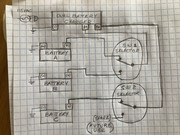
Battery selector switches are readily available and are of reasonable cost from multiple in-store or on-line sources.
While you could use just one selector switch having the second switching place would allow expansion to a fourth battery when desired.
Manually switching the batteries is an easy task on the checklist.
Another approach are automatic charge monitor battery switching devices that you could tie in for one pair of batteries.
This may cause issues with your ‘dual battery charger’ unit…there may be potential circuit charge sensor conflicts that will potentially arise depending upon the actual sensor circuits utilized in each item… something that you might want to avoid. The automatic charge monitoring devices can be more expensive as well.
From prior personal experiences with even high end RV parallel battery charge systems and in systems I’ve observed elsewhere I’d recommend staying away from the parallel battery approach.
As with anything, It’s your choice.
Best Regards
Over Easy


As BeFree said
You asked for an opinion from someone with an engineering background….Wakataka has it right
You really don’t want to attempt to parallel charge batteries.
Batteries are never identical, especially over time and use.
The even marginally ‘lower’ battery will end up getting compromised and damaged.
One approach: You can add one or two marine grade battery selector switches as shown in the attached sketch:
Battery selector switches are readily available and are of reasonable cost from multiple in-store or on-line sources.
While you could use just one selector switch having the second switching place would allow expansion to a fourth battery when desired.
Manually switching the batteries is an easy task on the checklist.
Another approach are automatic charge monitor battery switching devices that you could tie in for one pair of batteries.
This may cause issues with your ‘dual battery charger’ unit…there may be potential circuit charge sensor conflicts that will potentially arise depending upon the actual sensor circuits utilized in each item… something that you might want to avoid. The automatic charge monitoring devices can be more expensive as well.
From prior personal experiences with even high end RV parallel battery charge systems and in systems I’ve observed elsewhere I’d recommend staying away from the parallel battery approach.
As with anything, It’s your choice.
Best Regards
Over Easy


-
Be Free
- Admiral
- Posts: 1890
- Joined: Fri Nov 23, 2012 6:08 pm
- Sailboat: MacGregor 26X
- Location: Steinhatchee, FL
Re: Going from 2 batteries to 3
In this case I'm afraid I'm going to have to "concur in part and dissent in part".
Charging batteries in parallel is a common practice and can be done without problems as long as the batteries are reasonably identical. Batteries manufactured with different capacities or chemistries, or with significantly different manufacture dates or usage patterns are not good candidates for paralleling. Ideally you would start with two new, identical batteries with the same manufacture date. That is what PhysicsTeacher said he had.
I will agree that "batteries are never identical, especially over time and use" but neither is every cell in the battery identical yet they still result in a battery that meets the expected specifications. I'm not sure where you draw the line at "marginally lower", but a couple of tenths of a volt difference in the resting voltage or a few thousandths of an ohm difference in the internal resistance of the battery is not going to make a difference. The batteries don't have to be identical, they just need to be reasonably identical.
While I do agree that your multi-switch configuration will work I am concerned that it may be needlessly complicated and has a very real possibility of leaving one or more batteries undercharged. Your suggested design requires a person to notice that the first battery is charged and then manually switch to the second battery. Switching too soon will leave the first battery undercharged to some extent. Switching too late wastes time in the charging cycle. In any case, only one of the batteries will benefit from the float phase unless you keep manually switching back and forth after they are charged. In my experience, any design that requires manual intervention to function properly is not a good choice over the long-haul.
I can't argue with your personal experience with parallel hookups on an RV but I can tell you that I've no problems with them on my MacGregor.
My setup is two banks of deep cycle batteries, each hooked to a 1-2-both-off type of battery switch. The output of the switch is connected to the positive bus on the boat.
All battery charge sources are connected to the positive and negative busses so the position of the switch not only determines which bank is being used but which bank is being charged. The switch is always in either the "off" position or the "both" position. My entire house bank is charged and discharged as if it were a single battery.
The only reason I would have to select a single bank would be if one of the batteries developed a problem. This allows me to isolate the damaged battery and still have the rest of the system working. I've never had to isolate a battery but I also test and water each battery regularly so I have always caught failing batteries on the way down and well before they were a problem.
After six years of heavy use the batteries are still within a tenth of a volt (resting voltage) and a few thousandths (varies) of an ohm internal resistance.
Charging batteries in parallel is a common practice and can be done without problems as long as the batteries are reasonably identical. Batteries manufactured with different capacities or chemistries, or with significantly different manufacture dates or usage patterns are not good candidates for paralleling. Ideally you would start with two new, identical batteries with the same manufacture date. That is what PhysicsTeacher said he had.
I will agree that "batteries are never identical, especially over time and use" but neither is every cell in the battery identical yet they still result in a battery that meets the expected specifications. I'm not sure where you draw the line at "marginally lower", but a couple of tenths of a volt difference in the resting voltage or a few thousandths of an ohm difference in the internal resistance of the battery is not going to make a difference. The batteries don't have to be identical, they just need to be reasonably identical.
While I do agree that your multi-switch configuration will work I am concerned that it may be needlessly complicated and has a very real possibility of leaving one or more batteries undercharged. Your suggested design requires a person to notice that the first battery is charged and then manually switch to the second battery. Switching too soon will leave the first battery undercharged to some extent. Switching too late wastes time in the charging cycle. In any case, only one of the batteries will benefit from the float phase unless you keep manually switching back and forth after they are charged. In my experience, any design that requires manual intervention to function properly is not a good choice over the long-haul.
I can't argue with your personal experience with parallel hookups on an RV but I can tell you that I've no problems with them on my MacGregor.
My setup is two banks of deep cycle batteries, each hooked to a 1-2-both-off type of battery switch. The output of the switch is connected to the positive bus on the boat.
All battery charge sources are connected to the positive and negative busses so the position of the switch not only determines which bank is being used but which bank is being charged. The switch is always in either the "off" position or the "both" position. My entire house bank is charged and discharged as if it were a single battery.
The only reason I would have to select a single bank would be if one of the batteries developed a problem. This allows me to isolate the damaged battery and still have the rest of the system working. I've never had to isolate a battery but I also test and water each battery regularly so I have always caught failing batteries on the way down and well before they were a problem.
After six years of heavy use the batteries are still within a tenth of a volt (resting voltage) and a few thousandths (varies) of an ohm internal resistance.
Bill
2001 26X Simple Interest
Honda BF40D
"If I were in a hurry I would not have bought a sailboat." Me
2001 26X Simple Interest
Honda BF40D
"If I were in a hurry I would not have bought a sailboat." Me
-
Be Free
- Admiral
- Posts: 1890
- Joined: Fri Nov 23, 2012 6:08 pm
- Sailboat: MacGregor 26X
- Location: Steinhatchee, FL
Re: Going from 2 batteries to 3
For those wishing to parallel batteries, I recommend the following maintenance procedures. I assume that you know how to select and properly connect batteries in parallel. I'm also going to assume that you know how to choose and attach an appropriate charging source. These procedures are specifically for flooded lead acid batteries are somewhat applicable to SLA and AGM batteries.
In practice, if having your house bank go dead sooner than you would like is not a safety issue then hang onto them as long as you want. I have a dedicated start battery, a backup anchor light, and always have a generator when I'm out for multi-day trips so killing my house bank is a non-event for me.
If you find that one battery, or even one cell in a battery is consistently lower than the others that is usually a sign that you have a charging problem with that battery. If you charge one battery and then let it spill over to a parallel battery it will tend to overcharge (and overheat) the battery that the charger is connected to. Overcharging a battery will "boil" out electrolyte. Don't do that.
One cell consistently lower may indicate an internal problem with the battery. Try an equalization charge but the battery is probably on it's way out.
Swelling or distortion to the case or battery post is almost always a sign of overcharging. Find out why you are overcharging that battery but in any case you will need to replace it.
Unfortunately, if you have to replace one battery in a bank you should replace them all. Batteries with unmatched specifications will damage one another. Adding a new battery to an old bank is just throwing away your money. Odds are, if one of the batteries is worn out the others are not far behind anyway so don't worry about the fact they they seem to be working right now.
- Establish a baseline when the batteries are new.
Fully charge and document the resting voltage of each battery.
Ideally you would also record the internal resistance of each battery at this time.
- On a regular basis
Check the resting voltage of each battery.
Check the internal resistance of each battery.
Check and replenish the (distilled) water in each battery.
Check for any swelling or distortion to the battery case.
In practice, if having your house bank go dead sooner than you would like is not a safety issue then hang onto them as long as you want. I have a dedicated start battery, a backup anchor light, and always have a generator when I'm out for multi-day trips so killing my house bank is a non-event for me.
If you find that one battery, or even one cell in a battery is consistently lower than the others that is usually a sign that you have a charging problem with that battery. If you charge one battery and then let it spill over to a parallel battery it will tend to overcharge (and overheat) the battery that the charger is connected to. Overcharging a battery will "boil" out electrolyte. Don't do that.
One cell consistently lower may indicate an internal problem with the battery. Try an equalization charge but the battery is probably on it's way out.
Swelling or distortion to the case or battery post is almost always a sign of overcharging. Find out why you are overcharging that battery but in any case you will need to replace it.
Unfortunately, if you have to replace one battery in a bank you should replace them all. Batteries with unmatched specifications will damage one another. Adding a new battery to an old bank is just throwing away your money. Odds are, if one of the batteries is worn out the others are not far behind anyway so don't worry about the fact they they seem to be working right now.
Bill
2001 26X Simple Interest
Honda BF40D
"If I were in a hurry I would not have bought a sailboat." Me
2001 26X Simple Interest
Honda BF40D
"If I were in a hurry I would not have bought a sailboat." Me
-
OverEasy
- Admiral
- Posts: 2873
- Joined: Mon Sep 28, 2020 11:16 am
- Sailboat: MacGregor 26X
- Location: NH & SC
Re: Going from 2 batteries to 3
Hi Be Free!
I think we’re on the same page but slightly different perspectives…. No harm No foul
Ideally yes one would have a matched set to start with but that hasn’t always been the case for me (or others I could speculate).
Personally I’ve experienced times where one battery of a matched battery set (same lot number, initialization date, amperage, model) has crapped out early and the other has run nigh to perfectly for 4 to 6 years longer without incidence… Go figure.
Anyway I long ago gave up on the parallel battery charging approach and never looked back as I’ve generally gotten well in excess of 7 even 8 plus years out of my RV batteries by not charging in parallel. I agree that monitoring each battery and each cells condition is key. It not a bother to me and for me hasn’t been a problem to switch the charge between batteries but that’s not here nor there…just a regular habit.
Automatic charging is a nice way to go I’ll agree but I think the original problem was going from a dual battery setup with a dual battery charger to a three battery system… while keeping them all available for use.
Another thing I’ve seen done is the use of independent isolation battery switches and individual low amp trickle chargers for each battery.
The user’s perspective was that automatic trickle chargers are near dirt cheap and it gave them redundancy… thought it was an interesting approach.
I believe we both agree that Main thing is to not get into a situation where a bum battery in a parallel charging set leads to over heating.
Regular frequent routine maintenance of the charge state and electrolyte condition levels is the key to long battery life and lower costs.
Best Regards,
Over Easy
I think we’re on the same page but slightly different perspectives…. No harm No foul
Ideally yes one would have a matched set to start with but that hasn’t always been the case for me (or others I could speculate).
Personally I’ve experienced times where one battery of a matched battery set (same lot number, initialization date, amperage, model) has crapped out early and the other has run nigh to perfectly for 4 to 6 years longer without incidence… Go figure.
Anyway I long ago gave up on the parallel battery charging approach and never looked back as I’ve generally gotten well in excess of 7 even 8 plus years out of my RV batteries by not charging in parallel. I agree that monitoring each battery and each cells condition is key. It not a bother to me and for me hasn’t been a problem to switch the charge between batteries but that’s not here nor there…just a regular habit.
Automatic charging is a nice way to go I’ll agree but I think the original problem was going from a dual battery setup with a dual battery charger to a three battery system… while keeping them all available for use.
Another thing I’ve seen done is the use of independent isolation battery switches and individual low amp trickle chargers for each battery.
The user’s perspective was that automatic trickle chargers are near dirt cheap and it gave them redundancy… thought it was an interesting approach.
I believe we both agree that Main thing is to not get into a situation where a bum battery in a parallel charging set leads to over heating.
Regular frequent routine maintenance of the charge state and electrolyte condition levels is the key to long battery life and lower costs.
Best Regards,
Over Easy
-
rsvpasap

- First Officer
- Posts: 241
- Joined: Fri Dec 13, 2013 2:05 pm
- Sailboat: MacGregor 26X
- Location: Seattle, WA
Re: Going from 2 batteries to 3
Folks connect 12 volt batteries in multiple battery banks all the time. On my 26X, I have a ProMariner 1250P 50 amp charger connected to six 105 AH lead acid batteries.
There's no obvious reason you would not be able to simply add it additional battery in parallel to one of your existing batteries as long as it's the same size and type of battery.
The only problem is, the owners manual for your battery charger can be interpreted as specifically saying don't do it. It could also be interpreted as saying don't connect the battery charger to the positive terminal of one battery and the negative terminal of another, even if those two batteries are wired together in parallel. Seems vague to me and I cannot understand the rationale behind saying you can't have multiple batteries wired in parallel. Maybe it's because it's only a 10 amp charger.. Suggest you follow up with ProMariner.

There's no obvious reason you would not be able to simply add it additional battery in parallel to one of your existing batteries as long as it's the same size and type of battery.
The only problem is, the owners manual for your battery charger can be interpreted as specifically saying don't do it. It could also be interpreted as saying don't connect the battery charger to the positive terminal of one battery and the negative terminal of another, even if those two batteries are wired together in parallel. Seems vague to me and I cannot understand the rationale behind saying you can't have multiple batteries wired in parallel. Maybe it's because it's only a 10 amp charger.. Suggest you follow up with ProMariner.
-
Be Free
- Admiral
- Posts: 1890
- Joined: Fri Nov 23, 2012 6:08 pm
- Sailboat: MacGregor 26X
- Location: Steinhatchee, FL
Re: Going from 2 batteries to 3
The cable connecting the positive terminals together and both negative cables together brings them both to the same electrical potential. Electrically, that is one battery with two posts on the positive side and two on the negative.
The two best choices for hooking up the chargers are per the ProMariner manual or both positives on one battery and both negatives on the other. Those are virtually identical electrically.
The only bad choice would be both positives and both negatives on one battery. That way increases the likelihood of uneven charging in the batteries and premature failure of one or both.
The two best choices for hooking up the chargers are per the ProMariner manual or both positives on one battery and both negatives on the other. Those are virtually identical electrically.
The only bad choice would be both positives and both negatives on one battery. That way increases the likelihood of uneven charging in the batteries and premature failure of one or both.
Bill
2001 26X Simple Interest
Honda BF40D
"If I were in a hurry I would not have bought a sailboat." Me
2001 26X Simple Interest
Honda BF40D
"If I were in a hurry I would not have bought a sailboat." Me