

Hi Folks,
I have older 26s that does not have stop bracket to limit downward travel of the centerboard. Can anybody share info where the stop bracket goes and how far the centerboard goes out (90 degrees or perhaps less) ?
Any info would be appreciated, thank you!
Mars
Stop bracket for the centerboard of 26s
-
Stickinthemud57

- Captain
- Posts: 786
- Joined: Thu Nov 12, 2020 7:50 am
- Sailboat: MacGregor 26S
- Location: Grapevine, Texas
- Contact:
Re: Stop bracket for the centerboard of 26s
I will try to get out the the back lot today and get that info.
The key to inner peace is to admit you have a problem and leave it at that.
-
Stickinthemud57
- Captain
- Posts: 786
- Joined: Thu Nov 12, 2020 7:50 am
- Sailboat: MacGregor 26S
- Location: Grapevine, Texas
- Contact:
Re: Stop bracket for the centerboard of 26s
Okay...
I went and took measurements of my trailer, and then it dawned on me that our trailers may differ significantly. So, I reasoned that the important dimension was the top of the "V" formed by the support bar from the bottom of the boat as it sits on the trailer is the critical one. Too high and you have boat weight resting on the bar, too low and centerboard won't be high enough to clear the bunk in the back as it slides off. Aside: Always remember to tension your centerboard cable when launching lest the centerboard drops too much and catches the back bunk as it slides back.
My trailer has transverse bunks, which is to say they run perpendicular to the centerline of the boat. In my case, when you draw a line between the bottom of the V's formed by the bunks, the top of the V formed by the support bar rests about two inches below that line. My centerboard drops about that much past the bottom of the centerboard trunk and does not snag on the way back, so that is working fine for me.
Please let me know if this information needs further explanation, and good luck!
I went and took measurements of my trailer, and then it dawned on me that our trailers may differ significantly. So, I reasoned that the important dimension was the top of the "V" formed by the support bar from the bottom of the boat as it sits on the trailer is the critical one. Too high and you have boat weight resting on the bar, too low and centerboard won't be high enough to clear the bunk in the back as it slides off. Aside: Always remember to tension your centerboard cable when launching lest the centerboard drops too much and catches the back bunk as it slides back.
My trailer has transverse bunks, which is to say they run perpendicular to the centerline of the boat. In my case, when you draw a line between the bottom of the V's formed by the bunks, the top of the V formed by the support bar rests about two inches below that line. My centerboard drops about that much past the bottom of the centerboard trunk and does not snag on the way back, so that is working fine for me.
Please let me know if this information needs further explanation, and good luck!
The key to inner peace is to admit you have a problem and leave it at that.
Re: Stop bracket for the centerboard of 26s
Thanks Stickinthemud57
I managed to get the boat out of the trailer and put it on the stand so I can work on it easily. The centerboard was about 2" out of the boat and also about 2" above the rollers. To be safe with it I lifted the boat about 5" above the rollers and pulled the trailer out, than put the stand beneath and fixed it on the sides. The lifting mechanism (crane) is home made and if anybody is interested I'll share the photos and explain.
What I'm puzzled now is where the bracket for the end of the cable should be. My boat is older and does not have a bracket, therefore the movement of the end of the centerboard cable was limited with the turning block at the top of the galley sink, for which I'm not sure if it should be there or it is just modification made by the previous owner(s). With that limitation while sailing the centerboard used to be about 45 degrees from the boat. Is that the designed angle or it should go lower? I guess the former.
I managed to get the boat out of the trailer and put it on the stand so I can work on it easily. The centerboard was about 2" out of the boat and also about 2" above the rollers. To be safe with it I lifted the boat about 5" above the rollers and pulled the trailer out, than put the stand beneath and fixed it on the sides. The lifting mechanism (crane) is home made and if anybody is interested I'll share the photos and explain.
What I'm puzzled now is where the bracket for the end of the cable should be. My boat is older and does not have a bracket, therefore the movement of the end of the centerboard cable was limited with the turning block at the top of the galley sink, for which I'm not sure if it should be there or it is just modification made by the previous owner(s). With that limitation while sailing the centerboard used to be about 45 degrees from the boat. Is that the designed angle or it should go lower? I guess the former.
-
Stickinthemud57
- Captain
- Posts: 786
- Joined: Thu Nov 12, 2020 7:50 am
- Sailboat: MacGregor 26S
- Location: Grapevine, Texas
- Contact:
Re: Stop bracket for the centerboard of 26s
I think I misunderstood your original post. I should have read it more closely.
The stop bracket for the lifting/lowering cable attaches to the inboard side of the galley enclosure, near the top and close to the aft/inboard corner. There should be two holes for the bolts there. With the stock cable installed (available from Blue Water Yachts - https://shop.bwyachts.com/product-p/5501-1c0.htm), the bracket should prevent the centerboard from dropping past its intended angle. Not sure exactly what that angle is.
Let me know if you need pics.
The stop bracket for the lifting/lowering cable attaches to the inboard side of the galley enclosure, near the top and close to the aft/inboard corner. There should be two holes for the bolts there. With the stock cable installed (available from Blue Water Yachts - https://shop.bwyachts.com/product-p/5501-1c0.htm), the bracket should prevent the centerboard from dropping past its intended angle. Not sure exactly what that angle is.
Let me know if you need pics.
The key to inner peace is to admit you have a problem and leave it at that.
-
Be Free

- Admiral
- Posts: 1891
- Joined: Fri Nov 23, 2012 6:08 pm
- Sailboat: MacGregor 26X
- Location: Steinhatchee, FL
Re: Stop bracket for the centerboard of 26s
I'd be interested in seeing how your homemade lift works.
Bill
2001 26X Simple Interest
Honda BF40D
"If I were in a hurry I would not have bought a sailboat." Me
2001 26X Simple Interest
Honda BF40D
"If I were in a hurry I would not have bought a sailboat." Me
Re: Stop bracket for the centerboard of 26s
Thanks for the info. It seems that the previous owners did not modify anything. Simply, the cable movement was limited by the turning block before the bracket was introduced. I also found pictures here: https://macgregor.sailboatowners.com/mo ... 016&mn=26S
Thanks again.
I'll take and post images of the lifting mechanism later today.
Cheers.
Thanks again.
I'll take and post images of the lifting mechanism later today.
Cheers.
Re: Stop bracket for the centerboard of 26s
Finally, the images are here.
The lifting mechanism was built by a friend to lift his 2.5 tons Pasara. Lifting 26S was far easier.
First we lowered the front wheel of the trailer lifting by that the back part (end the stern) and we put stand beneath the stern (after the trailer so we could pull it out from the front). Than we installed the lifting mechanism (image 1). The mechanism consists of two stands (painted in black), two vertical pipes (pillars) and the horizontal beam. The pillars and the beam are shown in image 2. In the upper corners of this "П" shaped structure are attached 2 hand winches that lift the boat. All pipes are from the local hardware store and welded by my friend. Everything can be easily erected or dismantled. Needles to say, the whole structure is quite unstable and should be positioned very accurately. If the structure is not perpendicular to the boat, when lifted the boat will start leaning on side twisting the structure. Three people are needed for lifting: one on each side to operate the winches and one in front to coordinate, that is to tell which side should be lifted to compensate possible leaning. WE lifted the front part of the boat about 5" above the rollers and side supports and pulled the trailer out (still visible in image 1). Then the front and side stands were mounted and the boat was lowered. It takes about 30-45 minutes to do everything, including assembly and disassembly of the structure.
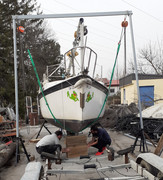
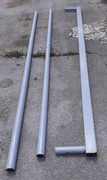
The lifting mechanism was built by a friend to lift his 2.5 tons Pasara. Lifting 26S was far easier.
First we lowered the front wheel of the trailer lifting by that the back part (end the stern) and we put stand beneath the stern (after the trailer so we could pull it out from the front). Than we installed the lifting mechanism (image 1). The mechanism consists of two stands (painted in black), two vertical pipes (pillars) and the horizontal beam. The pillars and the beam are shown in image 2. In the upper corners of this "П" shaped structure are attached 2 hand winches that lift the boat. All pipes are from the local hardware store and welded by my friend. Everything can be easily erected or dismantled. Needles to say, the whole structure is quite unstable and should be positioned very accurately. If the structure is not perpendicular to the boat, when lifted the boat will start leaning on side twisting the structure. Three people are needed for lifting: one on each side to operate the winches and one in front to coordinate, that is to tell which side should be lifted to compensate possible leaning. WE lifted the front part of the boat about 5" above the rollers and side supports and pulled the trailer out (still visible in image 1). Then the front and side stands were mounted and the boat was lowered. It takes about 30-45 minutes to do everything, including assembly and disassembly of the structure.
-
Stickinthemud57
- Captain
- Posts: 786
- Joined: Thu Nov 12, 2020 7:50 am
- Sailboat: MacGregor 26S
- Location: Grapevine, Texas
- Contact:
Re: Stop bracket for the centerboard of 26s
I have to admit looking at that rig gave me the willies. Without cross-bracing I'm not sure I would have had the courage to attempt what you did. Definitely not a windy day activity.
The key to inner peace is to admit you have a problem and leave it at that.
Re: Stop bracket for the centerboard of 26s
I was very...very scared. Of course, there was no wind at all. The biggest problem was the fact that the ground was not ideally horizontal, it required a lot of attention to compensate for that. The scariest part is yet to come: putting the boat back on trailer.I have to admit looking at that rig gave me the willies. Without cross-bracing I'm not sure I would have had the courage to attempt what you did. Definitely not a windy day activity.
I don't know how my friend did it with a 2.5 tons boat (I was not there).
-
Stickinthemud57
- Captain
- Posts: 786
- Joined: Thu Nov 12, 2020 7:50 am
- Sailboat: MacGregor 26S
- Location: Grapevine, Texas
- Contact:
Re: Stop bracket for the centerboard of 26s
It's probably as well you weren't there!
Coming down off my "arrangement" ended with damage to the tailgate of my van.
Glad the boat and everyone else is safe.
Coming down off my "arrangement" ended with damage to the tailgate of my van.
Glad the boat and everyone else is safe.
The key to inner peace is to admit you have a problem and leave it at that.