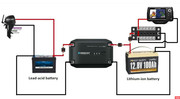
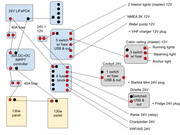
300Ah LiFePO4 upgrade

A forum for discussing boat or trailer repairs or modifications that you have made or are considering.
User avatar
Starscream
Admiral
Posts: 1593
Joined: Tue Nov 03, 2009 10:08 am
Sailboat: MacGregor 26X
Location: Montreal, Quebec. 2002 26X - Suzi DF90A

300Ah LiFePO4 upgrade

Post by Starscream »

Round 2 of electrical work. Last year I added a 100Ah lithium battery to our two 80AH lead-acid batteries in a non-standard way, the intent of which was not to touch the original system and have a super-easy install. What I did worked, but it's not a permanent solution. On our mini-loop trip last year we still ran into power consumption issues, especially with 7 phones being constantly charged, and the fridge trying to keep stuff cool in a heat wave. Not really knowing how much energy was left in the house batteries was a constant worry. This year we're adding a zero-breeze air conditioner so we'll have even more loads than ever.

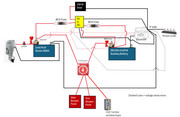
The plan is to go to one 80Ah lead acid starting battery and a 300Ah LiFePO4 battery. It's going to be a lot of work. The plan is:

*Starter battery linked directly to motor through an unfused wire with a battery on/off switch rated for motor start.
*Starter battery linked to a 1/2/Off switch (not both) through a 125A terminal fuse so that the starter battery COULD power house loads if for some reason that was critical.
*Starter battery linked through a 40A inline fuse to a bluetooth-enabled 50A DC-DC charger with solar MPPT, set to 30A charging via onboard software.
*DC to DC linked to 300Ah house battery through a 40A inline fuse
*New 100W solar panel from BougeRV that's supposed to do very well in partial shading. The solar feeds directly to the DC to DC charger, which then decides which battery should get the solar juice (I think it prioritizes the starter battery).
*Negative terminal of the 300Ah battery linked directly to a bluetooth-enabled Shunt300, which monitors both the starter and the house battery.
*300A fuse from house battery to 1/2/off switch to power house loads.
*6A shore-power charger for starter battery
*10A shore-power charger for house battery (yeah that's small but I already own it).


AI gives the wiring diagram the green light, and suggests to consider adding 1A fuses to the dashed voltage-sensing lines. Given the number of mistakes AI made in developing the plan, I sure would appreciate some human feedback :D

PS I seriously don't know how I'm going to physically add the motor on/off switch: IIRC the dealer used extremely heavy gauge wire to minimize voltage drop to the 90HP, and I don't know if my crimper will do that wire size. I forget what it was but I wanna say it was around 0 guage: all I actually remember is that 20' of it cost me like 400.


Image
User avatar
Be Free
Admiral
Posts: 1981
Joined: Fri Nov 23, 2012 6:08 pm
Sailboat: MacGregor 26X
Location: Steinhatchee, FL

Re: 300Ah LiFePO4 upgrade

Post by Be Free »

Generically it looks workable but the devil is in the details.

Can you provide make/model of the DC-DC charger?
Bill
2001 26X Simple Interest
Honda BF40D
"If I were in a hurry I would not have bought a sailboat." Me
User avatar
Starscream
Admiral
Posts: 1593
Joined: Tue Nov 03, 2009 10:08 am
Sailboat: MacGregor 26X
Location: Montreal, Quebec. 2002 26X - Suzi DF90A

Re: 300Ah LiFePO4 upgrade

Post by Starscream »

Be Free wrote: Mon Mar 09, 2026 12:15 pm Generically it looks workable but the devil is in the details.

Can you provide make/model of the DC-DC charger?
Hi Bill, I was hoping you'd answer this :) It's a Renogy RBC50 MPPT dual input, with the bluetooth module.
User avatar
Be Free
Admiral
Posts: 1981
Joined: Fri Nov 23, 2012 6:08 pm
Sailboat: MacGregor 26X
Location: Steinhatchee, FL

Re: 300Ah LiFePO4 upgrade

Post by Be Free »

I'll check it out a little later. What you are describing is not far from what I've done on Simple Interest but like I said before, "The devil is in the details."
Bill
2001 26X Simple Interest
Honda BF40D
"If I were in a hurry I would not have bought a sailboat." Me
User avatar
ris
Captain
Posts: 715
Joined: Sat Feb 28, 2015 4:27 pm
Sailboat: MacGregor 26X
Location: Frostproof Florida

Re: 300Ah LiFePO4 upgrade

Post by ris »

We use a Sterling Power 20 amp DC to DC charger in our camper and the Mac. Our 60 hp Honda puts out 22 amp to two Trojan 105's. The Mac has two 6volt Trojan 105's wired to make it 12 volt. The house is a 200 amp hr Power Queen LiFePO4. The camper has 12 volt truck battery (Silverado 1500) with the same Power Queen 200 as house battery. Power Queen and Sterling DC to DC move from Mac to camper as needed. Have 200 watts of solar for camper and 175 watts for Mac with Rich Solar 20 amp solar controller. Just use solar if we are staying in one place for 4 or 5 days. If we move every 3 or 4 days power is not usually a problem. Just two of us.
User avatar
FittsFly
Deckhand
Posts: 48
Joined: Sun Jun 30, 2024 2:54 pm
Sailboat: MacGregor 26X
Location: Roswell NM

Re: 300Ah LiFePO4 upgrade

Post by FittsFly »

Im so glad you brought this up Starscream! I am doing the same thing with the exception of Solar. Yours looks pretty complex! Heres a diagram of what I've found on the net that seems to be somewhat similar. But I look forward to the experts in here letting us know the right way!
PS I use a Honda EU2100 invertor generator to power my AC (8000 BTU) and hot water.
Image
User avatar
FittsFly
Deckhand
Posts: 48
Joined: Sun Jun 30, 2024 2:54 pm
Sailboat: MacGregor 26X
Location: Roswell NM

Re: 300Ah LiFePO4 upgrade

Post by FittsFly »

PS, As you may note my diagram doesnt have the 1,2,both switch in play. To my understanding the Renogy will force my 50 HP Suzuki to charge the lead acid first and then switch to the life po house battery with no 1 2 switch needed.
tuxonpup
Engineer
Posts: 180
Joined: Fri Oct 25, 2024 10:37 am
Sailboat: MacGregor 26X
Location: Tucson AZ

Re: 300Ah LiFePO4 upgrade

Post by tuxonpup »

Timely thread! Looks like I'll get some time to work on the boat next week as it's spring break and it's supposed to be in the mid-70s at the lake.

I've got the supply side sorted with two 130w flex panels in series connected to the MPPT solar controller/DC-DC converter, and a pair of 100Ah LiFePO4 batteries wired in series as the house 24V supply:

Image

The 12V lead-acid start battery is wired directly to the motor's alternator via an on-off switch, but can eventually connect to the boost/buck DC-DC converter as well.
1996 MacGregor 26X w/150% RF Genoa & Nissan 50hp 2-stroke
User avatar
Be Free
Admiral
Posts: 1981
Joined: Fri Nov 23, 2012 6:08 pm
Sailboat: MacGregor 26X
Location: Steinhatchee, FL

Re: 300Ah LiFePO4 upgrade

Post by Be Free »

I don't see anything wrong in the charging circuits. The outboard will always charge the start battery and the DCDC charger will charge the house battery. As soon as the start battery can hold 13.2V the DCDC charger will begin to charge house battery based on the profile you choose. With a single 100W solar you will always combine the output of the generator with the solar to charge the house battery once the start battery is charged. If you get above 24A on the solar side you may get into the odd situation where the DCDC charger will not use the generator output at all but that's a problem for a day when you have more panels.

I'm not personally familiar with the shunt you are using but off the top of my head I don't think it will be able to keep track of both batteries simultaneously. I suspect that it will do coulomb counting on the house battery and just display the voltage of the start battery by default.

I know you are still on the fence with the battery switch on the start battery. In my opinion, it has minimal usefulness and opens the possibility of an expensive repair if it is turned off when the engine is running.

The other battery switch worries me as well. If you want to put it on the house side only, then I don't see a problem but allowing it to connect the house circuits to the start battery can be an issue. I don't think it's a good idea to hook the start battery to the house loads.

If the house battery is dead you should start your outboard with the charged start battery and then let the DCDC charger charge the house bank.

If the start battery is dead use a jumper pack to jump start the engine and charge the start battery.

Note: If there is no way to connect the start battery to the house load then the house loads can't kill the start battery. According to my friend Murphy, if there is a way to connect them you will eventually do so (at the most inopportune time).

I can't tell you if the fuses are sized correctly without knowing the size of the wires. The fuse should be the smaller of the maximum the device can use and the maximum the wire feeding the device can carry (with a safety margin). The wire should be large enough to handle the maximum load that the device can use. The device manufacturer will generally specify minimum wire and fuse sizes in the install manual.

The AI is correct that you should probably have a small (1A is good) fuse in the voltage sense lines.

True Story: the only wire I had a dead short in was a voltage sensing wire. I had the main switch off and was pulling the start battery sense wire out to move the gauges but had forgotten that it was wired directly to the battery (more accurate measurement). When I was pulling it out the end I'd just disconnected from the gauge flopped over and welded itself to the negative bus. I saw the insulation melting and ripped it out with my bare hand. I did not have a fuse in the line and could have burned the boat down but in the end I just ended up with a burned hand. Start and house sense wires got fuses when I hooked them back up.
Bill
2001 26X Simple Interest
Honda BF40D
"If I were in a hurry I would not have bought a sailboat." Me
User avatar
Be Free
Admiral
Posts: 1981
Joined: Fri Nov 23, 2012 6:08 pm
Sailboat: MacGregor 26X
Location: Steinhatchee, FL

Re: 300Ah LiFePO4 upgrade

Post by Be Free »

ris wrote: Mon Mar 09, 2026 7:31 pm We use a Sterling Power 20 amp DC to DC charger in our camper and the Mac. Our 60 hp Honda puts out 22 amp to two Trojan 105's. The Mac has two 6volt Trojan 105's wired to make it 12 volt. The house is a 200 amp hr Power Queen LiFePO4. The camper has 12 volt truck battery (Silverado 1500) with the same Power Queen 200 as house battery. Power Queen and Sterling DC to DC move from Mac to camper as needed. Have 200 watts of solar for camper and 175 watts for Mac with Rich Solar 20 amp solar controller. Just use solar if we are staying in one place for 4 or 5 days. If we move every 3 or 4 days power is not usually a problem. Just two of us.
You can take this design to the bank! Between the boat and the camper ris probably has more hours on this setup than anyone else on this forum (by a large margin). I've changed some of the brands and capacities but I based a lot of my design on what I saw he'd done in his camper.
Bill
2001 26X Simple Interest
Honda BF40D
"If I were in a hurry I would not have bought a sailboat." Me
User avatar
Be Free
Admiral
Posts: 1981
Joined: Fri Nov 23, 2012 6:08 pm
Sailboat: MacGregor 26X
Location: Steinhatchee, FL

Re: 300Ah LiFePO4 upgrade

Post by Be Free »

tuxonpup wrote: Tue Mar 10, 2026 12:49 pm Timely thread! Looks like I'll get some time to work on the boat next week as it's spring break and it's supposed to be in the mid-70s at the lake.

I've got the supply side sorted with two 130w flex panels in series connected to the MPPT solar controller/DC-DC converter, and a pair of 100Ah LiFePO4 batteries wired in series as the house 24V supply:

Image

The 12V lead-acid start battery is wired directly to the motor's alternator via an on-off switch, but can eventually connect to the boost/buck DC-DC converter as well.
Your 130W panels are probably going to max out between 7 and 8 Amps each so the fuse between the panels and the controller may be too big (unless you wired it with #8 or larger wire).
I'll repeat my concerns re: start battery switch from the previous post.
Hooking up the start battery to the DCDC charger is a great idea.
Bill
2001 26X Simple Interest
Honda BF40D
"If I were in a hurry I would not have bought a sailboat." Me
User avatar
Be Free
Admiral
Posts: 1981
Joined: Fri Nov 23, 2012 6:08 pm
Sailboat: MacGregor 26X
Location: Steinhatchee, FL

Re: 300Ah LiFePO4 upgrade

Post by Be Free »

FittsFly wrote: Tue Mar 10, 2026 5:31 am Im so glad you brought this up Starscream! I am doing the same thing with the exception of Solar. Yours looks pretty complex! Heres a diagram of what I've found on the net that seems to be somewhat similar. But I look forward to the experts in here letting us know the right way!
PS I use a Honda EU2100 invertor generator to power my AC (8000 BTU) and hot water.
Image
You diagram looks great. It looks like the DCDC charger you are using has an isolated ground. Was that by design or does it just look that way in the picture?
One of the complications of Starscream's design is the battery monitoring setup. It requires careful attention to where the negative cables are connected and can make a simple circuit diagram look messier.
Bill
2001 26X Simple Interest
Honda BF40D
"If I were in a hurry I would not have bought a sailboat." Me
User avatar
Starscream
Admiral
Posts: 1593
Joined: Tue Nov 03, 2009 10:08 am
Sailboat: MacGregor 26X
Location: Montreal, Quebec. 2002 26X - Suzi DF90A

Re: 300Ah LiFePO4 upgrade

Post by Starscream »

Be Free wrote: Tue Mar 10, 2026 3:31 pm I don't see anything wrong in the charging circuits. The outboard will always charge the start battery and the DCDC charger will charge the house battery. As soon as the start battery can hold 13.2V the DCDC charger will begin to charge house battery based on the profile you choose. With a single 100W solar you will always combine the output of the generator with the solar to charge the house battery once the start battery is charged. If you get above 24A on the solar side you may get into the odd situation where the DCDC charger will not use the generator output at all but that's a problem for a day when you have more panels.

I'm not personally familiar with the shunt you are using but off the top of my head I don't think it will be able to keep track of both batteries simultaneously. I suspect that it will do coulomb counting on the house battery and just display the voltage of the start battery by default.

I know you are still on the fence with the battery switch on the start battery. In my opinion, it has minimal usefulness and opens the possibility of an expensive repair if it is turned off when the engine is running.

The other battery switch worries me as well. If you want to put it on the house side only, then I don't see a problem but allowing it to connect the house circuits to the start battery can be an issue. I don't think it's a good idea to hook the start battery to the house loads.

If the house battery is dead you should start your outboard with the charged start battery and then let the DCDC charger charge the house bank.

If the start battery is dead use a jumper pack to jump start the engine and charge the start battery.

Note: If there is no way to connect the start battery to the house load then the house loads can't kill the start battery. According to my friend Murphy, if there is a way to connect them you will eventually do so (at the most inopportune time).

I can't tell you if the fuses are sized correctly without knowing the size of the wires. The fuse should be the smaller of the maximum the device can use and the maximum the wire feeding the device can carry (with a safety margin). The wire should be large enough to handle the maximum load that the device can use. The device manufacturer will generally specify minimum wire and fuse sizes in the install manual.

The AI is correct that you should probably have a small (1A is good) fuse in the voltage sense lines.

True Story: the only wire I had a dead short in was a voltage sensing wire. I had the main switch off and was pulling the start battery sense wire out to move the gauges but had forgotten that it was wired directly to the battery (more accurate measurement). When I was pulling it out the end I'd just disconnected from the gauge flopped over and welded itself to the negative bus. I saw the insulation melting and ripped it out with my bare hand. I did not have a fuse in the line and could have burned the boat down but in the end I just ended up with a burned hand. Start and house sense wires got fuses when I hooked them back up.
Thank you so much for that review.

I agree that the usefulness of the 1/2/off switch is questionable and opens the door to Murphy. It should never be in the position where the starter battery feeds the loads, but I just like having that option: if ever there's a situation involving food storage or light, we can tap into the starter battery like it's a house battery and keep the fridge going without having to immediately start the motor. I'll mark the switch carefully and obviously.

The solar panel is 100W/32.4V peak, so very low amperage. I had to return my original Renogy RBC30 and exchange it for the RBC50 because I found the small print showing that the RBC30 triggers overvoltage at 30.5V (very easy to do through Renogy customer service, who even paid for the return shipment). My previous 2x50W solar panels were able to keep the fridge going for days despite being very susceptible to shading, so I hope this new panel does an even better job.

The motor on/off switch may or may not get installed. I don't like the idea of working on such a heavy cable with my Amazon tools. I wanted to have it to be able to deactivate the motor tilt switch, and to kill the power to the motor if ever needed for maintenance.

Im on the fence about fusing the voltage sense lines: I feel like every wire cut, crimp, and additional component add potential failure points. Your opinion holds a lot of weight though and I'll likely follow it.

I'm wiring the system using 8ga tinned marine wire, with M8 and M10 studs in the various components. The RBC50 charger will be set via software to limit charging current to 30A, and the fuses are 40A each.
User avatar
Starscream
Admiral
Posts: 1593
Joined: Tue Nov 03, 2009 10:08 am
Sailboat: MacGregor 26X
Location: Montreal, Quebec. 2002 26X - Suzi DF90A

Re: 300Ah LiFePO4 upgrade

Post by Starscream »

FittsFly wrote: Tue Mar 10, 2026 5:31 am Im so glad you brought this up Starscream! I am doing the same thing with the exception of Solar. Yours looks pretty complex! Heres a diagram of what I've found on the net that seems to be somewhat similar. But I look forward to the experts in here letting us know the right way!
PS I use a Honda EU2100 invertor generator to power my AC (8000 BTU) and hot water.
Image
FF, the Renogy DC to DC also has a voltage sense wire system, IIRC. It's not shown in the manual on the main wiring diagram, but it's there a few pages down. It's called the D+ wire and it has to sense 12V before the charger will operate. I added a small manual switch to the D+ wire that allows me to quickly shut down the DC to DC charger for storage in cold weather.
User avatar
Starscream
Admiral
Posts: 1593
Joined: Tue Nov 03, 2009 10:08 am
Sailboat: MacGregor 26X
Location: Montreal, Quebec. 2002 26X - Suzi DF90A

Re: 300Ah LiFePO4 upgrade

Post by Starscream »

tuxonpup wrote: Tue Mar 10, 2026 12:49 pm Timely thread! Looks like I'll get some time to work on the boat next week as it's spring break and it's supposed to be in the mid-70s at the lake.

I've got the supply side sorted with two 130w flex panels in series connected to the MPPT solar controller/DC-DC converter, and a pair of 100Ah LiFePO4 batteries wired in series as the house 24V supply:

Image

The 12V lead-acid start battery is wired directly to the motor's alternator via an on-off switch, but can eventually connect to the boost/buck DC-DC converter as well.
Hi T.Pup,

I'm wondering about your parallel solar setup with the 30A DC to DC w/MPPT. Not sure if it's a Renogy charger like mine is, but I just had to exchange the 30A charger for the 50A charger from Renogy because their 30A is limited to 30.5V from the solar panels. Most 12V panels will produce up to 18V at peak conditions, so if wired in parallel, those panels may cycle the charger off when it's needed most. In my last setup, I used parallel connections in my solar panels to allow one panel to be shaded without shutting the other one down.
Post Reply