Mine has been notched in a couple of places, but I preferred to patch it up with E6000 (a flexible adhesive), Seems to be holding up pretty well, even though the patches were semi-transparent and not black. But I am sure you can find an equivalent adhesive in black.
The idea of peeling off the whole rubrail and replacing it wholly scares the bejeezus out of me. I remember having read some horrifying reports. And, after all, it's just a "skinny bumper", supposed to endure a few bumps. Mine doesn't leak and doesn't look too abused (though it is), so I'll leave it in place
March wrote: ↑Sat May 10, 2025 1:14 pm
The idea of peeling off the whole rubrail and replacing it wholly scares the bejeezus out of me. I remember having read some horrifying reports. And, after all, it's just a "skinny bumper", supposed to endure a few bumps. Mine doesn't leak and doesn't look too abused (though it is), so I'll leave it in place
The replacement of the tub rail is something we did for Over Easy early on not long after we adopted her. At the time I wasn’t physically up to doing it (or much else back then with then current physical restrictions/health issues) so we had our local boat yard do it. It wasn’t terribly expensive or difficult really. If we were to have to do it agian we’d do it our selves.
There isn’t a wider rub rail than what BWY offers that I’m aware of.
The removal of the old rub rail , cleanup of the flanges, repair of any damaged fiberglass, replacement of compromised hardware isn’t all that difficult. Call BWY and talk to them. I believe they will have all the materials and process instructions you will need. The whole process isn’t hard especially if you have someone to be an extra set of hands. The boat yard did it with just one guy.
I believe BWY will just send you the instructions if you ask.
That way you can get the supplies locally if that works out better for your situation.
Best Regards
Over Easy
Last edited by OverEasy on Sun Mar 22, 2026 12:53 am, edited 1 time in total.
We just replaced our rub rail with one bought from Blue water Yachts. The old one had been hit hard a few times and it looks so much better now. The hardest part was after removing the old rub rail was getting the old 5200 off. Easiest way was a wire wheel on a hand grinder. We then checked all the bolts for tightness found 2 or 3 loose ones then we put slightly thickened epoxy on the whole joint twice with a paint brush as there were several crushed areas of the joint. We then stretched the rub rail for 2 days put in place around the boat then starting at the front had a friend help hold the rub rail away from the boat put the 5200 in the groove of the rub rail then pushed it on firmly doing about 4 feet at a time. The pics are listed under the topic of "Hope everyone is doing well haven't been on lately". Feb 1 2025 under the Forum MacGregor Power Sailors Form. You are always welcome to email and we can talk on the phone. Blue Water Yachts sent, I think 3 tubes of 5200 with the rub rail. We also caulked the top of the rub rail/boat junction. We did leave it on for 24 hrs after caulking before loosing the tension but holding in place while we caulked the last foot around the corner and installed the 3 screws that hold it in place. Then loosened the other side but held it in place on the corner so it does not loosen while doing the last foot of rub rail and screwing in place.
I'm looking to do my rub rail. You said you used a wire wheel on a handgrinder. I have a 4" makita grinder. So the wire wheel did not grind off any fiberglass? That's my concern.
Papa Baer wrote: ↑Sat Mar 21, 2026 2:22 pm
I'm looking to do my rub rail. You said you used a wire wheel on a handgrinder. I have a 4" makita grinder. So the wire wheel did not grind off any fiberglass? That's my concern.
Hi Papa Baer!
There are many different styles of wire wheels available right angle grinders.
Lots of them are pretty aggressive as they are typically used for metal plate cleaning prior to paint or weld.
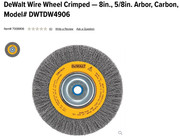
I’ve found some softer straight wire wheels at Harbor Freight and at Northern Tool that aren’t so aggressive.
Here’s one example that might work for your needs.
Technique and a gentle touch is still needed to avoid ‘chewing’ away the fiberglass as this is a powerful tool.
Just take it slow ‘n easy and watch what’s happening and you should be ok.
Test it and adapt.
One can very quickly and accidentally grind through the gel coat and into the fiberglass. I mostly used a combination of sandpaper and a Dremel with various sandpaper attachments, (bands, flap wheels). A Dremel is small and has a highly variable rotation speed so you can do precise work.
Also, there is apparently a solvent that claims to dissolve cured 3M 4,000 / 4200 / 5200. I have never used it. But if I do this again, I will certainly try it. https://marineformula.com/#about
For what it’s worth….
I’ve used odorless mineral spirits to soften/remove/clean-up 5200 and 5400.
It ‘works’ but it mainly soften it and kinda tended to smear it around which required additional cleanup to get the residual film off surfaces. I personally found that careful scraping with a sharp edged hard plastic knife or scraper seemed to be my best first step. Then after getting up as much as I could reasonably I’d use a the mineral spirits. Finally, if needed, I’d frugally degrease with acetone with lots of fresh air ventilation (w/ nitrile gloves and a filter canister mask.)

 needs update to the run rail.