Hi RanaSails!
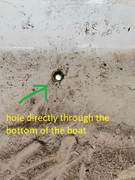
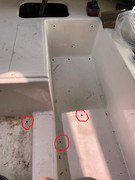
We are so sorry that some kind of a dangerous klutz drilled all those holes in your boat.
Yes, “dangerous” and “klutz” are the appropriate operative words.
While even the Romans had a problem with unscrupulous individuals popularizing the phrase “Buyer Beware” deliberately damaging a vessel that is to carry people is inexcusable given there appears to be no effort to convey those damages to you at purchase.
First it sounds like you are new to working with fiberglass repairs. If I’m mistaken I apologize in advance.
I’d like to see you and your family (&friends) fully enjoy your boat for many years to come with safety and confidence.
Nothing sucks the joy out of boating faster than repeat repairs of things you thought were fixed except being fearful of water moving from the outside of the boat to the inside of said boat …..


The following are some hopes/suggestions based upon experience with fiberglass structures.
=> I’m hoping that when you filled the holes with resin that you over drill them to expose ‘new’ smooth edges and possibly even used a countersink to bevel the edges, ideally on both sides of the holes if possible. This is needed to get the old crud and dirt and broken fibers removed that will result in a weak contaminated bond.
=> I’m also hoping that you cleaned and scuffed the areas around the holes to provide a footing area for the resin to adhere to. When made most fiberglass structure surfaces have a residual coating of mold release and or wax that if left in place will inhibit an appropriate bond to the parent structure.
=> I’m hoping that you didn’t just use plain resin to putty fill the holes. There needs to be some glass fiber material with the resin to give it strength. Resin by itself, especially many epoxies, can tend to become brittle with age.
=> I’m hoping that you overfilled the holes on both the inside and outside to help mechanically capture repair materials to the hull parent material. It wouldn’t hurt to have also applied a 10x diameter patch piece of fiberglass material over at least the interior (and exterior) of the hole being repaired. This reinforces the local area as well as retaining the plug.
A properly done repair should restore the integrity of the structure as well as seal out the water from coming in.
Might I suggest that you also apply some marine grade epoxy paint to the repaired areas. This will inhibit water migration into the parent fiberglass and the potential for osmotic blistering later.
Might I also suggest repairing the topside deck holes as well sooner rather than later.
The holes probably have rough edges and loose fibers which can pierce the skin or cause cuts.
Boats aren’t necessarily the most hygienic surfaces.
Those holes are also letting water in between the tod deck and the hull where it can become trapped leading to other issues like stagnant water ponding. (An friend once had water trapped in an aft bilge area of his boat and contended with a persistently recurring gnat & mosquito

issues until we chased it down and cleaned it out along with placing a vacuum out line so it could be more easily emptied should it collect water there again…)
You may want to make absolutely sure that whoever drilled those holes didn’t pierce into the water ballast tank areas.
To miss even one ballast tank hole after your efforts would be a shame.
Again, really sorry that this happened to you but it sounds like you are a good competent individual who can see past the problems tosolutions and the future enjoyment you boat will provide you and your family.
There are the original MacGregor Manuals in the “RESOURCES” section of this website in addition to original brochures that should provide the mast base interface information you asked about.
Best Regards,
Over Easy



 issues until we chased it down and cleaned it out along with placing a vacuum out line so it could be more easily emptied should it collect water there again…)

